eBook - ePub
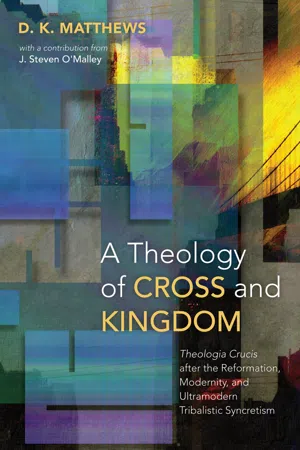
A Theology of Cross and Kingdom
Theologia Crucis after the Reformation, Modernity, and Ultramodern Tribalistic Syncretism
- 302 pages
- English
- ePUB (mobile friendly)
- Available on iOS & Android
eBook - ePub
A Theology of Cross and Kingdom
Theologia Crucis after the Reformation, Modernity, and Ultramodern Tribalistic Syncretism
About this book
Luther's theology of the cross has impacted major theologians and centuries of theology, including the present, and yet it is weakened by its reactionary theological determinism, reductionism, and understandable failure to properly integrate fluid, melioristic, and pro-creation kingdom eschatology. N. T. Wright's revolutionary cross, articulated in The Day the Revolution Began: Reconsidering the Meaning of Jesus's Crucifixion, is a brilliant and clarion new creation eschatological call to action that suffers from a somewhat cryptic, imprecise, and unrefined eschatology. Heino O. Kadai has presented an authoritative and concise rendering of Luther's key insights. Rustin Brian has carefully assessed whether Luther's theology of the cross deserves blame for the Deus absconditus of modernity in his Barthian influenced Covering Up Luther. Robert Cady Saler has masterfully articulated a relevant and pastoral Theologia Crucis framed by Moltmann's Theology of Hope that is most applicable to the contemporary church and sociopolitical engagement. A Theology of Cross and Kingdom sympathetically and creatively critiques and synthesizes dominant themes in such classical and contemporary theologies of the cross within a unified cross and kingdom eschatology. Matthews deftly overcomes many of the less than helpful disjunctive approaches to the theology of the cross while proffering a way forward for this most influential and core theological treasure of the church.
Trusted by 375,005 students
Access to over 1.5 million titles for a fair monthly price.
Study more efficiently using our study tools.
Information
Topic
Theology & ReligionSubtopic
Christian Theology1
Introduction and Major Trajectories
Jesus spoke these things; and lifting up His eyes to heaven, He said, “Father, the hour has come; glorify [from δόξα, glory] Your Son, that the Son may glorify You, even as You gave Him authority over all flesh, that to all whom You have given Him, He may give eternal life.
—John 17:1–2
But the Lord said to him, “Go, for he is a chosen instrument of Mine, to bear My name before the Gentiles and kings and the sons of Israel; for I will show him how much he must suffer for My name’s sake.”
—Acts 9:15–16
Now this He said, signifying by what kind of death he [Peter] would glorify [from δόξα, glory] God. And when He had spoken this, He said to him, “Follow Me!”
—John 21:19
A Personal Journey toward the Via Dolorosa
Weeks after setting aside research on Luther’s theology of the cross for another writing project, I was sitting in a hospital prayerfully holding the hand and, hopefully, comforting the last days and hours of a perishing, homeward bound loved one. This moment and related experiences seemed all too common in recent years. Echoing down the hallway from another hospital room was the frequent and almost hourly cry of, “Help, help, help.” Lives were being saved, heroic and herculean efforts were evident by the medical staff, and the joyful yet somewhat ironic music of Brahms lullaby was heard every few hours to herald a new birth on a more celebratory floor. Only the term surreal captures the moment.
On our floor the culture included beeping monitors, uncomfortable tubes and unpredictable medications, troubling hallucinations, endless well-intended interruptions from helpful staff day and night, impossible end-of-life decisions, painful and life-threatening miscalculations by staff when attempts were made to provide comfort, less than needed sleep, loss of critical information between employee shifts, labored breathing, caring tears, and purgatorial endless nights. These are not the experiences most of us hope for or pursue. Some evangelicals view such experiences as the lack of divine blessing or faith. These are realities we sometimes, at least in part, pretend do not exist until the illusion finally vanishes in the crucible. And they are often not viewed as indispensable or defining of our discipleship and Christian formation.
In just a few short and endless years such sea billows ever rolled forward. The loss of multiple loved ones, including a centenarian whose memorial I officiated, failed and botched surgeries, repeat surgeries, endless tests and visits with physicians, the dynamics of hospice care, a daunting workload, and the challenging attempt to bring a healing salve to bear on the pain and sleep management of loved ones all converged.
My mind was certainly not on Luther or his theology of the cross during one of these long days and nights at the final bedside in the hospital. The bittersweet but agonizing and shadowy hours of losing a beloved was not a new experience. Then as I sat alone that dark night in the wee hours of the morning, playing classical hymns of the faith from my Bluetooth device with the hope of providing some encouragement to the suffering loved one, Luther’s theologia crucis seemed unexpectedly relevant. In a world and church that often glories in and baptizes that which is not genuinely of God (a theology of glory), Luther contended that God is unexpectedly found in the hiddenness of the cross, suffering, pain, and shame. Somewhere in the middle of the night the entire room and my loved one seemingly became irradiated with the presence of the kenotic and cruciform Holy One. Perhaps it was a special visitation of the Spirit. Perhaps it was the reality of a loved one transitioning to another dimension and that deeper dimension fully enveloping the moment. Regardless, while the dark dagger in the heart was real, that sheer reality also lucidly conveyed the presence of the true future that forever redefined the present.
A few lessons were hopefully learned at these hospital and hospice deathbeds. Some of the worst days of my life and a loved one’s life were surprised by a profound sense of God’s presence. Spiritualizing and denial are ephemeral or short-lived. Years later these experiences continued to drive and frame my spiritual walk. I continued to wrestle with the dagger of loss, yet the dagger was the window to and mirror of reality. In over three decades of ministry, counseling, teaching, and chaplaincy, I have seen many responses to such trials and tribulation. Most become better, bitter, or land in seemingly endless spiritual vertigo and angst. Suffering is not simply marginal to a genuine, enduring, victorious and blessed Christian life and spiritual quest, or only distantly connected to the persecution or martyrdom of heroes of the faith in another time and place. Suffering and pain and loss are key conditions of authentic Christlikeness and spirituality given our fallen condition in an inverted world. Our response to suffering frames whether we will take up the cross of kingdom advance. Ministering to or being the one who suffers is not tangential or something to endure, but absolutely determinative of who we are in Christ as creatures seeking full and final redemption. Scripture does not call us to pursue suffering for the sake of suffering, yet these bedrock experiences must be integrated into our theology of the Christian life.
This work will argue that God certainly can be found in successes and a properly defined glory in this life, but if our response to suffering is removed from the kingdom equation then only the kingdom of spiritual fluff remains. The hope of heaven—as earth transformed according to N. T. Wright—for those suffering and for loved ones lost is not to be discounted in such situations. However, caution is in order lest this hope is little more than a flight from grieving, suffering, and a “spiritual” and psychologically unhealthy means of denial.
To be clear, such hospital sojourns and related hospice experiences with loved ones do not lie precisely at the soteriological core of Luther’s theology of the cross, yet by way of analogy and existential relevance they certainly sparked reflection on Luther’s influential construct. God’s presence was especially evident amidst the seemingly endless last hours of suffering of the loved one and family member referenced at the very beginning of this chapter. However, this same loved one best embodied a theology of cross and kingdom years prior to this final hospice experience. A car with reckless young drivers, perhaps under the influence, had crossed the line and collided with our car. This elderly family member was driving our car, and stated that he turned the car at the last minute to take the full impact of the collision from the swerving car and protect other family members. I was in the back seat. After the accident our family member who was the driver, with a head injury, could not sleep in his own bed for a number of nights, as the head injury caused significant swelling, discomfort, and permanent scarring. He tried to sleep in a recliner. This accident also took place not long after his major open heart surgery. During this challenging season of life for the driver another family member who was also in the car accident was traversing great emotional distress, criticism, and marginalization at work—due to an unfortunate and seemingly prejudiced work and Christian ministry environment.
I will forever recall the lasting impact of the words of this loved one and driver, who was typically very quiet and non-expressive, with his head swollen and bandaged from the car accident. He sliced through the fog of his own pain and suffering while standing in the kitchen and offered powerful, bright, passionate, selfless, focused, and redemptive words of love and encouragement that comforted and strengthened the other family member. God’s love and wisdom were mediated, and even more inspirational and memorable, via his tribulations. These words from the suffering driver and loved one helped ...
Table of contents
- Title Page
- Tables
- Contributors
- Preface
- Acknowledgments
- Chapter 1: Introduction and Major Trajectories
- Chapter 2: Classical Themes of Theologies of the Cross
- Chapter 3: Deterministic versus Non-Deterministic Staurology
- Chapter 4: Theology of the Cross in Luther and Its Reconfiguration in the Pietistic and Wesleyan Awakenings
- Chapter 5: Sovereignly Good Soteriological Singularity
- Chapter 6: Sovereignly Good Epistemological Singularity
- Chapter 7: Contra Theology of Glory and Self-Glorification
- Chapter 8: Integrative and Conjunctive Theological Anchor
- Chapter 9: Kenotic Cruciform Kingdom Holiness
- Chapter 10: Cruciform Liberation and Kingdom Approximation
- Chapter 11: Glorious Cross as Kingdom Eschatology
- Chapter 12: Normative Eschatological Assumptions Framing Cross and Kingdom Theology
- Chapter 13: Theologia Crucis Post Post
- Chapter 14: Conclusions and Possible Applications
- Appendix: of Key Scriptures1
- Bibliography
Frequently asked questions
Yes, you can cancel anytime from the Subscription tab in your account settings on the Perlego website. Your subscription will stay active until the end of your current billing period. Learn how to cancel your subscription
No, books cannot be downloaded as external files, such as PDFs, for use outside of Perlego. However, you can download books within the Perlego app for offline reading on mobile or tablet. Learn how to download books offline
Perlego offers two plans: Essential and Complete
- Essential is ideal for learners and professionals who enjoy exploring a wide range of subjects. Access the Essential Library with 800,000+ trusted titles and best-sellers across business, personal growth, and the humanities. Includes unlimited reading time and Standard Read Aloud voice.
- Complete: Perfect for advanced learners and researchers needing full, unrestricted access. Unlock 1.5M+ books across hundreds of subjects, including academic and specialized titles. The Complete Plan also includes advanced features like Premium Read Aloud and Research Assistant.
We are an online textbook subscription service, where you can get access to an entire online library for less than the price of a single book per month. With over 1.5 million books across 990+ topics, we’ve got you covered! Learn about our mission
Look out for the read-aloud symbol on your next book to see if you can listen to it. The read-aloud tool reads text aloud for you, highlighting the text as it is being read. You can pause it, speed it up and slow it down. Learn more about Read Aloud
Yes! You can use the Perlego app on both iOS and Android devices to read anytime, anywhere — even offline. Perfect for commutes or when you’re on the go.
Please note we cannot support devices running on iOS 13 and Android 7 or earlier. Learn more about using the app
Please note we cannot support devices running on iOS 13 and Android 7 or earlier. Learn more about using the app
Yes, you can access A Theology of Cross and Kingdom by D. K. Matthews in PDF and/or ePUB format, as well as other popular books in Theology & Religion & Christian Theology. We have over 1.5 million books available in our catalogue for you to explore.