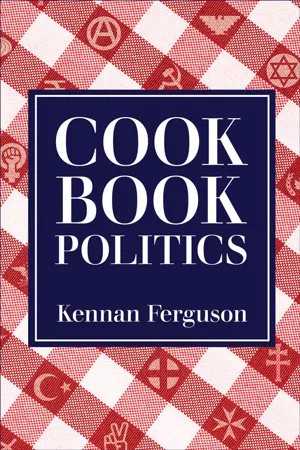
An original and eclectic view of cookbooks as political acts Cookbooks are not political in conventional ways. They neither proclaim, as do manifestos, nor do they forbid, as do laws. They do not command agreement, as do arguments, and their stipulations often lack specificity — cook "until browned." Yet, as repositories of human taste, cookbooks transmit specific blends of flavor, texture, and nutrition across space and time. Cookbooks both form and reflect who we are. In Cookbook Politics, Kennan Ferguson explores the sensual and political implications of these repositories, demonstrating how they create nations, establish ideologies, shape international relations, and structure communities. Cookbook Politics argues that cookbooks highlight aspects of our lives we rarely recognize as political—taste, production, domesticity, collectivity, and imagination—and considers the ways in which cookbooks have or do politics, from the most overt to the most subtle. Cookbooks turn regional diversity into national unity, as Pellegrino Artusi's Science in the Kitchen and the Art of Eating Well did for Italy in 1891. Politically affiliated organizations compile and sell cookbooks—for example, the early United Nations published The World's Favorite Recipes. From the First Baptist Church of Midland, Tennessee's community cookbook, to Julia Child's Mastering the Art of French Cooking, to the Italian Futurists' proto-fascist guide to food preparation, Ferguson demonstrates how cookbooks mark desires and reveal social commitments: your table becomes a representation of who you are.Authoritative, yet flexible; collective, yet individualized; cooperative, yet personal—cookbooks invite participation, editing, and transformation. Created to convey flavor and taste across generations, communities, and nations, they enact the continuities and changes of social lives. Their functioning in the name of creativity and preparation—with readers happily consuming them in similar ways—makes cookbooks an exemplary model for democratic politics.
- 184 pages
- English
- ePUB (mobile friendly)
- Available on iOS & Android
eBook - ePub
Cookbook Politics
About this book
Trusted by 375,005 students
Access to over 1.5 million titles for a fair monthly price.
Study more efficiently using our study tools.
Information
Publisher
University of Pennsylvania PressYear
2020Print ISBN
9780812252262
9780812252262
eBook ISBN
9780812297126
1

DEMOCRACY: THE RECIPE,
THE COOKBOOK,
AND THE FORMS OF POLITICS
We instantly know what we are looking at when we encounter a cookbook. From the most basic compilation of recipes to the glossy and expensively bound commercial cookbook, readers acknowledge and embrace such books’ similarities far more than their differences. In the same way, the form of the recipe is instantly recognized, both in layout and in content. Looking at a recipe from a cookbook, in a newspaper cutting, or handwritten on a card, we fundamentally understand what it says and what it allows us to do; even when accessing recipes online or through other digital transmissions, we take them as simple sets of instructions.
That they are so easily perceived and used means that we have a deep understanding of their form: they constitute a genre. Just as readers or viewers know the configurations of a romance novel, a murder mystery, or a technological thriller, they also know what to expect from a cookbook and a recipe. In fact, this genre knowledge may go even further; many people learn recipe forms long before they can even distinguish fiction from nonfiction.
So what is a genre? When a reader comes to a piece of text (or even when an author begins to write one), he or she brings a set of expectations and hopes to it. Each form has certain capabilities and limitations, which the text accomplishes poorly or well. Readers and authors operate within and against genre distinctions, borrowing from and playing against other genres. To recognize a text as a poem, a novel, or an essay means to preconceive a wide range of histories, legitimacies, forms, and meanings necessary for reading or critiquing it. News reporting and stage plays should not, indeed cannot, be read or experienced the same way, and to understand how and why each acts in its own way is to investigate the nature of genre. Genres serve to organize these wide range of responses and analyses. They determine expectations; they develop formulae.
Genre thus concerns generalization.1 Its study, in the words of the literary theorist Tzvetan Todorov, concerns the attempt to “discover a principle operative in a number of texts, rather than what is specific about each of them.”2 What makes up a genre—its form, its content, its distribution, its purpose, its history, along with myriad other dynamics—allows it to be both recognized and used. A letter, for example, is easily recognized both in terms of its content and its form: readers can identify a “business letter” made up only of appropriately laid out nonsense symbols, but can also recognize one in a single unformatted block of text with the appropriate address, salutation, and signature.3 An average reader could certainly do the same with a recipe.
However, differences between genres have proven impossible to precisely define. Much of the most interesting work done in various traditions has deliberately confused the boundaries between them: journalism in the form of fiction, poems as political documents, epistolary novels. Contra structuralists such as Todorov, genre does not make up a totalizing set of meanings interrelated to one another.4 Genres change, come into being, combine, disappear; like languages, genres have their own histories and their own trajectories. Indeed, the differences between language and genre go far beyond such surface similarities into the very questions of how we are to understand them.5 Are they communicative forms or representational acts? Do their attributes arise from their internal structures or their historical purposes? Should they be properly understood through their forms or their uses? Do the “laws” underpinning each serve as limits on creativity or as prerequisites for it?6
This book touches on these questions only tangentially.7 Instead, this chapter examines the genre of the physical, printed cookbook to make sense of how it operates, how its genre as a whole makes sense, and what its particular form promotes or discourages. As part of this investigation, it is important to identify three distinct aspects of the genre of the cookbook, each one quickly apparent and each available for reuse and reconfiguration.8 These three aspects are, first, the physicality of the cookbook itself, as a material and located resource; second, its organization and use, as a reference material without narrative flow; and third, its character as a collection of recipes, as consolidations of different but necessary components of directions. From these genre distinctions come separate focuses, abilities, and potentials.
The first aspect forms such a general category that it is easily overlooked as a particularity of its form: the bookishness of the cookbook itself. Textually printed, bound between covers, passed from hand to hand or preserved in libraries, cookbooks have a particular physical form. Their bookishness contrasts with their orally oriented presumed predecessors: word of mouth and familial and group cooking practices. It also contrasts with their presumed successors in the virtual world: highly mobile, on-demand text or video instructions available over networks directly into homes. The physical presence of cookbooks has demanded certain physical layouts in kitchens (shelves, for example, and the surfaces or stands where the cookbook lies open). At the same time, their physicality also limits their uses, since they must be specified in scope and limited in length. Too-thin pages tear; insufficiently reinforced spines snap; overly condensed type blurs. A cookbook established along the lines of the old Compact Oxford English Dictionary, with its pretense to inclusivity and its magnifying glass, would be close to useless.
This physical form also gives the cookbook an aura of continuity and presence. Certain cookbooks become familial, whether because they are passed from one person to another or because their sense of taste seems to more and more resemble the cook’s. The pages open to familiar recipes. They are stained along certain margins, with memories of particular meals absorbed in the paper’s fibers. Each of these limitations and potentialities inheres in cookbooks as books.
The second aspect of the genre, linked to but distinct from the physicality, location, and materiality, is the organizational form of the cookbook. When they are utilized (as opposed to when they are read cover to cover), cookbooks operate as structures without narrative, operands for creating particulars rather than stories that build over time from events and concepts. In a cookbook, one is meant to pick and choose; what appears on page 100 rarely depends on what has appeared on page 50. The presumptions we generally bring to a book—that it develops a narrative or plot, that it organizes time from the front to the back, and that it develops connections between one page and another—are all absent. This compilationist form, related in kind to the encyclopedia, breaks down the causality and temporality so central to other genres, even bringing the necessity of space and time within genre into question.
The third important aspect of the cookbook genre is the distinct textual form that makes up the majority of most cookbooks: the recipe. Though recipes are without question instructions, they prove to be a strange kind of direction: sometimes mere suggestion, sometimes necessary demand, sometimes oblique prompt. As compared to other kinds of instructions, recipes are surprisingly nonobligatory; ingredients can be replaced (at least most of the time) and quantities can be doubled or halved (again, with some important exceptions). Baking recipes are of necessity less forgiving than soup recipes, as the former usually fundamentally depend on specific chemical and heat reactions while the latter allow more for associations of tastes and flavors.
This chapter does not aim at an exclusive or total description of the aspects of the cookbook genre, nor does it attempt to fix the genre within a structural matrix of textuality. Its project is thus neither taxonomic nor etymological. Instead, it attempts to uncover some of the sources of the resilience and reiteration of the genre involved in textual representations of cooking. What encourages and reinforces the cookbook? What do these books enable? And, just as importantly, who is served by this genre?
In the process, it points to one overarching theme of the genre of the cookbook. These books are, above all, generative: they produce modes of creativity. Cookbooks are books of recipes meant to guide and provoke the act of making food. Of course, many genres could be argued to aim to spark imagination or sympathy. But there is something particularly specific, deliberate, and recognizable about cookbooks: their creations come about through the active, physical embodiment of their processes. Because of this, the very form of the cookbook must by definition be open, manipulable, originative, and speculative. Their formulae combine with the interests, goals, and imaginations of their readers in a creative process.
As such, as this chapter concludes, they are a profoundly democratic genre, perhaps the most democratic of genres. Their narrative indeterminancy, their infinite replicability, their partiality and specificity: all allow for, even demand, a participatory and experimental engagement. Even if one comes to a cookbook looking for clarity and guidance, one cannot help but participate in its making and remaking. And this engagement that cookbooks demand is in the service of one of the most individual and communal aspects of the human sensorium, that of taste. Cookbooks consist of consumption and generation, mixed up and served in the form of a book.
Why a Book?
One important aspect of the cookbook genre has to do with the physical form that it takes: that of the bound, paginated, set of papers sold through booksellers and kept on bookshelves. Cookbooks have a heft, a presence, both in their distributive networks and in our kitchens. Unlike most other forms of books (novels, for example), they have historically existed as a kind of reference codex, as utilitarian works meant to be kept accessible. They are not presumed to be disposable, like newspapers, but neither are they meant for prominent display. If they were to be shown off (in the sociological sense, as a marker of status), it was through the dishes made using them rather than through their literal presentation; while a cook might refer to having made a dish from a specific famous cookbook, home libraries and public repositories never privileged the place of cookbooks as they did first editions or antique books.
Most discussions of genre assume that the physical mode of a narrative—the genre’s “container,” as it were—is either irrelevant to the question of genre or at most secondary to more important questions of structure, development, and character. The genres of horror, of melodrama, or of mystery, for example, are presumed to be equally at work in novels and in films. When differences are noted, they are usually assumed to be qualities of the respective genres (voice-overs in film, for example) rather than formative of the genre itself. Scholars may at times focus on how differences in genre emerge in various media forms, yet still presume that genres cut across form—a romantic comedy may be a play, book, or movie, but the term promises a certain continuity across all these variants.
Cookbooks belie such easy transmutations across various media; instead, they show how much all genres depend upon material form. Take alternative forms of recipe distribution, such as recipe cards included in magazines to be filed in a recipe box. Or newspaper columns of recipes, meant to be read and disposed of (except for the rare, clippable gem). Or the friend’s handwritten recipe, scrawled at the end of a successful dinner party. In each case, the recipe’s physical form makes up part of the content of the food’s preparation: its history, its memorialization, its importance. A return to the recipe means also a reliving of the experience of its reception. More recently, the emergence of digital forms of transmission has separated the concept of the recipe from the book, highlighting, by contrast, the cookbook’s historical and conceptual location.
The material form of the cookbook is a particular and specific way of locating recipes, one that maximizes thematic unity while also allowing for the density and organization of recipes. But what makes this such a recognizable structure? What were the productions that both made it possible and that it in turn made possible? What weight, literal and conceptual, does it have? Looking at the economics of cookbook production and sales provides one set of answers; examining how they are used in most people’s kitchens gives another. Parts of this book are concerned with the first: Chapter 4, for example, examines the specific form of community cookbooks, how they were and are produced, what forms they have taken, which channels of distribution they follow. But the everyday usage and placement of cookbooks proves more useful to understanding the implications of genre. Where do people keep them; how do they use them; which ones do they repeatedly return to?
Even this has its limitations, in that some cookbooks aren’t used as cookbooks at all. In recent years, many cookbooks have been produced not to be references in a traditional sense but to be read strictly for pleasure, consumed for their images and techniques, outside of the kitchen. One can easily identify such works. They are lavishly illustrated, occasionally oversized in height and width (unlike the depth of traditional encyclopedic cookbooks). They may be dependent upon extravagant techniques or exotic ingredients. Often such cookbooks are linked to popular chefs or restaurants. These are intended to be read rather than referenced, producing aesthetic pleasures tied to the memory and imagination.9 One notes the hurdles of cooking many of the modern dishes listed in some of these cookbooks: among other things, the sheer expense of the ingredients and technologies required exceeds the price of the dish as served in a restaurant.”10
This sub-genre of cookbook has recently been tagged with the moniker “gastroporn.” This sobriquet highlights what its denigrators imagine to be a fatal criticism, namely that such cookbooks are designed to themselves act as the object of desire rather than being utilized to make comestibles. In gastroporn, the visual field overwhelms that of taste, resulting in a “vicarious sensual thrill of the visual stimulation of food photography often accompanied by evocative and descriptive text” resulting in “the cookbook as objet d’art.”11 As Alexander Cockburn, who coined the term, noted, “gastro-porn heightens the excitement and also the sense of the unattainable by proffering colored photographs of various completed recipes.”12 That such dishes are meant for the eyes, not the palate, seems an insurmountable false presumption; that cookbooks might be produced to be read rather than cooked from, seems equally fatuous to such critics.
But how, ultimately, does t...
Table of contents
- Cover
- Half title
- Title
- Copyright
- Contents
- Introduction
- 1 Democracy: The Recipe, the Cookbook, and the Forms of Politics
- 2 Nationalism: Why States Need Cookbooks
- 3 International Relations: Mastery, Sensibility, and Relational Cooking
- 4 Community: Cookbooks as Collectivity
- 5 Ideology: Food, Fast and Slow
- Conclusion: How Taste Matters
- Notes
- Index
- Acknowledgments
Frequently asked questions
Yes, you can cancel anytime from the Subscription tab in your account settings on the Perlego website. Your subscription will stay active until the end of your current billing period. Learn how to cancel your subscription
No, books cannot be downloaded as external files, such as PDFs, for use outside of Perlego. However, you can download books within the Perlego app for offline reading on mobile or tablet. Learn how to download books offline
Perlego offers two plans: Essential and Complete
- Essential is ideal for learners and professionals who enjoy exploring a wide range of subjects. Access the Essential Library with 800,000+ trusted titles and best-sellers across business, personal growth, and the humanities. Includes unlimited reading time and Standard Read Aloud voice.
- Complete: Perfect for advanced learners and researchers needing full, unrestricted access. Unlock 1.5M+ books across hundreds of subjects, including academic and specialized titles. The Complete Plan also includes advanced features like Premium Read Aloud and Research Assistant.
We are an online textbook subscription service, where you can get access to an entire online library for less than the price of a single book per month. With over 1.5 million books across 990+ topics, we’ve got you covered! Learn about our mission
Look out for the read-aloud symbol on your next book to see if you can listen to it. The read-aloud tool reads text aloud for you, highlighting the text as it is being read. You can pause it, speed it up and slow it down. Learn more about Read Aloud
Yes! You can use the Perlego app on both iOS and Android devices to read anytime, anywhere — even offline. Perfect for commutes or when you’re on the go.
Please note we cannot support devices running on iOS 13 and Android 7 or earlier. Learn more about using the app
Please note we cannot support devices running on iOS 13 and Android 7 or earlier. Learn more about using the app
Yes, you can access Cookbook Politics by Kennan Ferguson in PDF and/or ePUB format, as well as other popular books in Politics & International Relations & Political History & Theory. We have over 1.5 million books available in our catalogue for you to explore.