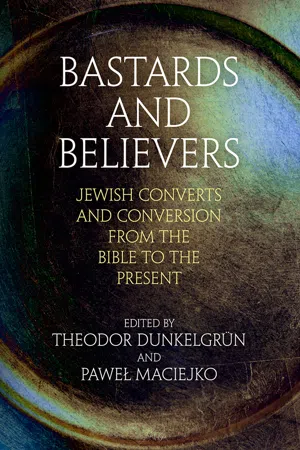
A formidable collection of studies on religious conversion and converts in Jewish history Theodor Dunkelgrün and Pawel Maciejko observe that the term "conversion" is profoundly polysemous. It can refer to Jews who turn to religions other than Judaism and non-Jews who tie their fates to that of Jewish people. It can be used to talk about Christians becoming Muslim (or vice versa), Christians "born again, " or premodern efforts to Christianize (or Islamize) indigenous populations of Asia, Africa, and the Americas. It can even describe how modern, secular people discover spiritual creeds and join religious communities.Viewing Jewish history from the perspective of conversion across a broad chronological and conceptual frame, Bastards and Believers highlights how the concepts of the convert and of conversion have histories of their own. The volume begins with Sara Japhet's study of conversion in the Hebrew Bible and ends with Netanel Fisher's essay on conversion to Judaism in contemporary Israel. In between, Andrew S. Jacobs writes about the allure of becoming an "other" in late Antiquity; Ephraim Kanarfogel considers Rabbinic attitudes and approaches toward conversion to Judaism in the Middles Ages; and Paola Tartakoff ponders the relationship between conversion and poverty in medieval Iberia. Three case studies, by Javier Castaño, Claude Stuczynski, and Anne Oravetz Albert, focus on different aspects of the experience of Spanish-Portuguese conversos. Michela Andreatta and Sarah Gracombe discuss conversion narratives; and Elliott Horowitz and Ellie Shainker analyze Eastern European converts' encounters with missionaries of different persuasions.Despite the differences between periods, contexts, and sources, two fundamental and mutually exclusive notions of human life thread the essays together: the conviction that one can choose one's destiny and the conviction that one cannot escapes one's past. The history of converts presented by Bastards and Believers speaks to the possibility, or impossibility, of changing one's life. Contributors: Michela Andreatta, Javier Castaño, Theodor Dunkelgrün, Netanel Fisher, Sarah Gracombe, Elliott Horowitz, Andrew S. Jacobs, Sara Japhet, Ephraim Kanarfogel, Pawel Maciejko, Anne Oravetz Albert, Ellie Shainker, Claude Stuczynski, Paola Tartakoff.
eBook - ePub
Bastards and Believers
Jewish Converts and Conversion from the Bible to the Present
- 392 pages
- English
- ePUB (mobile friendly)
- Available on iOS & Android
eBook - ePub
Bastards and Believers
Jewish Converts and Conversion from the Bible to the Present
About this book
Trusted by 375,005 students
Access to over 1.5 million titles for a fair monthly price.
Study more efficiently using our study tools.
Information
Publisher
University of Pennsylvania PressYear
2020Print ISBN
9780812251883
9780812251883
eBook ISBN
9780812296754
Topic
Theology & ReligionSubtopic
European HistoryChapter 1

The Term Ger and the Concept of Conversion in the Hebrew Bible
SARA JAPHET
Introduction
The phenomenon or status of a “religious convert”—a person who changes his affiliation from one religion to another—is defined in postbiblical Judaism by different terms: ger defines a convert to Judaism, and mumar or meshumad defines a convert from Judaism to other religions. The act of conversion is consequently defined as giyyur for the one, and hamarah or shemad for the other. While the term ger is of biblical origin and well attested in the different biblical books,1 the two other terms are postbiblical and attested in various sources of rabbinic literature.2
As has been shown by earlier scholars, the meaning of the biblical term ger is different from its meaning in postbiblical literature, and it certainly does not signify “a religious convert.”3 This lexicographical/terminological data, which I will discuss further, raises two different series of questions: (1) If the biblical ger does not mean “a religious convert,” where did this usage come from? Or better, what is the semantic development that led to this usage in postbiblical literature (or perhaps in very late biblical literature) and caused this to become the universal, even technical sense of the term? (2) From another perspective, if the biblical term ger does not mean “religious convert,” is the phenomenon or the idea of “religious conversion”—either to Judaism or from Judaism—recognized by the Bible? If yes, how are these phenomena defined? Do they have legal or social implications? How are they appreciated? The following discussion will examine these two sets of questions.
The Term Ger
The term ger was defined already by Rashi in the eleventh century, and the same definition, in varying phrasing, is suggested by all modern dictionaries. Rashi (in Exod. 22:20) says, “The meaning of ger: a person who was not born in this country but came from another country to live here.”4 The noun ger is thus seen as deriving from the basic meaning of the verb gur,5 well illustrated by the locus classicus in the words of Joseph’s brothers to Pharaoh: “We have come to sojourn [lagur] in the land” (Gen. 47:4). As explained in the Passover Haggadah, “And sojourned there. This teaches us that our forefather Jacob did not intend to settle in Egypt but just to live there temporarily, as it is said: ‘We have come,’ they told Pharaoh, ‘to sojourn in the land, for there is no pasture for your servants’ flocks.’”6 In accord with this view, the Israelites in Egypt are often described as gerim: “You shall not wrong a ger [NJPS: stranger] or oppress him for you were gerim [NJPS: strangers] in the land of Egypt” (Exod. 22:20, and many more).7 Since the ger is a newcomer and an outsider in his dwelling place, his rights in the new place are limited, and he needs the protection of the place’s permanent inhabitants; “his right of landed property, marriage and taking part in jurisdiction, cult and war has been curtailed.”8 Since he has no landed property and no family or clan support, the ger often belongs with the helpless sections of the society, and the Israelites are called on not to oppress him and to treat him well. And although the ger may have resided among the Israelites for many generations, his status as a foreign element within the Israelite society is retained.9
Nevertheless, the gerim are often included in the Israelite community, and we hear that on two occasions they took part in the great assemblies of the people of Israel: at the making of the covenant between the people of Israel and God, mediated by Moses (Deut. 29:10); and at the reading of the Torah in the time of Joshua (Josh. 8:33, 35). The ger is included in the command to keep the Sabbath (Exod. 20:10; Deut. 5:14) and is allowed to bring sacrifices to the Lord (Num. 15:14).10 However, an important exception is incorporated in the instructions regarding the Passover sacrifice. It is stated explicitly there that the ger is excluded from partaking of the Passover sacrifice—like any other foreigner—unless he is circumcised (Exod. 12:43, 48, 49). This clearly means that circumcision is, as a general rule, not required of the ger, and that he may or may not—at his will—choose circumcision and participate in the Passover sacrifice. In this respect the ger is similar to the slave, who may participate in the Passover sacrifice only if circumcised (Exod. 12:44).11
We may summarize by saying that the ger is an alien, a temporary resident in Israel. It should be noted particularly that in all the references to the ger in the Pentateuch, and in the instructions regarding him, his religious background is not explicitly referred to. His status should thus be defined in social terms rather than in religious ones. In fact, the term ger is not restricted to non-Israelites; it may also apply to Israelites who had moved from their original home to reside among another tribe or family (see, for instance, Judg. 17:7–9).12 In contrast to the later, postbiblical Jewish definition, the ger is not seen as having joined the religion of Israel but rather as having come to live within the social (or political) entity of Israel. The idea that a ger is someone who came to any location in the land of Israel or joined any component of the people of Israel in order to join their religion or “the faith of Yahweh” is never expressed in these texts.
Can we say anything about the religion followed and practiced by the gerim in general? Although there is no explicit indication to this effect, it seems unquestionable that the (non-Israelite) gerim adopted the religion of Israel and followed its forms of worship. It should be emphasized, however, that the adoption of the Israelite religious practices was not the motive for their coming to live in the land of Israel or for their joining the people of Israel, but rather its result. Their adoption of the religion of Israel should be seen as an outcome of their residency in the land—which, however, did not affect their peculiar social status as aliens.

Let me explain this matter in somewhat more detail. I take as a point of departure the narrative parts of the Bible rather than the legal ones, and turn first to David’s address to Saul after he had the opportunity to kill him and refrained from doing so. David blames and curses anonymous people in Saul’s entourage for inciting Saul against him; among other things, he says, “If the Lord has incited you against me, let Him be appeased by an offering, but if it is men, may they be accursed of the Lord! For they have driven me out today, so that I cannot have a share in the Lord’s possession, but am told: ‘Go and worship other gods’” (1 Sam. 26:19). The gist of David’s complaint is that by forcing him to leave his home country—or in his more poetic language, “the Lord’s possession”—they force him also to worship other gods. The land of Israel is “the Lord’s possession,” the place where the Lord is worshiped; any other land to which he may be forced to go would be a land of other gods, who will demand allegiance from the land’s inhabitants.
The view expressed in David’s concise statement is illustrated at greater length in 2 Kings 17, in the story about the peoples whom the kings of Assyria settled in Samaria:
The king of Assyria brought [people] from Babylon, Cuthah, Avva, Hamath and Sepharwaim, and he settled them in the towns of Samaria in place of the Israelites. . . . When they first settled there they did not worship the Lord, so the Lord sent lions against them which killed some of them. They said to the king of Assyria: “The nations which you deported and resettled in the towns of Samaria do not know the rules of the God of the land, therefore He has sent lions among them [RSV; NJPS: He let lions loose against them] which are killing them—for they do not know the rules of the God of the land.” The king of Assyria gave an order: “Send there one of the priests whom you have deported; let him go and dwell there and let him teach them the practices of the God of the land.” So one of the priests whom they had exiled from Samaria came and settled in Bethel; he taught them how to worship the Lord. (2 Kings 17:24–28)
In this passage, the definition of the Lord is “the God of the land,” and the people living in his land are seen as obliged to follow “his rules” (mishpat elohei ha-arets).
An extremely concrete expression of this view, almost fetishistic, is presented in the story about Naʻaman, the commander of the Aramean army (2 Kings 5). Naʻaman expresses the wish to worship the God of Israel in his own country, Aram, and therefore asks for permission to take with him to Aram some earth from Israel in order to build an altar, so that a certain fraction of the “Land of the Lord” will be transferred to Aram: “Then at least your servant be given two mule-loads of earth; for your servant will never again offer up burnt offering or sacrifice to any god except the Lord” (2 Kings 5:17).
The presuppositions of this view are straightforward: Each land has its own “God of the land,” who demands allegiance from the land’s inhabitants. In the same way that the Lord is the “God of the land” in the land of Israel, other countries have their own “gods of the land,” worshiped there. Everyone residing in the land of Israel is obliged to worship the God of Israel, while a person leaving the land of Israel would be obliged to worship the gods of the land to which he had moved.13
The implications of this view for the ger—the sojourner who leaves his place of origin and moves to another land—are clear: he is expected to adopt the religious practices of the land to which he has moved. There is no hint anywhere in the Bible that the adoption of the “rule of the God of the land” implies a formal act or a formal declaration. The ger becomes a member of the new social framework—although not equal in status to the authentic members—and adopts its rules. As far as we can learn from the biblical texts, and as far as religious practice is concerned, the ger has only one limitation: he is prevented from partaking of the Passover sacrifice unless he is circumcised.
Thus, in practice, the ger may be viewed as a convert, for he has adopted a religion that was not originally his. However, this conversion is not prompted by religious convictions and is not described in religious terms. It is the practical outcome of the ger’s residence in the land of Israel, the land where the Lord is “the God of the land.”
The Concept and Definition of “Religious Conversion”
Contrary to the biblical understanding of gerut as the automatic and external acceptance of the religion of Israel, as a result of residence among the Israelites, religious conversion is a conscious act by which a person (or a community) adopts a new religious faith and practices because of religious conviction.14 The question is whether the Bible recognizes or acknowledges such a phenomenon as “religious conversion.” Some influential scholars have claimed that “the idea of religious conversion appeared only in later times. It was the creation of the oral law and developed only after the biblical period. The concept of religious conversion, that is, the turning from idolatry to Israel’s God, exists in Scripture but only as an idea. There was no practicable possibility whereby the alien could become an Israelite by reason of religious association alone. . . . There is no reference to any ritual whereby the faith of Israel is accepted.”15 Similarly, “the Biblical period does not recognize religious conversion, except as a by-phenomenon of the practical joining and as its result.”16 This view was adopted enthusiastically by Shaye D. Cohen and emphasized in a series of articles.17
My own view is different. As I will soon show, both the idea and the phenomenon of religious conversion did exist in biblical times; they are attested mostly in the postexilic literature, but also earlier. The idea or the phenomenon is not, however, defined by the term ger or by its derivatives.
The earliest evidence of this idea and practice is found in the story of Naʻaman, the Aramean commander (2 Kings 5). After having been cured of his leprosy, through following the instructions given to him by the prophet Elisha, Naʻaman declares, “Now I know that there is no God in the whole world except in Israel” (2 Kings 5:15). He therefore decides to worship the Lord alone: “Your servant will never again offer up burnt offering or sacrifice to any god except the Lord” (2 Kings 5:17). This is the gist of a religious conversion: the recognition of the Lord as the only God in the world—that is, a true monotheistic faith—and commitment to the exclusivity of the Lord’s worship, as expressed in sacrificial rituals. We may describe Naʻaman as the first convert to the Israelite monotheistic faith!18 ...
Table of contents
- Cover
- Half title
- Title
- Copyright
- Contents
- Introduction
- Chapter 1. The Term Ger and the Concept of Conversion in the Hebrew Bible
- Chapter 2. Ex-Jews and Early Christians: Conversion and the Allure of the Other
- Chapter 3. Conversion to Judaism as Reflected in the Rabbinic Writings and Culture of Medieval Ashkenaz: Between Germany and Northern France
- Chapter 4. Of Purity, Piety, and Plunder: Jewish Apostates and Poverty in Medieval Europe
- Chapter 5. “Cleanse Me from My Sin”: The Social and Cultural Vicissitudes of a Converso Family in Fifteenth-Century Castile
- Chapter 6. Converso Paulinism and Residual Jewishness: Conversion from Judaism to Christianity as a Theologico-political Problem
- Chapter 7. Return by Any Other Name: Religious Change Among Amsterdam’s New Jews
- Chapter 8. The Persuasive Path: Giulio Morosini’s Derekh Emunah as a Conversion Narrative
- Chapter 9. “Precious Books”: Conversion, Nationality, and the Novel, 1810–2010
- Chapter 10. Between European Judaism and British Protestantism in the Early Nineteenth Century
- Chapter 11. When Life Imitates Art: Shtetl Sociability and Conversion in Imperial Russia
- Chapter 12. Opposition, Integration, and Ambiguity: Toward a History of the Israeli Chief Rabbinate’s Policies on Conversion to Judaism
- Notes
- Contributors
- Index
Frequently asked questions
Yes, you can cancel anytime from the Subscription tab in your account settings on the Perlego website. Your subscription will stay active until the end of your current billing period. Learn how to cancel your subscription
No, books cannot be downloaded as external files, such as PDFs, for use outside of Perlego. However, you can download books within the Perlego app for offline reading on mobile or tablet. Learn how to download books offline
Perlego offers two plans: Essential and Complete
- Essential is ideal for learners and professionals who enjoy exploring a wide range of subjects. Access the Essential Library with 800,000+ trusted titles and best-sellers across business, personal growth, and the humanities. Includes unlimited reading time and Standard Read Aloud voice.
- Complete: Perfect for advanced learners and researchers needing full, unrestricted access. Unlock 1.5M+ books across hundreds of subjects, including academic and specialized titles. The Complete Plan also includes advanced features like Premium Read Aloud and Research Assistant.
We are an online textbook subscription service, where you can get access to an entire online library for less than the price of a single book per month. With over 1.5 million books across 990+ topics, we’ve got you covered! Learn about our mission
Look out for the read-aloud symbol on your next book to see if you can listen to it. The read-aloud tool reads text aloud for you, highlighting the text as it is being read. You can pause it, speed it up and slow it down. Learn more about Read Aloud
Yes! You can use the Perlego app on both iOS and Android devices to read anytime, anywhere — even offline. Perfect for commutes or when you’re on the go.
Please note we cannot support devices running on iOS 13 and Android 7 or earlier. Learn more about using the app
Please note we cannot support devices running on iOS 13 and Android 7 or earlier. Learn more about using the app
Yes, you can access Bastards and Believers by Theodor Dunkelgrün, Paweł Maciejko, Theodor Dunkelgrun,Pawel Maciejko,Theodor Dunkelgrün,Paweł Maciejko in PDF and/or ePUB format, as well as other popular books in Theology & Religion & European History. We have over 1.5 million books available in our catalogue for you to explore.