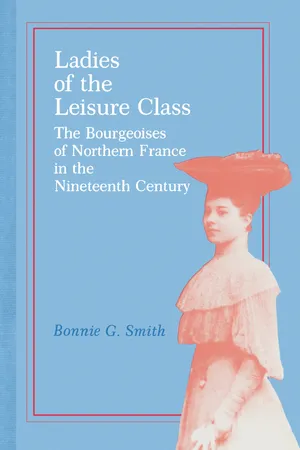
In a social and cultural study of nineteenth-century bourgeois women in northern France, Bonnie Smith shows how the advent of industrialization removed women from the productive activity of the middle class and confined them to a largely reproductive experience. Out of this, she suggests, they created their own world, centered on domesticity, family, and religion. To understand these women, the author argues, it is necessary to examine their world on its own terms as a coherent whole.
Professor Smith draws on demographic, psychoanalytic, anthropological, linguistic, as well as historical insights and uses a variety of evidence that includes personal interviews, photographs, letters, genealogical records, and traditional archival sources. Part One outlines the transition from mercantile to industrial manufacturing that terminated the relationship between home and business and that separated the sexes according to their respective functions. Part Two concentrates on the lives of the women following their acceptance of an exclusively reproductive function and shows how the interdependence and fusion of household chores, religious values, and social conscience fostered a unified cultural system. Part Three, then, explores the propagation of this domesticity by the convent, as the primary educational system, and by the sentimental novel, as the vehicle most suited for an ideological expression of domestic life.
eBook - ePub
Ladies of the Leisure Class
The Bourgeoises of Northern France in the 19th Century
- English
- ePUB (mobile friendly)
- Available on iOS & Android
eBook - ePub
About this book
Information
Publisher
Princeton University PressYear
2020Print ISBN
9780691101217
9780691053301
eBook ISBN
9780691209487
I
The Historical Context

1
Introduction: A World Apart

What is a bourgeois woman? The question first came to mind when I studied history with teachers who described the modern world in terms of class. They used the words “bourgeoisie” and “proletariat,” in particular, to define relationships in the productive or market world. Here the question first arose: How was a wealthy woman properly called bourgeois when she spent most of her life at home without any direct connection with either the market or production? In terms of class analysis, what was her place? The problem deepened as I proceeded to look at “bourgeois” attitudes. Nineteenth-century men were nothing if not industrious, rational, and committed to accumulating capital. But I envisioned the bourgeois woman as someone who probably passed many idle hours, and who was more concerned with spending money than with accumulating it. And if she were rational, why the many depictions of the bourgeois woman as preoccupied with furniture and fashion? I could not jettison accumulated wisdom in a blind defense of her scientific mindset. Outside the classroom came other meanings of the word “bourgeois.” There were the epithets: oppressors of the people, political swindlers, and the ubiquitous construction of the word bourgeois as synonymous with bad taste. But in no instance did any of these satisfy my craving for a picture of the bourgeois woman. Conventional definitions all applied to men of the bourgeoisie.
There is a way to connect the bourgeois woman with the marketplace world that shaped nineteenth-century history, and historians have made sympathetic efforts to locate her in that environment. They have seen her as the bearer of its children, the consoler of its hard-pressed businessmen, and occasionally as volunteer nurse binding up social wounds through charitable activities. In addition, the clothing with which she adorned herself and the decorative objects she strewed throughout her home contributed to the perpetuation of modern society by softening its increasingly stark contours. The bourgeois woman was also the leading consumer of industrial goods, and, increasingly guided by advertising, she developed a complementary relationship with her male counterpart. While the bourgeois man directed production, she was responsible for the purchase of commodities.
Such an analysis, for all its merit, does not exhaust the substance of bourgeois women’s lives, however. It ignores their remoteness from production, and even their explicit dislike for industrial society and its attendant social change. Bourgeois women mistrusted market values and the world beyond the home. Instead of adopting an individualistic, rational, and democratic world view, they abhorred it. Instead of working to amass capital or to contribute to either the economic or political advance of industrial society, they devoted their lives to their families, and, as often, to the Church. Although physically part of an industrial society, bourgeois women neither experienced its way of life nor partook of its mentality. They inhabited and presided over a domestic world that had its own concerns.
To penetrate this world and its concerns I have chosen as a case study a group of women who lived in the French department of the Nord during the nineteenth century. As wives, sisters, daughters, and mothers of men engaged in the professions or in running businesses and heavy industry, these women constitute a sample of several thousand who could be investigated in terms more or less applicable to bourgeois women in most industrial societies.
To begin, I have looked at the simple, obvious characteristics of their lives. Specifically and primarily, the bourgeois woman of the nineteenth century engaged in reproduction, and her body experienced reproductive cycles more regularly and palpably than did the bodies of men. Menstruation, pregnancy, parturition, lactation, and menopause relentlessly ordered the configuration of female life. It does not require biological determinism to appreciate how deeply rooted in nature woman’s activity is. Simone de Beauvoir treated this theme minutely in The Second Sex, and it would be foolhardy (especially in a study of French women) to disregard her insights. De Beauvoir’s work begins with female biology and leads to an explanation of why men have viewed women as lacking humanity. Along the way she examines the various stages in women’s lives as at least partially modulated by their physical fluctuations. It is interesting to connect de Beauvoir’s thesis with another pioneering work, Alice Clark’s The Working Life of Women in the Seventeenth Century. Clark argued that the home of that era was slowly losing many of its productive functions, and historians hastened to join her in calling the modern home “functionless.” Others began to look at the psychological workings of the home or at its “spiritual” nature in an attempt to impute vigor to domestic life. Yet, Clark’s depiction linked to de Beauvoir’s theory suggests that the home constituted a reproductive arena, an area charged with the content of women’s physical lives.
The biological charge to reproduce does not, however, preclude cultural activity. This is the conclusion of Sherry Ortner’s article that seeks out and locates the cultural activities in the socialization of children.1 Explicitly building on de Beauvoir’s work, she argued that in this capacity women transmitted a civilized tradition, but that the private setting for this activity hid their contribution and perpetuated the affinity of women and nature in men’s eyes. Despite an admirable effort, Ortner failed to build on de Beauvoir’s insight when she characterized women as merely transmitters of culture, as robots, one might say, in service to the exterior world of male values and standards. Indeed, one might expect a different turn from a feminist anthropologist, for the home remains unexamined, even in a tentative way, as a source of an indigenous and autonomous culture.
In fact, the culture of the home has been so obtrusive that it already has its name. During the nineteenth century the domestic world of reproductive women overflowed with artifacts and produced patterns of behavior, the sum of which has been labeled “domesticity.” Domesticity flowered from this period until the present day. Bourgeois women, in particular, suddenly released from much of the productive activity that had accompanied their reproductive life, began to fashion a home life for themselves, their husbands, and their children. Initially the prerogative of the upper classes, domestic habits and thoughts became common to rich and working-class women alike, as fewer and fewer married women participated in the industrial work force on a sustained basis. As a result, by the twentieth century women found themselves almost exclusively concerned with interior decorating, fashion, cuisine, etiquette, needlework, and child-rearing; and by extension, these occupations came to be considered intrinsic to the female personality, arranged and systematized as they were into a symbolic expression of women’s biological mission and the reproductive course of their lives.
The presence of a domestic culture and the accessibility of domestic artifacts suggest, it seems to me, a more direct study of women than the approach taken by conventional economic or political history. Scholars have traditionally found that the biological functions of women have made a historical treatment of women’s lives difficult. Because neither discourse nor a record of intellectual, political, or economic achievement exists as evidence of their reproductive activities, scholars remove women from the historical stage and relegate their study to the natural sciences. In addition, the attachment of academics to rational (or even irrational) discourse as the only valid source of information has moved them to dismiss women’s involvement with fashion and interior decorating as signs of mental inferiority and of the triviality of their minds. I share the concern for rational discourse to the point of attempting to put into words what women expressed through their system of domestic artifacts. The possibility that fashion and housekeeping habits have an expressive content demands that we consider them in order to increase our knowledge of the home as an internally coherent, symbolic form. Not only is it interesting to uncover different modes of speech, for instance; it is crucial if we remember what nineteenth-century men never failed to recognize: the culture of the home often stood in opposition to the imperative of industrial progress.
Recently, demographers in family reconstitution studies have attempted to recover the reproductive past, as well as the history of many inarticulate groups, through statistics. For all that this fruitful method has extended our knowledge, it does not fully illuminate the substance and meaning of the domestic universe. Aside from the incongruity involved in describing with numbers women who never thought in mathematical terms, statistics may mislead by assigning false significance to the sheer quantity and spacing of children of marriages. Although the bourgeois women we will meet in this study cared deeply about their children, reproduction and other bio-sexual determinants remained central to their lives whether they had one or ten children. Each expressed that centrality through a system of domestic symbols (a preverbal language, perhaps) that then reversed itself to form a set of rules and cultural standards binding all women. Although statistics are often helpful in charting behavior, insofar as they contain their own symbolic expression, they obstruct our view of this type of reversible cultural equation.
Along with reproduction and domestic life, women’s religious practices provide another access to their culture. The bourgeois woman was nothing if not devoted to the Church. Like the fact of reproduction and domesticity, however, this circumstance has often failed to enlighten, and has even blocked investigation. Secularism, once blessed with a measure of humility, has tended to construe religious faith as the opiate of womanhood. Faith has earned more epithets than understanding; and thus, in contrast to the lucid rationalism attributed to modern men, women are called “fanatic,” “superstitious,” and “ignorant.” Sometimes, as in Ann Douglas’s work, The Feminization of American Culture, religion acquires a rational connotation when it is seen as an instrument of social power for the otherwise impotent woman.2 But what is gained by this in terms of historical respectability for religion is lost for the anthropological investigation of the domestic mind. By modernizing religion and fashioning it to her own devices, Douglas misses its importance as a cosmological system, its decidedly anti-modern thrust, and the congruence between domestic ritual and religious rites. Because women maintained a traditional and preindustrial way of life, and because religion had long offered an explanation of the universe based on preindustrial experience, we should expect, rather than distort or modernize, the coupling of domesticity and faith. Indeed, it might be necessary for us to face, as did Freud and many anthropologists, the persistent adherence of women to the Church with curiosity instead of with blatant or ill-disguised contempt.
Modern historians have fairly well established that the nineteenth-century bourgeois man not only tended toward freethinking but also supported republican and democratic government. From a narrowly construed class perspective, women should have moved in a similar political direction. Yet our still rudimentary knowledge of the nineteenth-century woman suggests quite the opposite. For example, most politicians, when confronted with the suffrage movement, opposed the vote for women out of fear that they would support the forces of reaction. This consideration particularly moved French republicans whose power depended on preventing the revitalization of monarchism—a cause widely supported by women. There is a contemporary, though perhaps trivial, indication of the dichotomous political tendencies separating the political views of men and women: while men read Le Monde and Le Figaro, women satisfy their monarchist instincts in the pages of Jours de France. Despite such evidence, both sexes have been placed under the bourgeois umbrella.
A similar lack of discrimination provokes charges that men and women of the bourgeoisie equally “oppressed the proletariat.” Because women generally had little economic contact with the working class, the source of this oppression is found in their charitable activity, which allegedly blinded workers to the source of their misery. This interpretation confuses the possible effect of women’s volunteer activities with the social vision prompting their efforts. Embedded in the word “charity” and in its practice was an interpretation of the social order as a static and hierarchical construct. Women sought to maintain these distinctions through charity, whereas men hoped by similar activities to achieve a certain measure of social homogenization, or at least to present it as a political goal. The intent of modern social welfare (beginning in the nineteenth century) to bring everyone to a minimum standard of living contrasts sharply with women’s desire to perpetuate social hierarchy.
In theory, static hierarchy died at the hands of French revolutionary politicians. In its place they substituted a creed of liberty and equality. Bourgeois women, however, scorned both revolutionary doctrine and democratic institutions: “ ‘liberty,’ we all know what that means,” they warned.3 They clung instead to rigid, even aristocratic notions of place and status, all the more surprisingly when many of their husbands had amassed their fortunes because of new mobility and opportunity. Their retrograde views were less manifestations of stubbornness than of the sustained connection between women and family. Family depended on fixed patterns of authority, and to women aristocratic government and hierarchic social order best reproduced their familial experience. Because this experience so molded their opinions, women saw the entire universe shaped in this hierarchical way through a chain of command that originated with God, passed through kings, and eventually reached to parents. Thus, when bourgeois women performed a charitable act, they envisioned it as an act in the spirit of hierarchy (noblesse oblige). Among their own kind etiquette performed a similar function of denoting place in this type of ordering by blood.
All these subjects receive full treatment in subsequent chapters, but I introduce them now in order to suggest a line of argument. The bourgeois woman lived in an atmosphere and acted according to precepts entirely at odds with the industrial, market, egalitarian, and democratic world—the world, that is, of her husband. In addition, she had little use for the primary article of faith of the nineteenth century: rationalism. The women we will meet believed that scientific knowledge was chimerical, especially when it challenged the proper ordering of things, including family, society, and political authority. For them science had a substantial va...
Table of contents
- Cover Page
- Title Page
- Copyright Page
- Dedication
- Contents
- List of Illustrations
- List of Tables
- Part I. The Historical Context
- Part II. The Domestic System
- Part III. Passing the Torch
- Appendix: Tables
- Acknowledgments and Sources
- Abbreviations
- Notes
- Bibliography
- Index
Trusted by 375,005 students
Access to over 1.5 million titles for a fair monthly price.
Study more efficiently using our study tools.
Frequently asked questions
Yes, you can cancel anytime from the Subscription tab in your account settings on the Perlego website. Your subscription will stay active until the end of your current billing period. Learn how to cancel your subscription
No, books cannot be downloaded as external files, such as PDFs, for use outside of Perlego. However, you can download books within the Perlego app for offline reading on mobile or tablet. Learn how to download books offline
Perlego offers two plans: Essential and Complete
- Essential is ideal for learners and professionals who enjoy exploring a wide range of subjects. Access the Essential Library with 800,000+ trusted titles and best-sellers across business, personal growth, and the humanities. Includes unlimited reading time and Standard Read Aloud voice.
- Complete: Perfect for advanced learners and researchers needing full, unrestricted access. Unlock 1.5M+ books across hundreds of subjects, including academic and specialized titles. The Complete Plan also includes advanced features like Premium Read Aloud and Research Assistant.
We are an online textbook subscription service, where you can get access to an entire online library for less than the price of a single book per month. With over 1.5 million books across 990+ topics, we’ve got you covered! Learn about our mission
Look out for the read-aloud symbol on your next book to see if you can listen to it. The read-aloud tool reads text aloud for you, highlighting the text as it is being read. You can pause it, speed it up and slow it down. Learn more about Read Aloud
Yes! You can use the Perlego app on both iOS and Android devices to read anytime, anywhere — even offline. Perfect for commutes or when you’re on the go.
Please note we cannot support devices running on iOS 13 and Android 7 or earlier. Learn more about using the app
Please note we cannot support devices running on iOS 13 and Android 7 or earlier. Learn more about using the app
Yes, you can access Ladies of the Leisure Class by Bonnie G. Smith in PDF and/or ePUB format, as well as other popular books in History & French History. We have over 1.5 million books available in our catalogue for you to explore.