Although ecologists have long considered morphology and life history to be important determinants of the distribution, abundance, and dynamics of plants in nature, this book contains the first theory to predict explicitly both the evolution of plant traits and the effects of these traits on plant community structure and dynamics. David Tilman focuses on the universal requirement of terrestrial plants for both below-ground and above-ground resources. The physical separation of these resources means that plants face an unavoidable tradeoff. To obtain a higher proportion of one resource, a plant must allocate more of its growth to the structures involved in its acquisition, and thus necessarily obtain a lower proportion of another resource. Professor Tilman presents a simple theory that includes this constraint and tradeoff, and uses the theory to explore the evolution of plant life histories and morphologies along productivity and disturbance gradients.
The book shows that relative growth rate, which is predicted to be strongly influenced by a plant's proportional allocation to leaves, is a major determinant of the transient dynamics of competition. These dynamics may explain the differences between successions on poor versus rich soils and suggest that most field experiments performed to date have been of too short a duration to allow unambiguous interpretation of their results.
- 376 pages
- English
- PDF
- Available on iOS & Android
eBook - PDF
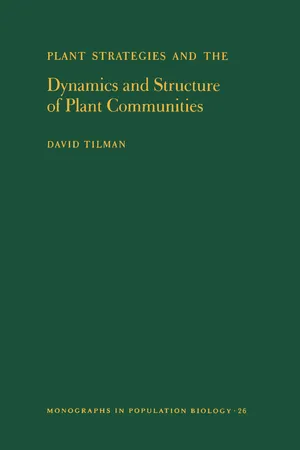
Plant Strategies and the Dynamics and Structure of Plant Communities
About this book
Information
Publisher
Princeton University PressYear
2020Print ISBN
9780691084893
9780691084886
eBook ISBN
9780691209593
Table of contents
- Cover Page
- Half-title Page
- Title Page
- Copyright Page
- Contents
- Preface
- 1. Introduction
- 2. The Isocline Approach to Resource Competition
- 3. Mechanisms of Competition for Nutrients and Light
- 4. Allocation Patterns and Life Histories
- 5. Vegetation Patterns on Productivity and Loss Rate Gradients
- 6. The Dynamics of Plant Competition
- 7. Succession
- 8. Secondary Succession on a Minnesota Sandplain
- 9. Questions and Conclusions
- Appendix: Mathematics of the Model ALLOCATE
- References
- Author Index
- Subject Index
Trusted by 375,005 students
Access to over 1.5 million titles for a fair monthly price.
Study more efficiently using our study tools.
Frequently asked questions
Yes, you can cancel anytime from the Subscription tab in your account settings on the Perlego website. Your subscription will stay active until the end of your current billing period. Learn how to cancel your subscription
No, books cannot be downloaded as external files, such as PDFs, for use outside of Perlego. However, you can download books within the Perlego app for offline reading on mobile or tablet. Learn how to download books offline
Perlego offers two plans: Essential and Complete
- Essential is ideal for learners and professionals who enjoy exploring a wide range of subjects. Access the Essential Library with 800,000+ trusted titles and best-sellers across business, personal growth, and the humanities. Includes unlimited reading time and Standard Read Aloud voice.
- Complete: Perfect for advanced learners and researchers needing full, unrestricted access. Unlock 1.5M+ books across hundreds of subjects, including academic and specialized titles. The Complete Plan also includes advanced features like Premium Read Aloud and Research Assistant.
We are an online textbook subscription service, where you can get access to an entire online library for less than the price of a single book per month. With over 1.5 million books across 990+ topics, we’ve got you covered! Learn about our mission
Look out for the read-aloud symbol on your next book to see if you can listen to it. The read-aloud tool reads text aloud for you, highlighting the text as it is being read. You can pause it, speed it up and slow it down. Learn more about Read Aloud
Yes! You can use the Perlego app on both iOS and Android devices to read anytime, anywhere — even offline. Perfect for commutes or when you’re on the go.
Please note we cannot support devices running on iOS 13 and Android 7 or earlier. Learn more about using the app
Please note we cannot support devices running on iOS 13 and Android 7 or earlier. Learn more about using the app
Yes, you can access Plant Strategies and the Dynamics and Structure of Plant Communities by David Tilman in PDF and/or ePUB format, as well as other popular books in Biological Sciences & Evolution. We have over 1.5 million books available in our catalogue for you to explore.