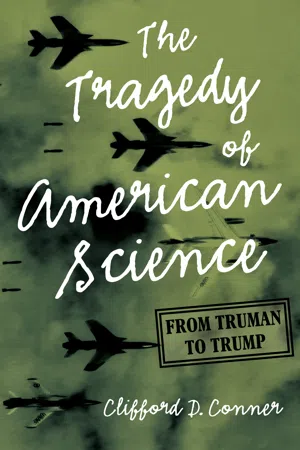
Despite a facade of brilliant technological advances, American science has led humanity to the brink of interrelated disasters. In The Tragedy of American Science, historian of science Clifford D. Conner describes the dual processes by which this history has unfolded since the Second World War, addressing the corporatization and the militarization of science in the US. First, he examines the role of private profit considerations in determining the direction of scientific inquiry and the ways those considerations have dangerously undermined the integrity of sciences impacting food, water, air, medicine, and the climate. Second, Conner explores the relationship between scientific industries and the US military, discussing the innumerable financial and human scientific resources that have been diverted from other critical areas in order to further military aggrandizement and technological development. While the underlying problems may appear intractable, Conner compellingly argues that replacing the current science-for-profit system with a science-for-human-needs system is not an impossible, utopian dream. But to get there, we’ll need to grapple with this important history.
- English
- ePUB (mobile friendly)
- Available on iOS & Android
eBook - ePub
About this book
Trusted by 375,005 students
Access to over 1.5 million titles for a fair monthly price.
Study more efficiently using our study tools.
Information
Subtopic
Military & Maritime HistoryIndex
HistoryChapter 1
The Big Fat Lie
Research into food-related problems is conducted by scientists trained in a large number of traditional disciplines, from microbiology and physical chemistry to gastroenterology and psychiatry. This inquiry into the current state of the food sciences, however, focuses on two broader areas of interdisciplinary interest: nutrition science (the subject of this chapter) and agronomy (the subject of the next chapter). Nutrition science concerns the interaction of food and human bodies, and agronomy has to do with how food is produced.
Is Nutrition Science an Oxymoron?
The crucial role of nutrition in human health means that everyone has a stake in the accuracy of information about the food we eat. Almost half the adult population of the United States—133 million people—has at least one of the four leading diet-related health problems: heart disease, stroke, cancer, or diabetes. Those chronic conditions are responsible for seven out of ten American deaths every year.1
My personal experience with food-related advice—a lifelong effort to keep my weight under control—has led me to think of the phrase “nutrition science” as an oxymoron. However unfair that characterization may seem, frequent scandals have laid bare significant ways in which nutrition research has indeed been deeply corrupted.2
In September 2018, the career of “one of the most respected food researchers in America . . . came to an unceremonious end,” wrote Anahad O’Connor in the New York Times. Dr. Brian Wansink, head of the Food and Brand Lab at Cornell University, resigned after a university investigation found him guilty of “academic misconduct in his research and scholarship, including misreporting of research data.”3
Some experts perceived this scandal to be “symptomatic of a broader problem in food and health research.” Critics “argue that an alarming number of food studies are misleading, unscientific or manipulated to draw dubious conclusions.”
Dr. Wansink’s lab was known for data dredging, or p-hacking, the process of running exhaustive analyses on data sets to tease out subtle signals that might otherwise be unremarkable. Critics say it is tantamount to casting a wide net and then creating a hypothesis to support whatever cherry-picked findings seem interesting—the opposite of the scientific method.4
Dr. Wansink’s disgrace and the exposure of his unscrupulous methods are, unfortunately, not expected to lead to major improvements in nutrition science practices. As will become clear in the examples below, studies based on flimsy statistical evidence are far from rare, and no one thinks data dredging is going away anytime soon.
How Scientific Are the Government’s Dietary Guidelines?
If you had come to accept as an article of faith that eating low-fat foods is essential to the good health of your heart, you were not alone. Meanwhile, public awareness of sugar as a factor in causing heart disease has been comparatively nonexistent. These perceptions had long been promoted as scientifically based by the nutrition profession and bolstered by the stamp of government approval.
The federal government issues and updates its Dietary Guidelines for Americans every five years. Whether or not very many Americans pay direct attention to them, the guidelines have a substantial impact on the way we eat. They form the basis of nutrition education, food labeling laws, food-assistance programs, and research priorities at the National Institutes of Health. Those food-assistance programs, by the way, directly impact a quarter of the American population. School breakfast and lunch programs and the food-stamp program SNAP (Supplemental Nutrition Assistance Program) expend more than $100 billion a year to provide food that is legally bound to meet the federal nutrition requirements. Furthermore, the guidelines affect not only Americans; they serve as a model for governmental dietary recommendations throughout the world.
The guidelines are required by law to reflect the “preponderance of the scientific and medical knowledge” regarding nutrition.5 The issuance of the most recent set, in 2015, was preceded by a preliminary report authored by a Dietary Guidelines Advisory Committee of appointed experts.6 Their report was then to be shaped into the official Dietary Guidelines for Americans and released under the aegis of the US Department of Agriculture and the Department of Health and Human Services.7
When the preliminary report appeared in February 2015, it attracted an unprecedented level of interest. Whereas the previous report, five years earlier, received only about two thousand public comments, this one was greeted by twenty-nine thousand. And that was but the opening round of raging debates between consumer advocates and lobbyists over sugar, red meat, sustainable agriculture, and science. The BMJ (formerly the British Medical Journal) published an in-depth analysis of the report, sharply criticizing it as insufficiently scientific.8
A key element of the BMJ’s critique was that the science allegedly underlying the report was tainted by financial conflicts of interest. The committee of experts acknowledged that they had relied heavily on data provided by health advocacy organizations funded by the food and pharmaceutical industries.
The American Heart Association, for example, had received “decades of support from vegetable oil manufacturers, whose products the AHA has long promoted for cardiovascular health.”9 Furthermore, members of the expert committee itself had undisclosed conflicts of interest. One had received research funding from walnut growers and vegetable oil giant Unilever; another from publicists for General Mills and PepsiCo; and for the first time, the committee chair was not from a university but from a health-industry corporation. In summary, the BMJ charged, “This reliance on industry backed groups clearly undermines the credibility of the government report.”
Nutrition Science’s Big Sugar Addiction
A 2016 investigative report by Anahad O’Connor in the New York Times cited newly discovered documents demonstrating that “five decades of research into the role of nutrition and heart disease, including many of today’s dietary recommendations, may have been largely shaped by the sugar industry.”10 The evidence is summarized in a 2016 article published in the American Medical Association’s JAMA Internal Medicine.11 Internal documents of the sugar industry reveal that an industry trade group named the Sugar Research Foundation (later renamed the Sugar Association) funded a 1967 study that set the agenda for nutritional research and provided the propaganda message for Big Sugar for decades to come.
Three Harvard professors were paid by the Sugar Research Foundation to produce a review12 of research studies that had been chosen by the trade group itself. Their paper, which appeared in July 1967 in the authoritative New England Journal of Medicine,13 minimized the role of sugar in heart disease and implicated saturated fat instead. The thousands of pages of archival documents that came to light leave no room for doubt about the conscious nature of the collusion between the Harvard scientists and the sugar industry:
[In 1964] John Hickson, a top sugar industry executive, discussed a plan with others in the industry to shift public opinion “through our research and information and legislative programs.” At the time, studies had begun pointing to a relationship between high-sugar diets and the country’s high rates of heart disease. . . . Mr. Hickson proposed countering the alarming findings on sugar with industry-funded research. “Then we can publish the data and refute our detracto...
Table of contents
- Foreword
- Introduction
- The Corporatization of American Science
- The Militarization of American Science
- How We Got into This Mess . . .
- . . . And the Only Way Out
- Acknowledgments
- Endnotes
Frequently asked questions
Yes, you can cancel anytime from the Subscription tab in your account settings on the Perlego website. Your subscription will stay active until the end of your current billing period. Learn how to cancel your subscription
No, books cannot be downloaded as external files, such as PDFs, for use outside of Perlego. However, you can download books within the Perlego app for offline reading on mobile or tablet. Learn how to download books offline
Perlego offers two plans: Essential and Complete
- Essential is ideal for learners and professionals who enjoy exploring a wide range of subjects. Access the Essential Library with 800,000+ trusted titles and best-sellers across business, personal growth, and the humanities. Includes unlimited reading time and Standard Read Aloud voice.
- Complete: Perfect for advanced learners and researchers needing full, unrestricted access. Unlock 1.5M+ books across hundreds of subjects, including academic and specialized titles. The Complete Plan also includes advanced features like Premium Read Aloud and Research Assistant.
We are an online textbook subscription service, where you can get access to an entire online library for less than the price of a single book per month. With over 1.5 million books across 990+ topics, we’ve got you covered! Learn about our mission
Look out for the read-aloud symbol on your next book to see if you can listen to it. The read-aloud tool reads text aloud for you, highlighting the text as it is being read. You can pause it, speed it up and slow it down. Learn more about Read Aloud
Yes! You can use the Perlego app on both iOS and Android devices to read anytime, anywhere — even offline. Perfect for commutes or when you’re on the go.
Please note we cannot support devices running on iOS 13 and Android 7 or earlier. Learn more about using the app
Please note we cannot support devices running on iOS 13 and Android 7 or earlier. Learn more about using the app
Yes, you can access The Tragedy of American Science by Clifford D. Connor in PDF and/or ePUB format, as well as other popular books in History & Military & Maritime History. We have over 1.5 million books available in our catalogue for you to explore.