Essays on how chaos, totalitarianism, and trauma have shaped Ukraine's culture: "A milestone of the scholarship about Eastern European politics of memory." —Wulf Kansteiner, Aarhus University
In a century marked by totalitarian regimes, genocide, mass migrations, and shifting borders, the concept of memory in Eastern Europe is often synonymous with notions of trauma. In Ukraine, memory mechanisms were disrupted by political systems seeking to repress and control the past in order to form new national identities supportive of their own agendas. With the collapse of the Soviet Union, memory in Ukraine was released, creating alternate visions of the past, new national heroes, and new victims. This release of memories led to new conflicts and "memory wars."
How does the past exist in contemporary Ukraine? The works collected in
The Burden of the Past focus on commemorative practices, the politics of history, and the way memory influences Ukrainian politics, identity, and culture. The works explore contemporary memory culture in Ukraine and the ways in which it is being researched and understood. Drawing on work from historians, sociologists, anthropologists, psychologists, and political scientists, the collection represents a truly interdisciplinary approach. Taken together, the groundbreaking scholarship collected in
The Burden of the Past provides insight into how memories can be warped and abused, and how this abuse can have lasting effects on a country seeking to create a hopeful future.
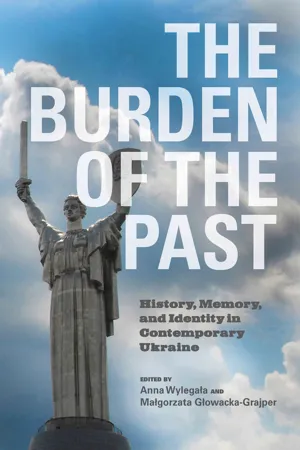
eBook - ePub
The Burden of the Past
History, Memory, and Identity in Contemporary Ukraine
- 320 pages
- English
- ePUB (mobile friendly)
- Available on iOS & Android
eBook - ePub
The Burden of the Past
History, Memory, and Identity in Contemporary Ukraine
About this book
Trusted by 375,005 students
Access to over 1.5 million titles for a fair monthly price.
Study more efficiently using our study tools.
Information
Publisher
Indiana University PressYear
2019Print ISBN
9780253046703
9780253046703
eBook ISBN
9780253046727
PART I
THE MEMORY OF HOLODOMOR
1
IDLE, DRUNK, AND GOOD FOR NOTHING
Cultural Memory of the Rank-and-File Perpetrators of the 1932–33 Famine in Ukraine
Daria Mattingly
THIS CHAPTER FOCUSES ON IDENTICAL TRACES OF THE rank-and-file perpetrators of the 1932–33 famine in Ukraine and their portrayal in cultural memory. Although the role of the party leaders and security service in the famine has been studied in detail by Viola, Vasyl’iev, Doroshko, and Shapoval, the scholarship on the men and women who facilitated the mass famine on the ground is still at its initial stages.1 Who were these people and how are they remembered? Transferring overarching typology of the perpetrators of mass violence suggested by Smeulers to the Holodomor yields some possible answers and reveals previously understudied groups of such participants as female perpetrators.2 This typology splits perpetrators on the basis of their motivation into six groups: professionals, profiteers and careerists, fanatics, sadists and criminals, followers, and compromised perpetrators.3 This nuanced approach to addressing the famine facilitators also could be found in cultural memory—namely in samvydav and tamvydav Ukrainian novels. Post-Soviet Ukrainian and diaspora prose, on the other hand, is still being dominated by dichotomy of the sadist profiteering Other, quisling sons, and repentant communists, which mirrors their portrayal in the Soviet Ukrainian novels as “unflinching” Bolsheviks and weak or counterrevolutionary officials.
Thus this chapter will be developed by looking into (a) methodology, typology, and sources used to establish the mechanism of the famine on the ground; (b) the search brigades and their (c) various groups of perpetrators on the village level. Then depiction of the perpetrators in (d) Ukrainian novels will be explored. In conclusion, similarities and differences between the portrayals of the perpetrators will be discussed.
Methodology and Sources
The 1932–33 famine was a crime against humanity that claimed millions of lives.4 People who organized and executed the crime were the perpetrators. Since the line between the perpetrators and the victims in the famine was sometimes blurred (perpetrators could become victims and vice versa) the term participants or actors will be used where applicable. Some scholars consider the following legislative provisions helped bring on the famine and made men and women engaged in their enforcement complicit in mass violence:
1.Collective and individual farmers had to surrender grain and renounce their right to retain any for their own consumption or seed reserve. The state also collected shares of meat, milk, eggs, and other produce from collective and individual farmers.5
2.The homes of all peasants could be searched arbitrarily; if grain was found, the peasants could be prosecuted for theft.
3.Collective farms, villages, and entire districts were blacklisted or actually turned into ghettos—supply of any goods, including salt, kerosene, and matches, was stopped, all available foodstuffs confiscated and removed, and commerce and communications banned.
4.From November 20, 1932, meat procurements were demanded fifteen months in advance from the collective farms and farmers who failed to meet grain procurement targets. Thus the peasants had to either slaughter their cattle or buy meat at the market. This punitive measure contributed to the fact during the famine almost half the rural population was left without any livestock;6 all grain previously distributed to collective farmers for use on the farms was ordered to be returned; all existing grain reserves in the villages were confiscated and credited toward procurement.7
5.Any produce found in the fields resulted in prosecution under the law of August 7, 1932, against “pilfering.”
6.Commerce in food was banned until the procurement quotas were met (decreased several times over 1932–33, they were never met).8
7.Restricted rail travel for peasants.
The mechanism of the famine included cooperation between many institutions of the modern state in their efforts to remove all foodstuffs from the victims and ensure the starving did not have access to the storehouses or the fields and could not escape the villages. House searches, looming large in oral memory, were conducted by the search brigades that were organized and overseen by the local officials or party plenipotentiaries. Local officials, in their turn, received their orders from district officials and formed liaisons with security services who helped to enforce policies in cases of failure of local officials or insurgency. Detailed study of all participants of the legislative provisions would be beyond the scope of this chapter, and therefore people involved in enforcing the first five points will be assessed: searches, removal of foodstuffs and valuables, and refusal of available resources to the starving.
A plethora of many nonlethal functions that all together contributed to mass murder but made it possible for the actors not to perceive themselves as perpetrators. Empowered or instructed to carry out a task, an official or a village activist did not necessarily intentionally cause harm to the victims. Perpetration was diffused behind the screen of collectivization, grain procurement, and the so-called class war. Each perpetrator could feel that his or her part did not change anything and there was little point in objecting. Or their involvement was part of a great transformation of the country. Or they could not feel anything at all. Thus, few of them later reflected on their actions as acts of perpetration. They were activists, officials, conductors, guards, teachers, field guards involved in collectivization and grain procurement. In most cases, a participant had a specific function to fulfill for his or her job. The mundane job of being a watch at a granary in a village during the famine contributed to the organized starvation by denying emaciated villagers grain. Although some supporting roles fall short of criminal responsibility, their importance should not be minimized.
In identifying participants of the famine, it is important to consider the timeframe, which was not limited to 1932–33. The Holodomor would not have been possible without a wider context of collectivization and a habituation to violence. Participants referred to removal of land and other property from private ownership, displacement and deportation, and various repressions and executions as “the third front.” But this war was fought not in a distant trench war but in the villages of largely agrarian country since the Soviet rule was established and prodrazverstka (confiscation of food and other agricultural products) in 1921. It was a mixture of state-sanctioned violence and gross violations of human rights that unfolded gradually and progressively. After years of hands-on involvement during collectivization it became more difficult for participants to escape the cycle of violence they were part of. As in the circumstance of the subjects in Milgram’s experiment on obedience who would not have given the victim the highest shock without earlier small shocks, the perpetrators of the Holodomor had previous experience of collective violence.9
Nevertheless, the rank-and-file perpetrators were not entirely mere cogs in the machine or being forced into perpetration. Although most people are naturally influenced by authority or groups, some choose not to progress on a continuum of destructiveness.10 Indeed, during the Holodomor, some local officials and activists refused to accept unrealistic procurement targets or search houses of their neighbors. As nineteen-year-old activist Olena Dun from Kamiani Potoky in Kremenchuk district recalled, “Once the village council sent me to an old woman. There I found a hungry woman crying. I was like her myself, why would I look for whatever she had? You can put me on trial tomorrow but I won’t go and I didn’t go.”11 It is the agency of the perpetrators—that is, the reasons behind their choice for participation, that many scholars of collective violence and international crimes—including Hilberg, Fromm, Gupta, and Mann—base their typologies on. Perhaps the most detailed, inclusive, and overarching typology is the one by Smeulers.12 How this typology could be applied to the Holodomor is illustrated in table 1.1. One perpetrator can belong to a few groups simultaneously.
The sources for this chapter include documents from republican, provincial, and district archives in Ukraine, village museums, and private collections. Major corpuses of oral memory, memoirs, and diaries were also consulted. Using witness testimonies on the identities and activities of perpetrators presents several challenges.13 Although some scholars reflect on the impossibility of bearing witness to a traumatic event, Schmidt argues that “the interruptions, the silence, and even the flaws within Holocaust survivor testimonies are symptomatic expressions of the internal truth.”14 In perpetrator testimonies this nonwitnessing, lack of internal truth, and political agenda is “a constitutive element of genocide” or crime against humanity.15 Indeed, many perpetrators keep silent or conceal their perspective by speaking in Bolshevik jargon—impersonal and distanced. Such accounts also present a hermeneutic problem. Their authors, as former perpetrators, consciously attempt to represent themselves in a positive light and bear ambivalence to witnessing as a political act, for most of the memoirs were published in the West during the Cold War.
According to Christian Gerlach, in order to ensure some certainty, one has to use the testimonies as supportive evidence together with many sources and testimonies of the same events.16 Christopher Browning develops this method of recovering factuality by conducting four tests: self-interest, vividness, possibility, and probability.17 In other words, of prime interest are statements in the testimony that are contrary to the self-interest of the perpetrator, the degree of detail in the events described, the lack of direct contradiction by other sources, and indirect confirmation in other documents.
Table 1.1. Typology of the perpetrators of Holodomor.
Group | Definition | Participation in the Holodomor |
Professionals | Trained to enforce policies, which at times include violence. | Security services (GPU), militia, and—in some cases—the army. |
Profiteers and careerists | Benefit from participation. | Use their position of power to benefit financially, to settle scores with neighbors, or to advance their party career through deployment in the village. |
Fanatics (5%) | Driven by ideology or greater good. | Plenipotentiaries from the cities and local communists who “firmly believed that the ends justified the means. Our great goal was the universal triumph of Communism, and for the sake of the goal everything was permissible—to lie, to steal, to destroy hundreds of thousands and even millions of people.” |
Sadists and criminals (5%) | Take advantage of situation to fulfill sadistic or other criminal deviations. | Tortured, raped, and murdered the victims. |
Followers (65%) | Majority of participants that simply follow orders or comply with authority. | Collective farmers, officials, plenipotentiaries, communists, young people. When confronted by the victims about his actions leading to the deaths of children, one activist replied, “Well, and what else . . . that’s it, we are sent and we are doing it.” |
Compromised ordinary people | Usually vulnerable people coerced i... |
Table of contents
- Cover
- Title Page
- Copyright
- Contents
- Note on Transliteration
- List of Abbreviations
- Introduction / Anna Wylegała and Małgorzata Głowacka-Grajper
- Part I: The Memory of Holodomor
- Part II: World War II in the Ukrainian Memory
- Part III: Heroes or Traitors: Creating a Heroic Canon
- Part IV: Traces of the Lost Multiethnicity and Memory of the Ethnic Cleansing
- Part V: History and Politics in a Post-Soviet State: Ukraine, Russia, and Independence
- Index
Frequently asked questions
Yes, you can cancel anytime from the Subscription tab in your account settings on the Perlego website. Your subscription will stay active until the end of your current billing period. Learn how to cancel your subscription
No, books cannot be downloaded as external files, such as PDFs, for use outside of Perlego. However, you can download books within the Perlego app for offline reading on mobile or tablet. Learn how to download books offline
Perlego offers two plans: Essential and Complete
- Essential is ideal for learners and professionals who enjoy exploring a wide range of subjects. Access the Essential Library with 800,000+ trusted titles and best-sellers across business, personal growth, and the humanities. Includes unlimited reading time and Standard Read Aloud voice.
- Complete: Perfect for advanced learners and researchers needing full, unrestricted access. Unlock 1.5M+ books across hundreds of subjects, including academic and specialized titles. The Complete Plan also includes advanced features like Premium Read Aloud and Research Assistant.
We are an online textbook subscription service, where you can get access to an entire online library for less than the price of a single book per month. With over 1.5 million books across 990+ topics, we’ve got you covered! Learn about our mission
Look out for the read-aloud symbol on your next book to see if you can listen to it. The read-aloud tool reads text aloud for you, highlighting the text as it is being read. You can pause it, speed it up and slow it down. Learn more about Read Aloud
Yes! You can use the Perlego app on both iOS and Android devices to read anytime, anywhere — even offline. Perfect for commutes or when you’re on the go.
Please note we cannot support devices running on iOS 13 and Android 7 or earlier. Learn more about using the app
Please note we cannot support devices running on iOS 13 and Android 7 or earlier. Learn more about using the app
Yes, you can access The Burden of the Past by Anna Wylegala,Malgorzata Glowacka-Grajper,Anna Wylegała,Małgorzata Głowacka-Grajper in PDF and/or ePUB format, as well as other popular books in History & Eastern European History. We have over 1.5 million books available in our catalogue for you to explore.