- English
- ePUB (mobile friendly)
- Available on iOS & Android
Digital Communication Techniques
About this book
There have been considerable developments in information and communication technology. This has led to an increase in the number of applications available, as well as an increase in their variability. As such, it has become important to understand and master problems related to establishing radio links, the layout and flow of source data, the power available from antennas, the selectivity and sensitivity of receivers, etc.
This book discusses digital modulations, their extensions and environment, as well as a few basic mathematical tools.
An understanding of degree level mathematics or its equivalent is a prerequisite to reading this book. Digital Communication Techniques is aimed at licensed professionals, engineers, Masters students and researchers whose field is in related areas such as hardware, phase-locked loops, voltage-controlled oscillators or phase noise.
Trusted by 375,005 students
Access to over 1 million titles for a fair monthly price.
Study more efficiently using our study tools.
Information
1
Modulation
1.1. Modulation?
1.1.1. Main reasons for modulation
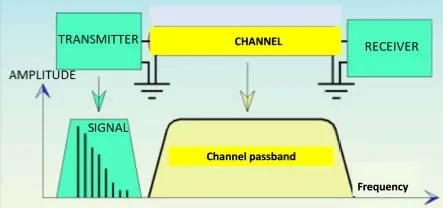
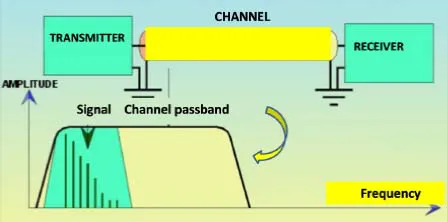
- – In the modulation process, one characteristic of a high-frequency (passband) carrier signal is modified according to the instantaneous amplitude of the signal to be processed (in its baseband).
- – Why does modulation make sense for signal transmission (distance, etc.)?
- – Several signals are transmitted on the same channel.
- – Capacitative or inductive devices need high frequency (carrier) to operate (to ensure Stability and a good Noise Rejection).
1.1.2. Main modulation schemas
- – Examples of application: transmitting audio and video signals.
- – Mobile radio communications, such as cell phones. Basic modulation types are as follows:
- – amplitude modulation (AM): modifies the amplitude;
- – frequency modulation (FM): changes the frequency;
- – phase modulation (PM): changes the phase.
1.1.3. Criteria for modulation via electronics
- – speed;
- – reliability and precision;
- – low energy consumption.
1.1.4. Digital modulation: why do it?
1.2. Main technical constraints
- – available passband;
- – usable power;
- – level of system background noise.


Table of contents
- Cover
- Table of Contents
- Preface
- Introduction
- History Pages
- List of Acronyms
- 1 Modulation
- 2 Some Developments in Modulation Techniques
- 3 Signal Processing: Sampling
- 4 A Little on Associated Hardware
- Conclusion
- APPENDICES
- References
- Index
- End User License Agreement
Frequently asked questions
- Essential is ideal for learners and professionals who enjoy exploring a wide range of subjects. Access the Essential Library with 800,000+ trusted titles and best-sellers across business, personal growth, and the humanities. Includes unlimited reading time and Standard Read Aloud voice.
- Complete: Perfect for advanced learners and researchers needing full, unrestricted access. Unlock 1.4M+ books across hundreds of subjects, including academic and specialized titles. The Complete Plan also includes advanced features like Premium Read Aloud and Research Assistant.
Please note we cannot support devices running on iOS 13 and Android 7 or earlier. Learn more about using the app