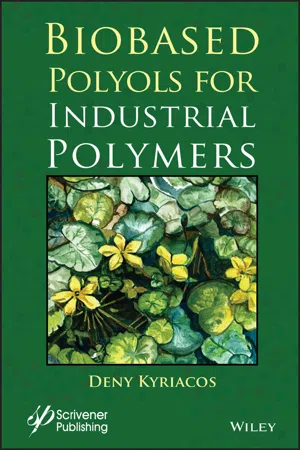
The replacement of polyols synthesized from petrochemical by polyols originating from natural products, notably from vegetable oils and animal fats, has been the subject of research projects for a number of decades.
Very recently, however, the polymers industry has intensified its efforts to include the "green products", such as biobased polyols, in applications already available in the market. Examples of such applications include polyurethane foams, elastomers and epoxides.
This book describes the extraction of the natural constituents of several fruits and plants as well as their chemical conversion to polyols. In addition to the chemistry involved in the process, particular emphasis is attributed to their applications.
Trusted by 375,005 students
Access to over 1.5 million titles for a fair monthly price.
1 Vegetable Oils, Animal Fats, Carbohydrates and Polyols
1.1 Introduction
This chapter describes polyols in detail, including diols, the chemical components of which are obtained from sources other than crude oil.
The polyols are used in the manufacture of commercial polymers and polyurethanes, for example.
Among the major natural chemicals from which polyols can be derived are:
Vegetable oils
Fish oils
Animal fats
Carbohydrates
For industrial purposes vegetable oils and carbohydrates are the most approachable sources of chemicals. Work on polyols derived from animal fats can be found in the patent literature [1].
Those products are, quite rightly, described as green products because they originate from natural sources, the production of which humans can control almost at will. They are renewable because, in contrast to crude oil, they originate from non-depletable sources. Their availability is not the monopoly of some countries which possess vast amounts of oil reserves. Agricultural products require the right weather conditions to grow as well as an area large enough for them to be cultivated on.
The first detailed studies on the use of vegetable oils and animal fats in polyurethane technology date back to the late fifties and early sixties.
Among the reasons given for utilizing polyols from natural sources were:
Since a favorable price differential exists for castor oil over most polyesters, information concerning the properties of various castor urethane foams should be useful to manufacturers and consumers of expanded foams [2].
Dimer acids are commercially available and are produced by the polymerization of polyunsaturated fatty acids derived from soybean, cottonseed, and linseed oils. Less expensive polyols should result from the condensation of ethylene oxide with dimer acid [3, 4].
The properties of the castor oil-based foams (PU) are comparable to those of foams obtained from more costly polyols [5].
A large potential market exists for polyols from natural sources in the rapidly expanding urethane foam industry [6].
In general, the price of oil (Figure 1.1) used to produce the components of polyether and polyester polyols is determined by speculation largely founded on the production policies of the OPEC cartel.
Unfortunately, the pricing of basic carbohydrates or bean oils generally is not much different from that of crude oil.
Soybean oil futures are traded at the Chicago Futures Market, where the price of soybean oil is still lower than that of petroleum (Figure 1.2).
This means that, triglycerides, even if considered renewable sources of chemicals, are subject to speculative pricing the same way crude oil is. However, the difference is that their production is not restricted to only a few countries. Bean oil, or carbohydrate cartels, will be difficult to establish and organize on a global scale. This trading approach does not exclude speculative price hikes similar to those of crude oil.
Figure 1.1 Crude oil (petroleum) price chart (1barrel of crude ~ 140 kg) [7].
Figure 1.2 Soybean oil price variation compared to that of crude oil in USD/ton [7].
Polyols based on renewable raw materials, such as fatty acid triglycerides, sugar, sorbitol, glycerol and dimer fatty alcohols, are already used in diverse ways as raw materials in the preparation of polymer chemicals.
It is claimed that soybean-oil-based polyols cost less than the petroleum polyols they replace, because they require considerably less energy to produce; can be used in a broad range of polyurethane applications; and produce polyurethane products with equivalent or better physical characteristics [8].
In any event, polyols manufactured from petrochemical sources constitute the majority of the polyols, polyesters as well as polyethers used in industry.
Another source of polyols has emerged from the co-polymerization of CO2 and epoxides [9].
1.2 Sustainability
During the last few years, the term sustainability has been mentioned repeatedly in published articles, speeches, pre...
Table of contents
Cover
Table of Contents
Preface
1 Vegetable Oils, Animal Fats, Carbohydrates and Polyols
2 Polyurethanes, Polyesters and Epoxies
3 Vegetable Oils and Fats
4 Chemistry of Triglycerides and Fatty Acids
5 Polyols from Triglycerides
6 Carbohydrate-Based Polyols
7 Biobased Polyols and Their Applications
Appendix
Index
End User License Agreement
Frequently asked questions
Yes, you can cancel anytime from the Subscription tab in your account settings on the Perlego website. Your subscription will stay active until the end of your current billing period. Learn how to cancel your subscription
No, books cannot be downloaded as external files, such as PDFs, for use outside of Perlego. However, you can download books within the Perlego app for offline reading on mobile or tablet. Learn how to download books offline
Perlego offers two plans: Essential and Complete
Essential is ideal for learners and professionals who enjoy exploring a wide range of subjects. Access the Essential Library with 800,000+ trusted titles and best-sellers across business, personal growth, and the humanities. Includes unlimited reading time and Standard Read Aloud voice.
Complete: Perfect for advanced learners and researchers needing full, unrestricted access. Unlock 1.5M+ books across hundreds of subjects, including academic and specialized titles. The Complete Plan also includes advanced features like Premium Read Aloud and Research Assistant.
Both plans are available with monthly, semester, or annual billing cycles.
We are an online textbook subscription service, where you can get access to an entire online library for less than the price of a single book per month. With over 1.5 million books across 990+ topics, we’ve got you covered! Learn about our mission
Look out for the read-aloud symbol on your next book to see if you can listen to it. The read-aloud tool reads text aloud for you, highlighting the text as it is being read. You can pause it, speed it up and slow it down. Learn more about Read Aloud
Yes! You can use the Perlego app on both iOS and Android devices to read anytime, anywhere — even offline. Perfect for commutes or when you’re on the go. Please note we cannot support devices running on iOS 13 and Android 7 or earlier. Learn more about using the app
Yes, you can access Biobased Polyols for Industrial Polymers by Deny Kyriacos in PDF and/or ePUB format, as well as other popular books in Technology & Engineering & Chemical & Biochemical Engineering. We have over 1.5 million books available in our catalogue for you to explore.