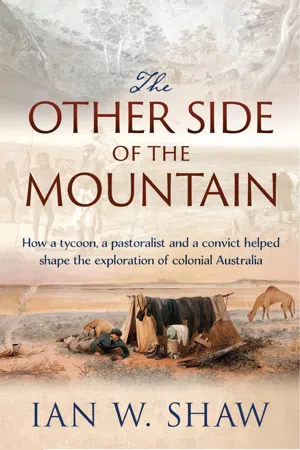
In the early 1800s the Great Australian Unknown would be slowly revealed, in part by formal government expeditions, but also by runaway convicts, little known and privately funded explorers, and pastoralists seeking both knowledge of what lay beyond and land to occupy. Through extensive research, and with engaging storytelling, The Other Side of the Mountain brings three of these men's stories together into a single enthralling narrative: Ralph Entwistle, runaway convict and bushranger who led a brief and briefly successful rebellion against the brutality of the convict system on the fringes of New South Wales' western plains; John Horrocks, an English textiles magnate who brought most of his village from the north of England to Adelaide and beyond, and who was the first to explore Australia's parched interior by camel - a decision that cost him his life; and Horace Wills, a printer, rebel, overlander, pastoralist and politician who gave up everything to push the frontier back in the far north of the continent.
While our history books recount the momentous advances made when Europeans spread across the continent, the stories of Ralph Entwistle, John Horrocks and Horace Wills are a reminder that those advances were almost always built on smaller endeavours, often made by people whose names we rarely hear today but whose impacts were often of the greatest significance.
eBook - ePub
The Other Side of the Mountain
How a Tycoon, a Pastoralist and a Convict Helped Shape the Exploration of Colonial Australia
- 256 pages
- English
- ePUB (mobile friendly)
- Available on iOS & Android
eBook - ePub
The Other Side of the Mountain
How a Tycoon, a Pastoralist and a Convict Helped Shape the Exploration of Colonial Australia
About this book
Trusted by 375,005 students
Access to over 1.5 million titles for a fair monthly price.
Study more efficiently using our study tools.
Information
A Beautiful, Fatal Bird

The push to the north-west began in earnest on Friday 22 August when John Horrocks and Samuel Gill set off to examine some small, flat-topped hills which lay about 16 miles away in that direction. They set off, armed and on horseback, shortly after breakfast and soon found that the country beyond Depot Creek was no different to that they had crossed to reach Depot Creek: low scrub, patchy grass and everywhere the tracks of kangaroos, emus and wallabies.
En route to the low hills, the men crossed several small dry creek beds, and at length came to a small lake, which was also dry. They crossed this at its neck, where the main water channel would enter it during heavy rains, and found that the sand there was exceptionally soft and treacherous in parts. They also found that the terrain changed on the far side of the lake. There, they had to cross a succession of low sand ridges rather than sand hills, all covered with a small, dry and very dusty shrub. Beyond that, the natural surface and vegetation of the plain continued as the men rode steadily north-west, keeping an eye out for either forage or water, but without success.
As the two horsemen approached the base of the largest of the flat-topped hills, they spotted two Aboriginals standing on a large patch of flat land covered by the dusty scrub. Horrocks and Gill had approached to within 400 yards of the couple before they were spotted but, when they were, both Aboriginals started to run away from them. Urging their horses into a canter, the explorers took off after the fleeing figures and were soon close enough to see that they were chasing a woman and a small child, both of whom were clearly apprehensive of the men and more so of the horses.
Reining in their horses in front of the frightened Aboriginal, both Horrocks and Gill used sign language and gestures to indicate that they were looking for water and asked the woman to show them where it could be found. When the woman turned and moved off, they followed her, riding through the scrub for around two miles until they came upon three more Aboriginal children, who fled at their approach. The woman looked as though she wanted to run off after them but, after a brief pause, she continued on in the direction she had been travelling. In a relatively short space, certainly not more than 800 yards, they found two Aboriginal men and another child.
The two men simply stood and stared at the Europeans for a moment and then started to walk towards them. As they did so, they put down the baskets they had both been carrying and picked up spears which had been lying on the ground nearby. When they were drawing close, Gill and Horrocks both motioned for the men to sit down, which they did. They dismounted and spoke to the two Aboriginal, again making signs for water.
By now, the woman and child had both disappeared somewhere in the bush, while the men spoke to Horrocks and Gill in a loud and an aggressive manner. For several minutes, neither of the Aboriginal men showed any inclination to take them to water or to even move in any direction. The Europeans tried a variety of tactics, walking over to and laughing with the Aboriginal, patting them on the back, and generally acting in what they believed was an exceedingly friendly manner. After a while, the younger of the two men stood up and began to move off. The older man followed him but was obviously reluctant to do so.
The water they had been seeking was just 30 yards away. It was in the form of a large puddle rather than a waterhole. A few inches of muddy rainwater that appeared to have drained down from the hills and was now drying up. The horses lapped it up. The Aboriginal seemed to indicate that there were waterholes in three other directions, but again showed no inclination to take the Europeans to any of them. Rather, they just stood up and watched Horrocks and Gill; they, too, were obviously scared of the European’s horses.
Horrocks then gave both the men some tobacco leaf, but it appeared to both he and Gill that they simply ate the leaf. To show them what he meant, Horrocks took another piece of tobacco, crushed it into the bowl of his pipe, and lit the pipe with his burning glass; both the Aboriginals seemed monumentally disinterested in this demonstration. In fact, both men appeared to be increasingly ill at ease. The older man started to draw back from the group, so Horrocks and Gill took their guns and pistols from their holsters, but again without exciting any interest from the Aboriginal.
The younger Aboriginal, who had a piece of red cloth tied around his head, seemed to understand the word knife but, like his older companion he, too, started to back away from the Europeans. By then, the older man was some yards distant and was both signalling and calling out loudly, presumably threatening Horrocks and Gill while calling the young man back. At this point, Horrocks fired one barrel of his gun into the air, but even that failed to generate any response from the Aboriginal.
Considering they could do no more, Gill and Horrocks both had a drink, watered their horses again, and set off back towards the southern end of the flat-topped hills they had been making for. It was a distance of about two miles and, once there, they dismounted and tied their horses together. They then climbed up the side of the hill, quite a difficult task as it was both steep and exceptionally stony.
At the top of the hill, the men used the telescope to examine the country even further out towards the north-west, as that was still where Horrocks intended to explore. To Gill, the country appeared to be a desert, “one immense space of dry, sandy country with a low, crisp scrub without the slightest sign of grass or probability of water.” Gill sketched what he could see from that vantage point while he and Horrocks discussed aloud and at length whether or not it would be possible to cross the land that lay ahead. When Gill had finished his sketch, they returned to their horses and rode back to the waterhole, where they knew there was also some grass for the horses.
Just as they reined in at the waterhole, Gill realised that he had somehow mislaid a quart pot and his compass. The two men retraced their short ride but could find no trace of either.
The Aboriginals they had spoken to earlier had by now moved well away from the waterhole and could be seen further away at the base of a low hill. To both Horrocks and Gill, they seemed to be restless rather than threatening. The men watered their horses from what was now a red brick dust coloured bog and let them graze awhile on the oaten grass before remounting and turning back in the direction of Depot Creek. They had only travelled a short distance, a couple of hundred yards at most, when they were confronted by a lone Aboriginal man carrying a fire stick. He waved the stick at them both while shouting out what both men took to be threats against them.
They then spotted, on a small hill and just 100 yards away, a small group of Aboriginals who were also shouting at them. This group were all carrying spears, and when they started running down the hill towards where Horrocks and Gill sat astride their horses, the two men took up their guns and fired, Horrocks discharging both barrels of his shot gun. The men deliberately fired short, and the three musket balls kicked up little puffs of dust where they struck.
The Aboriginals stopped at this and looked around, apparently uncertain about what had just happened. They looked closely at the ground where the musket balls had hit and moved away from it. Horrocks and Gill both reloaded their guns and then rode slowly towards the Aboriginal, who retreated back to the top of the hill, from where they yelled and laughed down at the Europeans. The horsemen stopped some 80 yards short of the hill and fired in front of the Aboriginals again, causing them to again retreat, this time back over the crest of the hill.
By now, it was quite late in the afternoon, and Horrocks in particular wanted to get clear of the area. He led the way, and the two men cantered through the scrub to a point half a dozen miles away from the hills in the direction of Depot Creek. There they stopped and camped for the night.
***
The next morning, Horrocks and Gill rose at dawn and smoked their pipes before mounting their horses and continuing on. It was still early when they set out across the plains and they recrossed the empty creek beds before they arrived back at Depot Creek around 10 a.m. in the morning. The first thing they did was eat a real breakfast. They then looked to the horses after what Gill estimated had been a 50-mile ride with very little food and only just enough water. The horses were hobbled and turned loose to graze while Horrocks and Gill had a bath, of sorts, at the spring.
During the remainder of that day, Horrocks had a number of discussions with the other members of the party and, as a result, came to a decision about what they would attempt next. In line with what he had originally planned, they would continue to use Depot Creek as a base to push further into what seemed to be the interior deserts of the colony and the continent. The next reconnaissance inland would be in the direction of a large tableland or rising country that had been noted, but not explored, by the Eyre and Darke expedition six years earlier. He estimated that the feature was approximately 80 miles distant from their current base and, once there, he would decide on what next to do, where next to go.
On this reconnaissance he would be accompanied by two of the party — Gill and Bernard Kilroy — while John Theakston would remain in charge of the base at Depot Creek. Horrocks estimated that the reconnaissance would take two weeks, but his little party would take rations sufficient for three. The men would travel on foot with their equipment and supplies being carried by the camel. Horrocks would also be looking for a permanent water supply, such as they had at Depot Creek and, if such a spot was found, he would return and they would use the drays to carry everything to what would become their new base of operations.
That day was Sunday 23 August. There was still a bit to do, but Horrocks said that he hoped to depart around the end of the week.
***
With the start of a new week, and with the first major reconnaissance in the offing, a number of significant activities started. The first was the relocation of their base camp further up Depot Creek from Eyre’s original site. For all the comfort and familiarity of that site, it was still a hundred yards or more from the spring, which was their only source of fresh water; a relatively short trip but one that was becoming increasingly tiresome. The move occupied most of the first morning and was completed to Horrocks’ satisfaction by early afternoon.
Once he had established just what the main issues to be addressed before they departed were, he made a brief site inspection, spoke to the men and then, restless as usual, he continued his own exploration of the areas around their campsite, this time heading down the Depot Creek bed and away from the others. When he returned several hours later, he told the others that he had found several tobacco plants growing some distance downstream and showed them an example of leaf he had picked. They could only speculate on how the plants came to be there.
After the new campsite was completed, and while Horrocks was off exploring on his own, the others filled in the time in their own ways. Gill was, as usual, working on his various sketches while Theakston cleaned and checked his navigational instruments. Others checked on the animals and the equipment, loaded cartridges for their various guns, prepared meals and the like.
The next morning, John Theakston and Jimmy Moorhouse took the dogs and went out hunting. Fresh meat was always welcome in the camp and, with the northern reconnaissance about to commence, it might be possible to salt or jerk some meat for them to take as ration supplements as well. Theakston’s hunting party flushed out two large kangaroos and two adult emus from the scrub, but they were unable to catch any of them as the dogs proved incapable of slowing them, let alone bringing them down. For Theakston, the failure reinforced his belief that while their greyhounds were certainly fast enough to keep up with such prey, they lacked both the weight and the strength to drag them down.
It was also another day of preparation for the expedition north, for the sorting of stores and discussions about what to take and what to leave behind. Gill finally finished a number of the sketches he had begun as they crossed the Flinders Ranges, and the others continued their work to bring this, their main base, into the most appropriate configuration they could. As their group would split in half during the expedition, certain accommodations would need to be made.
Most of the stores and equipment, for instance, had simply been left on one or other of the drays, covered by a tarpaulin and accessed when they were needed. The departure of Horrocks, Gill and Kilroy meant that one large tent would become vacant while another would have some extra space available. The men decided that the large tent would therefore be used to store everything that was currently on the drays. Not only would that keep those stores and equipment well out of the elements, it would mean they were a lot more secure should Aboriginals decide to visit the camp.
Both the elements and the Aboriginals were discussed at length that week as the weather was changing and changing quite dramatically. Daytime temperatures were now on the hot side of warm, with early hints of the summer to come. With the heat came the flies, just to add something else to the discomfort of humans and animals alike. Those flies and that heat also presumably discomfited the local Aboriginal, although that was just a guess as the Europeans had not seen any since Horrocks’ and Gill’s encounter at the little hills to the north-west. They were all convinced that there were Aboriginals somewhere in the neighbourhood; they also suspected that they were now deliberately avoiding the explorers’ camp.
John Horrocks also used the time to work with the camel, testing its capacity and endurance. After several short excursions carrying various loads and load configurations, he was convinced that Harry could easily travel 25 miles a day carrying a load of 350 pounds’ weight, with a minimum of food and water, and with the prickly desert bushes providing all t...
Table of contents
- Introduction
- The Ribbon Boys of Bathurst
- The Land Beyond the Mountains
- The Absconders
- The Battle of Grove Creek
- To the Lachlan
- The Reckoning
- Ribbon Gang Lane
- The Great Beyond
- The Horrocks of Penwortham Hall
- North
- A Camel Named Harry
- Depot Creek
- A Beautiful, Fatal Bird
- Coming Home
- The Other Side of the Mountain
- The Last Frontier
- Birthrights
- Lexington
- The Bunyip Aristocracy
- The Overlanders
- Attack and Retribution
- All Their Tomorrows
- A note on sources
- Also available from Woodslane Press
Frequently asked questions
Yes, you can cancel anytime from the Subscription tab in your account settings on the Perlego website. Your subscription will stay active until the end of your current billing period. Learn how to cancel your subscription
No, books cannot be downloaded as external files, such as PDFs, for use outside of Perlego. However, you can download books within the Perlego app for offline reading on mobile or tablet. Learn how to download books offline
Perlego offers two plans: Essential and Complete
- Essential is ideal for learners and professionals who enjoy exploring a wide range of subjects. Access the Essential Library with 800,000+ trusted titles and best-sellers across business, personal growth, and the humanities. Includes unlimited reading time and Standard Read Aloud voice.
- Complete: Perfect for advanced learners and researchers needing full, unrestricted access. Unlock 1.5M+ books across hundreds of subjects, including academic and specialized titles. The Complete Plan also includes advanced features like Premium Read Aloud and Research Assistant.
We are an online textbook subscription service, where you can get access to an entire online library for less than the price of a single book per month. With over 1.5 million books across 990+ topics, we’ve got you covered! Learn about our mission
Look out for the read-aloud symbol on your next book to see if you can listen to it. The read-aloud tool reads text aloud for you, highlighting the text as it is being read. You can pause it, speed it up and slow it down. Learn more about Read Aloud
Yes! You can use the Perlego app on both iOS and Android devices to read anytime, anywhere — even offline. Perfect for commutes or when you’re on the go.
Please note we cannot support devices running on iOS 13 and Android 7 or earlier. Learn more about using the app
Please note we cannot support devices running on iOS 13 and Android 7 or earlier. Learn more about using the app
Yes, you can access The Other Side of the Mountain by Ian W Shaw in PDF and/or ePUB format, as well as other popular books in History & Australian & Oceanian History. We have over 1.5 million books available in our catalogue for you to explore.