All farming in prehistoric Europe ultimately came from elsewhere in one way or another, unlike the growing numbers of primary centers of domestication and agricultural origins worldwide. This fact affects every aspect of our understanding of the start of farming on the continent because it means that ultimately, domesticated plants and animals came from somewhere else, and from someone else. In an area as vast as Europe, the process by which food production becomes the predominant subsistence strategy is of course highly variable, but in a sense the outcome is the same, and has the potential for addressing more large-scale questions regarding agricultural origins. Therefore, a detailed understanding of all aspects of farming in its absolute earliest form in various regions of Europe can potentially provide a new perspective on the mechanisms by which this monumental change comes to human societies and regions. In this volume, we aim to collect various perspectives regarding the earliest farming from across Europe. Methodological approaches, archaeological cultures, and geographic locations in Europe are variable, but all papers engage with the simple question: What was the earliest farming like? This volume opens a conversation about agriculture just after the transition in order to address the role incoming people, technologies, and adaptations have in secondary adoptions.
The book starts with an introduction by the editors which will serve to contextualize the theme of the volume. The broad arguments concerning the process of neolithisation are addressed, and the rationale for the volume discussed. Contributions are ordered geographically and chronologically, given the progression of the Neolithic across Europe. The editors conclude the volume with a short commentary paper regarding the theme of the volume.
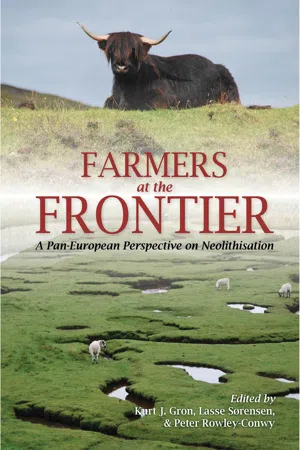
eBook - PDF
Farmers at the Frontier
A Pan European Perspective on Neolithisation
- 466 pages
- English
- PDF
- Available on iOS & Android
eBook - PDF
Farmers at the Frontier
A Pan European Perspective on Neolithisation
About this book
Trusted by 375,005 students
Access to over 1.5 million titles for a fair monthly price.
Study more efficiently using our study tools.
Information
Subtopic
Economic HistoryIndex
HistoryTable of contents
- Cover
- Book Title
- Copyright
- Table of Contents
- List of contributors
- Introduction Agricultural origins: where next? : Kurt J. Gron, Lasse Sørensen and Peter Rowley-Conwy
- 1. Growing societies: an ecological perspective on the spread of crop cultivation and animal herding in Europe : Maria Ivanova
- 2. Direct insight into dietary adaptations and the individual experience of Neolithisation: comparing subsistence, provenance and ancestry of Early Neolithic humans from the Danube Gorges c. 6200–5500 cal BC : Camille de Becdelièvre, Jelena Jovanović, Zuzana Hofmanová, Gwenaëlle Goude and Sofija Stefanović
- 3. Pioneer farming in earlier Neolithic Greece : Paul Halstead and Valasia Isaakidou
- 4. Did early farmers keep pigs? A morphometric analysis from Italy : Sofía Tecce and Umberto Albarella
- 5. First farmers in Liguria, north-western Italy: new evidence from Arene Candide and nearby sites : Peter Rowley-Conwy, Chiara Panelli, Stefano Rossi, Renato Nisbet and Roberto Maggi
- 6. First farming in the north-western Mediterranean: evidence from Castellar-Pendimoun during the sixth millennium BCE : Didier Binder, Janet Battentier, Laurent Bouby, Jacques Elie Brochier, Alain Carré, Thomas Cucchi, Claire Delhon, Cristina De Stefanis, Léa Drieu, Allowen Evin, Linus Girdland Flink, Gwenaëlle Goude, Lionel Gourichon, Sébastien Guillon, Caroline Hamon and Stéphanie Thiébault
- 7. Integrating domesticates: earliest farming experiences in the Iberian Peninsula : Maria Saña, Ferran Antolín, Roger Alcántara, Alejandro Sierra and Carlos Tornero
- 8. Early Neolithic Portuguese sheep (Ovis aries): were they shipped across the Mediterranean 8000 years ago? : Simon J. M. Davis and Teresa Simões
- 9. The discontinuous development of farming communities in the Polish lowlands, 5300–3900 BC : Peter Bogucki
- 10. Cattle-based agriculture in the Early Neolithic in the Polish lowlands: an outline : Arkadiusz Marciniak
- 11. The simple life of LBK settlers in Kuyavia? The example of site 10 in Kruszyn, Wloclawek county, Poland : Dominik Kacper Plaza and Piotr Papiernik
- 12. The first farmers on the Vistula river in the Polish lowlands : Joanna Pyzel, Aldona Mueller-Bieniek and Magdalena Mosk
- 13. Dealing with domestic animals in the fifth millennium cal BC Dutch wetlands: new insights from old Swifterbant assemblages : Canan Çakırlar, Rianne Breider, Francis Koolstra, Kim M. Cohen and Daan C.M. Raemaekers
- 14. Biased data or hard facts? Interpretations of the earliest evidence of agrarian activity in southern Scandinavia from 6000 to 4000 cal BC in a theoretical discourse on random down-the-line exchanges and structured migrations : Lasse Sørensen
- 15. The Early Neolithic frontier farming of southern Scandinavia : Kurt J. Gron
- 16. Low-level agriculture in Neolithic western Norway : Knut Andreas Bergsvik, Kari Loe Hjelle, Lene Synnøve Halvorsen, Asle Bruen Olsen and Camilla Zinsli
- 17. Culture and context of the Scandinavian Neolithic : Håkon Glørstad, Steinar Solheim and Per Persson : Håkon Glørstad, Steinar Solheim and Per Persson
- 18. Interpreting complex diachronic ‘Neolithic’-period data in Norway : Christopher Prescott
- 19. The earliest farming in Britain: towards a new synthesis : Peter Rowley-Conwy, Kurt J. Gron, Rosie R. Bishop, Julie Dunne, Richard Evershed, Catherine Longford, Rick Schulting and Edward Treasure
- 20. Exploring the ‘somewhere’ and ‘someone’ else: an integrated approach to Ireland’s earliest farming practice : Jessica Smyth, Meriel McClatchie and Graeme Warren
- Conclusion The Early Neolithic origins of agriculture : Kurt J. Gron, Lasse Sørensen and Peter Rowley-Conwy
- Back Cover
Frequently asked questions
Yes, you can cancel anytime from the Subscription tab in your account settings on the Perlego website. Your subscription will stay active until the end of your current billing period. Learn how to cancel your subscription
No, books cannot be downloaded as external files, such as PDFs, for use outside of Perlego. However, you can download books within the Perlego app for offline reading on mobile or tablet. Learn how to download books offline
Perlego offers two plans: Essential and Complete
- Essential is ideal for learners and professionals who enjoy exploring a wide range of subjects. Access the Essential Library with 800,000+ trusted titles and best-sellers across business, personal growth, and the humanities. Includes unlimited reading time and Standard Read Aloud voice.
- Complete: Perfect for advanced learners and researchers needing full, unrestricted access. Unlock 1.5M+ books across hundreds of subjects, including academic and specialized titles. The Complete Plan also includes advanced features like Premium Read Aloud and Research Assistant.
We are an online textbook subscription service, where you can get access to an entire online library for less than the price of a single book per month. With over 1.5 million books across 990+ topics, we’ve got you covered! Learn about our mission
Look out for the read-aloud symbol on your next book to see if you can listen to it. The read-aloud tool reads text aloud for you, highlighting the text as it is being read. You can pause it, speed it up and slow it down. Learn more about Read Aloud
Yes! You can use the Perlego app on both iOS and Android devices to read anytime, anywhere — even offline. Perfect for commutes or when you’re on the go.
Please note we cannot support devices running on iOS 13 and Android 7 or earlier. Learn more about using the app
Please note we cannot support devices running on iOS 13 and Android 7 or earlier. Learn more about using the app
Yes, you can access Farmers at the Frontier by Kurt J Gron, Lasse Sørensen, Peter Rowley-Conwy, Kurt J Gron,Lasse Sorensen,Peter Rowley-Conwy, Kurt J Gron, Lasse Sorensen, Peter Rowley-Conwy in PDF and/or ePUB format, as well as other popular books in History & Economic History. We have over 1.5 million books available in our catalogue for you to explore.