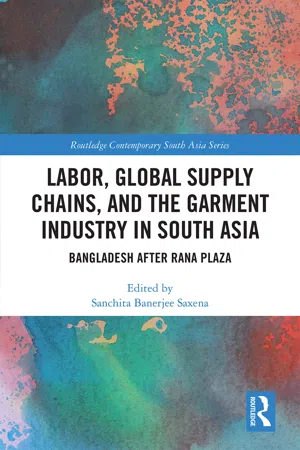
This book argues that larger flaws in the global supply chain must first be addressed to change the way business is conducted to prevent factory owners from taking deadly risks to meet clients' demands in the garment industry in Bangladesh.
Using the 2013 Rana Plaza disaster as a departure point, and to prevent such tragedies from occurring in the future, this book presents an interdisciplinary analysis to address the disaster which resulted in a radical change in the functioning of the garment industry. The chapters present innovative ways of thinking about solutions that go beyond third-party monitoring. They open up possibilities for a renewed engagement of international brands and buyers within the garment sector, a focus on direct worker empowerment using technology, the role of community-based movements, developing a model of change through enforceable contracts combined with workers movements, and a more productive and influential role for both factory owners and the government. This book makes key interventions and rethinks the approaches that have been taken until now and proposes suggestions for the way forward. It engages with international brands, the private sector, and civil society to strategize about the future of the industry and for those who depend on it for their livelihood.
A much-needed review and evaluation of the many initiatives that have been set up in Bangladesh in the wake of Rana Plaza, this book is a valuable addition to academics in the fields of development studies, gender and women's studies, human rights, poverty and practice, political science, economics, sociology, anthropology, and South Asian studies.
Trusted by 375,005 students
Access to over 1.5 million titles for a fair monthly price.
How do we understand the Rana Plaza disaster and what needs to be done to prevent future tragedies
Sanchita Banerjee Saxena
Sector background
The export garment manufacturing sector in Bangladesh began in the late 1970s following the establishment of the Multi-Fibre Arrangement (MFA) in 1974. The MFA, though it was only supposed to be a temporary measure, was in effect for 20 years, until 1994. This arrangement restricted garment and textile imports to the United States, Canada, and the European Union by allocating quotas to countries throughout the developing world (Saxena 2014). Bangladesh’s industry began with fewer than 12 garment firms; by 1985, there were 450 independent companies; and by 2015, close to 7,000 firms and subcontractors (Labowitz and Baumann-Pauly 2015). By the 1990s, women accounted for more than 90% of the almost four million workers, and by 2016, garment exports accounted for 82% of the country’s total exports. Today, the industry employs 5.1 million people (Ali 2006, Khan 2009, Saxena 2007, Winterbottom et al. 2017).
Foreign buyers looked to Bangladesh as a source of cheap labor, and thus, readymade garments became the country’s main export in a short time. The focus on “CM” (cut and make) orders and a strategy of producing basic garments (e.g. T-shirts) quickly made Bangladesh South Asia’s “success” story (Saxena 2014). This success came in many forms: increased gross domestic product, improved development opportunities, and women’s empowerment (Chapter 2, this volume).
The economic achievement in Bangladesh, however, also came with a very real price, one that resulted in an industry where low-cost garments are made in hazardous conditions with low wages in unregulated factories by workers whose physical and mental health is tested on a daily basis. Thus, in order to maximize profits, in effect, Western brands not only outsourced production, but also outsourced labor exploitation and environmental degradation in order to ensure that prices would remain so low.1 And Bangladesh was not new to disasters due to unsafe factories. More than 500 workers died between 2005 and 2012 in fires and building collapses in factories throughout the country (Bair et al. 2017).
Rana Plaza disaster
April 24, 2013 will be known as the day of the deadliest garment factory accident in history. More than 1,125 people died and 2,000 were injured when an eight-story building in the outskirts of the capital of Bangladesh, Rana Plaza, collapsed. The building, which was originally built as a shopping complex, was not meant to serve as a garment factory filled to capacity with more than 3,000 workers and their machines. Four stories had been added to the building without proper permits or documentation. According to Shakya (2013), the Dhaka building safety agency, the entity that is authorized to issue construction permits, simply could not keep up with the explosive growth of the industry over the last few decades. Large cracks in the building had appeared the day before the disaster, and other than the garment factory, all other parts of the building were closed that day. When garment workers pointed out the cracks to their supervisors, they were reprimanded and told to go back to work; otherwise, they would lose their jobs. This speaks to a much deeper and broader issue about the necessity of enabling workers’ rights that goes far beyond discussions about building inspections; this will be discussed later in the chapter.
It is hard to describe the effects of the tragedy on the families and communities in Bangladesh. In addition to the horrific loss of life, many families lost their primary wage earner. For those who survived, the disaster led to both short-term and long-term physical and psychological disabilities. More than five years later, the recovery process for many of these survivors has been very difficult and lengthy.
The necessity of third-party monitoring
In the aftermath of the tragedy, according to Stein (2016), a variety of public and private actors made funding commitments to improve Bangladesh’s garment sector in the form of loans to factories for safety improvements, grants to nongovernmental organizations and the International Labour Organization (ILO) for worker and management training programs, a trust fund for victims of the Rana Plaza collapse and their families, and more.2
In addition, Western companies invested in two organizations designed to strictly monitor and inspect a portion of Bangladesh’s registered factories.3 The Accord for Fire and Building Safety (Accord) is an agreement between global unions and over 180 retailers and brands from 20 countries in Europe, North America, Asia, and Australia. The Accord is a legally binding agreement where all those signed agree to arbitration or enforcement of fees can be pursued in their national legal system. Companies commit to sourcing and maintaining purchasing volumes in Bangladesh for five years. The Alliance for Bangladesh Worker Safety (Alliance) is an agreement of 28 mainly US-based retailers. It is similar to the Accord in its mandate, but the agreement is not legally binding nor are labor groups or unions a part of the Alliance.4
This move by Western brands has been touted as unprecedented and innovative, and while these organizations have made some important progress,5 for example in the areas of factory safety (Anner 2018, Schüßler et al. 2018), this volume challenges this predominant narrative by arguing that these plans are not really a departure from what has been tried in the past. Historically, there have been many attempts to ensure labor rights in the global supply chain. Locke (2013) highlights several of these including social clauses within trade agreements, ILO and United Nations (UN) decent work conventions, transnational nongovernmental organizations (NGOs), global corporations and industry associations, and multi-stakeholder initiatives (p. 11).6 He describes the trajectory of compliance initiatives; earlier, the focus was completely on enforcement and policing through upholding codes of conduct. These later developed into capability and capacity building programs designed to provide technical assistance to factories to make the much-needed improvements. The role of the third-party monitor has also changed from that of inspector to one of a consultant who works in collaboration with the factories in question (Locke 2013, p. 174–175).
Chaumtoli Huq argues, in her chapter, that while the Accord and Alliance agreements were historic in the sense that there had not been a unified effort by global brands to address safety issues in the global garment industry until after Rana Plaza,7 they were not a radical departure from the existing framework of corporate social responsibility programs by global brands of the past. While perhaps the Accord stands out as a new development in that it is a binding agreement between global brands, unions, and NGOs, it is still limited by its sole focus on factory inspections. The Accord and Alliance also do not cover all of the factories that produce garments in Bangladesh.
Many of the studies analyzing labor rights argue that there is a need for third-party accountability in order to push factories toward compliance with standards because countries in the Global South lack strong institutions and have high levels of corruption and instability which makes it difficult for internal actors to enforce regulation (Ruggie 2003, Nadvi and Waltring 2004, Vogel 2008, Belal et al. 2015, Rubenstein 2007). Workers and civil society are often seen as lacking in significant power to be able to pressurize owners or the state to enforce the right policies. The reality is that lead firms typically prefer to move production to countries with weak government regulation, which allows them to impose their own standards, codes of conduct, and auditing practices; thus, they play a paradoxical role – on the one hand trying to substitute for limited government capacity, while on the other, seeking out locations where precisely capacity is limited and prices are kept extremely low.
Against this context, surrogate account holders are seen as better equipped to pressurize power wielders to do what is “right” in terms of labor improvements (Rubenstein 2007). Surrogates can take the form of supranational bodies, civil society organizations, or partnerships among corporations. Both the Accord and, to a lesser extent, the Alliance were designed to serve this role (Sinkovics 2016, Reinecke and Donaghey 2015). Both these initiatives focus on the corporation as the “solution” to improving labor conditions; Chaumtoli Huq will discuss this in more detail in Chapter 4.
Critiques to this third-party monitoring model8
As the above snapshot demonstrates, the Accord and Alliance, while perhaps well intentioned, have not met their intended goals, even by their own standards. While 85%–88% of factories have fixed the individual safety problems, a very small percentage has completed the entire remediation process successfully. Both these plans address a narrowly defined universe of factories with a very small subset of safety issues (Table 1.1).
There are several notable flaws with the third-party monitoring model. First, this book argues that the singular emphasis by Western retailers on monitoring and compliance has neglected the larger issues around the entire global supply chain. There has been very little discussion around the indirect sourcing model prevalent in Bangladesh which results in the most compliant factories depending heavily on subcontractors as a part of their regular business practice to increase margins and boost production while keeping costs low. Because subcontractors fall out of the purview of monitoring and inspection, as Saxena and Baumann-Pauly demonstrate in their chapter, this complex system makes it relatively easy for Western brands to turn a blind eye to the potentially dangerous activities that their “compliant” direct suppliers may be engaging in.
According to empirical research conducted by the New York University (NYU) Stern School of Business, Center for Business and Human Rights, the garment production involves more than twice as many facilities than brands and retailers currently monitor directly.9 While many brands are adamant about their “zero tolerance policy” for unauthorized subcontracting, the policy is largely ineffective in practice. Bangladeshi manufacturers openly discuss the extensive network of small, less compliant factories and how they play an important role in meeting the demands of the larger factories that maintain the primary relationships with Western buyers.10 Their chapter explains how current business models of brands and retailers set incentives for the development of elaborate production networks in Bangladesh and how, thanks to these networks, the garment business has remained profitable post-Rana Plaza, despite fierce international competition, labor law reforms, and political blockages. The authors argue that unless business models change and all factories in Bangladesh are brought under a monitoring system that upgrades the entire sector, a large portion of the garment workers in Bangladesh will remain unsafe and other tragedies that cost workers’ lives cannot be excluded. The presences of this large informal sector also means new ways of thinking about improvements in the industry that go beyond traditional approaches. Tewari (this volume), for example, writes about the necessity of local initiatives that improve labor rights from the bottom-up:
Table 1.1 Snapshot of the garment industry (March 2017)a
The state can be the actor that can bring continuity by holding open the space for new organizational partnerships to emerge even as private supply chains and markets shift. This is especially important in countries and contexts where 90% of the total employment is in the informal sector, outside the reach of both labor laws as well as the monitoring protocols and codes of conduct of buyers and private companies.
Tied in with this, focusing only on monitoring factories as a solution to prevent future disasters does not address the extreme pressures suppliers face from brands to produce large quantities, at the lowest price and in the shortest time possible. Anner (2018) finds that since Rana Plaza, the price paid to Bangladeshi supplier factories has declined by 13%. On average, lead times declined by 8.14% between 2011 and 2015, as workers are constantly pushed by lead factories to produce their products quicker and faster; this is fueled by the desire for “fast fashion” in the United States and Europe leading to increased profit margins for global brands. Real wages have also dropped by 6.47% since the wage increase of December 2013. Schüßler et al. (2018) also write, “…some labour rights abuses, such as forced overtime, low wages, and verbal abuse remain entrenched in garment factories, reflecting an unchanged business model in the industry.” The constant threat by brands to source elsewhere leads factory owners to accept these impossible conditions in order to maintain their business. Thus, the extreme competition and insecurity around future work creates a perverse incentive structure and an environment of taking risks, even for factories that may have passed all the inspections (Piore 1997, Saxena 2014, Gearheart 2016).
Locke (2013) argues that compliance programs do little to change the root causes of poor working conditions. Many of the problems faced in global supply chains cannot simply be attributed to unethical factory managers in need of capacity building, auditing, or policing. Much of it is due to the pressures and policies that have been put in place by global brands to ...
Table of contents
Cover
Half Title
Title Page
Copyright Page
Dedication
Table of Contents
List of figures
List of tables
List of contributors
Preface
Acknowledgements
List of abbreviations
1 Introduction: how do we understand the Rana Plaza disaster and what needs to be done to prevent future tragedies
PART I Leading to the disaster
PART II Dealing with the aftermath
PART III Rethinking solutions in Bangladesh
PART IV Rethinking solutions: from an international perspective
PART V A way forward
Index
Frequently asked questions
Yes, you can cancel anytime from the Subscription tab in your account settings on the Perlego website. Your subscription will stay active until the end of your current billing period. Learn how to cancel your subscription
No, books cannot be downloaded as external files, such as PDFs, for use outside of Perlego. However, you can download books within the Perlego app for offline reading on mobile or tablet. Learn how to download books offline
Perlego offers two plans: Essential and Complete
Essential is ideal for learners and professionals who enjoy exploring a wide range of subjects. Access the Essential Library with 800,000+ trusted titles and best-sellers across business, personal growth, and the humanities. Includes unlimited reading time and Standard Read Aloud voice.
Complete: Perfect for advanced learners and researchers needing full, unrestricted access. Unlock 1.5M+ books across hundreds of subjects, including academic and specialized titles. The Complete Plan also includes advanced features like Premium Read Aloud and Research Assistant.
Both plans are available with monthly, semester, or annual billing cycles.
We are an online textbook subscription service, where you can get access to an entire online library for less than the price of a single book per month. With over 1.5 million books across 990+ topics, we’ve got you covered! Learn about our mission
Look out for the read-aloud symbol on your next book to see if you can listen to it. The read-aloud tool reads text aloud for you, highlighting the text as it is being read. You can pause it, speed it up and slow it down. Learn more about Read Aloud
Yes! You can use the Perlego app on both iOS and Android devices to read anytime, anywhere — even offline. Perfect for commutes or when you’re on the go. Please note we cannot support devices running on iOS 13 and Android 7 or earlier. Learn more about using the app
Yes, you can access Labor, Global Supply Chains, and the Garment Industry in South Asia by Sanchita Saxena, Sanchita Banerjee Saxena,Sanchita Saxena, Sanchita Banerjee Saxena in PDF and/or ePUB format, as well as other popular books in Business & Fashion & Textile Industry. We have over 1.5 million books available in our catalogue for you to explore.