This book presents original studies of how a cultural concept of Jewishness and a coherent Jewish history came to make sense in the experiences of people entangled in different historical situations. Instead of searching for the inconsistencies, discontinuities, or ruptures of dominant grand historical narratives of Jewish cultural history, this book unfolds situations and events, where Jewishness and a coherent Jewish history became useful, meaningful, and acted upon as a site of causal explanations. Inspired by classical American pragmatism and more recent French pragmatism, we present a new perspective on Jewish cultural history in which the experiences, problems, and actions of people are at the center of reconstructions of historical causalities and projections of future horizons. The book shows how boundaries between Jewish and non-Jewish are not a priori given but are instead repeatedly experienced in a variety of situations and then acted upon as matters of facts. In different ways and on different scales, these studies show how people's experiences of Jewishness perpetually probe, test, and shape the boundaries between what is Jewish and non-Jewish, and that these boundaries shape the spatiotemporal linkages that we call history.
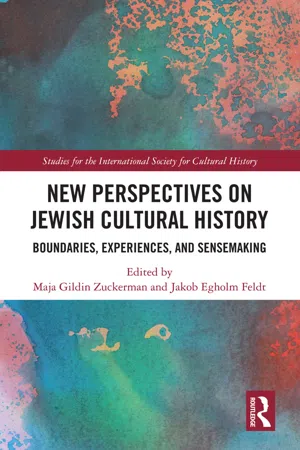
eBook - ePub
New Perspectives on Jewish Cultural History
Boundaries, Experiences, and Sensemaking
- 226 pages
- English
- ePUB (mobile friendly)
- Available on iOS & Android
eBook - ePub
New Perspectives on Jewish Cultural History
Boundaries, Experiences, and Sensemaking
1
Experience, Space, and Time in Jewish Cultural History
A Pragmatist Perspective
Ten years ago, historian Moshe Rosman asked, What is Jewish in Jewish history? This is a question that, in different forms, has been posed and examined again and again in Jewish historiography.1 Rosman asked this question against the backdrop of what he described as a postmodern era of historiography in general and Jewish historiography in particular. The moment, he argued, begged a fundamental question: Could there still be said to exist “a recognizable object for the subject of Jewish studies to study? If nothing can be defined objectively, how can we identify a unitary, continuous, coherent Jewish People with a distinct culture and history?”2
The question that Rosman and other scholars have been grappling with is, in other words, whether it is still possible, valid, and relevant to identify something specifically Jewish within an academic discourse that is increasingly concerned with polyphonic, decentralized, and deconstructed narratives of social groups and cultural identities. In the specific context of cultural history, can we still in any legitimate and convincing way treat a multicultural, multifarious, multi-temporal, multi-sited, and even multi-ontological subject like Jews and Jewishness as a single object of study? If so, how should we approach this troublesome actor that, through various times and places, has behaved like a tribal sect, a global religion, a territorial nation-state, a loosely tied group of diasporic intellectuals, a minority movement, and as insistently nonaffiliated, non-Jewish Jews? And more to the point, what is gained by such an approach?
In the following, we will describe our approach to the central question that guides this book: How is Jewish cultural history continuously recreated in space and time, despite the multitudes of historical and social contingencies that constantly twist and deform the boundaries of what Jewishness is? We offer a perspective that we argue has relevance not only for Jewish history but also for historical research in general. Fundamentally, we want to make a radical break from one of the core tenets of modern historical research: that the past is a different ‘country,’ one that is now inaccessible to us as it really was because it is different, done, and gone. Instead, the past is encoded in this very ‘country,’ which we could call the present.3 This perspective of a barrier between the past and the present has been equally important to both traditional historians, who deal with it via methodology, such as source criticism, and postmodernists, who deal with it via theories inspired by semiotics and linguistics. The barrier reproduces generations of the same questions, just set out in different vocabularies. That being said, it is important for us to clarify that we do not mean that all historical work created prior to today should go into the bin. Quite the opposite. Historiography is inseparable from the formation of history.
We will do away with the barrier between past and present with a rather banal and pragmatic turn: the past is in and of the present. Our pasts are part of the problems of our presents. We continuously recreate the trajectories of our inheritance. It simply does not make sense to talk about a barrier between the past and the present since all sources, remains, ruins, and artifacts exist and are dealt with in a present—and with this particular present’s conceptions, expectations, tools, and vocabularies. In our view, doing away with this barrier enhances the significance of the past for the present and for the future, and it gives us the opportunity to skip beyond the dichotomies of social construction, such as reality vs. representation, real vs. construction, and experience vs. discourse.4
To renew the question posed by Rosman and many others about what Jewish history is, we need to reach beyond the inherent dichotomy within it: objectivity, on the one hand, and instability, on the other. It is crucial that we consider questions of how temporality works in making sense of human experiences and interpretations of past presents, so that we can understand how Jewish cultural history is continuously recreated as a meaningful entity or object. First of all, we need to take more seriously what all historians already know—namely, that the past is unstable despite its doneness. New events and experiences in present moments change the order, meaning, and causal implications of the past all the time.5 Accordingly, the past is a process of reconstruction of spatiotemporal trajectories that provide meaning, logic, laws, causalities, and grounds for actions, which shape the future for people.
In the following pages, we employ concepts such as experience, topology, and boundaries in order to bridge notions of change and stability, as well as contingency and structure. These concepts, we believe, point to the processual character of how we make sense of a possible future with regard to what happens and what has happened. Experiences of Jewishness perpetually probe, test, and shape the boundaries between what’s Jewish and what’s non-Jewish, and these boundaries shape spatiotemporal linkages that we call topologies.6 By topology, then, we mean shapes that uphold their central properties under deformation, an issue to which we will return ahead.
Pragmatist History
We follow what we will call a pragmatist approach to Jewish history, and history in general, which aspires to identify experiences and events in which Jewish differences and similarities came into play and were acted upon as matters of fact. Thus, the contributions in this book set out to show how Jewish cultural history is a continuous process of the becoming of Jewish trajectories—that is, how experiences with Jewishness have shaped Jewish spatialities, temporal trajectories, and future horizons. Jewishness is then continuously both how and what it becomes. Some, such as archaeologist Michael Shanks, call pragmatist history “pragmatology,” meaning the study of people and things, including acts, encounters, contingencies, and beliefs involved with acting in and engaging with the world.7 Engaging with the world is both practical and imaginative.
Sociologist Andrew Abbott characterizes such an approach as a search for the boundary-making processes which make things “entities” which can be seen as inhabiting certain spatio-temporalities or topologies.8 Studying engagement with the material and social world—and how such engagements shape historical topologies—is fundamentally an actor-and event-centered approach to history. History comes after the events. Individual actors inhabit and experience the historical world in multiple “presents,” which have different pasts and futures than our own as historians. Rather than seeking to define the issues that have held Jews and Jewishness together in cultural history, we explore encounters of boundaries that, for the actors in question, emphasized the distinctions between Jewishness and non-Jewishness, or differentiated between various forms of Jewishness.
The pragmatist perspective on Jewish cultural history seeks to explore how truth happens in specific times and places. In pragmatist philosopher William James’s own words, “Truth happens to an idea. It becomes true, is made true by events. Its verity is in fact an event, a process: the process namely of its verifying itself, its veri-fication. Its validity is the process of its valid-ation.”9 This is a fundamentally processual approach to understanding how people validate, corroborate, and enact things that they come to experience as true.10 Such an approach seeks constantly to explore how things become real and authentic by looking at the practical effects that lead people to certainty, or at least some form of verification. Truth and meaning are concepts that in a pragmatist perspective work as construction tools. They work for the purposes of action, of addressing problems, and of dealing with life’s potentially endless uncertainties. In this way, truth, meaningfulness, and purpose can be considered valuable and marketable items. They are exchanged and shared, and often, they reshape previously held beliefs as they are incorporated and rearticulated through a new vocabulary. Some ideas will prove to work better than others when related to experiences people actually have.
Thus, rather than presupposing that we know who the Jews were, when they acted Jewish, or enacted their Jewishness—assumptions that are all based on preconceived notions of stable borders between what’s Jewish and what’s non-Jewish—a pragmatist position aims to trace accounts of how Jewishness became true in the eyes and minds of the actors involved. This is not, however, only a phenomenological question of perception and different life worlds where we bracket out any notion of material and objective reality. Pragmatism often operates with an ear to the interplay between truth and reality: reality exists despite our individual and social truth claims, yet the process of making sense of reality is where radical variations of understandings manifest themselves. It is crucial in any pragmatist study, then, to focus on the sensemaking process of how people see and experience the reality that they are facing; such a study should center on the practices that turn experiences into truths. Accordingly, we consider “human experience” a “firstness” and starting point of history, which is a process of making sense of what happens, what has happened, and what will happen. Experiences of the factuality and truth of Zionism, which figure prominently in several chapters of this book, were paramount to people across Europe, the Middle East, and America early in the twentieth century, and these experiences were acted upon as reconstruction processes of temporal trajectories. Such reconstructions were both micro-historical as individual biographies and macro-historical as science.
The chapters in this book all emphasize how actors experienced Jewishness, encountered boundaries and controversies of Jewishness, and reconstructed Jewish historical topologies on different but related scales. Each of them experienced events after which the future and the past looked different, and the difference, newness, and change that they encountered were—despite their often revolutionary character—reconstructions which upheld a connected Jewish historical topology.
Rethinking Jewish Cultural History
Many discussions within cultural history since the late 1980s have revolved around questions of monolithic, essentialized vs. polyphonic, deconstructed cultural perceptions, as Rosman also elaborates on in his book. From different strands, scholars have tried to rearticulate an approach to culture and cultural identities that redirects these studies away from what they saw as a position that was overly concerned with stasis, uniformity, sedentarism, and elitist expressions and worldviews. It has now become an almost truistic assumption to see culture as an unbound, partial, and constantly emerging process that both undergirds and suppresses ephemeral community unity. As historian Stephen Greenblatt notes,
Notions of wholeness, teleological development, evolutionary progress, and ethnic authenticity were said to have been dismantled forever…. [M]ost scholars energetically grappled with brave new theories of hybridity, network theory, and the complex “flows” of people, goods, money, and information across endlessly shifting social landscapes.11
In other words, the study of culture and cultural identity has crystallized into a paradigm that conceives of its objects as always hybrid, and always emerging.
Another paradigmatic move away from monolithic cultural perceptions has emerged through the framework of multiculturalism. In general terms, this perspective rests on an assumption that culture changes over time and place. Thus, rather than understanding Jewish culture as a singular entity spread around the globe through the ages, we should understand it as a multifarious phenomenon. This perspective foregrounds studies of diverse and distinct Jewish cultures—in plural—that each need to be understood on their own terms and not as a subgroup of a generic sense of Jewish culture. Sociologist Jeffrey Alexander suggests that the concept of multiculturalism today “appears ineluc...
Table of contents
- Cover
- Half Title
- Series Page
- Title
- Copyright
- Contents
- List of Figures
- Preface
- 1 Experience, Space, and Time in Jewish Cultural History: A Pragmatist Perspective
- 2 En Route to Palestine: Jewish Mobility and Zionist Emergence
- 3 The Death of the Renegade: On Jewish Experience in the Twentieth Century
- 4 Tropical Territorialism: Displaced Persons, Colonialism, and the Freeland League in Suriname (1946–1948)
- 5 Autoethnographic Cosmopolitanism: Jewish Travel Writers Among Their Coreligionists
- 6 The Presence of Past Struggles: The Jews and the Boundaries of Enlightenment
- 7 “It Is Hellas and Israel to Which Europe Owes Its Culture”: Georg Brandes and His Athens vs. Jerusalem Reinterpretations
- 8 From Jewish Separateness to Jewish and Non-Jewish Entanglement: A Shift to a “New Jewish History”?
- 9 To Walk in the Footsteps of Your Ancestors: Roots Tourism in Yiddishland
- Notes on Contributors
- Index
Frequently asked questions
Yes, you can cancel anytime from the Subscription tab in your account settings on the Perlego website. Your subscription will stay active until the end of your current billing period. Learn how to cancel your subscription
No, books cannot be downloaded as external files, such as PDFs, for use outside of Perlego. However, you can download books within the Perlego app for offline reading on mobile or tablet. Learn how to download books offline
Perlego offers two plans: Essential and Complete
- Essential is ideal for learners and professionals who enjoy exploring a wide range of subjects. Access the Essential Library with 800,000+ trusted titles and best-sellers across business, personal growth, and the humanities. Includes unlimited reading time and Standard Read Aloud voice.
- Complete: Perfect for advanced learners and researchers needing full, unrestricted access. Unlock 1.5M+ books across hundreds of subjects, including academic and specialized titles. The Complete Plan also includes advanced features like Premium Read Aloud and Research Assistant.
We are an online textbook subscription service, where you can get access to an entire online library for less than the price of a single book per month. With over 1.5 million books across 990+ topics, we’ve got you covered! Learn about our mission
Look out for the read-aloud symbol on your next book to see if you can listen to it. The read-aloud tool reads text aloud for you, highlighting the text as it is being read. You can pause it, speed it up and slow it down. Learn more about Read Aloud
Yes! You can use the Perlego app on both iOS and Android devices to read anytime, anywhere — even offline. Perfect for commutes or when you’re on the go.
Please note we cannot support devices running on iOS 13 and Android 7 or earlier. Learn more about using the app
Please note we cannot support devices running on iOS 13 and Android 7 or earlier. Learn more about using the app
Yes, you can access New Perspectives on Jewish Cultural History by Maja Gildin Zuckerman, Jakob Egholm Feldt, Maja Gildin Zuckerman,Jakob Egholm Feldt in PDF and/or ePUB format, as well as other popular books in History & World History. We have over 1.5 million books available in our catalogue for you to explore.