Cities, Railways, Modernities chronicles the transformation that London and Paris experienced during the nineteenth century through the lens of the London Underground and the Paris Métro. By highlighting the multiple ways in which the future of the two cities was imagined and the role that railways played in that process, it challenges and refines two of the most dominant myths of urban modernity: A planned Paris and an unplanned London. The book recovers a significant body of work around the ideas, the plans, the context and the building of metropolitan railways in the two cities to provide new insights into the relationship of transport technologies and urban change during the nineteenth century.
eBook - ePub
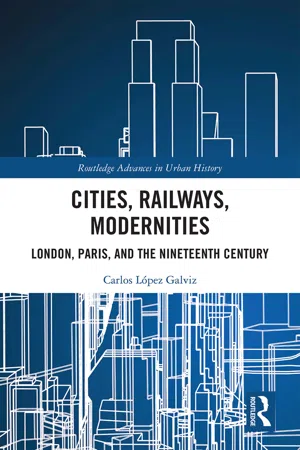
Cities, Railways, Modernities
London, Paris, and the Nineteenth Century
- 294 pages
- English
- ePUB (mobile friendly)
- Available on iOS & Android
eBook - ePub
About this book
Trusted by 375,005 students
Access to over 1.5 million titles for a fair monthly price.
Study more efficiently using our study tools.
Information
1 Past Futures
In the sequel to Alice’s Adventures in Wonderland (1865), Through the Looking-Glass, and What Alice Found There (1871), Lewis Carroll showed us the limits as well as the possibilities of mirroring worlds. In it, Alice steps through a mirror to discover a unique reflection of her own world, filled with new characters, notable among them the White Queen, who remembers future events. The mirror and the White Queen resonate with the reflection that I propose in this book. Images of the future of London and Paris – and cities worldwide, for that matter – function like mirrors: They project worlds, which are both a distortion and a promise of realities that are yet to come. This is a process that is as compelling today as it was over 150 years ago and before, and as it will be 10, 50 and 200 years into the future.
By chronicling the transformation that London and Paris experienced during the nineteenth century through the lens of urban transport infrastructure, Cities, Railways, Modernities highlights the ways in which the future of the two cities was imagined and the role that railways played in that process. In doing so, it challenges and refines two of the most dominant myths of urban modernity: A planned Paris and an unplanned London. The debates, plans and decisions that are examined throughout the book reveal London’s inroads towards coordination and a view of the whole, both of which are comparable with how change was effected in Paris during the second half of the nineteenth century. Conversely, they contrast the reality of modern Paris with visions that were far more ambitious and far more comprehensive than the legacy of wide boulevards and monumental vistas, as conceived by Napoléon III and his Prefect, Georges-Eugène Haussmann.
Cities, Railways, Modernities argues that when seen through the encounter between railways and the dynamics of growth, governance and change that have been intrinsic to the two cities throughout their history the transformation of London and Paris between c.1830 and 1910 looks different. It demonstrates that continuities mattered significantly more than the celebratory accounts of the Metropolitan Railway in London and the Métropolitain in Paris would have us believe, insisting as they did – and, indeed, still do – on the unprecedented, the new, the pioneering, the modern. Important changes did take place as a result of railway planning and building, of course. Railways became urban in cities, which meant, for example, considering taking trains beneath streets connecting to food markets, the post office and port facilities. At the same time, London and Paris expanded along railway lines that blurred the distinction between local, urban, suburban and regional traffic, which, in turn, opened up the country to (sub)urban residents. Ever since the building of their termini on the edges of the city centre, railways in London and Paris were perceived as one of the means of solving problems that were characteristically urban: Severe street congestion; overcrowding; sanitation that called for the opening of new and broader channels for the circulation of air, sun, water, waste, information (think of the telegraph), goods, people and even time pulses (‘pumped’ through pneumatic tubes). These are themes well known to and studied in great detail by historians.1 Equally important was innovation, exemplified by the application of technologies that would allow the operation of new means of transport by digging deeper into the city’s soil, not only adding layers but also containing and expanding the two capitals’ extension sideways; above streets; and, crucially, beneath them.
Charting the collaborations, disputes and disagreements among private railway companies, institutions such as the City of London; the Metropolitan Board of Works; the London County Council; and, in the case of Paris, the Seine Prefect, the ministries, the corps of engineers and the national and municipal authorities, the book shows the various ways in which the imagining of future London and future Paris was implicated in a range of debates: From street improvements to enlarging food markets through to slum clearances; social reform induced by the ideal of suburban living; the possibilities but also the limitations of electricity; and, in the specific case of Paris, the coordinated redistribution of tax-collection points along the city walls. Something that was often called the ‘public benefit’ was central to each and every one of these debates. To paraphrase Gerard de Vries, in the context of railways, London, Paris and the nineteenth century, the public benefit was ‘neither an ideal to be realized, nor a set of preferences people ha[d] in mind when entering the political arena’.2 It was first and foremost praxis: Contingent, unintended, provisional, a vehicle between a past that seemed outdated and a future that was both promising and uncertain.
The vast number of plans for the future of the two cities encapsulated an idea in and of progress, aspects of which were implemented, transforming the spaces, the politics and the technologies of transport that would be made available to Londoners and Parisians. The plans became central to modernising the two cities in a way that resembles the plans that are expected to guide their futures today. The tunnelling of Crossrail in London was complete in 2015, with passenger services being introduced gradually from 2018. The métro automatique Grand Paris Express is one of the key features of the visions of future Paris in the new incarnation of a long-standing tradition of grands travaux publics that features emperors, kings and the presidents of five republics. This was the launch, in 2007, of the ‘Grand Paris’ by former president Nicolas Sarkozy. London is building a line rather than a system, yet again. A system is being developed, somehow and who knows for how long, in Paris. In both cases, the public benefit is at the centre of how the two cities will be transformed: Providing some relief to overcrowded trains and cutting travelling times between the City and Heathrow by one-third in London, and striking a balance between Parisians and Franciliens (from the Île de France) at a time when divisions in French politics cut across cities and regions.
The pursuit of the public benefit was neither deliberate nor conscious in the nineteenth century. Nor was there a clear idea of what the public benefit was or how best to articulate it. There were related concepts whose meaning, definition and precise relationship to how the two cities should be transformed depended upon whose interests were represented and what degree of influence each was able to exert. On the other hand, the several attempts to define the public benefit faced similar difficulties in the two cities, particularly when the issue of representation was at stake. Whose futures the visions of the London and Paris plans incorporated and which publics they represented are but two of the main questions guiding this book.
The range of publics included railway entrepreneurs and their companies, railway engineers, civil engineers, architects, intellectuals, authorities – local, municipal, metropolitan, regional and national – and the rich mix of people affected by the opening of a new railway line: Shopkeepers whose business would be affected by the scale of the works; landlords who were forced to deal with the noise, the pollution and the viaducts across their properties; and tenants displaced without recourse to much else beyond their own means, the majority consisting of the poor. Imagining the future of London and Paris was an exercise that would include many publics in contrast with the many other publics excluded by what was built in the end. Paying close attention to this array of publics allows us to move beyond rather simplistic dichotomies, such as top-down and bottom-up developments, as well as approaches that concentrate on the cultural representations of railways and cities, on the one hand, and institutional studies that focus on those who plan, build and operate railways, on the other hand.3
Three interrelated themes, each the focus of one chapter, will connect this wealth of publics to the precise relationship between the building and the planning of railways, and the envisioning of the future of London and Paris during the period that concerns us here. First, what I term the politics of circulation and its emphasis on improvements; second, the growth of the suburbs and, with them, ideas about the centrifugal forces of railways which contrasted with models of transport communication circumventing the centre and connecting the periphery; and, third, the urban dimensions of technological innovation, specifically electric traction, which connected a geography of traffic circuits to the interests of global capital and to the enterprises of Thomas A. Edison, the Belgian Baron Empin, William Thomson, the Siemens Brothers and others.
A recent work by David Bownes, Oliver Green and Sam Mullins, Underground: How the Tube Shaped London (2012), has reminded us of the importance of seeing historical change in London through the lens of urban transport. The collection edited by Florence Bourillon and Annie Fourcaut, Agrandir Paris 1860–1970 (2012), in turn, draws important comparisons across space and over time, placing the expansion of Paris in 1860 – incidentally, the same administrative limits of the city today – in a broader context vis-à-vis cities such as Lyon, Brussels, Rome, London, Berlin and Madrid. Comparative histories of the two cities have covered their monuments, art, architecture and planning as well as their nightlife, drawing parallels with other cities, notably Vienna and Berlin.
Donald Olsen in The City as a Work of Art (1986) has deployed the lens of the art historian to explore the ‘political forms, social institutions, economic practices, and ideological convictions’ that were intrinsic to the transformation of the built environment of London, Paris and Vienna during the century before 1914. Out of the extensive transformation that Paris experienced during the Second Empire and the Third Republic, fittingly qualified as ‘a program of deliberate self-glorification’, Olsen identifies, for example, the significantly different patterns which that transformation created in the suburbs and the centre,4 a theme which this book develops with reference to transport connectivity and the role that railways did and did not play in that process.
Joachim Schlör’s Nights in the Big City (2016, originally published in 1996) poses the question of what a study of the night in Berlin, London and Paris tells us about changes to the urban experience between 1840 and 1930. That experience includes a rich mixture of urban characters, including the night watch men, policemen, missionaries, criminals, prostitutes, the homeless, the fallen sisters and a whole assortment of commentators whose views circulated via newspapers, a key source of Schlör’s insightful study. As he concedes, his approach explores modernisation from the ‘other’ side, one that escapes the totalising vision of the planner or the reformer, and which, in the process, shows us the many social interactions, the human empathy, and their relation to values which were shared (or not) according to class, education and one’s role in society. Equally illuminating, if not strictly surprising, is the resilience, largely of the less privileged and poor, in the nights of the three European capitals during a time of profound demographic and social change.
In her contribution to the first volume of the Victorian City, edited by H. J. Dyos and M. Wolff (1973), Lynn Lees has outlined a brief and illuminating contrast of London and Paris during the nineteenth century in light of key factors such as migration, the position of the two capitals in their respective national economies, the characteristics of their working force – a topic explored later in this chapter – the significant differences concerning the two cities’ elites as well as their middle classes and more. Their uniqueness in the economic, political and cultural domains of Britain and France made the perception of London and Paris during this period profoundly ambivalent: ‘as if they possessed both the best and the worst that the nineteenth-century city had to offer’.5 Claire Hancock’s fascinating study of travel guides and travel accounts (récits de voyage) takes us further into the realm of how nineteenth-century London and Paris were perceived by foreigners, including the English and British visitors to Paris as well as their French counterparts in London, through depictions that often made explicit reference to classical tropes highlighting imperial and democratic values in differing measure. Supplementing these accounts are the official and unofficial French missions to London, which sought to learn from the building of the first underground railways, and, similarly, the visits from national and metropolitan authorities as well as a range of English experts to events such as the Paris exhibitions in the interest of brin...
Table of contents
- Cover
- Half Title
- Series Page
- Title Page
- Copyright Page
- Dedication Page
- Table of Contents
- List of Figures
- List of Tables
- Acknowledgements
- 1 Past Futures
- 2 Circulation and Improvement
- 3 Lines and Circles
- 4 Steam and Light
- 5 Modernities or Remembering Future Events
- Bibliography
- Index
Frequently asked questions
Yes, you can cancel anytime from the Subscription tab in your account settings on the Perlego website. Your subscription will stay active until the end of your current billing period. Learn how to cancel your subscription
No, books cannot be downloaded as external files, such as PDFs, for use outside of Perlego. However, you can download books within the Perlego app for offline reading on mobile or tablet. Learn how to download books offline
Perlego offers two plans: Essential and Complete
- Essential is ideal for learners and professionals who enjoy exploring a wide range of subjects. Access the Essential Library with 800,000+ trusted titles and best-sellers across business, personal growth, and the humanities. Includes unlimited reading time and Standard Read Aloud voice.
- Complete: Perfect for advanced learners and researchers needing full, unrestricted access. Unlock 1.5M+ books across hundreds of subjects, including academic and specialized titles. The Complete Plan also includes advanced features like Premium Read Aloud and Research Assistant.
We are an online textbook subscription service, where you can get access to an entire online library for less than the price of a single book per month. With over 1.5 million books across 990+ topics, we’ve got you covered! Learn about our mission
Look out for the read-aloud symbol on your next book to see if you can listen to it. The read-aloud tool reads text aloud for you, highlighting the text as it is being read. You can pause it, speed it up and slow it down. Learn more about Read Aloud
Yes! You can use the Perlego app on both iOS and Android devices to read anytime, anywhere — even offline. Perfect for commutes or when you’re on the go.
Please note we cannot support devices running on iOS 13 and Android 7 or earlier. Learn more about using the app
Please note we cannot support devices running on iOS 13 and Android 7 or earlier. Learn more about using the app
Yes, you can access Cities, Railways, Modernities by Carlos López Galviz in PDF and/or ePUB format, as well as other popular books in History & 19th Century History. We have over 1.5 million books available in our catalogue for you to explore.