Before World War I, Southern women's participation in the workforce consisted of black women's domestic labor and white working-class women's industrial or manufacturing work, but after the war, Southern women flooded business offices as stenographers, typists, clerks, and bookkeepers. This book examines their experiences in the clerical workforce, using both traditional labor sources and exploring the cultural institutions that evolved from these women's work-related milieu.
Businessmen throughout the South molded this workforce to meet their needs using both labor-saving management techniques and exploiting social mores to enforce gender boundaries that limited women's workplace opportunities. This study traces the social and economic implications of Southern women's increased participation in clerical labor after World War I. While it increased the civic activities of white middle-class southern women, it also confined them to a routinized days work and limited venues of occupational achievement. Through a varied network of business women's clubs and organizations, women struggled with their new identities as workers and attempted to integrate their work lives with their community and family obligations.
(Ph.D. dissertation, Emory University, 1995; revised with new Introduction and Preface)
eBook - ePub
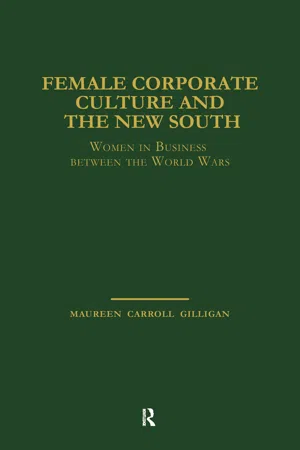
Female Corporate Culture and the New South
Women in Business Between the World Wars
- 192 pages
- English
- ePUB (mobile friendly)
- Available on iOS & Android
eBook - ePub
Female Corporate Culture and the New South
Women in Business Between the World Wars
About this book
Trusted by 375,005 students
Access to over 1.5 million titles for a fair monthly price.
Study more efficiently using our study tools.
CHAPTER 1
Urbanization, Clerical Work, and the Modern Southern Woman
By the end of World War I, the United States was recognized worldwide as an industrialized and urbanized nation. Factories that had produced a growing body of consumer products such as household goods, ready-to-wear clothing, and food products in the 1910s converted to war materiel production in 1917 and 1918. Technological breakthroughs in agricultural production greatly enhanced the United State’s ability to feed the warring armies of Great Britain and France. By the war’s end, conversion of wartime industrial and agricultural production to domestic goods and services greatly altered women’s prewar work roles and opportunities. Women participated in this transformation through their work, their roles in families, and the civic networks established by and for women. The nation’s female nonagricultural labor force grew steadily throughout the period 1880 to 1930, and female clerical labor force participation accounted for much of this growth. The war greatly accelerated the pace of women’s office work participation, which increased nearly 50 percent from the pre-war decade.1 In Atlanta, white women increased their public labor force participation from 16 percent in 1890 to 28.9 percent in 1930 (See Table 1.1). Atlanta’s female labor force in 1890 was one of the smallest in the nation, but was comparable to other southern cities, such as Charleston, Nashville, New Orleans, and Richmond. By 1930, Atlanta’s white female labor force participation more closely matched the rates recorded in some of the nation’s well-established cities than it did the female workforce participation in southern urban centers. Also by 1930, the city’s clerical workforce participation had leapt ahead of the national urban average, which hovered at 30 percent.
Table 1.1: White Female Labor Force Participation & Proportion of Employed Clerical Workers, 1890 & 1930, Selected Cities

Source: Elyce Rotella, From Home to Office, Appendix B, ‘The Urban Sample”.
Between the 1880s and the 1920s, women entered offices and contributed to the rapid growth of white collar workforces that cities like Atlanta grew upon, thus playing a significant role in the process of urbanization through their workforce participation.2 Throughout the 1920s and 1930s, the wages, working conditions, and availability of office work surpassed industrial work opportunities and made clerical work an appealing occupation for Atlanta women.3 Trade and clerical occupations employed approximately 25 percent of the 1920 female working population. Clerical employment alone engaged approximately 19 percent of the 1920 Atlanta female working population over the age of ten. Manufacturing and mechanical industries employed approximately 15 percent of Atlanta’s working females.4 By the end of the decade, Atlanta’s female clerical workforce had increased by a third. Only domestic and personal service, which engaged approximately 50 percent of the total female workforce, employed more women than clerical occupations, and these servants and laundresses were predominantly black (See Table 1.2, “Atlanta Female Workforce Participation, Selected Occupations, 1910–1940”.) The regional racial phenomena that bifurcated Atlanta’s female working population literally created two groups of Atlanta working women, one symbolized by the typewriter, the other by the mop.5 The image of the early female clerical worker, reflected in national and Atlanta newspapers, magazines, business periodicals, popular literature, and among women’s organizations, identified them as a single occupational group. The nearly all-white, youthful clerical workforce inspired this literature. Except for a few black-owned establishments, which employed black women for office work, the clerical workforce in Atlanta was white with a median age of twenty-five.6
Race often has defined the difference between national and southern economic growth and cultural trends, and has helped create a historical genre defined as southern distinctiveness. In clerical work occupations, racial segregation followed the regional trend mirrored in social settings. Black women did not have the opportunity to enter clerical work as easily as white women did. No public school office training programs existed for black students, and few employers beckoned even the overqualified black college graduates seeking clerical work. The gender isolation and hierarchy of clerical work exhibited in southern offices may better define regional or southern distinctiveness than race. Although gender segregation was endemic to office occupations, certain cultural beliefs and practices in the South likely contributed to the persistence of employment practices that decreased women’s ability to rise occupationally in southern offices. These southern peculiarities are explored throughout this study.
Although Atlanta’s female clerical workforce growth paralleled the nation’s on many levels, it is unique because southern urban expansion accompanied the increase of commercial professions, especially in the twentieth century. Established as a post-Civil War transportation and mercantile center, Atlanta entered the twentieth century poised to dominate the region as a versatile financial, service, and manufacturing metropolis. The rapid expansion of real estate, banking, insurance, and transportation trade interests in the city prior to 1918, affected the urban fabric, its working population, and the identity of the city.
By 1920, cities throughout the U.S. employed between 11 and 17 percent of their workforces in clerical occupations, and approximately 50 percent of that workforce was female.7 Atlanta’s clerical workforce participation in 1920 (14 percent) compared more favorably to northeastern cities with larger populations, including Boston and Pittsburgh or to emerging regional centers exhibiting similar economic and occupational growth patterns such as Denver, Houston, and San Francisco than to other southern cities. Although female participation rates are historically high in southern cities because of black female labor in domestic and personal service occupations, it does not diminish the contribution female clerical labor made to the growth of southern cities like Atlanta.
Table 1.2: Atlanta Female Workforce Participation Selected Occupations, 1910–1940


Atlanta’s total workforce participation outstripped most of the region’s cities, except New Orleans, although proportionally southern urban women’s employment was similar in all cities. Atlanta women composed approximately 37 percent of the city’s working population. Comparably, Richmond women composed 35 percent of its workforce; in Nashville and Memphis, women made up 34 percent of the employed population. Predominantly an industrial center, Birmingham had a smaller female working population (28 percent). Among these regional cities, the female workforce shared similar occupational distribution. Consistently, women composed three-fourths of the domestic and personal service workers in southern cities. Atlanta, Richmond, and Nashville shared sexually balanced clerical populations (averaging between 43 and 47 percent female). However, both Richmond and Nashville had more professional women than Atlanta did (See Table 1.3).
Atlanta’s economy and workforce, exhibiting growth in the service and clerical sectors, typified the southern urban experience as the twentieth century unfolded. For southern women, these expanded areas provided occupational choices not available in the previous decades. Atlanta’s diversified economy differed from the nation’s largest urban centers, which had experienced urbanization through industrialization. As Atlanta’s economy shifted from manufacturing and distribution of goods tied to its sizeable railroad development to finance and other service industries, the workforce and the urban fabric changed along with it. Female clerical workers played a significant role in these new urbanization trends, which were associated with the nonmanufacturing business community and symbolized by new skyscrapers and the movement of the central business district away from the railroad corridors.8 Manufacturing still played an important role in Atlanta’s economy prior to World War II, however, and city leaders strove to increase industrial capacity through the Forward Atlanta campaign in the mid-1920s. Despite these efforts, the city’s image increasingly rested in figures like office products magnate Ivan Allen, banker Robert Maddox, and manufacturer and financier, Asa Candler, not industrial giants.
Table 1.3: Southern Region Female Workforces Selected Occupations, 1920

Source: U.S. Department of Commerce, Fourteenth Census of the United States, 1920: Population, I.
DEFINING WOMEN’S CLERICAL WORKFORCE HISTORY
Many scholars have studied the growth, feminization, proletarianization, and stabilization of the American female office workforce.9 The transformation of middle-class clerical positions into the modern office hierarchy of low-level clerks and a chain of managers is treated thoroughly. These studies describe the antebellum male-dominated office, which consisted of a few autonomous clerks who were charged with a variety of duties including copying of documents, correspondence, and bookkeeping, and were nominally supervised by the proprietor or a senior clerk. The relationship between the clerk and his employer was familiar and often paternalistic. Within this relationship, class differences were obscured and often any shortcomings in the labor system were perceived as personal, rather than economic problems. However, the expansion of capitalist markets, the growth of transportation and communication systems, and technological innovations following the Civil War produced profound changes in the accounting of manufacturing, financial, and other business transactions. Thus, the scientific organization of offices and office work emerged. Informal or non-existent administrative hierarchies, common in small offices, failed to organize the detailed transactions of a burgeoning capitalist corporate economy. Small offices rarely employed the labor necessary to record these transactions, and large offices lacked systematic accounting and work organization. As a result, new organization techniques, which encompassed labor and task management emerged and often replaced the familiar relationship between the clerk and his employer.10
Women entered clerical occupations on the cusp of this change. The education level, availability, and volume of the female labor force complimented the needs of offices in flux and filled the gap between increased labor demands and streamlined procedures. Female clerical employment certainly contributed to the rapid and widespread adoption of modern office labor management. However, the introduction of women office workers did not create these changes. Both Cindy Aron and Margery Davies agree that American businesses forfeited personal paternalistic policies of management for more business-like ones, characterized by departmental division, administrative hierarchies, and specialized tasks, before feminization occurred. Efficiency and profit motives, not gender domination, motivated labor proletarianization. Many women trained for and entered clerical jobs because they thought they were good jobs.
Aron and other scholars also emphasize that female clerical employment significantly altered business work environments by domesticating the office sphere, relaxing the decorous and often circumspect social relations between Victorian men and women, and creating precedents for female behavior within the office. Middle-class domestic female roles transferred well into late nineteenth-century offices, particularly the expression of familial obligations. Married and single women stressed their participation in family economies and how work in the public sphere expanded the definition of their domestic female roles. Once engaged in positions, employers often identified women as dependable and loyal workers, well suited for the low-level and segregated positions offered to them. Most women prepared for specific tasks within offices through business schools and were not expected to pursue independent or autonomous roles within the office. Male and female office workers assumed that domestic activities and emotional relationships within the family remained preeminent in women’s lives. Whether married or single, work roles only added to these domestic responsibilities. The Victorian middle-class female model lasted well into the twentieth century and afforded a precedent for employers to enforce patriarchical values upon women...
Table of contents
- Cover
- Half Title
- Title Page
- Copyright Page
- Table of Contents
- Tables and Photographs
- Introduction
- Chapter One Urbanization, Clerical Work, and the Modern Southern Woman
- Chapter Two A Manageable Workforce: Scientific Management and Women Workers
- Chapter Three What An Office Should Be
- Chapter Four Building Civic Bridges: Building Business Consensus
- Chapter Five Businesswomen’s Idealism: Civicism and the Clerical Worker
- Chapter Six Losing Ground
- Conclusion
- Bibliography
- Index
Frequently asked questions
Yes, you can cancel anytime from the Subscription tab in your account settings on the Perlego website. Your subscription will stay active until the end of your current billing period. Learn how to cancel your subscription
No, books cannot be downloaded as external files, such as PDFs, for use outside of Perlego. However, you can download books within the Perlego app for offline reading on mobile or tablet. Learn how to download books offline
Perlego offers two plans: Essential and Complete
- Essential is ideal for learners and professionals who enjoy exploring a wide range of subjects. Access the Essential Library with 800,000+ trusted titles and best-sellers across business, personal growth, and the humanities. Includes unlimited reading time and Standard Read Aloud voice.
- Complete: Perfect for advanced learners and researchers needing full, unrestricted access. Unlock 1.5M+ books across hundreds of subjects, including academic and specialized titles. The Complete Plan also includes advanced features like Premium Read Aloud and Research Assistant.
We are an online textbook subscription service, where you can get access to an entire online library for less than the price of a single book per month. With over 1.5 million books across 990+ topics, we’ve got you covered! Learn about our mission
Look out for the read-aloud symbol on your next book to see if you can listen to it. The read-aloud tool reads text aloud for you, highlighting the text as it is being read. You can pause it, speed it up and slow it down. Learn more about Read Aloud
Yes! You can use the Perlego app on both iOS and Android devices to read anytime, anywhere — even offline. Perfect for commutes or when you’re on the go.
Please note we cannot support devices running on iOS 13 and Android 7 or earlier. Learn more about using the app
Please note we cannot support devices running on iOS 13 and Android 7 or earlier. Learn more about using the app
Yes, you can access Female Corporate Culture and the New South by Maureen Carroll Gilligan in PDF and/or ePUB format, as well as other popular books in History & World History. We have over 1.5 million books available in our catalogue for you to explore.