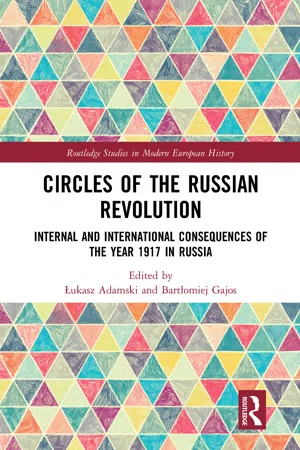
This volume provides the English-speaking reader with little-known perspectives of Central and Eastern European historians on the topic of the Russian Revolution. Whereas research into the Soviet Union's history has flourished at Western universities, the contribution of Central and Eastern European historians, during the Cold War working in conditions of imposed censorship, to this field of academic research has often been seriously circumscribed. Bringing together perspectives from across Central and Eastern Europe alongside contributions from established scholars from the West, this significant volume casts the year 1917 in a new critical light.
eBook - ePub
Circles of the Russian Revolution
Internal and International Consequences of the Year 1917 in Russia
- 282 pages
- English
- ePUB (mobile friendly)
- Available on iOS & Android
eBook - ePub
Circles of the Russian Revolution
Internal and International Consequences of the Year 1917 in Russia
1 The Russian Revolution and its many circles
Through me the way is to the city dolent;
Through me the way is to eternal dole;
Through me the way among the people lost.
Thus, in the late medieval vision by Dante Alighieri, the Inferno welcomed cursed souls consigned to eternal damnation. The poet himself, or rather his alter ego, upon crossing the threshold of hell, travelled through successive circles of the netherworld and described them in this way:
There sighs, complaints, and ululations loud
Resounded through the air without a star,
Whence I, at the beginning, wept thereat.
Languages diverse, horrible dialects,
Accents of anger, words of agony,
And voices high and hoarse, with sound of hands,
Made up a tumult that goes whirling on
Forever in that air forever black,
Even as the sand doth, when the whirlwind breathes.
Similar thoughts may have occurred after 1917 to many former members of the elite in the Russian Empire, a country which – after the revolution of 1905 and the subsequent reforms by Prime Minister Pyotr Stolypin – not only began to recover economically but which also, as many believed, took the road of slow-paced alignment with Europe’s dominant model of government. Starting in 1914, though, in a brief span of just several years, the average Moscow merchant, St. Petersburg clerk, Tambov-region landowner, or monk from Kiev-Pechersk Lavra monastery was to experience a series of violent tremors, each bringing momentous change to Russia. First came the war against the Central Powers, with all its consequences: human losses, an economic downturn, and problems with the provision of food and other necessities. Then the tsar was toppled, and eight months later the Provisional Government, which had declared an intention to build a democratic Russia, fell to a Bolshevik coup. As civil war engulfed the country, Russia lost vast territories to Germany and to the newly emerging nation states. Simultaneously, the Bolsheviks began implementing their revolutionary ideas in the economy, bringing about radical social and legal changes. And finally, the civil war between Reds and Whites was accompanied by a bloody terror that spared virtually no one. Division lines in the domestic conflict often ran across families, as exemplified by General Pyotr Makhrov and his brother Nikolai – the former serving under Anton Denikin, and the latter commanding the Bolshevik 28th Rifle Division – who, incidentally, did not consider their presence in hostile camps to be an obstacle when attempting to cultivate family ties.1 Still, for the greater part of the former elites, the revolution that began in 1917 caused pauperisation, a fall in social status, and often death or emigration. Little wonder, then, that many Russians saw themselves as descending into ever lower and lower circles of the hell in which they found themselves.
Obviously, things might be viewed from a different perspective by beneficiaries of the revolution and supporters of the Bolsheviks – basically, workers, peasants (especially the poor among them), and craftsmen – if only they survived the terror ensuing from the internal conflict. The revolution gave them a chance to improve economic and social standing, which they were unlikely to receive in normal circumstances. The bulk of the party apparatus was recruited from among them, including all the leaders of the Soviet state in the post-Stalin era. Georgy Malenkov, Nikita Khrushchev, Leonid Brezhnev, Yuri Andropov, Konstantin Chernenko, and Mikhail Gorbachev – all of them came from either worker or peasant families.
A still different view of the events of 1917 and later years was taken by people in those nations where the revolution greatly helped in gaining or regaining statehood (e.g. Poles, Finns) or where it accelerated nation-building processes, as was the case with the Ukrainians. Whatever those peoples’ own effort, there can be no doubt that without Russia’s political collapse, post-revolution, the course of these process would have been different, and the goals of national movements would have been more difficult to achieve. Here, the impact of the revolution, even if hard to establish accurately – “alternative history” being a quack-science with no analytical tools for empirical study – is unquestionable.
And what about the outside world? What about the West? The takeover by adherents to a communist utopia, seeking to realise it by totalitarian means, came as a shock indeed. But while Germany and Austria-Hungary managed to turn the ensuing chaos to their own advantage and bring their war against Russia to a victorious end (pushing the country back to the 17th-century borders of Muscovy), for the Entente Powers the revolution meant the loss of a military ally and a thorny internal problem. Their fears that the Central Powers might avoid defeat and that the “Bolshevik disease” might spread into other European countries effected the stance they took and the policies they pursued. And it looks like the Bolsheviks skilfully fed those fears, purposely breaching the diplomatic conventions of the time and ostentatiously demonstrating the “unpredictability” of their government, with concrete political benefits in mind. In a letter to Lev Kamenev, dated 23 October 1918, on the eve of the revolution’s first anniversary, Leon Trotsky wrote:
We should popularise Wilson domestically. I propose not to forget about Wilson, Lloyd-George, Mikado, Clemenceau and others during the anniversary celebrations. We will do well, I believe, if we burn Wilson in effigy and then broadcast this news around the world. Such rituals may truly impress America’s democratic scoundrels.2
The metaphor of the circles of the revolution, though, could also be read without references to the Renaissance masterpiece. The revolution also had its geographical dimension. Its first circle could be described as the territory of the former Russian Empire. Within it, one could identify the second circle, namely the areas inhabited by the peoples who aspired to have their statehood established or regained. The third circle would be defined as Central European countries outside the reach of pre-revolutionary Russia. And finally, the fourth one would comprise countries in Western Europe. Those circles of the revolution – surely not all of the many circles that could perhaps be identified – are discussed in the articles collected in the present publication.
***
One thing remains indisputable: the epoch-making events sparked by the revolution left an indelible mark on the history of not only the Russian state, with its multiple peoples, but almost the whole of humanity. The attempted construction of a communist utopia coupled with a creeping territorial expansion, the transplanting – on Red Army bayonets – of the Soviet model of government, and the ideological rivalry with the old imperialist and capitalist world engaged attention, in a greater or smaller degree, across the entire globe. Even with the Soviet system imploding towards the end of the 1980s and the Bolshevik-created statehood finally breaking up in 1991, the repercussions of the 70-plus-year rule by Lenin and his successors continue until today to have a political and mental impact on those nations who themselves tasted the power of the Soviets and those who maintained any kind of relations with them – meaning everybody.
Obviously, then, discussions about the Russian Revolution, and especially about communism, are by no means confined to a narrow group of academic historians, but are also being held by intellectuals, politicians, and the public in general. Round-year anniversaries offer a good opportunity – and a temptation, rarely resisted by researchers and academic institutes – to publicise their outcomes and, consequently, increase recognisability, sum up the findings so far, and sometimes present an original interpretation or new insights, adding to the existing body of knowledge about the subject. The numbers of publications about the Russian Revolution have indeed been rising fast with each successive anniversary. One hundred years on, a separate library would now be needed to encompass all articles, documents, diaries, books, reports, and memoires devoted to the events taking place between 1914 and 1922 on the vast spaces of the Russian Empire and what was left of it.
The Cold War rivalry between two superpowers, especially, was the time of full bloom for Soviet studies literature, reflecting the enormous demand in the West for any titbit of information about the communist state. But it was not only in the West that such literature was being written.
Polish pre-war Sovietologists, their findings and conclusions, are hardly known in the outside world. But as it happens, the works by those Western researchers of totalitarianism and Soviet history who did not conceal their negative attitudes towards the subject of their studies – including, e.g., Zbigniew Brzeziński and Richard Pipes – were in large part a continuation, as well as a broadening, of the ideas and postulates of researchers from countries lying west of the U.S.S.R. and finding themselves behind the Iron Curtain after World War II. The obscurity of Polish pre-war Sovietologists was due to factors other than merits. Most of their texts were written in a language other than French, German, or English – and never translated into these – and besides, the more than 40 years of Soviet domination in Central and Eastern Europe made it difficult, if not outright impossible, to conduct free debates, write without interference from censors, or exchange views with colleagues from the other side of the Iron Curtain.
Prior to the 1939 aggression by Germany and the Soviet Union, Poland was a country with a great number of publications about the U.S.S.R., including brochures, articles in newspapers and magazines, travel reports, and academic analyses. Around a thousand of them were cited by Marek Kornat, a leading specialist on the subject.3 Writers Jan Parandowski (1895–1978) and Antoni Słonimski (1895–1976), literary critic Rafał Blüth (1891–1939), jurist Wiktor Sukiennicki (1901–1983), historian Jan Kucharzewski (1876–1952), historian of ideas Marian Zdziechowski (1861–1938), historian of philosophy Bogumił Jasinowski (1883–1969), historian of law Konstanty Grzybowski (1901–1970), economist Stanisław Swianiewicz (1899–1997), and sociologist Ludwik Kulczycki (1866–1941) – these are but a few names of those who before 1939 wrote and published about the Soviet system, economic situation, social transformations, Stalinist purges, and Bolshevik ideology. Some of them worked for the Research and Study Institute for Eastern Europe in Wilno (now Vilnius), a specialist analytical institute that existed between 1930 and 1939.4
Most of those scholars, irrespective of their political beliefs and sympathies, were in agreement on one key conclusion: the changes in Russia were profoundly influenced by the historically shaped Russian political culture and mentality, so different from what could be seen in the West. This diagnosis led to the next observation, about huge problems with, or actually the impossibility of, building a Western European-style democracy or launching reforms and building communism in accordance with Marx and Engels’s recipes. It was emphasised that neither the Provisional Government nor the Council of People’s Commissars could ignore the post-imperial determinants, namely the social anomie, the fact that prior to 1917 an overwhelming majority of society did not participate in public life (or participated only marginally), and the police-centred nature of Tsarist Russia.
The Polish experts were known for their aversion to, and moral condemnation of, Bolshevik Russia and the U.S.S.R. – in which they did not differ from Polish public opinion at large. Delivered in fine emotional language, the following passage by Parandowski mirrors the perception of the ongoing changes in Russia, as shared by most of his contemporaries:
Under their rule, everything that gives life sense and elegance is gone. Following their two years in power people suffer from hunger, and are stupefied by terror, incapable of effective work in any field, and morally fallen. The will to work and a sense of duty have disappeared among the masses. Those intelligent people who, by Bolsheviks’ mercy, have stayed alive see their hopes for human progress ruined. The Russian people, bereft of those of noble t...
Table of contents
- Cover
- Half Title
- Series Page
- Title Page
- Copyright Page
- Table of Contents
- List of contributors
- Acknowledgments
- Editorial note
- 1. The Russian Revolution and its many circles
- 2. “A ravaged century”: Did the Russian Revolution define the 20th century?
- 3. Violence in the Russian Revolution and Civil War, 1914–20: A survey of recent historiography
- 4. From utopia to a lawless state: Russian Marxism and Russian Revolutions as a totalitarian project
- 5. Loci of political power: The 1917 Russian revolution from regional perspectives
- 6. The Karaims: Political and social activities during the Russian Revolution and civil war
- 7. The 1917 Russian Revolution and Belarusian national movement
- 8. Great Britain and the 1917 revolution in Ukraine
- 9. “Finexit”: The Russian Revolution and Finnish independence
- 10. Rebellion: Social conflict in Central and Eastern Europe in 1917–1920
- 11. French political circles and the consequences of the Russian Revolution in Eastern Europe
- 12. The consequences of the Russian Revolution on the Polish question from the Western powers’ point of view
- 13. Austria-Hungary and the Russian Revolution
- 14. Great Britain and the Russian Revolution of 1917
- 15. Idle memory? The 1917 anniversary in Russia
- 16. A quiet jubilee: Practices of the political commemoration of the centenary of the 1917 revolution(s) in Russia
- 17 (R)evolutionary memory in Tambov (1991–2017)
- Index
Trusted by 375,005 students
Access to over 1.5 million titles for a fair monthly price.
Study more efficiently using our study tools.
Frequently asked questions
Yes, you can cancel anytime from the Subscription tab in your account settings on the Perlego website. Your subscription will stay active until the end of your current billing period. Learn how to cancel your subscription
No, books cannot be downloaded as external files, such as PDFs, for use outside of Perlego. However, you can download books within the Perlego app for offline reading on mobile or tablet. Learn how to download books offline
Perlego offers two plans: Essential and Complete
- Essential is ideal for learners and professionals who enjoy exploring a wide range of subjects. Access the Essential Library with 800,000+ trusted titles and best-sellers across business, personal growth, and the humanities. Includes unlimited reading time and Standard Read Aloud voice.
- Complete: Perfect for advanced learners and researchers needing full, unrestricted access. Unlock 1.5M+ books across hundreds of subjects, including academic and specialized titles. The Complete Plan also includes advanced features like Premium Read Aloud and Research Assistant.
We are an online textbook subscription service, where you can get access to an entire online library for less than the price of a single book per month. With over 1.5 million books across 990+ topics, we’ve got you covered! Learn about our mission
Look out for the read-aloud symbol on your next book to see if you can listen to it. The read-aloud tool reads text aloud for you, highlighting the text as it is being read. You can pause it, speed it up and slow it down. Learn more about Read Aloud
Yes! You can use the Perlego app on both iOS and Android devices to read anytime, anywhere — even offline. Perfect for commutes or when you’re on the go.
Please note we cannot support devices running on iOS 13 and Android 7 or earlier. Learn more about using the app
Please note we cannot support devices running on iOS 13 and Android 7 or earlier. Learn more about using the app
Yes, you can access Circles of the Russian Revolution by Łukasz Adamski, Bartłomiej Gajos, Łukasz Adamski,Bartłomiej Gajos in PDF and/or ePUB format, as well as other popular books in History & 20th Century History. We have over 1.5 million books available in our catalogue for you to explore.