- 256 pages
- English
- ePUB (mobile friendly)
- Available on iOS & Android
eBook - ePub
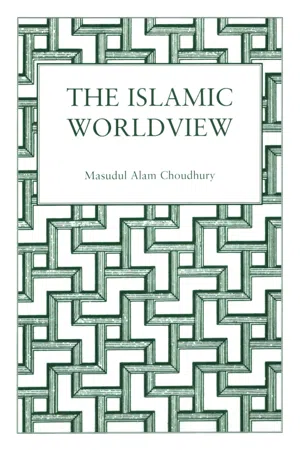
Islamic World View
About this book
The quest for a systematic unity of the universe in all of its manifestations is a common topic in Western thought. In this book the author shows what Islam can bring to this field of human enquiry. Defining a paradigm of Islamic political economy and world systems, he presents a study of epistemology in the light of general systems derived from the Qur'anic premise. The result is an intellectual endeavour without any dogmatic or reglious and philosophoical enquiry. First published in 2001. Routledge is an imprint of Taylor & Francis, an informa company.
Information
CHAPTER 1
GENERAL PERSPECTIVES: THE WORLDVIEW OF ISLAM AND THE OCCIDENT
FROM PRESENT TO THE FUTURE
With the coming of the information age mankind has entered an extensively interactive world-system. This world-system works at various levels. At the level of thought, it carries an epistemology of a process-oriented worldview, which Huxley foresaw to be the biological expression in his Brave New World. Whitehead referred to such a process view of reality in his Process and Reality. At the level of society the interactive worldview carries the seeds of new questions embedded in a post-modernist outlook of the future social arrangement. In this area we are witnessing today the rise of subnational interest groups. At the level of global political economy, borderless trading boundaries are transmitting the nature of managerial and financial capitalism. Here the implications are different from that earlier conceived in terms of the ownership and distributional questions involving labour and capital. At the level of science, new epistemologies for unification of the methodologies of science are being conceptualized. At the level of institutions, the world-system of capitalism is being intensified by a new type of mercantilist hegemony. It is a hybrid between Eurocentricity and regionalism.
Even as we pass this scene of enforcement during the coming millennium, the question crosses our mind: Where lies that human future which is to be embedded in social well-being? Have not the greatest thinkers at every juncture of human history revived the question of the moral contract to underlie the essence of change? Yet was change ever possible by separating the spiritual from the material world? Indeed, some form of morality, ethics or humanism has always grounded the vision of human future at every juncture of social transition. The sciences have not remained separate from such a demand. The important contribution in the history of thought has been the incessant pursuit for unity in the sciences and the categorization of morality inside the methods of science. Roger Penrose says in this regard (Penrose 1989, p. 97): ‘Great works of art are indeed ‘closer to God’ than are lesser ones. It is a feeling not uncommon amongst artists, that in their greatest works they are revealing external truths which have some kind of prior ethereal existence.’
If unification and processual ordering of nature is to be the essence of future socio-scientific inquiry – spanning across society, political economy, institutionalism, science and technology – then new and abiding questions arise on the nature of globalism that is presently on.
QUESTIONS OF GLOBALISM
First there is the inquiry around the following question: Can the globalization of managerial and financial capitalism, trade and regionalism, and the kind of scientific support for these patterns, evolve into an interactive order of ethical linkages within the socio-scientific order? Can globalization of this type realize social well-being as something that is premised on extensive unity of the human race and its moral and material premises? Can science and society reach a unified worldview in the midst of the emerging globalization of this age?
Second, there is the inquiry around the following issue: If the answers to the first set of inquiry are in the negative, then positive answers must be sought afresh in the realm of new epistemologies in the area of unity of knowledge. The methodological individualism and reductionism of all socio-scientific ideas must be changed for a process-oriented world of intrinsic unity. This is of the essence that nothing can be meaningfully explained and realized unless all conditions of the new world-system can be premised on fundamental Unity. We are then aiming at a methodology that emanates from and in turn intensifies the socio-scientific outlook in a biological age in the light of a fundamental and most irreducible Unity of Being.
Of recent we have heard the clamour regarding a knowledge-based economy dawning with the information age, as a megatrend of socioeconomic transformation of the new millennium (Naisbitt & Aburdeen 1990). The knowledge economy is being claimed as the ultimate post-capitalist order and a medium that can equalize the distribution of social and economic benefits to all nations (Drucker 1993). Yet in the midst of these claims resides the concept of human resource development as an input of skills that revolves around economic efficiency and social development according to a neoclassical economic model. Diffusion of human resource development to the poor and the grassroots is being modelled in and around the demand configuration of an economy that is set into motion by the principles, institutions and power of a capitalist world-system. Consequently, there remains a close interrelationship between capitalism as a system of acquisition and ownership on the one hand, and education as a medium to sustain the former on the other hand. Education according to the neoclassical human resource model then becomes a medium that sustains the de-equalizing ownership within capitalism.
However, now the nature of capitalism is extended beyond the simple theme of ownership arising out of conflict between capital assets and labour services. It becomes a legitimation for the ownership of information technology and its knowledge base by the corporate world. The latter form can be referred to as managerial capitalism. Now human resource development in the knowledge economy of managerial capitalism becomes an instrument for sustaining the latter. At the end we find that such a conception of human resource development does not liberate individuals from the throes of inequality and deprivation in as far as capitalism can perpetuate itself in the midst of such unequal partnership, conflict and ownership.
The twin goals, namely of attaining economic efficiency and social equity for human well-being, now appear as conflicting and substituting ones within the model of neoclassical trade-off. In this picture we find that while human resource development must serve the goals of an efficient economy, it must become a powerful instrument in the hands of capitalists. The share of national wealth for capital must consequently remain substantially higher than the share for labour. Hence the trade-off is spelt out in terms of such conflicting trade-offs in the global production menu with a neoclassical conception of human resource. Nothing better can be expected from such a perspective of human resource development in the framework of a knowledge economy beyond accelerated economic growth and its trickle down effect that renders no improvement of the relative scale of well-being among unequal agents transacting in the capitalist global economy.
Yet another perspective of capitalism arising from the powerful property rights of the knowledge economy is financial capitalism. At this juncture, the global community is witnessing a rapid transference of money from national governments and international financial institutions to the multinational banking sector (Bhaduri & Steindl 1985). Financial multinationals are today capable of affecting the global supply of money through issuance of bonds and loanable capital. They are then equally capable of making the global economy highly speculative and risk-prone. We are witnessing the highly speculative nature of the global economy entrenched in such financial issues of promissory notes (Independent Commission on Population and Quality of Life 1996). Even the Tobin tax on international financial transactions does not help out, for an ad volerem tax on the production of economic ‘bads’ by oligopolies can always be transferred to the consumer by such conglomerates, thus reducing economic welfare (Nordhaus & Tobin 1972).
In the end, global financial capitalism is found to aim at a control of monetary resources while engendering real sector activities in low-wage and resource-abundant economies. As long as the control of financial policies and instruments remain vested with giant multinationals, the reign of speculative fever and the whims of political and economic uncertainty for nation states will always remain within the control of giant corporations at the expense of the grassroots (Korten 1995). The most pervasive causes of such widespread uncertainties are found to be the high rates of interest and exchange rate volatility in developing countries. Policies to control such rates cannot be set independently of the financial and economic policies of industrialized nations. Such policies are in turn determined by the financial policies dictated by large banks and their central banking authorities. An example in this regard is the global merger of large corporations in recent times that have intensified oligopolistic power and have affected the flow of capital and goods across the globe. The recent capital flights from Asian countries is an example testifying the governance of large corporations over the fate of nation states.
Following the debt crisis of the eighties, the IMF too was pulled into a risk-absorption commitment set by the large financial banks. This caused IMF policies on interest rate, exchange rate and balance of payments to be determined by the wishes of the global banking consortium. A glaring example of this is the privatization of Special Drawing Rights and the Euro Currency in the form of preferred bonds that can be held by large financial corporations (IMF 1995).
In the end, the global economy is experiencing nothing new today in the way of ameliorating social well-being, and the new millennium is not expected to be any different from the Eurocentric mercantilist spirit of the industrial revolution. In recent times we have also heard the empty slogans of a new global order, the peace dividend, human rights issues linked with international trade, the reorganization of the United Nations and the commercialization of Rio Earth Summit (Stockholm Initiative 1991, Urquhart & Childers 1996, Parikh 1992, Ongun 1994). Yet for all, the debt crisis is once again found to be linked with the financial uncertainties of nation states, whereas the assets of the poor have suffered the most in this debacle. Examples of the assets of the poor being liquidated in the recent currency crashes in Malaysia and Indonesia testify to this fact.
NEW GLOBALISM
A new perspective of globalization based on jointly realizing social justice, distributive equity and economic growth (efficiency) must therefore be engendered. This is to arise from the common will of the global community, or failing this, by the grassroots in various nations. Social well-being would then be achieved by realizing complementarity between the social and economy ends. The underlying forces that can make this complementarity happen, must be supported jointly by the instruments of science and the organization of polity at all levels of the social structure. Each such level will have to be guided by the same principle of extensive participation and complementarity among the agents involved. Participation and complementarity are attributes that depict interactions and consensus among various agents. Such consensus result in systems of social contracts.
Globalism is then to be redefined to mean a consensual world-system that is causally interrelated with pervasively interactive systems interlinking society, economy, polity and science along with all their sub-systems. An ecological wholeness incorporating such interactive and consensual orders now break down barriers of dichotomy, conflict and disorder. Participation and complementarity replace marginalist substitution, which we saw above to be characterizing the neoclassicism resource allocation. Neoclassical trade-offs are replaced by the globally unified world-systems caused by a unification of knowledge among exchanging systems and their agents. Since interactions and integration define the dynamics of the unification process of global complementarity, and this reflects diverse possibilities, therefore the worldview of new globalism must be a processual one. Being of unifying type across systems, it must be fundamentally epistemological and ontological in essence. Being applicative, it must be governed by concrete instruments, programs, policies, guidance and enforcement.
Such a vision must be epistemologically sensitive within the new global order at every step of its evolution. Its very essence of unity at the roots would contradict the rationalistic basis of both socialism and capitalism. Its morally charged complexity must be opposed to the ethically neutral deterministic order of rationalism.
In this regard we note that Marx started his dialectical thesis on the premise of ‘economism’ and reduced all social actions to this one-dimensional determinant (Staniland 1985, Marcuse 1964). Likewise, capitalism remains premised on a social contractarian philosophy that is organized around ownership by conflict, an attribute of social Darwinism. Consequently, rationalism must predominate in this order to sustain evolution but in a random plane or to be regimented by hegemony (Kant trans. Friedrich 1987, Hegel trans. Sibree 1956, Heilbroner & Milberg 1995). There is even a claim among some quarters today that a rationalistic understanding of evolution marks the stereotyping of an occidental concept of historicism in all world-systems (Fukuyama 1992).
On the other hand, the epistemology of fundamental unity and the emerging worldview of unification of knowledge from it across hierarchies of agents, variables, relations and systems, outrightly annuls rationalism, its resulting dualism and pluralism (Bergson see Russell 1990). Likewise, ‘economism’ is replaced by knowledge generation out of fundamental unity in all systems. Thereafter, all materiality gets determined simultaneously by means of the continuous flow of knowledge as input and output of its associated cognitive order. Disequilibrium, conflict and sustained inequality of these systems are resolved by participation in the midst of interactions. Interactions lead to consensus or social integration. Now the attained levels of unification caused by generated knowledge cause fresh evolution of knowledge and their induced material forms. A socio-scientific order emerges epistemologically from the foundations of fundamental unity both at the levels of conceptualization and its application to a reformed world-system in the new global order. Such evolutionary systems have order but complexity in them as they permanently revolve around fundamental unity. Such attributes make them altogether different from the rationalistic world-systems premised on dualism and pluralism. The latter have formed the permanent and historical characteristics of capitalism, socialism and their prototypes (Schumpeter 1950).
Marxism, occidentalism and their prototypes in the socio-scientific order, have for long now abandoned any meaningful reference to the moral precept of unity. Consequently, the resulting social contractarian ideas of these systems have permanently relied on power-driven, conflicting and hegemonic institutions of man fuelled by the human ego. Morality could not be sustained in such systems due to the presence of such unilateral or collectivized power and hegemony. Linearity of processes in such systems resulted from the absence of interactions toward realizing participation as opposed to individualism or hegemony. Likewise in the sciences, as in the case of Newtonian time, a linearity of relations overshadowed the profundity of more complex reality. Yer where complexity is assumed, there randomness becomes endemic. Where order is derived from chaos, there adaptive control is assumed to configure equilibrium by hegemony. All of these states are assumptions of a methodological nicety rather than of realism, such states are required to attain an optimal-equilibrium state in the socio-scientific order that remains devoid of extensively interactive processes. The emerging processes must at the same time unify as well as enrich the evolving ranks of the interactions and consensus through diversities of human possibilities and must be premised on fundamental unity. Now moral social contract becomes the rule of engagement in this new world-system. Its methodology is systemically processual, leading to evolutionary equilibria but never to optimality (Shackle 1972).
In none of th...
Table of contents
- Cover
- Half Page
- Title Page
- Copyright Page
- Dedication
- Original Dedication Page
- Prologue
- Table of Contents
- Figure
- Acknowledgements
- Illustrations
- Foreword
- Introduction
- CHAPTER 1: GENERAL PERSPECTIVES: THE WORLD VIEWS OF ISLAM AND THE OCCIDENT
- CHAPTER 2: THE OUR’ANIC WORLDVIEW IN THE SCIENCES
- CHAPTER 3: THE OUR’ANIC MODEL OF KNOWLEDGE: THE INTERACTIVE, INTEGRATIVE AND EVOLUTIONARY PROCESS
- CHAPTER 4: COMPARATIVE POLITICAL ECONOMY: ISLAM AND THE OCCIDENT
- CHAPTER 5: ISLAMIC POLITICAL ECONOMY, A CRITIQUE OF ISLAMIC ECONOMICS
- CHAPTER 6: KNOWLEDGE AND INTERACTIONS IN POLITICAL ECONOMY AND ECONOMIC THEORY
- CHAPTER 7: COMPLEMENTARITY IN THE OUR’ANIC ECOLOGICAL MODEL
- CHAPTER 8: DECISION-MAKING IN ISLAMIC POLITICAL ECONOMY
- CHAPTER 9: ISLAMIC CONSUMPTION, PRODUCTION AND DISTRIBUTIONAL MENUS
- CHAPTER 10: CONTRASTING MODELS OF KNOWLEDGE AND ‘DE-KNOWLEDGE’
- CHAPTER 11: CONCLUSION
- REFERENCES
- GLOSSARY OF ARABIC TERMS
- SUBJECT INDEX
Trusted by 375,005 students
Access to over 1.5 million titles for a fair monthly price.
Study more efficiently using our study tools.
Frequently asked questions
Yes, you can cancel anytime from the Subscription tab in your account settings on the Perlego website. Your subscription will stay active until the end of your current billing period. Learn how to cancel your subscription
No, books cannot be downloaded as external files, such as PDFs, for use outside of Perlego. However, you can download books within the Perlego app for offline reading on mobile or tablet. Learn how to download books offline
Perlego offers two plans: Essential and Complete
- Essential is ideal for learners and professionals who enjoy exploring a wide range of subjects. Access the Essential Library with 800,000+ trusted titles and best-sellers across business, personal growth, and the humanities. Includes unlimited reading time and Standard Read Aloud voice.
- Complete: Perfect for advanced learners and researchers needing full, unrestricted access. Unlock 1.5M+ books across hundreds of subjects, including academic and specialized titles. The Complete Plan also includes advanced features like Premium Read Aloud and Research Assistant.
We are an online textbook subscription service, where you can get access to an entire online library for less than the price of a single book per month. With over 1.5 million books across 990+ topics, we’ve got you covered! Learn about our mission
Look out for the read-aloud symbol on your next book to see if you can listen to it. The read-aloud tool reads text aloud for you, highlighting the text as it is being read. You can pause it, speed it up and slow it down. Learn more about Read Aloud
Yes! You can use the Perlego app on both iOS and Android devices to read anytime, anywhere — even offline. Perfect for commutes or when you’re on the go.
Please note we cannot support devices running on iOS 13 and Android 7 or earlier. Learn more about using the app
Please note we cannot support devices running on iOS 13 and Android 7 or earlier. Learn more about using the app
Yes, you can access Islamic World View by Masudul Alam Choudhury,Choudhury in PDF and/or ePUB format, as well as other popular books in Social Sciences & Anthropology. We have over 1.5 million books available in our catalogue for you to explore.