Examining the surrealist novels of several contemporary writers including Edwidge Danticat, Tananarive Due, Nalo Hopkinson, Junot Díaz, Helen Oyeyemi, and Colson Whitehead, AfroSurrealism, the first book-length exploration of AfroSurreal fiction, argues that we have entered a new and exciting era of the black novel, one that is more invested than ever before in the cross sections of science, technology, history, folklore, and myth. Building on traditional surrealist scholarship and black studies criticism, the author contends that as technology has become ubiquitous, the ways in which writers write has changed; writers are producing more surrealist texts to represent the psychological challenges that have arisen during an era of rapid social and technological transitions. For black writers, this has meant not only a return to Surrealism, but also a complete restructuring in the way that both past and present are conceived, as technology, rather than being a means for demeaning and brutalizing a black labor force, has become an empowering means of sharing information. Presenting analyses of contemporary AfroSurreal fiction, this volume examines the ways in which contemporary writers grapple with the psychology underlying this futuristic technology, presenting a cautiously optimistic view of the future, together with a hope for better understanding of the past. As such, it will appeal to scholars of cultural, media and literary studies with interests in the contemporary novel, Surrealism, and black fiction.
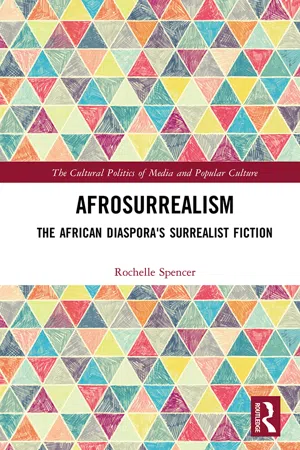
- 140 pages
- English
- ePUB (mobile friendly)
- Available on iOS & Android
eBook - ePub
About this book
Information
1 Mat Johnson’s Pym and Helen Oyeyemi’s boy snow bird
AfroSurrealism, magical realism, and the psychology of reimagining the past
Is AfroSurrealism an offspring of Surrealism and the avant-garde? Or do its roots lie elsewhere, balanced within a magical realist, third-world philosophy that challenges dominant Western views? Should these distinctions matter?
Paul Gilroy takes issue with the concept of both a black aesthetic situated inside a “hermetically enclosed culture” and a modernist black aesthetic rooted within a pluralistic and fluid definition of race that downplays the realities of racial oppression (32). AfroSurrealism, I argue, meets Gilroy’s challenge of locating the “doggedly evasive essence of black artistic and political sensibility” while also acknowledging the hybridity of black culture. AfroSurrealism explores the dialectic between the “ontological essentialist” black aesthetics associated with the Black Arts Movement and those of Trey Ellis’s modernist New Black Aesthetic. Larry Neal posits that the black aesthetics movement should reject “protest literature”—art aimed towards white audiences that protests blacks’ social conditions—and instead, must be appraised within the context of black nation building. In contrast, Ellis’s “cultural mulatto” celebrates black culture while advancing what some black artists describe as a lesser commitment to political action (233–243). Among its several disruptive strategies, AfroSurreal texts connect political action to black hybridity and function as cultural rhizomes investigating how the multiplicity and diversity of the black experience could offer strategies for resisting racial domination.
As I explained in the Introduction, AfroSurrealism is related to Surrealism and the avant-garde, but it would be inaccurate to describe AfroSurrealism as simply an offshoot of Surrealism. AfroSurrealism acknowledges slavery’s legacy in African-Americans’ physical and psychological dislocation, and also recognizes the term “Surrealism”—divorced from the prefix “Afro”—as inadequate to fully describe black subjectivity, as black texts resist the “uncomfortable legacy of avant-garde primitivism” (Edmondson 42). In fact, black people may not see ourselves as primitive or Other at all.
What happens when ontology, the creative process, and empathy are understood and explained by the Other? What occurs when the subject belongs to the culture or nation being examined? In AfroSurreal texts, what do contemporary black protagonists reveal about the African Diaspora or the legacies of slavery and the Middle Passage? The AfroSurrealism of Mat Johnson’s Pym and Helen Oyeyemi’s boy snow bird perform a significant function: through language, they dramatize the psychological tensions of the black protagonist’s clash with Western notions of modernity and logic. Johnson follows protagonist Chris Jaynes through his journey into fantastical sites in the Antarctic, and boy snow bird examines the science behind optical illusions, as Oyeyemi explores a family’s mixed-race connections. (In this discussion, in keeping with a fluid conception of blackness, the ethnicity of mixed-race protagonists of African ancestry is alternatively described as “black” and “mixed race.”) Still, it is overly simplistic to argue that all black artists, by simply being black, will reflexively produce revolutionary texts that do not simply reinscribe western values. Black people interact with mainstream culture and are often influenced by hegemonic cultural ideas.
In “The Idea of Black Culture,” Hortense Spillers convincingly argues of one possible future—an assimilated black culture drained of its particularities, and consequently, its resistance. Spillers also describes Kant and Hegel as black intellectual W.E.B. Du Bois’s influences and argues, with certainty, that “Du Bois executed a Marxist critique” (17). Spillers’ argument proves the difficulty of separating currents of black intellectual thought from western academic discourse. Black intellectuals are often in conversation with intellectuals of myriad traditions; through language alluding to “intellectual technologies” and “corporate media,” Spillers suggests a possible future where black capitalism and social mobility dilute black culture of its critical force (26). How can black culture, especially in media spaces that deemphasize physical blackness and the black body, demonstrate an intellectual resistance or function as “a counterstatement to American culture/civilization, or Western culture/civilization” (25)? But that has yet to happen. Spillers argues, and I agree, that black culture, as “one of the last bastions of critique,” hasn’t yet “[fallen] away” (26). Jennifer A. González acknowledges “the enactment of racial identity in online sites takes a variety of forms” and the ways coded—and not so coded—messages about race, ethnicity, and culture can infiltrate present-day, online spaces (29). González examines race and technology in the context of avatars and online passing,1 and recent research suggests user patterns can also be racially coded: the Pew Research Center reveals social media patterns vary with race and ethnicity (Krogstad). People can form racial identities in online/technological space and racial signifiers can be transmitted through text, language, and music.
Further, blackness has not been subsumed into the mainstream political processes and institutions. Even with the ascendancy of a black United States president, black people remain, often violently, separated from—and unincorporated into—white mainstream institutions. Historian William Jelani Cobb’s 2010 study The Substance of Hope reminds us that “[as] a black man planned to assume the most powerful office in the world [Barack Obama’s inauguration] … three black men were shot by police, two of them fatally; two of them unarmed” (158). Cobb reminds us of a particular form of violence that positions black people on society’s margins, creates an oppositional tension towards mainstream authorities, and yet, forces new, oppositional worldviews and definitions of selfhood.
If we accept the premise that temporality is part of one’s subjectivity, then to ignore people’s conceptions of time is to deny their humanity. Western philosophers have created persuasive arguments about economics, aesthetics, and psychology but these arguments are subtly biased towards a linear, western conception of time. Karl Marx brilliantly incorporates history into economic theory that moves linearly from (European) feudalism to capitalism. Richard Wolin suggests most western philosophers took linear temporality for granted, and even though German philosopher Martin Heidegger argued for time as a fundamental aspect of the human or Daesin’s existence, Heidegger, a Nazi sympathizer, believed Jewish and black peoples stood outside of history2 (76). Because in West Africa there has been an oral storytelling culture and in the Americas black people were forbidden to read and write, black people have often been deemed by text-oriented thinkers as departures from history, which western philosophers have defined as written. Linear temporality subtly influences much of western thought, and my argument centers not so much on the author’s ethnicity but on the black protagonist and the reader’s psychological processes. As the reader empathizes with a black protagonist who confronts racial oppression suggested through strange or surreal moments, the reader discovers—or rediscovers—new ways of understanding time.3 The black protagonists of Pym and boy snow bird provide an alternative understanding of temporality, which subsequently challenges Western theories on topics as varied as progress, economics, intelligence, and beauty.
While the history of Surrealism and AfroSurrealism intersect, AfroSurrealism operates within a different understanding of history and temporality and examines black protagonists whose agency and freedom are reflected in society’s treatment of raced subjects. Jennifer L. Griffiths writes of the specific traumas visited upon the black female body and argues for “a cultural memory of violence” (65). Kodwo Eshun has claimed the Middle Passage and its corresponding alienation generate art that attempts to make meaning from trauma (289–292). Griffiths’ and Eshun’s theories suggest not only discursive groups’ use of art as a way to reconcile trauma and generate meaning, but also how varied cultural experiences may cause aesthetics and worldviews to diverge. We can recognize the value of cultural pollination, hybridization, and creolization while still admitting the asymmetrical influence particular philosophies and experiences may exert over distinct groups of people.
Speaking to these various histories, AfroSurrealism attempts to develop a language for the DuBoisian psychological struggle, the process Claudia Tate has described as black people’s “Manichean conflict between their public performance of an essentialized, homogenous blackness” and a “private performance of individual personality” (6). The AfroSurreal text provides this language through ambiguous images and events that affirm the marvelous and the imagination, while providing a trenchant critique of capitalism and rationalism.
Pym and boy snow bird produce alternative understandings of temporality by revisiting narratives from the Western canon and infusing these stories with African-American histories, folklore, and cultural references in scenes that disrupt the western tale’s diegesis and distort linear time. Eshun’s work on Afrofuturism suggests how knowledge is tied to culturally distinctive understandings of time. Countermemory, the term Eshun uses to describe the process in which “black intellectuals explored memories that questioned the concept of primitivism by positioning slavery as the basis of modernity,” is part of a black tradition that “defined itself as an ethical commitment to history, the dead and the forgotten” (288). Johnson and Oyeyemi rely on countermemory, which is a key feature of the AfroSurreal text. While Eshun argues that Afrofuturism also explores countermemory, “Afrofuturism’s first priority is to recognize that Africa increasingly exists as the object of futurist projection” (288). However, as I’ve argued, futurist investigation is not AfroSurrealism’s first priority. Thus, I position countermemory and its strategic employment in resisting present-day oppression and producing psychological resiliency as AfroSurrealism’s primary concern.
The way we think about time structures our politics and the ways we imagine race and class; a text’s subtle disruptions of time shifts the narrative. Eshun argues that Afrofuturism intervenes to create a chronopolitics that imagines alternative futures predicated on the rejection of the primitive (297). Because alternative futures have yet to be experienced, the Afrofuturist narrative is less concerned with the uncanny, the process by which the familiar becomes strange, and more invested in demonstrating that blackness should not be situated in the past, but imaginatively in the present. In contrast, the AfroSurreal text incorporates histories and mythologies to exaggerate the strange, uncanny effect of our present-day oppressions. Eugene Redmond has said of Henry Dumas’s AfroSurreal fiction that it “may appear to be ‘new’ in the literary sense of that term” but is “ancient in origins, archetypes, meanings, and structures” (150). Other AfroSurreal texts wield storytelling strategies with archetypal figures and narratives, in that they revisit African, Afro-Caribbean, and Afro-American folklore, and reinterpret texts from European traditions, which alters the way we read the hypotext.
Afrosurrealism as a subset of black modernism
Black intellectuals such as Toni Morrison and Kodwo Eshun suggest that texts authored by black writers do not fit neatly into modernism or the avant-garde, as these terms have been defined by critic Peter Bürger, whose influential work Theory of the Avant-Garde examines the avant-garde’s failure to integrate itself with life (22–51). Yet, if Bürger argues that institutionalized art can still offer individual catharsis and “stabilize the subject” (95), what concerns should we have if the subject itself is at odds with society? Historically, Njoroge Njoroge reminds us that the “[m]usic, dance and aesthetic production” of black slaves were distinctive and “often masked potential subversion” (20). I argue that blackness continues to subvert, challenge, and function as a counter-force to mainstream societal institutions (e.g., police, school) as long as racism exists. Several black writers, notes Veronica Watson, have written about white people and developed an “oppositional black gaze”4 that questions white supremacy and its hypocrisy (141). In AfroSurreal fiction, strange events reveal the absurdities of white society and the challenges facing the black protagonist. And, if we consider Bürger’s ideas about the role art can play in individual catharsis at face value, if we embrace the concept of art as a source of emotional resilience for the individual subject, at least, then could a black subject, at odds with mainstream culture, transform society while undergoing a creative and cathartic release? AfroSurrealism is related to the Surrealist and avant-garde traditions; however, the black subject infuses AfroSurreal texts with unique oppositional tensions.
In the introduction to The Avant-Garde: Race Religion War, Mike Sell argues that both the artists associated with “Fluxus and Happenings and the activists-intellectuals and artists of the Black Arts Movement” can be viewed as minorities “challenging political power” (7). In a way, they are. Yet, as Surrealist scholars Dawn Ades and Michael Richardson point out, “Surrealism … emerged as the negation of the Dadaist negation” and examined the “crisis of consciousness of western thought” (8). So, as with other avant-garde movements, AfroSurrealism explores the “crisis of consciousness of western thought” but with an additional focus: the AfroSurreal text purposefully incorporates West African philosophies about temporality, science, and truth. These African traditions may not be as apparent with other avant-garde movements. Post-World War I Surrealists, for example, rejected colonialism and celebrated the Other, but relied on a conception of linear temporality. The “modern man,” Antonin Artaud, the theorist connected with theater and the avant-garde, writes, “acts like a beast or like the terrified individual of primitive times” (qtd. in Ades and Richardson 264). Similarly, the writer Jacques Viot describes the people of New Guinea as estranged from the present: “We spend our time trying to link primitivism with civilisation. We will not succeed” (qtd. in Ades and Richardson 112). These ideas about ruptured “progress” and “civilization” may be questioned by many writers of black speculative fiction, and the AfroSurreal text, in particular, highlights the absurdity of linear conceptualizations of “progress,” “culture,” and “society.”
Splintered, metamodernist culture offers a persuasive claim against my argument for resistant, oppositional AfroSurreal texts. One could argue that contemporary culture produces decentralized, authoritarian institutions and renders black artists less a rebellious tsunami than a current in a quickly shifting wave. If we live in an environment where, as Oskar Negt and Alexander Kluge remind us, “[I]nstitutions of art and literature … have long since been recontextualized by other media of expression, representation, and reception,” then how do we create spaces of resistance? This argument complicates theories put forth by Mike Sell in The Avant-Garde: Race Religion War and by David Bate in Photography and Surrealism which suggest the avant-garde is in itself already a minority, although these minority groups may possess varying degrees of power. Minority artists possessing a minority perspective within an already divided and fragmented culture would seem to hold little power. Still, I argue that these divided sub-groups may produce more challenging or subversive art precisely because they are located outside of more dominant, mainstream cultures.
Bü...
Table of contents
- Cover
- Half Title
- Series Page
- Title Page
- Copyright Page
- Dedication
- Table of Contents
- Acknowledgments
- Introduction: AfroSurrealism: a new black surrealism
- 1. Mat Johnson’s Pym and Helen Oyeyemi’s boy snow bird: AfroSurrealism, magical realism, and the psychology of reimagining the past
- 2. Edwidge Danticat’s Claire of the Sea Light, Chris Abani’s The Secret History of Las Vegas, and the AfroSurreal grotesque
- 3. AfroSurreal and Afrofuturist cinematic storytelling: Junot Diaz’s The Brief Wondrous Life of Oscar Wao and Colson Whitehead’s Zone One
- 4. The postmodern fables of Victor LaValle’s Big Machine and Summer Brenner’s Oakland Tales
- 5. Horror and immortality in Tananarive Due’s Ghost Summer, Nalo Hopkinson’s Falling in Love with Hominids, and Rachel Eliza Griffiths’ Woman after Her Last Wound
- Conclusion: Jeffrey Renard Allen and sustaining the surreal moment
- Appendix
- Index
Trusted by 375,005 students
Access to over 1.5 million titles for a fair monthly price.
Study more efficiently using our study tools.
Frequently asked questions
Yes, you can cancel anytime from the Subscription tab in your account settings on the Perlego website. Your subscription will stay active until the end of your current billing period. Learn how to cancel your subscription
No, books cannot be downloaded as external files, such as PDFs, for use outside of Perlego. However, you can download books within the Perlego app for offline reading on mobile or tablet. Learn how to download books offline
Perlego offers two plans: Essential and Complete
- Essential is ideal for learners and professionals who enjoy exploring a wide range of subjects. Access the Essential Library with 800,000+ trusted titles and best-sellers across business, personal growth, and the humanities. Includes unlimited reading time and Standard Read Aloud voice.
- Complete: Perfect for advanced learners and researchers needing full, unrestricted access. Unlock 1.5M+ books across hundreds of subjects, including academic and specialized titles. The Complete Plan also includes advanced features like Premium Read Aloud and Research Assistant.
We are an online textbook subscription service, where you can get access to an entire online library for less than the price of a single book per month. With over 1.5 million books across 990+ topics, we’ve got you covered! Learn about our mission
Look out for the read-aloud symbol on your next book to see if you can listen to it. The read-aloud tool reads text aloud for you, highlighting the text as it is being read. You can pause it, speed it up and slow it down. Learn more about Read Aloud
Yes! You can use the Perlego app on both iOS and Android devices to read anytime, anywhere — even offline. Perfect for commutes or when you’re on the go.
Please note we cannot support devices running on iOS 13 and Android 7 or earlier. Learn more about using the app
Please note we cannot support devices running on iOS 13 and Android 7 or earlier. Learn more about using the app
Yes, you can access AfroSurrealism by Rochelle Spencer in PDF and/or ePUB format, as well as other popular books in Social Sciences & Sociology. We have over 1.5 million books available in our catalogue for you to explore.