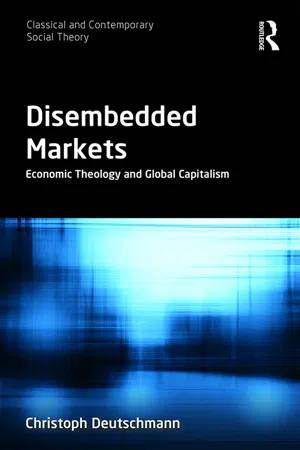
This book offers a sociological analysis of globalised capitalist markets, advancing the notion of 'disembedded markets' to challenge the idea of 'social embeddedness' common in economic sociology. Avoiding an exclusive focus on institutions, networks and trust relationships surrounding markets, the author concentrates on private property as the key institution of markets, in order to emphasise the historical origins of modern capitalism the free market narrative, and develop a socio-historical analysis of the disembedding process together with an account of the built-in contradictions and limits of market universalisation. Through an analysis of their encompassing character, this volume demonstrates that disembedded markets do not fit standard theoretical accounts of sociality – a problem taken up not only by Karl Marx, but also by Friedrich August von Hayek and Niklas Luhmann – and questions the attempts of the emerging approach of 'economic theology' to draw parallels between the practices that arise from disembedded markets and from forms of religious experience and ritual. A rigorous examination of the phenomenon of disembedded markets and the claims to which they give rise concerning the equivalences between religion and capitalism, this book will appeal to scholars of sociology and economics with interests in capitalism, social theory, and global markets.
- 150 pages
- English
- ePUB (mobile friendly)
- Available on iOS & Android
eBook - ePub
About this book
Information
1 Introduction
Economic theology as a challenge to economic theory
Political theology is an approach well known in political science, going back to Carl Schmitt’s controversial enquiry into the theological foundations of state sovereignty (Schmitt 1934).1 In comparison to this approach, economic theology is of much more recent origin, and is still relatively unknown. This study aims to clarify it and to review it from the perspectives of economic sociology and a social theory.
What is economic theology? Above all, it is something very different from what one might first guess, such as a theological ethic of economic action, which of course is not new, but a discipline deeply anchored in the traditions of theological thinking. Most religions have instituted ethical norms to guide the economic practices of their believers concerning, for example, the responsible handling of money and wealth, restrictions on charging interest, the giving of charity to the poor, and fairness and honesty in business transactions. A theological ethic is based on the religious distinction between a transcendent sphere and the profane world; it aims to transform revelation-based knowledge into practically relevant principles of moral conduct (for an overview, see Wilson 1997). Economic theology does not contradict the distinction of the transcendent and the profane. What it rejects, however, is the exclusive attribution of the economy to the profane world. To be precise, we are not talking about the economy in general, but of the economy of present-day global capitalism.
Global capitalism has emerged from a process which economic sociologists – following Karl Polanyi – characterise as a ‘disembedding’ of markets. ‘Disembedding’ refers to the expansion of markets across given territorial, institutional and social confines starting in the early nineteenth century and resulting in the historical formation of capitalism as a global system. As an encompassing social system, disembedded markets give rise to the very epistemological problem that is associated with any idea of society as a ‘totality’: in becoming total, markets cannot become an object to any observer, but are experienced as a ‘horizon’, framing actions and observations in an involuntary way and being accessible only from the perspective of a participant. While Carl Schmitt concentrates on the implications of politics becoming total, economic theology focuses on markets, which, by virtue of their disembeddedness, take on an encompassing character and cannot be known as a totality by anyone – and liberal economists (in particular Friedrich August von Hayek) have emphasised this point. As an encompassing social reality, markets and money (as their medium) possess enigmatic and even numinous qualities that traditionally have been attributed to religious experience. No longer is capitalism being interpreted as a system merely ‘influenced’ by religious traditions, as Max Weber (1978) did in his studies of the Protestant ethic. Rather, economic theology follows Walter Benjamin (1985), who in his famous fragment defined capitalism as a religion. This is a departure from conventional economic thought and its view of the economy as a profane reality governed by nothing but utilitarian rationalism and materialism. Economic science, in this view, has been confronted with a historically new world of contingencies, which, though being man-made, are reminiscent of religious transcendence due to their encompassing and existential character. To deal with these contingencies in practice, action patterns showing formal parallels with religious rituals have evolved. From such a viewpoint, it may become understandable why some authors, such as Alexander Rüstow (2001) and Robert Nelson (2001), have diagnosed a latent proximity between theology and economic theory.
How can such an unorthodox approach be justified? In the recent debate, three lines of discussion have developed. The first debate concerns the theological genealogy of the term ‘economy’ itself. Oikonomia in the original ancient Greek, as coined by Aristotle, can be translated as ‘management’ or ‘housekeeping’. The concept marked the domestic sphere of reproduction, to be distinguished from the public realm (the polis or city-state). As Giorgio Agamben (2011) has shown, the concept’s original profane meaning underwent a change in the course of its reception by Christian theologians. Paul and the Church Fathers in the first centuries CE used the concept of oikonomia in order to circumscribe the governance of mundane life by God. Christian teaching emphasised the idea of one God; it rejected the Gnostic dual world-view with its distinction between the superior being and an inferior creator God (the ‘demiurge’). The Trinitarian formula was introduced to settle the problem of how God as a transcendent being could nevertheless enter into mundane history and reign over the human world. Oikonomia now referred to the management of the world by God through his three-fold presence as father, son and Holy Spirit (Agamben 2001: 17–18.). At the same time, the Church followed the Aristotelian conception of the mundane economy as a big household being organised as a self-sufficient sub-unit of a hierarchically structured cosmos and as something that is not compatible with chrematistic practices of making more money with money. William of Auxerre (1160–1229) condemned interest as a sinful human intervention into the sovereignty of God over time; Thomas Aquinas (1225–1274) followed Aristotle in denouncing interest and usury as unnatural and evil. Despite the gradual rise of markets, commerce and banking during the Middle Ages, the condemnation of usury by the Church became even harsher. Only after the Reformation did the interpretation of divine providence change. It shifted from the perception of God as an omnipresent ruler to that of a legislator, leaving men the freedom to regulate their own affairs within the natural laws that he had instituted. As a consequence, the economy could no longer be conceptualised as an entity purposively organised by God; rather, it was interpreted – such as in the work of Thomas Hobbes and Bernard de Mandeville – as a ‘machine’ coordinated by natural laws. Still in the physiocratic school of the eighteenth century (most famously represented by Anne Robert Jacques Turgot and François Quesnay), economic governance was understood as the application of metaphysically based ‘laws of nature’ to human reproduction (Koslowski 1998: 32–33; Priddat 2013: 51–52). Gradually, however, the focus shifted from natural laws to human interests and to the modern idea of the economy as an order not instituted by God but as a phenomenon emerging spontaneously from free market forces.
And it this concept that leads us to the second debate, which has to do with open and hidden references to theology within modern economic theory. Adam Smith’s ‘invisible hand’,2 that is, his concept of an emergent self-regulation of market transactions providing social welfare in an unintentional way, has remained a core piece of economic theory up to the present day. Different from later economic theorists, Smith never presented any rigorous theoretical explication of the concept, but confined himself to a variety of ad hoc illustrations. And the scientific character of Smith’s conception continues to be contested.3 While most economists view Smith as the founder of modern, scientific economics, Lisa Hill (2001) made a strong point that such an interpretation cannot be upheld without reservations upon closer examination of Smith’s philosophical and theological background. Although he found little attractive in Christianity, Smith shared the deist belief in a benevolent divine ‘Providence’ that was widespread amongst the intellectuals of his time: ‘God exists, the world is the product of design, and the observable order of regularity in human affairs is a direct result of his design and purpose in nature’ (Hill 2001: 5). As Hill argues, these assumptions were basic to the argument set out in The Theory of Moral Sentiments (Smith 1991 [1759]) as well as in The Wealth of Nations (Smith 1999 [1776]). In this sense, Smith’s work is ‘manifestly theological’ (Hill 2001: 1). Smith conceptualised the economy as a two-tiered model, with the first tier representing the individual action level and the second tier representing the social system level designed by divine Providence. This distinction of levels allowed him to follow the Stoic justification of apparently vicious human desires and actions as indirectly beneficial. Even intentionally immoral individual actions can have positive consequences for society as a whole in a way that is transparent not to limited human reason, but only to the divine creator. In this sense, the old concept of oikonomia as divine governance of profane human affairs continues to be present in Smith’s apparently secular concept of the invisible hand (see also Viner 1972; Viner 1998: 37–38; Agamben 2011: 277–278; Priddat 2013; and Binswanger 2015).
Even if one concedes theological influences on Smith’s thinking, one could argue that this is irrelevant for modern economics, since there has been no lack of later attempts to establish equilibrium theory on a truly ‘scientific’ basis. The milestones here were, as it is well known, the general equilibrium models of Leon Walras (1954) and, much later, that of Kenneth Arrow and Gerard Debreu (Arrow and Debreu 1954). The ‘scientific’ reconstruction of the invisible hand here meant its mathematical explication as an overall constellation of goods and factor prices that would satisfy the condition of Pareto optimality. ‘General equilibrium’ referred to an ideal stage of the total system, in which no rational actor would have reasons to change their disposition; it was a model which was designed to serve as a tool with which to reconstruct the actual working of market forces. As many critics have noted, however, the mathematical demonstration of general equilibrium was possible only under extremely restrictive assumptions, assumptions that were far away from empirical evidence such as the perfect rationality of actors, perfect knowledge and competition, given and concave preferences, given technologies, constant returns of scale, the absence of external effects, and the neutrality of money. This meant eliminating the uncertainty of markets on the level of analytical premises and assuming everything away that could give rise to empirical doubts about the possibility of a general equilibrium being reached. General equilibrium analysis is empirically void, as Friedrich Hayek noted:
What is the problem we wish to solve when we try to construct a rational economic order? On certain familiar assumptions the answer is simple enough. If we possess all relevant information, if we can start out from a given system of preferences and if we command complete knowledge of available means, the problem, which remains, is purely one of logic. That is, the answer to the question of what is the best use of the available means is implicit in our assumptions.(Hayek 1945: 519)
The real problem of economic analysis does not lie in mathematics, but in the fact that the knowledge required to implement general equilibrium theory is ‘not given to anyone in its totality’ (Hayek 1945: 520). The price for reconstructing the invisible hand idea in mathematical terms is its empirical irrelevance. The theory ends up in the tautology that the working of free market forces culminates in the welfare optimum, the latter in turn being defined as the very result of free market forces.
Hayek’s critique of neoclassical equilibrium theory is clear and concise. The intellectual provocation lies in the conclusions he draws from it. The most plausible conclusion would have been a concept of markets as a black box, a field of contingencies, where almost everything can happen. Price signals may induce a positive, welfare-enhancing feedback effect on individual actions, but likewise may produce contradictory impulses,4 or may induce self-reinforcing disequilibria and bubbles, as is often the case in real estate and financial markets. Markets are an arena providing ample opportunities for actors to phish and cheat each other (Akerlof and Shiller 2015). Market transactions may produce negative externalities at the cost of third parties instead of enhancing the general welfare. Competition in the markets tends to undermine itself by reinforcing power asymmetries and giving rise to monopolies. Instead of such a black box concept, Hayek ends up with a euphemistic portrait of markets as spontaneous processes generating a higher level of human evolution. Since markets are able to process a level of complexity that surpasses anything individual human reason can grasp, there is no chance to assess the ‘rationality’ of price signals. Nevertheless, we have to accept them, as Hayek argues, not only as a matter of fact, but with ‘humility’, because they represent a ‘higher’ order of human affairs transcending the power of individual reasoning. ‘True’ individualism, in contrast to ‘false’ rationalist individualism, qualifies itself by its ‘consciousness of the limitations of the individual mind which induces an attitude of humility toward the impersonal and anonymous processes by which individuals help to create things greater than they know’ (Hayek 1948: 8). Hayek’s apology of free markets not only brushes away management and organisation as fundamental issues of economic practice and theory, but also appears to be self-contradictory: Hayek criticises individual reason in the name of an allegedly superior collective reason incorporated into the evolutionary process. However, how should the latter be accessible without recourse to the former? What Hayek is offering is not a scientific theory, but a eulogy for market-driven evolutionary progress, and its in-built superior reason, which not by chance is reminiscent of theological thought. Smith’s divine providence appears again, albeit not in an explicit theological language but in that of higher evolutionary ‘reason’ (for a discussion and critique of Hayek, see Kley 1992; Brodbeck 2001; Backhaus 2005; Vogl 2010; and Fleischmann 2010).
A further tradition of economic thinking, where theological heritage is also influential, albeit less in the sense of economic theology and more in the sense of conventional theological ethics, is the German school of ordoliberalism. This school, which had a strong programmatic influence on the reconstruction of the West German economy after 1949, constituted itself in Freiburg and Cologne in the 1920s and early 1930s; its leading members were Walter Eucken, Alexander Rüstow, Wilhelm Röpke, Franz Böhm and Alfred Müller-Armack (for an overview, see Koslowski 2000: 93–274). The term ‘ordoliberalism’ denotes precisely the difference between this school and the Anglo-Saxon liberal tradition of Adam Smith, David Ricardo and Jeremy Bentham: what is advocated here is not a ‘genuine’ liberalism, relying on the welfare-producing effects of spontaneous market forces, but a market economy that is embedded into a strong institutional and moral order. It was the common conviction of the ordoliberals that the traditional free market concept, which they termed derogatorily as ‘paleo-liberalism’, had become outdated due to the crises of the early twentieth century. Alexander Rüstow (2001) even warned of the belief in free markets becoming a ‘religion’ in a dangerous and fatal sense. This did not mean that the ordoliberals deemed religion to be irrelevant for the governance of markets. However, as they argued, the genuine locus of religion should not be the market process itself, but the institutional and normative order framing it. Such an institutional frame was considered vital to preventing the rise of monopolies and excessive social inequalities, to enforcing the rules of fair competition, and to securing the equality of social chances. It was not the market itself, but only a strong state that could contain excesses of self-interest and guarantee the smooth and beneficial working of the market mechanisms. The role of government was not confined to setting up general rules, a point that had been vital for Hayek. Discretionary interventions to regulate competition were considered legitimate to some degree too; Müller-Armack even advocated collective bargaining and social policy interventions to protect the market position of the poor, though there were profound disagreements on these issues within the circle of the ordoliberals (Hien and Joerges 2017). The state, in turn, could be strong and superior to particular interests only under the condition of founding its legitimacy not on secular, democratic values, but on higher, transcendent ones. As Philip Manow (2001) has shown, the theorists of ordoliberalism did not develop their position from a liberal background, but from a strong commitment to Protestant theology. Eucken, Böhm, Röpke and Müller-Armack were deeply concerned about the decay of Christian values in modern, secularised mass society, and their concept of a ‘social’ market economy was intended to set a counterpoint against this tendency (Holthaus 2015; concerning Röpke, see also Horn 2011). They did not see the state primarily as an institution of free citizens laying down the rules of the market, but as an agency of moral education, fighting not only market monopolies, but also greed, egoism and consumerism. The key responsibility of economic policy should not only lie in promoting wealth and economic efficiency, but in managing competition and individual motivation in a way that is conductive to superior moral values.
This interventionist conception of the state revealed profound differences between ordoliberalism and the Anglo-Saxon tradition of liberalism. For the Anglo-Saxon liberals, including Smith, Ricardo, John Stuart Mill, Bentham and Hayek, markets constituted the very core of a free and universal civil society, with the state performing only an instrumental role for citizens to regulate their proper affairs. For the ordoliberals, on the contrary, the state was an agency superior to markets. As an agency instituted by God to contain the sinful nature of man, the state, not markets, represented the true and ultimate nexus of society. Ordoliberalism, thus, is at odds with the universalistic impetus of Hayekian liberalism. What it offers instead is a national container model of the economy, which plays down the transnational scope of markets in contemporary capitalism.
A third debate where economic theology is present has evolved around the interpretation of modern capitalism as a ‘secularised’ form of Christian eschatology. One of the leading authors here is Robert Nelson with his interpretation of economics as a religion (Nelson 2001). Being educated as a professional economist and drawing largely on the historical work of Jacob Viner (1972, 1978), Nelson reviews the history of modern economic thought, aiming to detect hidden normative foundations in apparently ‘technical’ and ‘scientific’ discourses. His special focus is on a ‘theological’ reconstruction of the teachings in Harvard (Paul Samuelson) and Chicago (Frank Knight, Milton Friedman, George Stigler) as the two dominant schools of economics in the United States. He then goes on to consider the approaches of ‘institutional economics’. Nelson’s point is that modern economists, contrary to their self-understanding as scientists, actually are taking the role of preachers: ‘Beneath the surface of their formal economic theorizing, economists are engaged in an act of delivering religious messages. Correctly understood, these messages are seen to be promises of the true path of salvation in this world – to a new heaven on earth’ (Nelson 2001: xx). He then continues: ‘Startling as the thought must be to most current economists, it may be that their most important social role has been preachers of a religion with the special ch...
Table of contents
- Cover
- Half Title
- Series Page
- Title Page
- Copyright Page
- Table of Contents
- Acknowledgements
- 1. Introduction
- 2. Disembedded markets and society: Ambiguities in Polanyi’s analysis
- 3. Markets as a social system: The liberal narrative
- 4. Dimensions of disembedding
- 5. Religion as a self-representation of society
- 6. Modernity, capitalism and religion
- 7. Disembedding and the dilemma of the self-representation of Society
- 8. Markets as an ultimate social reality?
- 9. A multi-level model of capitalist dynamics
- 10. Conclusions
- References
- Index
Trusted by 375,005 students
Access to over 1.5 million titles for a fair monthly price.
Study more efficiently using our study tools.
Frequently asked questions
Yes, you can cancel anytime from the Subscription tab in your account settings on the Perlego website. Your subscription will stay active until the end of your current billing period. Learn how to cancel your subscription
No, books cannot be downloaded as external files, such as PDFs, for use outside of Perlego. However, you can download books within the Perlego app for offline reading on mobile or tablet. Learn how to download books offline
Perlego offers two plans: Essential and Complete
- Essential is ideal for learners and professionals who enjoy exploring a wide range of subjects. Access the Essential Library with 800,000+ trusted titles and best-sellers across business, personal growth, and the humanities. Includes unlimited reading time and Standard Read Aloud voice.
- Complete: Perfect for advanced learners and researchers needing full, unrestricted access. Unlock 1.5M+ books across hundreds of subjects, including academic and specialized titles. The Complete Plan also includes advanced features like Premium Read Aloud and Research Assistant.
We are an online textbook subscription service, where you can get access to an entire online library for less than the price of a single book per month. With over 1.5 million books across 990+ topics, we’ve got you covered! Learn about our mission
Look out for the read-aloud symbol on your next book to see if you can listen to it. The read-aloud tool reads text aloud for you, highlighting the text as it is being read. You can pause it, speed it up and slow it down. Learn more about Read Aloud
Yes! You can use the Perlego app on both iOS and Android devices to read anytime, anywhere — even offline. Perfect for commutes or when you’re on the go.
Please note we cannot support devices running on iOS 13 and Android 7 or earlier. Learn more about using the app
Please note we cannot support devices running on iOS 13 and Android 7 or earlier. Learn more about using the app
Yes, you can access Disembedded Markets by Christoph Deutschmann in PDF and/or ePUB format, as well as other popular books in Social Sciences & Sociology. We have over 1.5 million books available in our catalogue for you to explore.