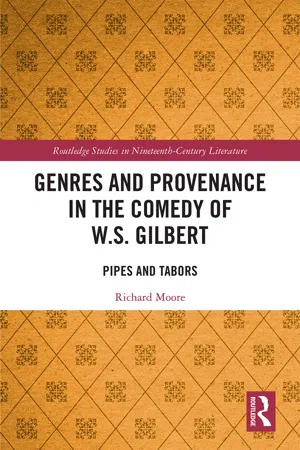
In The Progress of Fun W.S. Gilbert was considered, not as a 'classic Victorian', but as part of an on-going comedic continuum stretching from Aristophanes to Joe Orton and beyond. Pipes and Tabors continues the story, covering the comedic experience differently by reference to genres. Here – treated in relation to a line of significant others – we discover how Gilbert responded to areas such as the Pastoral, the Irish drama, nautical scenarios, melodrama, sensation-theatre, the nonsensemode, pantomime spectaculars, fairy plays, and classical farce. Also included is a wider look at his relation to various European musical forms and (for instance) to the English line of wit and the Elizabethan pamphleteers.
To consider a writer not so much by a study of individual works as by threads of linking generic modes tells us a great deal about cultural interconnections and the richly textured nature of theatrical experience. Pipes and Tabors offers a tapestry of overlapping genres and treatments, showing not just the design of the finished products but the shreds and patches which form the underside of the weave. According to Dorothy L. Sayers, life itself offers us the apparent loose ends of a design which will only be revealed from the front after death. In terms of Gilbertian comedy, we are privileged to be able to track both the effort of the weave and the skill of the finished product. On the way we will also discover some new links and sub-text implications about other 19th century denigrated groups which were buried from sight for too long.
- 336 pages
- English
- ePUB (mobile friendly)
- Available on iOS & Android
eBook - ePub
About this book
Information
Part 1
The Gilbertian Background
Harlequin, Masque, and Anti-masque
Most writers have a key interest or inspirational figure affecting and infiltrating their own writing. In Gilbert’s case one such is his obsessively reworked Harlequin. Over the years, this character had developed from a devilish figure to a dim-witted servant to an agile acrobat. In Gilbert he is sometimes also a weary self-aware failure.
The links, however, go back much further. They extend from Hellequin legends, to the Mediaeval mystery plays and thence – rather circuitously – to the Commedia dell’ Arte. By the 17th century, adaptations of commedia characters were familiar to English audiences, a situation further affected by particular circumstances. Following the suppression of unlicensed Parisian theatres, numerous French performers joined the London circuits. This encouraged a non-speaking dance mode, the English harlequinades becoming primarily visual, though limited dialogue was later admitted.1
Throughout the 18th century the basic ingredients of the Harlequinade remained familiar, but within continuity again there was change. Drury Lane’s Robinson Crusoe; or, Harlequin Friday (1781–1782) seems to be the first pantomime to separate the opening and the Harlequinade into two distinct halves. Earlier Harlequin’s episodes had often been inserts, as in Perseus and Andromeda (1730), where the comic episodes ridicule and undercut the serious parts.2 Now, for the first time the early scenes (starring Grimaldi) told the main story of Robinson’s adventures, while the last part depicted the antics of Harlequin and his comedic band.
The gradual separation of the Harlequinade had intermediate aspects. Harlequin and Pierrot might, for instance, be rescued from cannibals in the first part, before later starring in the Harlequinade. The bridging of the two would eventually lead to an ever-more extended transformation scene, with pantomime characters such as the Pantomime Prince themselves transformed into Harlequinade characters.
Even before 1782, separation of a sort had existed. In the patent London theatres, productions interweaving classical stories with music and ballet might end with a so-called comic ‘night scene’. One key development occurred in 1716 when John Weaver, the dancing master at Drury Lane, presented The Loves of Mars and Venus, described as ‘a new Entertainment in Dancing after the manner of the Antient Pantomimes’. At Lincoln’s Inn, there were similar novelties. Here John Rich performed as a mute dancing Harlequin in similar (but rival) productions.
John Rich, in fact, was far more than a dancer. It was he who was responsible for the New Theatre at Lincoln’s Inn Fields (1714), which he managed until in 1732 he opened the Theatre Royal, Covent Garden. From 1717 to 1760 he was the leading Harlequin, moving away from the poor, dishevelled, loud, and crude characterization to a colourfully dressed mime-artist, performing fanciful tricks, dances, and magic. This had the further advantage of dispensing with his unappealing speaking voice. The emphasis became mimetic and visual, Harlequin gaining increasing power to create stage magic in league with offstage craftsmen working trick scenery.
By the time Gilbert took up his playwriting pen, the transformative Harlequin was well established. Armed with a magic sword or bat (actually a slap-stick) he treated his weapon as a wand, striking the scenery to sustain the illusion of changing the setting from one locale to another and transforming objects by magical means. By now, however, the bridge between play and Harlequinade was usually effected by a fairy. Meanwhile, theatrical structures were becoming more diverse. In the 18th century a leading actor, dancer, and/or playwright might single-handedly form a theatre company, choose the plays, perform leading roles, and manage the company’s business.
ii
Harlequin and his companions throve on artifice. Many of the conceptions were consciously ‘stagy’, some of them derived from that most highly wrought of scenarios, the court masque. This had its own mirror-opposite, the anti-masque, usually taking the form of a comic or grotesque dance presented before or between the acts. Gilbert himself sometimes uses an anti-masque element, though displacing it from its normal position. In The Grand Duke Ludwig’s bacchanalian court offers a kind of anti-masque effect offsetting the rigidly controlled ceremonial of Rudolph’s penny-pinching rituals. The implicit seasonal dimension meanwhile inverts a common court masque motif. Far from being sumptuous, extravagant, and adored, Rudolph is less a sun-king than a despised and vilified embodiment of a life-denying wintry regime.
The sun-king concept gains in significance when we note how many masques – both English and French – exploited it. Charpentier’s pastoral entertainments Les arts florissants and La couronne de fleurs (1685) were, for instance, commissioned to celebrate peace after the military victories of the sun-king Louis XIV. La couronne features celebrating shepherds, using an adaptation of Charpentier’s own Prologue to Molière’s comedy-ballet Le malade imaginaire. Les arts florissants shows Poetry, Painting, and Architecture proclaiming sumptuously how they glorify Louis XIV, a ruler whom they directly address.
The original court masque has its own convoluted history. Probably its origins lie in Italy where forms of it included the intermedio, a musical spectacular performed between the acts of a play to celebrate special occasions and anniversaries. Sometimes linked with pageant, this looks forward to later opera. Music, dancing, acting, and song are framed within an elaborate stage design, the architectural structures and rich costumes complementing a deferential allegory flattering to the patron.
The pageant-masque was itself something of a genre-blend. In the tradition of masque, Louis XIV himself danced in ballets at Versailles. Gluck’s Orfeo (1762/1774) – a festa teatrale – is operatically conceived but ends with dancing nymphs and shepherds. In Louis X1V’s case the music was often sourced from Jean-Baptiste Lully, himself Italian-born though denying any Italianate influence on his French baroque music.
The use of the masque as a tribute to a glorious monarch is well documented. It is shown, for instance, in Ben Jonson’s Masque of Blackness. First performed in 1605 at Whitehall, this opens to a scene of water-nymphs played by Queen Anne and her ladies-in-waiting. These are dressed in costumes of blue, silver, and pearl to contrast with the dark painted hues of their skin. After they have seated themselves in a giant seashell, two male actors appear on stage, one being Oceanus (god of the Atlantic Ocean) and the other Niger (Oceanus’s son). Oceanus asks Niger why he has changed his river’s course. Niger explains that he diverted at the behest of his daughters who are Ethiopian water-nymphs and hence also the masquers sitting in the seashell.
The point about all this is that it has a twofold purpose. Partly it panders to the Queen’s whim to appear as a ‘blackamore’ and partly it looks towards the hailing of her husband as a black-bleaching sun. Niger’s daughters, the River explains, have recently been informed by northern poets that they are not as beautiful as they once believed. Despite being the first goddesses ever created, they now curse their progenitor sun for making them too dark. Fortunately, the moon goddess, Aethiopia, has recently arisen in their aid. What they must do is to find a land whose name ends in -tania where they will find a suitable resolution.
Needless to say, the end of this quest is arrival in Britannia, a land ruled by a sun-like king named James. His potent light of reason will bleach away their blackness. The implicit racial assumptions are obvious, but the idea of a glorious monarch goes back much further. It is exemplified in the rising sun badge of Richard II which is inverted to a setting sun in Shakespeare’s treatment.
iii
Gilbert’s own reversal of monarchical glory is seen many times. King Paramount is an intimidated monarch in thrall to his controlling wise men. King Gama is deformed, spiteful, and disliked. Rudolph is a mean-minded runt, and Ludwig an imposter. Marco and Giuseppe – again in a substitute-king motif – go equally against type. They are republican monarchs subservient to their own court. Even the current incumbent is hardly flattered. Rudolph references Queen Victoria’s Hanoverian relations. When the Pirates yield at the invocation of the sacred name of Queen Victoria, the treatment is that of burlesque.
The inversion of the tendency of the masque is part of Gilbert’s anti-privilege stance, exemplified in his Hymn to the Nobility.3 He is, however, surely aware that a more common trend is the opposite. Even in the 18th century, when masques were less frequently staged, their royalist or patriotic credentials survived. Rule, Britannia (music by Arne) originated in Alfred, a masque about Alfred the Great co-written by James Thomson and David Mallet. It was devised to celebrate the third birthday of Augusta, daughter to the Prince of Wales, its first eight bars, in Wagner’s view, summing up the British psyche.
iv
Even when masque began to lose popularity, it was not completely submerged. During the late 17th century, English semi-operas by composers such as Henry Purcell included masque scenes inset between the main drama’s acts. Here too there was often a political element. Dryden’s Albion and Albanius (music by Louis Grabu) is pure Stuart propaganda. Traditionally, the anti-masque had featured lower-class characters whose discord opposed harmony. The main masque linked the king with the sweeter music of a higher class, loyally bound to his allegiance. The anti-masque was generally played by professional actors. This left members of the court to be the main (but mute) performers in the masque’s tableaux and dancing.
v
The above does not mean that masque forms were static. Gradually there developed a tendency to split the elements, with the anti-masque developing into farce and/or pantomime. In the interim the single anti-masque had already developed into several, preceding the main item. The final transition from anti-masque to masque was itself a precursor. It looks to the elaborate transformation scenes in Victorian pantomime.
Nowadays the concept of the ‘anti-masque’ is generally attributed to Ben Jonson. But wild man scenarios had existed much earlier. One example is referenced in a 9th- or 10th-century Spanish penitential, alluding to a heathen dance, which clearly demanded atonement.
The heathen dance probably originates in a Frankish source but its actual details are disputed. Three key figures are Orcus, Maia, and Pela, all possibly represented in disguise. The identity of Pela is unknown, but Maia is sometimes identified as the earth goddess wild woman (Holz-maia in later German glossaries) or as the embodiment of a devilish May (Maia) festival. In the latter interpretation pelam becomes a corruption of pellacem (wax) and exercised pelam means the donning of animal skins. Either way, names related to Orcus are associated with wild man festivals throughout the Middle Ages.4
The wild man concept essentially suggests a link between man and beast. In the margins of a late 14th-century Book of Hours, wild people are shown as being of the wilderness. They are associated with hairiness – possibly the hairiness of ‘Hairy Cain’ or Harlequin – and by the 12th century they are almost invariably described as being hirsute. Another link is with the Charivari, itself related to the English skimmington and German Katzenmusik. This refers to a folk custom in which a parade was staged through a community accompanied by a discordant mock serenade. In the first and most violent form, a wrongdoer would be dragged from home or work-place, paraded by force, and probably pelted and dunked. Less drastically a neighbour might be carried through the streets impersonating the target and singing ribald verses mocking him. In a final form – as in The Mayor of Casterbridge – a substitute effigy would be employed, followed by rough music played on kettles, drums and pans. Here the abused effigy would ofte...
Table of contents
- Cover
- Half Title
- Series Page
- Title Page
- Copyright Page
- Table of Contents
- List of Figures
- Acknowledgements
- Introduction and Parameters
- Part 1 The Gilbertian Background
- Part 2 Genres and Their Treatment
- Index
Trusted by 375,005 students
Access to over 1.5 million titles for a fair monthly price.
Study more efficiently using our study tools.
Frequently asked questions
Yes, you can cancel anytime from the Subscription tab in your account settings on the Perlego website. Your subscription will stay active until the end of your current billing period. Learn how to cancel your subscription
No, books cannot be downloaded as external files, such as PDFs, for use outside of Perlego. However, you can download books within the Perlego app for offline reading on mobile or tablet. Learn how to download books offline
Perlego offers two plans: Essential and Complete
- Essential is ideal for learners and professionals who enjoy exploring a wide range of subjects. Access the Essential Library with 800,000+ trusted titles and best-sellers across business, personal growth, and the humanities. Includes unlimited reading time and Standard Read Aloud voice.
- Complete: Perfect for advanced learners and researchers needing full, unrestricted access. Unlock 1.5M+ books across hundreds of subjects, including academic and specialized titles. The Complete Plan also includes advanced features like Premium Read Aloud and Research Assistant.
We are an online textbook subscription service, where you can get access to an entire online library for less than the price of a single book per month. With over 1.5 million books across 990+ topics, we’ve got you covered! Learn about our mission
Look out for the read-aloud symbol on your next book to see if you can listen to it. The read-aloud tool reads text aloud for you, highlighting the text as it is being read. You can pause it, speed it up and slow it down. Learn more about Read Aloud
Yes! You can use the Perlego app on both iOS and Android devices to read anytime, anywhere — even offline. Perfect for commutes or when you’re on the go.
Please note we cannot support devices running on iOS 13 and Android 7 or earlier. Learn more about using the app
Please note we cannot support devices running on iOS 13 and Android 7 or earlier. Learn more about using the app
Yes, you can access Genres and Provenance in the Comedy of W.S. Gilbert by Richard Moore in PDF and/or ePUB format, as well as other popular books in Literature & Literary Criticism. We have over 1.5 million books available in our catalogue for you to explore.