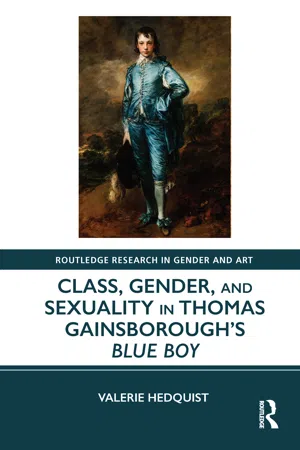
The reception of Thomas Gainsborough's Blue Boy from its origins to its appearances in contemporary visual culture reveals how its popularity was achieved and maintained by diverse audiences and in varied venues. Performative manifestations resulted in contradictory characterizations of the painted youth as an aristocrat or a "regular fellow," as masculine or feminine, or as heterosexual or gay. In private and public spaces where viewers saw the actual painting and where living and rendered replicas circulated, Gainsborough's painting was often the centerpiece where dominant and subordinate classes met, gender identities were enacted, and sexuality was implicitly or overtly expressed.
- 202 pages
- English
- ePUB (mobile friendly)
- Available on iOS & Android
eBook - ePub
Class, Gender, and Sexuality in Thomas Gainsborough’s Blue Boy
About this book
Information
1 Private Beginnings, Public Performances
Determined to display his artistic talents and attain a more secure social standing, Thomas Gainsborough painted The Blue Boy as a private act of emulation that met public goals of increased patronage and renown (Figure 0.1). His intimate portrayal of an unassuming youth in courtly dress followed portrait conventions established by Anthony van Dyck, a Flemish artist who had worked in England for the Stuarts in the early-seventeenth century. Although the portrait undoubtedly captured a good likeness of an actual person, Gainsborough was unencumbered by the expectations of a contemporary sitter, as it was neither commissioned nor of a well-known figure. Instead, the skillfully rendered anonymous boy performed an alternate identity and referred to a revered historical past that appealed to the aristocrats, landed gentry, business owners, and professionals who assembled in the spa community of Bath. When Gainsborough’s Blue Boy was exhibited along with Johann Zoffany’s painting of the royal family with similarly attired figures at the Royal Academy of Art’s second annual exhibition in 1770, the varied connotations suggested by Van Dyckian references in performative portraiture were on display. In particular, this anachronistic fancy dress recalled the reign of Charles I and was a favorite costume for masquerades where role-reversals led to performative transformations that were both liberating and dangerous.
A Spa Setting for The Blue Boy
Gainsborough’s painting had its beginnings in Bath where a convergence of classes relaxed in an ancient thermal spa settled by the Romans and fully revitalized during the Georgian era as a large leisure resort. 1 During the intervening centuries, while Bath’s economic fortunes waxed and waned, infirm visitors continued to soak in or drink the sulfurous hot spring waters collected in pools in the city center. In guidebooks, histories, and medical treatises, these waters had been endorsed as cures for countless ailments, including gout, eczema, and infertility. In the seventeenth century, visits by a succession of Stuart kings and queens enhanced Bath’s growing popularity as a fashionable hub of health and repose. When Queen Anne (1665 r. 1702–1714) visited the city in 1702 and 1703, Bath had about 3,000 inhabitants. By 1800, it was the tenth largest town in England, with a population of about 30,000. 2 Between October and May, during the height of tourist season, the city teemed with visitors. Some newcomers, such as the painter Gainsborough, who arrived in 1758, intended to remain in Bath year-round and capitalize on the prosperous, growing commercial center. 3
Bath’s success as a holiday destination for diverse social classes largely resulted from the efforts of one man, the professional gambler and businessman Richard “Beau” Nash who arrived from London in 1705. Nash had tastes similar to the other, mainly urban guests, whose expectations were met by his efforts to establish clean and stylish lodgings, build new entertainment venues, and improve the spa facilities. 4 Furthermore, as the unofficial Master of Ceremonies, Nash united “the vulgar and the great” by instituting rules of behavior and orchestrating daily social interactions that encouraged polite public exchanges among visitors of different backgrounds, including royalty and aristocrats, the gentry and small-town merchants, and the very rich and solidly middle class. 5
To provide these potential clients with access to his painting room and showroom, Gainsborough lived where tourists gathered. In the first half of the eighteenth century, these districts were located close to the Pump Room (where visitors socialized and drank the waters), near the King’s Bath (one of several bathing locations), or next to the Abbey (the most important church with remnants of the earlier medieval monastic buildings). By mid-century, new housing and tourist amenities had extended up a steady climb that culminated in a circle of uniformly terraced facades of honey-colored stone surrounding a central common called the Circus. From here, one of the several converging streets led gradually to another sweeping range of residences called the Royal Crescent. With each new promenade, townhouse, and garden extending north and west, businesses relocated to ensure proximity to their customers. Initially, Gainsborough lived and established his business near the Abbey, but he too followed his clients by moving from one high-rent district to another in the Circus in 1767. 6
Whether gathering in the lower Assembly Rooms near the Abbey and the Pump Room or, by 1771, in the recently completed Upper Rooms, visitors enjoyed playing cards, dancing at weekly balls, and attending concerts and plays. The commercial desires of these part-time inhabitants, numbering as many as 12,000 at mid-century, were met by a residential population of approximately 17,000. 7 Gainsborough, too, depended economically on these customers to whom he offered a tasteful portrait business where sitters could survey his recent paintings and commission a similarly successful likeness for themselves.
Gainsborough in Bath
When he arrived in Bath, Gainsborough intended to profit from the city’s growing tourism and real estate economies and to cultivate advantageous social ties to further his artistic career. Through several calculated moves, he had already established himself as a recognized artist of landscape and portraiture. As a young man, not yet 14, Gainsborough had left his birthplace of Sudbury for London where he had apprenticed himself to the French engraver Hubert François Gravelot and collaborated with the English painter Francis Hayman. 8 He earned a modest living in London, working on theatre scenery, restoration and decorative projects, and occasionally selling individual canvases or drawings. His financial situation improved with his marriage in 1746 to Margaret Burr, the illegitimate daughter of Henry, 3rd Duke of Beaufort, and thereby the recipient of a £200 annuity. 9 Although nearly four times the annual earnings of a skilled artisan, this income was not enough to pay for the costs associated with the promising future Gainsborough imagined.
For a short while, Gainsborough returned with his wife to Sudbury where he painted local landscapes and a small number of more lucrative commissioned portraits. After the births of his daughters Mary and Margaret (in 1750 and 1751, respectively), Gainsborough transferred his business to the larger, nearby port town of Ipswich. 10 For the next six years, he received increasingly important commissions from both local community members and more prominent individuals, such as John, 4th Duke of Bedford, and the local Lieutenant-Governor, Philip Thicknesse. Despite several landscape commissions from these influential patrons, Gainsborough recognized his dependency on portraiture for a steady income. In an undated letter to his friend William Jackson, the Exeter composer and musician, the artist wrote, “in mine [profession] a Man may do great things and starve in a Garret if he does not … conform … in chusing the branch [of painting] which they will encourage & pay for.” 11 After completing The Blue Boy, Gainsborough complained again to Jackson of his paying sitters as “Painter Plagues.” 12
Despite his objections, Gainsborough welcomed the consistent earnings generated by portraiture and became well known in Ipswich. At the same time, his personal ties with patrons and fellow artists who lived and worked in Bath and in London led him to consider better markets. Painting small-scale portraits and landscapes suited him, but he recognized, in part through the advice and encouragement of others, that he could broaden his pictorial interests and pursue a grander scale of portraiture elsewhere.
In fall 1758, the local newspapers announced the impending arrival of Gainsborough in Bath, where he lived for the next 15 years. 13 Gainsborough earned an early commendation in December 1758 from the poet laureate William Whitehead who wrote, “We have a painter here who takes the most exact likenesses I ever saw. His painting is coarse and slight, but has ease and spirit.” 14 Later, Gainsborough’s friend Ozias Humphry confirmed the artistic merit of his acquaintance by noting, “In Bath his general practice was in portraiture, in which he had peculiar excellence and frequently produced pictures of surprising resemblance and perfection.” 15 These recognized talents attracted important customers for whom Gainsborough produced portraits during the winter spa season and landscape drawings and paintings during the summer time. During his years in Bath, he...
Table of contents
- Cover
- Half-Title
- Series
- Title
- Copyright
- Contents
- List of figures
- List of plates
- Acknowledgements
- Introduction
- 1 Private Beginnings, Public Performances
- 2 The Blue Boy from Gainsborough’s Showroom to Grosvenor’s Picture Gallery
- 3 Public Recognition
- 4 Reproducing The Blue Boy
- Plates
- 5 Farewell to England
- 6 Welcome to America
- 7 Changing Roles for The Blue Boy
- Conclusion
- Bibliography
- Index
Trusted by 375,005 students
Access to over 1.5 million titles for a fair monthly price.
Study more efficiently using our study tools.
Frequently asked questions
Yes, you can cancel anytime from the Subscription tab in your account settings on the Perlego website. Your subscription will stay active until the end of your current billing period. Learn how to cancel your subscription
No, books cannot be downloaded as external files, such as PDFs, for use outside of Perlego. However, you can download books within the Perlego app for offline reading on mobile or tablet. Learn how to download books offline
Perlego offers two plans: Essential and Complete
- Essential is ideal for learners and professionals who enjoy exploring a wide range of subjects. Access the Essential Library with 800,000+ trusted titles and best-sellers across business, personal growth, and the humanities. Includes unlimited reading time and Standard Read Aloud voice.
- Complete: Perfect for advanced learners and researchers needing full, unrestricted access. Unlock 1.5M+ books across hundreds of subjects, including academic and specialized titles. The Complete Plan also includes advanced features like Premium Read Aloud and Research Assistant.
We are an online textbook subscription service, where you can get access to an entire online library for less than the price of a single book per month. With over 1.5 million books across 990+ topics, we’ve got you covered! Learn about our mission
Look out for the read-aloud symbol on your next book to see if you can listen to it. The read-aloud tool reads text aloud for you, highlighting the text as it is being read. You can pause it, speed it up and slow it down. Learn more about Read Aloud
Yes! You can use the Perlego app on both iOS and Android devices to read anytime, anywhere — even offline. Perfect for commutes or when you’re on the go.
Please note we cannot support devices running on iOS 13 and Android 7 or earlier. Learn more about using the app
Please note we cannot support devices running on iOS 13 and Android 7 or earlier. Learn more about using the app
Yes, you can access Class, Gender, and Sexuality in Thomas Gainsborough’s Blue Boy by Valerie Hedquist in PDF and/or ePUB format, as well as other popular books in Art & Art General. We have over 1.5 million books available in our catalogue for you to explore.