eBook - ePub
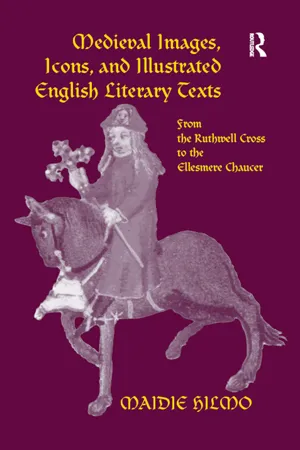
Medieval Images, Icons, and Illustrated English Literary Texts
From the Ruthwell Cross to the Ellesmere Chaucer
- 344 pages
- English
- ePUB (mobile friendly)
- Available on iOS & Android
eBook - ePub
Medieval Images, Icons, and Illustrated English Literary Texts
From the Ruthwell Cross to the Ellesmere Chaucer
About this book
The function of images in the major illustrated English poetic works from the Anglo-Saxon period to the early fifteenth century is the primary concern of this book. Hilmo argues that the illustrations have not been sufficiently understood because modern judgments about their artistic merit and fidelity to the literary texts have got in the way of a historical understanding of their function. The author here proves that artists took their work seriously because images represented an invisible order of reality, that they were familiar with the vernacular poems, and that they were innovative in adapting existing iconographies to guide the ethical reading process of their audience. To provide a theoretical basis for the understanding of early monuments, artefacts, and texts, she examines patristic opinions on image-making, supported by the most authoritative modern sources. Fresh emphasis is given to the iconic nature of medieval images from the time of the iconoclastic debates of the 8th and 9th centuries to the renewed anxiety of image-making at the time of the Lollard attacks on images. She offers an important revision of the reading of the Ruthwell Cross, which changes radically the interpretation of the Cross as a whole. Among the manuscripts examined here are the Caedmon, Auchinleck, Vernon, and Pearl manuscripts. Hilmo's thesis is not confined to overtly religious texts and images, but deals also with historical writing, such as Layamon's Brut, and with poetry designed ostensibly for entertainment, such as the Canterbury Tales. This study convincingly demonstrates how the visual and the verbal interactively manifest the real "text" of each illustrated literary work. The artistic elements place vernacular works within a larger iconographic framework in which human composition is seen to relate to the activities of the divine Author and Artificer.Whether iconic or anti-iconic in stance, images, by their nature, were a potent means of influencing the way an English author's words, accessible in the vernacular, were thought about and understood within the context of the theology of the Incarnation that informed them and governed their aesthetic of spiritual function. This is the first study to cover the range of illustrated English poems from the Anglo-Saxon period to the early 15th century.
Information
Table of contents
- Cover
- Half Title
- Dedication
- Title Page
- Copyright Page
- Table of Contents
- List of Illustrations
- Illustration Acknowledgments
- Preface
- Acknowledgments
- Epigraphs
- Introduction by Kathryn Kerby-Fulton
- 1 Reading Medieval Images
- 2 Visual and Verbal Manifestations of the Dual Nature of Christ on the Ruthwell Cross
- 3 The Wisdom and Power of the Creative Word: Images for Meditation and Transformation of Self and Society in Late Anglo-Saxon England
- 4 The Revival of the Vernacular and the Illustrated Caligula, Auchinleck and Vernon Manuscripts
- 5 Creating a Visual Narrative of the Spiritual Journey to the New Jerusalem in the Pearl Manuscript
- 6 Framing Chaucer’s Canterbury Tales for the Aristocratic Readers of the Ellesmere Manuscript
- A Select Bibliography
- Index of Manuscripts
- General Index
- Index of References
Trusted by 375,005 students
Access to over 1.5 million titles for a fair monthly price.
Study more efficiently using our study tools.
Frequently asked questions
Yes, you can cancel anytime from the Subscription tab in your account settings on the Perlego website. Your subscription will stay active until the end of your current billing period. Learn how to cancel your subscription
No, books cannot be downloaded as external files, such as PDFs, for use outside of Perlego. However, you can download books within the Perlego app for offline reading on mobile or tablet. Learn how to download books offline
Perlego offers two plans: Essential and Complete
- Essential is ideal for learners and professionals who enjoy exploring a wide range of subjects. Access the Essential Library with 800,000+ trusted titles and best-sellers across business, personal growth, and the humanities. Includes unlimited reading time and Standard Read Aloud voice.
- Complete: Perfect for advanced learners and researchers needing full, unrestricted access. Unlock 1.5M+ books across hundreds of subjects, including academic and specialized titles. The Complete Plan also includes advanced features like Premium Read Aloud and Research Assistant.
We are an online textbook subscription service, where you can get access to an entire online library for less than the price of a single book per month. With over 1.5 million books across 990+ topics, we’ve got you covered! Learn about our mission
Look out for the read-aloud symbol on your next book to see if you can listen to it. The read-aloud tool reads text aloud for you, highlighting the text as it is being read. You can pause it, speed it up and slow it down. Learn more about Read Aloud
Yes! You can use the Perlego app on both iOS and Android devices to read anytime, anywhere — even offline. Perfect for commutes or when you’re on the go.
Please note we cannot support devices running on iOS 13 and Android 7 or earlier. Learn more about using the app
Please note we cannot support devices running on iOS 13 and Android 7 or earlier. Learn more about using the app
Yes, you can access Medieval Images, Icons, and Illustrated English Literary Texts by Maidie Hilmo in PDF and/or ePUB format, as well as other popular books in Literature & Literary Criticism. We have over 1.5 million books available in our catalogue for you to explore.