Since the mid-1990s, political, legal, and historical debates about Nazi theft and confiscation of property, the use of slave labor during World War II, and restitution and compensation have reemerged. Revisiting the National Socialist Legacy presents completely new historical research on these issues conducted worldwide.This volume responds to concern about Holocaust era assets in Europe, the United States, and Latin America. It focuses on both reexamination of the history of National Socialist property theft and employment of forced labor in the wartime economy, and the compensation and restitution solutions advanced in various European and Latin American countries since 1945.
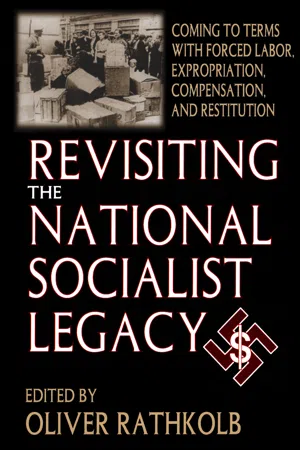
eBook - ePub
Revisiting the National Socialist Legacy
Coming to Terms with Forced Labor, Expropriation, Compensation, and Restitution
- 480 pages
- English
- ePUB (mobile friendly)
- Available on iOS & Android
eBook - ePub
Revisiting the National Socialist Legacy
Coming to Terms with Forced Labor, Expropriation, Compensation, and Restitution
1. At the Nexus of Justice, Media Coverage, Historical Scholarship and Politics
The German Industry Initiative for the Foundation “Rememberance, Responsibility and the Future”
Humanitarian gesture and creation of legal peace
In the context of a wartime economy, German companies were intertwined with the Nazi regime and, as such, implicated in the crimes committed by that regime. Persecution and forced labor were policies actively pursued by the Nazi regime. In recognition of this fact, throughout the post-war years and extending up to the present, the Federal Republic of Germany has made compensation payments amounting to a current total of around 104 billion marks, not including the 10 Billion Marks Foundation Fund established in 2000. In the years to come, there will continue to be payments made in the billions of marks on the basis of obligations that apply under existing legislation.
Forced labor existed in a wide variety of forms with a broad range of different working and living conditions. During the Second World War between 10 and 12 million forced laborers were employed by the “Third Reich”. These figures include foreign civilians, prisoners of war, and concentration camp prisoners. Forced labor was used in the agricultural sector by government employers, such as local authorities, as well as in almost all areas of private industry. During the war, forced and concentration camp laborers contributed significantly to the maintenance of everyday life in Germany.
Given that the London Debts Agreement of 1953 postponed resolving the reparations issue until after the conclusion of a peace treaty, questions regarding compensation for crimes committed by the Nazi regime, such as forced labor, went unanswered to a certain extent. In the wake of the Two-Plus-Four Treaty of 1990, which is also seen as a peace treaty, the forced labor issue took on renewed significance.
At the same time, as a result of the changes that took place in the Soviet Union and the lifting of the Iron Curtain, new political, legal, and economic options were opened up for Central and Eastern Europe. The American legal system became available to the peoples of Central and Eastern Europe. Because of the changed political situation, Germany provided 1.5 billion marks in compensation for surviving victims of the Nazi regime in Central and Eastern Europe, establishing foundations in Poland (500 million marks), Russia and Ukraine (400 million marks each), and in Belarus (200 million marks).
In addition to the political and legal factors that led to a revival of the forced labor issue, this issue was also affected by the feeling of many aging forced laborers that they needed to do something to increase public awareness of the fate that had befallen them and to prevent it from being forgotten. US lawyers also took up the issue and recognized the opportunity to use class action suits to project their activities beyond the United States and to open up new fields of business.
How the foundation initiative was created
On February 16,1999, after numerous preliminary meetings, the CEOs of what were at first twelve (Allianz, BASF, Bayer, BMW, DaimlerChrysler, Deutsche Bank, Degussa- Hiils, Dresdner Bank, Fried. Krupp AG Hoesch-Krupp, Hoechst, Siemens, Volkswagen) and then later seventeen (Bosch, Commerzbank, Deutz, RAG, VEBA) major German companies met with Chancellor Gerhard Schroder to talk about an initiative by German companies to create a foundation that would be called “Remembrance, Responsibility and the Future”. This meeting was also motivated by the coalition agreement that had been concluded between the SPD and the Greens, which called for the creation of a federal foundation that would provide indemnification for forgotten victims of Nazi-era crimes and a federal foundation that would provide compensation for Nazi-era forced laborers with the involvement of German industry. In the course of the negotiations, it became obvious that the best solution would be to combine the two foundation concepts.
As a gesture of reconciliation, key representatives of German industry declared their willingness to provide funds for a humanitarian foundation for the purpose of undertaking a broadly based effort to alleviate the effects of Nazi-era crimes by, among other things, providing assistance to surviving forced and slave laborers who had to work for German private companies under particularly difficult conditions and to other victims of the Nazi regime who suffered particular hardships.
The intention was to resolve all as yet unresolved cases of “Aryanization” (seizure of Jewish property and expropriation of the rightful owners), to provide some compensation for suffering caused in medical experiments, etc. In general all effects of Nazi-era crimes that were connected with industrial companies and also with banks and insurance companies were to be included.
There were many different kinds of involvement or interaction in German industry by the Nazi regime. But one should always keep in mind the fact that in the long run, industry cannot get away from involvement with whatever system is in power. Industry is an unavoidable part of the system and it fulfils its economic function and pursues its own selfserving objectives under the conditions set by the system. This observation is neither a legal nor a moral statement, but rather a description of a state of affairs that in my view has nothing to do with a specifically German situation. It is inherent in any system, since industry, in keeping with its tasks and the forces that drive it, is only able to act within the system.
There is no moral justification associated with this, particularly given the fact that the crimes committed by the system were perpetrated for its own advantage and were carried out to excess.
The measures undertaken by German governments
During their occupation of Germany after the Second World War, the Allies, first and foremost the Americans, urged that the resurgent public administrations in Germany, at first the governments at the state and local levels and then later at the federal level, to address the question of restitution and indemnification; in brief, the question of compensation for Nazi-era crimes. The first laws of this kind were passed in the American occupation zone: the Restitution Act (Law No. 59) on November 10, 1947, and the Indemnification Act on April 26,1949. There were separate laws and arrangements in each of the occupation zones. However, the basis for the federal laws that were later passed in the area of reparations for West Germany as a whole were the laws and arrangements that had been created in the American occupation zone.
Since the founding of the Federal Republic of Germany, every government, in American terms every federal administration, has recognized Germany’s responsibility for the crimes committed during the Nazi era. Every federal cabinet, every party represented in the federal parliament, and every federal parliament as a whole has felt obliged to compensate as much as possible for the crimes committed, either by means of restitution, in other words the return of seized or stolen property, or by means of payments in compensation for or in recognition of crimes committed.
The compensation laws were created under considerable influence from the American government.
The withdrawal of insurance policies and bank accounts was dealt with during the Nazi regime as expropriation, as a result of which the holdings in question became the property of the state. After the war insurance policies or bank accounts belonging to victims and still in existence had to be paid out to the victims or their heirs or transferred to a successor organization determined by the military governments such as the Jewish Restitution Successor Organization (JRSO) or the United Restitution Organization (URO).
In 1975 unclaimed accounts that were still in existence were listed in accordance with the provisions of the Currency Reform Completion Act, and the assets in question were transferred to the Federal Equalization of Burdens Office.
In contrast to the situation that existed in the case of Swiss banks, there were very few instances in which overlooked accounts turned up at German banks. The same applied with regard to insurance companies in Germany. Insurance policies maintained abroad, in Eastern Europe for instance, were seized by the respective governments. The German insurance companies did not, and as a rule still do not, have access to the documents in question nor any legal rights to obtain the assets in question.
Actions and attitudes taken by German industry
As I have already indicated, the fact that German industry was implicated and involved in Nazi-era crimes is incontestable and, to a certain extent, it was inevitable. It is also a fact that there were actions on the part of industry that extended beyond the unavoidable degree of involvement with the system and, as such, had an effect that served to strengthen the system and add to the crimes committed.
In the first decades after the war, it can be noted that German industry - as well as large parts of German society in general - devoted very little attention to an analysis of the role they played during the Nazi era. Indeed, it can be said that this chapter of company history was more or less covered up and closed for discussion. This, of course, also had something to do with the fact that in the initial decades after the war there were still numerous managers of German companies who had been personally involved in one form or another. This explains why many company managers today, representatives of post-war generations, are surprised at the extent to which their companies were interlinked with the Nazi regime and the extent to which they employed forced laborers.
German industry, in general, and companies who have been attacked individually took and continue to take the view - in full agreement with all past and present governments - that they cannot be held legally responsible for what happened. The initiator and perpetrator of the crimes was the Nazi state. As such, the primary legal and moral responsibility lies with it. The Federal Republic of Germany has always faced up to and accepted this responsibility - in contrast to the former GDR. The reparations laws are rooted in this fact. The legal side of the question has always been understood as part of the reparations issue that can only be resolved on the basis of international agreements.
The objectives of the German Industry Foundation Initiative
- To promote awareness of the role played by industry in this chapter of German history.
- To make payments to surviving victims in recognition of the injustices they suffered and to help them in their present situation of financial need.
- To include all surviving victims of Nazi-era crimes, particularly those living in Central and Eastern Europe.
- To provide payments specifically for surviving victims who were exposed to particularly severe forms of forced labor (internment in concentration camps).
- To include cases of Nazi-era crimes that have not yet been given sufficient attention such as unresolved cases of “Aryanization” of Jewish property, unresolved cases in the banking and insurance sector, cases involving medical experiments, cases involving the separation of mothers and children, etc.
- To end all litigation and court actions against German companies relating to their implication and involvement in Nazi-era crimes and in the war economy during the Second World War. As such, to create legal peace.
- To create a well endowed Future Fund, the purpose of which is to create awareness of the dangers that result from the suppression and violation of human rights.
In the meantime, the Foundation Initiative has achieved nearly all of its objectives, although it should be noted that the process was more difficult than anticipated.
In December 1999 the parties involved agreed that the amount of money to be paid into the foundation fund would be 10 billion marks - 5 billion from the German Industry Sector and 5 billion from the German government. Later the sum of 100 million marks in accrued interest was added to this from the German Foundation Initiative.
In the summer of 2000, all the documents that made up the overall agreement were approved. They include the Law Creating a Foundation “Remembrance, Responsibility and the Future” passed by the Bundestag, the Executive Agreement, which is the Ger- man-American Intergovernmental Agreement, and the Joint Statement, which was signed by all the parties involved, including all plaintiff lawyers.
Bringing about the dismissal of all Nazi-era-related cases that were still pending against German companies in United States courts proved to be more difficult and more time consuming than anticipated. This has now been achieved in all important cases but one. Nevertheless, the German Foundation Initiative agreed that the payments should begin.
The Foundation Initiative has since collected the full amount of 5 billion marks from more than 6,500 companies. The final transfer of funds to the foundation took place in the beginning of October 2001, and prior to that the transfer of money to the victims had already begun. In the meantime (May 2002), nearly 700,000 claimants have received the first payment, which is in total more than 2.7 billion marks.
Whether or not these agreements will hold up, only time will tell. The Foundation Initiative and German industry certainly hope so. In connection with the activities of ICHEIC (International Commission on Holocaust Era Insurance Claims), there are still issues that are proving to be very difficult to resolve.
An Outline
I commend the Stiftung Bruno Kreisky Archiv for initiating this important conference. We are meeting exactly one month after the September 11 terrorist attack on the New York World Trade Center, which launched a new major effort to combat terrorism, especially state sponsored terrorism.
In the context of this conference the victims of the Holocaust are victims of a massive state-sponsored, extensively planned and brutally executed campaign of terror with a unique objective: the extermination of an entire people. “The Final Solution - die Endlo- sung” - encompasses the totality of this evil program. Auschwitz is no longer only a place on the map. It has become the symbol of the nearly successful physical destruction, within only five years, of European Jewry with its millennium old culture and institutions for which Alfred Rosenberg planned a “museum of the extinct race.”
The focus of this symposium is the relatively recent significant developments in the area of compensation for Nazi wrongs and restitution. It is probably my fate or responsibility to put these developments in an historic perspective. My perspective comes “from the trenches” - over 50 years of struggle for a measure of justice for the Holocaust survivors after 12 years of the worst collective trauma in the history of the Jewish people.
This struggle began immediately after the end of World War II, after the liberation of the survivors from concentration camps and...
Table of contents
- Cover
- Half Title
- Title Page
- Copyright Page
- Contents
- Introduction
- 1. At the Nexus of Justice, Media Coverage, Historical Scholarship and Politics
- 2. Commissioned History
- 3. Research on Slave and Forced Labor
- 4. National Socialist Theft: Banking, Industry, Insurance and Works of Art
- 5. History as Catharsis: Coming to Terms with the Nazi Past in Brazil, Chile, Argentina and Austria - A Comparison
- Appendix
- List of Authors
Trusted by 375,005 students
Access to over 1.5 million titles for a fair monthly price.
Study more efficiently using our study tools.
Frequently asked questions
Yes, you can cancel anytime from the Subscription tab in your account settings on the Perlego website. Your subscription will stay active until the end of your current billing period. Learn how to cancel your subscription
No, books cannot be downloaded as external files, such as PDFs, for use outside of Perlego. However, you can download books within the Perlego app for offline reading on mobile or tablet. Learn how to download books offline
Perlego offers two plans: Essential and Complete
- Essential is ideal for learners and professionals who enjoy exploring a wide range of subjects. Access the Essential Library with 800,000+ trusted titles and best-sellers across business, personal growth, and the humanities. Includes unlimited reading time and Standard Read Aloud voice.
- Complete: Perfect for advanced learners and researchers needing full, unrestricted access. Unlock 1.5M+ books across hundreds of subjects, including academic and specialized titles. The Complete Plan also includes advanced features like Premium Read Aloud and Research Assistant.
We are an online textbook subscription service, where you can get access to an entire online library for less than the price of a single book per month. With over 1.5 million books across 990+ topics, we’ve got you covered! Learn about our mission
Look out for the read-aloud symbol on your next book to see if you can listen to it. The read-aloud tool reads text aloud for you, highlighting the text as it is being read. You can pause it, speed it up and slow it down. Learn more about Read Aloud
Yes! You can use the Perlego app on both iOS and Android devices to read anytime, anywhere — even offline. Perfect for commutes or when you’re on the go.
Please note we cannot support devices running on iOS 13 and Android 7 or earlier. Learn more about using the app
Please note we cannot support devices running on iOS 13 and Android 7 or earlier. Learn more about using the app
Yes, you can access Revisiting the National Socialist Legacy by Oliver Rathkolb in PDF and/or ePUB format, as well as other popular books in History & European History. We have over 1.5 million books available in our catalogue for you to explore.