This book applies Thorstein Veblen's cultural theory to a qualitative study of the charro cowboy culture and community in Mexico. Drawing on Veblen's arguments regarding cultural lag, the peaceable and the barbaric, predatory culture, vested interest, and pecuniary interest, it examines the comportment, clothing, mannerisms, and adherence to the norms that are unique to this subculture, while considering the cultural changes within race, class, and gender dynamics of this community in relation to mainstream Mexico. With close attention to the impact of business principles and standardization on the charro, leading to changes in practices and social interactions, the author considers generational differences and the tensions that exist between newer and older charros as a result of the developing emphasis on business. A close study of the nature of cultural adaptability and the persistence of inequality regardless of mainstream illusions of equality, this volume sheds new light on our understanding of what culture is rather than what culture does, while reintroducing the neglected ethnographic streak in Veblen's work as an important methodological and theoretical tool in the interpretation of culture.
eBook - ePub
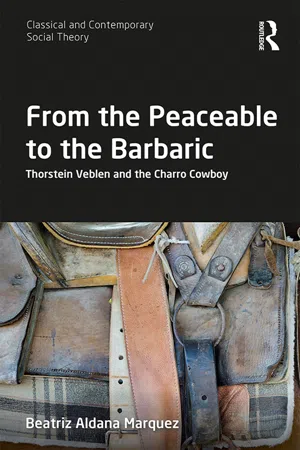
From the Peaceable to the Barbaric
Thorstein Veblen and the Charro Cowboy
- 138 pages
- English
- ePUB (mobile friendly)
- Available on iOS & Android
eBook - ePub
About this book
Information
1 Introduction
Thorstein Veblen’s cultural analysis has been used in the areas of culture and economics to explain differences in consumption based on social class. While Veblen’s most recognized theory, conspicuous consumption, is widely used in sociology, Veblen’s other vast contributions remain predominantly unknown and unused by cultural theorists in sociology. The aim of this book is to connect Veblen’s contributions using the case study of the charro (Mexican cowboy, which I will refer to as the charro cowboy) community. This community can be defined as a specific type of Mexican rural culture originating from the colonial period that later formed into a rodeo type of culture. While this work extends beyond the Untied States, it validates Veblen’s theory as transcending beyond American borders and can be useful to explore and investigate changing social cultural phenomena. The charro cowboy tradition, the national sport of Mexico, serves as the personification of centuries of culture and tradition as it is displayed through comportment and clothing, as well as the behavior, mannerisms, and adherence to the norms that are unique to this subculture. The charro cowboy community serves as an ideal case study of Veblen’s conception of the peaceable to the barbaric due to the growing influence of business principles. Although the charro cowboy tradition has changed throughout the years, Veblen’s theories can help document the cultural changes within race, class, and gender of this community in relation to mainstream Mexico, making his theories relevant to current ethnographic analyses.
Thorstein Veblen (1857–1929) was a Norwegian-American social theorist who is simultaneously praised as America’s greatest social critic and largely forgotten in the social sciences. He has been labeled variously as an economist, sociologist, and social critic. But according to his biographer, Joseph Dorfman, he devoted most of his time at the University of Chicago to studies of ethnographies and anthropology. But he is not cited by contemporary anthropologists or ethnographers. I propose to develop and apply this neglected ethnographic part of Veblen’s social theory, with regard to both theory and methodology. Like his contemporaries, Durkheim and Westermarck, Veblen developed an evolutionary theory of culture based upon extensive ethnographic research. The key points of his theory are that ancient barbaric traits are carried over into modern traits of conspicuous consumption, waste, and leisure; that the barbaric status of women as trophies is transformed but not eliminated in modern cultures; and that the “dolicho-blond” (white) cultural group carries predatory habits from the past into the present and future. I will illustrate these points, among others, in my ethnography of the charro cowboy community in contemporary Mexico.
Plan of the book
In Chapter 1, I provide a brief historical overview of Thorstein Veblen’s theoretical framework beyond his theory of conspicuous consumption. Additionally, I will offer a brief biographical sketch of his life and times based primarily upon Joseph Dorfman’s book, Thorstein Veblen and His America (1934), as well as David Riesman’s (1953) intellectual biography of Veblen. Veblen’s cultural understanding, ultimately forgotten by cultural sociologists, can be understood in terms of contamination of the original intentions of a particular culture and demonstrate their utility throughout the remainder of this book. I merge the contributions of his various works to explain why his reasoning presents the best explanation in the examination of changes in rural cultures, as in the charro cowboy tradition, exposed to features of the capitalistic spirit, rapid urbanization, and the pressure to use modern technology. Culture in this book will not be examined by differences in stages, such as developmental, but rather differences in kind. In this chapter, I also briefly delineate the complex history of the Mexican charro cowboy to familiarize the reader with its cultural significance and highlight the limitations of previous qualitative work on the charro cowboy community. Cultural shifts in the charro cowboy community are not uniform and emerge through careful examination that can only be clearly viewed through Veblen’s paradigm. Social structures within the bounds of the charro cowboy tradition designating gender relations, class dynamics, and distinctions regarding skin color resonate with Veblen’s arguments regarding cultural lag, the peaceable and the barbaric, predatory culture, vested interest, and pecuniary interests. To conclude I explain the significance of my ethnographic methodological approach and my connection to the charro cowboy community.
Chapter 2 examines Veblen’s theory of business principles as it relates to the growing capitalistic spirit of the charro cowboy community. This chapter introduces the concept of the charro cowboy jefe or the charro cowboy boss, operating like a bank, holding executive power over charro teams. The charro cowboy jefe is the owner of a charro cowboy team, solely responsible for winning competition titles, prizes, and recognition. Due to the growing pressure to win competitions, charro competitions have become more standardized than ever before and the safety of both animals and competitors has been compromised. I argue that the changing nature of the charro cowboy community, primarily the growing emphasis on business principles, has resulted in a growing rift between the new generation and older generations of charro men.
Chapter 3 analyses the socialization process of the charro cowboy with generational ties and their charro rookie counterparts using Veblen’s Theory of the Leisure Class (1899) to address class and racial differences. Generational ties become a symbolic mechanism of distinction between authentic connections to the charro cowboy tradition. I highlight the subtle way in which lower class charros use these generational ties to negotiate their legitimacy against wealthier members. The emphasis on “bloodline” as the only true component in “belonging” to the charro cowboy tradition will be the most used mechanism of defense among the younger and older generations of charro cowboys. While the older generation of charro cowboys are more likely to express that authenticity is dependent upon generational ties, the younger generation of charro cowboys with generational ties will make an effort to be more inclusive to outsiders or charro rookies. However, these expressions of inclusivity are dependent on the audience. Ultimately, I argue that charro rookies with indigenous ties experience higher incidents of marginalization and acts of exclusion from generational charro cowboys, regardless of age, further displaying the contradictions of the original intentions of charro cowboy brotherhood.
In the following two chapters I focus my attention on the role of women in the charro cowboy community. In Chapter 4, Veblen’s The Barbarian Status of Women (1899) is used to demonstrate how women in the charro cowboy community are continuously marginalized. The role of women in the cowboy community is reinforced and reproduced throughout generations of both men and women. Women in the charro cowboy community can be separated into different categories: 1) charro cowboy female family members; 2) charro cowboy love interests; and 3) female outsiders, vendedoras. I argue that this hierarchy of women in the charro cowboy community also plays a role in how women are “respected” and approached by charro cowboys. Further, the chapter explores the socialization of women in the charro cowboy community from generational ties compared to non-generational ties. The chapter also notes the important differences between these categories and illustrates how some women who resist charro cowboy culture are often and forcibly maneuvered back into submission.
Chapter 5 reflects upon the role of escaramuzas or charro cowboy women in competition. The main focus of this chapter is that escaramuzas tend to have a high income, generational ties, and are seen as respectable members of the charro cowboy community in comparison to other women in the charro cowboy community. Using both The Barbarian Status of Women (1899) and The Theory of Leisure Class (1899), escaramuzas can be classified as the ultimate form of symbolic conspicuous waste due to the vast economic investment that is needed to participate and organize competitions. Their contemporary competitions lack the same historical ties to equestrian skill of charro cowboy competitions. Escaramuzas are examined as a separate component in charro cowboy competitions and I document how these women view themselves in comparison to their charro cowboy male counterparts. Further, the chapter demonstrates how the Mexican Federation of Charros view escaramuzas as a way of making additional money, revealing their true vested interest in maintaining its tradition, even though escaramuzas hold no representative power in the Federation. Lastly, the chapter argues that charro cowboy women, even the most prestigious, are marginalized despite their fundamental role in charro cowboy history.
Chapter 6 returns to the larger societal context of Veblen’s theoretical contributions in cultural sociology. The logic of the charro cowboy tradition might seem irrational to outsiders, however, with careful consideration and appropriate cultural and theoretical framework, these irrationalities become much clearer. I argue that the charro cowboy tradition, analysed through the understanding of Veblen’s cultural logic, will continue to undergo change as long as Mexican society grows as a nation. The existing gatekeepers of the charro cowboy tradition will ultimately work hard to maintain components of the tradition as long as people remain active participants. In this concluding chapter, I address the implications of this book to scholars of Veblen’s work and encourage current and future ethnographers to incorporate his work in their assessments of culture.
Thorstein Veblen, often characterized as a quick-witted critic of capitalism, is recognized for his contribution to economic theory and sociological thought. Although a controversial figure, his most popular work, The Theory of the Leisure Class, demonstrates the changes in society that manifest social goods as evidence of wealth, power, and status. Nevertheless, this popular piece of work is not his only worthwhile contribution. Veblen remains popular with his followers, against his own wishes. In his critical biography of Veblen, David Riesman (1953, pp. 2–3) stated, “Veblen left strict instructions in his will that no biography or other memorial of him be prepared—but fortunately these instructions were disregarded by his admirers.” Although Veblen was highly respected by his admirers, his contributions often remain marginal to cultural sociologists. Veblen’s controversial personal history and social theories may have derailed his career, nevertheless, the value of Veblen’s work is timeless and essential to the analysis of cultural settings. A son of a Norwegian farming family, Veblen’s immigrant and rural background provided the necessary basis for his understanding of social theories such as innovation and parental bent, which refers to the genuine instinct to nurture and care for society (Riesman 1953). This chapter aims to review Veblen’s importance to the scholarship of economics, sociology, and most importantly cultural examination. Further, I will argue for the use of Veblen’s scholarship in the analysis of Mexico’s oldest equestrian tradition, the charro cowboy tradition, highlighting Veblen’s own use of qualitative observations to support his theoretical assertions.
Joseph’s Dorfman’s Thorstein Veblen and his America, a detailed and the most comprehensive biography of Veblen’s life, clearly highlights the influences in the development of Veblen’s scholarship. This is evident throughout explanations of his transition from his humble Norwegian background to his educational experiences. Veblen left his family farm and was separated from his cultural frame of reference. This is often the case for individuals that experience cultural shock when attending an institution of higher learning. When describing Veblen’s earlier experiences in Baltimore, Dorfman (1934) wrote:
At Baltimore Veblen found himself in the culture of the South, with its highly developed leisure class. For a while he was a boarder in a family which still clung to its aristocratic traditions. The raw youth was much amused by the family’s maintenance of the grand old pre-war style, with servants and meals which cost far more than was received from boarders.(p. 38)
Examples, like the one above, demonstrate how Veblen’s academic journey from farmland to ivy league campus played a major role in how Veblen was able to develop and form his theories and interpretation of American life, especially in his observation of the wealthy and highly educated classes. While Veblen did not deliberately use examples from his personal biography in his work, Dorfman’s outline of Veblen’s life provides the clear connection.
Another example can be observed in Veblen’s response to Mile Levasseur, a follower of the classical school of economics. In his book on American agriculture, Levasseur argued that American farmers’ complaints were, “not altogether well grounded”. Levasseur originally argued, along with others, that the disadvantages of the American farmer could be solved by lowering rent to reflect the true value of the land. Veblen responded, with true Veblenian wit, by stating that Levasseur’s opinion of the future of American agriculture is “hopeful without being enthusiastic” and pointing out the flaws of Levasseur’s logic utilizing his agricultural experience and his own development of a “workable socialistic economics” that accounted for changes in economic phenomena. His critiques, while off-putting for individuals unfamiliar with Veblen’s eccentric personality, were valid points because he disavowed economic theories that remained constant despite their inability to speak to changes in society.
Dorfman described Veblen’s early career as presenting some difficulties, however, the most significant point that gives substance to the idea of Veblen as a qualitative observer is evident in his commentary after Veblen’s appointment renewal at the University of Chicago. He provides accounts that show that Veblen himself admitted to being influenced by his experiences and observations. Dorfman stated:
In 1899, a month after the appearance of “The Barbarian Status of Women,” the last of his Journal article, Veblen published his first book, The Theory of the Leisure Class: An Economic Study in the Evolution of Institutions. He told Stuart that the general ideas of the book had been formed in his boyhood, in large part by his father’s remarks, and “Some Neglected Points in the Theory of Socialism” bears testimony that the book had been brewing in his mind before he came to Chicago.(p.174)
Veblen’s notions such as conspicuous consumption, conspicuous leisure, and pecuniary emulation were theorized by abstracting and carefully observing the occurrences of the society he lived in. As an outsider, to both his peers and ultimately his own family due his social mobility, Veblen had a talent for observing and making sense of social structures around him. Additionally, Dorfman wrote:
The data, Veblen declared in the preface, “have been preference been drawn from everyday life, by direct observation or through common notoriety, rather than from more recondite sources as a farther remove.” The introductory chapter presents the “theoretical premises” of the book. A more explicit statement of its theoretical position is made in the series of papers published in The American Journal of Sociology, “but the argument does not rest on these—in part novel—generalizations in such a way that it would altogether lose its possible value as a detail of economic theory in case these novel generalizations should, in the reader’s apprehension, fall away through being insufficiently backed by author or data.”(p. 175)
While Veblen’s harsher critics protested against his use of observational data and terminology, his supporters were able to see beyond the embedded satire to the valuable cultural analysis. Qualitative work can bridge the gap between theory and application. Veblen was able to do both to provide explanations for cultural phenomena, especially in a context that his followers could understand.
Veblen’s clear examples, pulled from observation, provided a straightforward depiction of a changing American society, but may have been too radical for classical economic scholars and early sociologists of culture. Veblen had an innovative approach to economics and sociological observations of culture that were underestimated by some of his colleagues and critics. While Veblen was fired in 1906 from the University of Chicago, prior to the emergence of the Chicago School during the 1920s, Veblen’s assessment of culture held the same ethnograph...
Table of contents
- Cover
- Half Title
- Series Page
- Title Page
- Copyright Page
- Table of Contents
- 1. Introduction
- 2. The influence of business principles
- 3. The modern charro cowboy ambition and fantasy
- 4. The ranking of charro cowboy women
- 5. Beautiful women on horses
- 6. Conclusion
- Index
Trusted by 375,005 students
Access to over 1.5 million titles for a fair monthly price.
Study more efficiently using our study tools.
Frequently asked questions
Yes, you can cancel anytime from the Subscription tab in your account settings on the Perlego website. Your subscription will stay active until the end of your current billing period. Learn how to cancel your subscription
No, books cannot be downloaded as external files, such as PDFs, for use outside of Perlego. However, you can download books within the Perlego app for offline reading on mobile or tablet. Learn how to download books offline
Perlego offers two plans: Essential and Complete
- Essential is ideal for learners and professionals who enjoy exploring a wide range of subjects. Access the Essential Library with 800,000+ trusted titles and best-sellers across business, personal growth, and the humanities. Includes unlimited reading time and Standard Read Aloud voice.
- Complete: Perfect for advanced learners and researchers needing full, unrestricted access. Unlock 1.5M+ books across hundreds of subjects, including academic and specialized titles. The Complete Plan also includes advanced features like Premium Read Aloud and Research Assistant.
We are an online textbook subscription service, where you can get access to an entire online library for less than the price of a single book per month. With over 1.5 million books across 990+ topics, we’ve got you covered! Learn about our mission
Look out for the read-aloud symbol on your next book to see if you can listen to it. The read-aloud tool reads text aloud for you, highlighting the text as it is being read. You can pause it, speed it up and slow it down. Learn more about Read Aloud
Yes! You can use the Perlego app on both iOS and Android devices to read anytime, anywhere — even offline. Perfect for commutes or when you’re on the go.
Please note we cannot support devices running on iOS 13 and Android 7 or earlier. Learn more about using the app
Please note we cannot support devices running on iOS 13 and Android 7 or earlier. Learn more about using the app
Yes, you can access From the Peaceable to the Barbaric by Beatriz Aldana Marquez in PDF and/or ePUB format, as well as other popular books in Social Sciences & Sociology. We have over 1.5 million books available in our catalogue for you to explore.