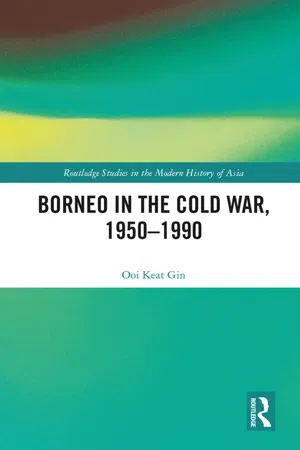
Although by about 1950 both British Borneo, including the protected sultanate of Brunei, and Indonesian Borneo seemed settled under their different regimes and well on the way to post-war reconstruction and economic development, the upheavals which affected Southeast and East Asia during the Cold War period also deeply affected Borneo. Besides the impact of the Korean and Vietnam Wars and the Malayan Emergency and communist uprisings in other Southeast Asian states, there was within Borneo the attempted communist takeover of Sarawak from the 1950s, a failed coup d'état in Brunei in 1962, Sukarno's Konfrontasi (confrontation) with Malaysia, and the horrific purge of Leftists and ethnic Chinese in the late 1960s. This book details these momentous events and assesses their impact on Borneo and its people. It is a sequel to the author's earlier books The Japanese Occupation of Borneo, 1941-1945 (2011) and Post-War Borneo, 1945-1950: Nationalism, Empire, and State-Building (2013), collectively a trilogy.
- 374 pages
- English
- ePUB (mobile friendly)
- Available on iOS & Android
eBook - ePub
Borneo in the Cold War, 1950-1990
1
Introduction
The worst thing that colonialism did was to cloud our view of our past.
Barack Obama (b. 1961), 44th U.S. president (t. 2009–2017)
Although regarded as the world’s third largest island, Borneo’s location in the midst of archipelagic Southeast Asia is often overlooked or bypassed, with priority and attention focussing on far more prominent and/or interesting areas such as mainland territories like Thailand (Siam) or Vietnam, or neighbouring islands, Singapore, Java, and Bali. It is not surprising for people to question the whereabouts of Borneo, even in this day and age of the mid-first quarter of the twenty-first century, as it had been the case for more than the past two millennia. Therefore, it is necessary to offer a geographical and demographical portraiture of the island of Borneo as a prelude to its historical analysis vis-à-vis the Cold War.
Physical and human setting
Borneo, the world’s third largest island, with an area of 427,500 square km, that is slightly bigger than California, is located at the heart of Southeast Asia (Map 1.1). Shaped like a sliced watermelon, its north and northwest shores are swept by the South China Sea, whereas the eastern part is washed by the Sulu and Celebes Seas, with the south and southeast portion fronting the Java Sea. Much of the island is hilly and mountainous, with a massive backbone of highlands running from the southwest towards the northeast, peaking at Mount Kinabalu (4,095 m). Thick tropical rain forest envelopes most of the island, with a vast assortment of flora and fauna of which the Rafflesia and the Orangutang are iconic representatives. The central mountainous spine acts as the watershed divide, with drainage patterns for the north and northwest (Rajang, 563 km) flowing towards the South China Sea, whereas the northeast (Kinabatangan, 560 km), east, and southeast (Mahakam, 980 km) drain into the Celebes Sea, and the southwest (Kapuas, 1143 km) and south into the Karimata Strait and Java Sea. With the equator slicing the island almost into two equal halves, Borneo experiences a year-round hot and wet climate with high temperatures (averaging between 27° C and 32° C) and equally high humidity (80 per cent). The lower reaches of the rivers enrich the coastal plains, whereby settlements and population tend to congregate.

Map 1.1 Geopolitical Location of Borneo and Malaysia within South and Southeast Asia
Source: Author
Overall the population is sparse and characteristically rural and agrarian, with a sprinkling of towns and cities on the main rivers and coastal fringes. Notable urban areas include Kuching (617,887),1 Sibu (247,995),2 Miri (300,543),3 Kota Kinabalu (199,742),4 Sandakan (157,330),5 Tarakan (178,900),6 Banjarmasin (612,800),7 and Pontianak (554,800).8
The contemporary political divide apportioned Borneo into four component parts (Map 1.2). East Malaysia comprises the states of Sabah and Sarawak and straddles the greater part of the north and northwest, occupying about a quarter of the island. Off the northwest coast of Sabah is the island of Labuan, a Malaysian federal territory. On Sarawak’s northeast lies the twin-teardrop of the independent sovereign sultanate of Negara Brunei Darussalam (hereinafter Brunei). The remainder of the island’s vast southeast and southern parts is Indonesia Kalimantan.
Within the four territories, the population is colourful and diverse, comprising a multitude of ethnic groups, each with its own defined language and/or dialect, socio-cultural customs and traditions, and lifestyle. More than 80 distinct ethnic communities reside in present-day Sabah and Sarawak. Sabah alone possesses 42 distinct ethnic groups, of which the Kadazandusun, Bajau, and Murut are the three largest indigenes. The Kadazandusun, a combination of two groups, Kadazan and Dusun, are the predominant peoples in Sabah. Other native communities include Orang Sungai, Rungus, Tidong, Lun Bawang/Lun Dayeh, Bruneian Malay, and Suluks. The Bajau are divided into two groups geographically and by way of life, namely the West Coast horse culture land-based Bajau Darat and the East Coast sea-dwelling Bajau Laut. While Bruneian Malays originally came from neighbouring Brunei, likewise Suluks initially migrated from Sulu. The largest non-indigenous peoples are the Chinese, with pockets of Indian, Punjabi, Javanese, Bugis, and Eurasian minorities.

Map 1.2 Contemporary Political Boundaries of Borneo
Source: Author
Out of the 40 ethnic groups in Sarawak, the Iban is the largest indigenous community, followed by Malay, Bidayuh, Orang Ulu, Melanau, and several minor groups like Penan, Kedayan, and Murut. Like in Sabah, Chinese comprise the largest non-native peoples in Sarawak.
Sunni Islam is the dominant religion of the Malays and Melanaus, whereas Christianity predominates among the Ibans, Kadazandusuns, Bidayuh, Kelabits, Kayans, Kenyahs, Muruts, Orang Hulu, and other indigenous communities. Traditional beliefs and practices in accordance to adat (customs, customary law) remain relevant to many non-Muslim native groups. The Chinese too embraced Christianity, but many still adhere to an eclectic combination of Confucianism, Daoism, and Buddhism. Bahasa Malaysia, basically the Malay language, is the lingua franca among the diverse peoples of Sabah and Sarawak, although each ethnic community possesses its own unique language and dialect. Hokkien, Teo-chew, Hakka, and Foochow inter alia are the disparate dialects spoken by the Chinese. Mandarin (Chinese language) furnishes the demands of a formal language (speech, text).
In Brunei, ethnic Malay is the umbrella term that includes Bruneian Malay, Tutong, Belait, Dusun, Murut, Kedayan, and Bisaya. Non-Malay ethnic groups are the indigenous Iban, Melanau, and Penan, among others. Chinese, Indian and Pakistani, and Europeans comprise the non-native residents. Islam, the sunni variant, is the predominant religion, and Brunei Malay is the main language of communication. Iban tended to embrace Christianity, whereas the Penan are animists and the Chinese adhere to a mixture of Buddhism juxtaposed with Daoism and Confucianism, the Chinese world of beliefs.
East Kalimantan, a territory that comprises the eastern portion of Borneo, is ethnically diverse as a result of transmigration being a major destination of origin for peoples from Java, Sulawesi, and South Kalimantan. Hence, Javanese and Bugis predominate as the major groups followed by Banjar. The indigenous Dayaks are found in the interior of central Borneo. Other minorities include Kutai, Torajan, Paser, Sundanese, Madurese, and Auto Buton. The majority ethnic community in South Kalimantan is Banjar with sub-groups of Banjar Kuala, Banjar Pahuluan, and Banjar Batang Banyu besides Javanese, Madurese, and Sundanese that comprise the migrant groups. Other migrants include Bugis Pagatan and Mandar, who occupy coastal areas. The native Dayak dwell around the Meratus mountains (Dayak Bukit) and the banks of the Barito River (Dayak Bakumpai). Other minorities include peoples of ethnic Arab descent and ethnic Chinese in Banjarmasin and Martapura, and Sungai Parit in Pelaihari (Cina Parit).
Indigenous Dayak and Malay are the predominant ethnic communities in West Kalimantan’s hinterland and coastal areas, respectively. Javanese are mainly in transmigration areas, whereas the Chinese settled mainly in urban centres such as Singkawang and Pontianak. Minor groups include Bugis, Sundanese, Batak, Madurese, and Banjar.
Besides the multiethnic population, Kalimantan also possesses a multiplicity of languages and religions. Akin to Malay, Bahasa Indonesia, the national language of Indonesia, is the main means of communication. In West Kalimantan, Malay Pontianak resembles and shares with Sarawak Malay and Johor/Riau Malay. Bahasa Malaysia is largely based on the Johor/Riau Malay variant. Hakka and Teochew dialects predominate among the Kalimantan Chinese communities. Overall the linguistic diversity extends over more than 200 dialects.
Religious-wise Islam is the majority belief followed by Christianity (both Catholic and Protestant), Buddhism, Daoism, and Confucianism. Whilst Malay, Javanese, Sundanese, Bugis, Banjar, and Madurese adhere to Islam, Dayak mainly embrace Christianity with some still practicing traditional beliefs (animism), and some Chinese Christians, though the majority of the Chinese practise a regime of Buddhism, Daoism, and Confucianism.
The provenance of political boundaries and governance
The current political configuration of four component territories – Sarawak, Brunei, Sabah, and Kalimantan – was a colonial legacy dating back to the nineteenth century. While the Dutch made tentative approaches to what is present-day Indonesia Kalimantan in the early part of the nineteenth century, the north and northeast were nominally the domain of the Malay Muslim Sultanate of Brunei. But Brunei, by the mid-century, was a waning political force, where factionalism at the court had greatly sapped its power and influence. During the sultanate’s heyday that spanned the greater part of the fifteenth to seventeenth centuries, Brunei claimed hegemony over the entire expanse of the island and north-eastward across the Philippine archipelago extending as far north as Manila.
The arrival of an English gentleman adventurer, James Brooke (1803–1868), in 1839 literally injected ‘life’ to Borneo that was hitherto little known, largely neglected, and/or overlooked, both politically and economically. Ignorance was the main culprit but accentuated with gory tales of head-hunters and dangerous wildlife. On his way to Marudu Bay in the vicinity of present-day Sabah as part of his scientific expedition to the Celebes (Sulawesi), Brooke made a stopover at Kuching to deliver gifts to the local chief in appreciation for assistance to shipwrecked British sailors who were given a boat and provisions to return to Singapore. When the schooner Royalist sailed up the Saarawak River and Brooke and his English crew landed at Kuching in 1839, Pangeran Hashim, the uncle to the reigning Brunei sultan, was on hand to greet them. A friendship was struck between Brooke and Hashim. The latter was in Kuching, the downstream capital of the fiefdom of Sarawak then under Pangeran Mahkota, its rajah or governor, to address the issue of suppressing an anti-Brunei revolt (1836–1841) staged by the local Malays of Siniawan in league with the Bidayuh, then referred to as Land Dayaks. Owing to this uprising, Brooke was denied entry farther inland, but instead he was granted permission to visit a longhouse on the Lundu River. With his curiosity satiated, Brooke and the Royalist continued their journey to Marudu Bay and thence to the Celebes.
On his return voyage to Singapore in 1841, Brooke decided to re-visit his friend Hashim. Sarawak was still in the midst of a rebellion. Hashim offered Brooke a challenge: suppress the ongoing rebellion, and in return, be granted the rajahship of Sarawak. Brooke took up his friend’s offer, and with his small crew, launched a daring assault on the rebels’ defence perimeter. Taken by surprise, the rebels fled and thus ended the uprising. Brooke was rewarded with the fiefdom of Sarawak with the title of rajah or governor. Hence begun the era of the White Rajahs. Sarawak then was a territory between the river valleys of the Lundu in the west and Samarahan in the east, an area encompassing present-day Kuching District. Brooke (r. 1841–1868) and his successors – Charles Brooke (1829–1917; r. 1968–1917) and Charles Vyner Brooke (1874–1963; r. 1917–1946) – pushed Sarawak’s boundaries eastwards to its current configuration encompassing both the Limbang and Trusan Rivers.
In response to the Englishman Brooke’s exploits in Sarawak, the Dutch across the border to what is today Indonesia Kalimantan again took a more proactive role in this vast territory. In the 1820s, the Koninklijk Nederlands Indisch Leger (KNIL, Royal Netherlands [East] Indies Army) had moved against the Chinese kongsi in West Kalimantan in the first of many campaigns, collectively referred to as the Kongsi Wars (1822–1824, 1850–1854, 1884–1885).
The auriferous areas of West Kalimantan prompted local Malay rulers to import Chinese to work the gold and tin deposits in the late eighteenth century. Subsequently, the Chinese miners established mining companies called kongsi that not only served as a means of governance from within amongst their...
Table of contents
- Cover
- Half Title
- Series Page
- Title
- Copyright
- Dedication
- Contents
- List of illustrations
- Foreword
- Preface
- Abbreviations and acronyms
- Currencies
- 1 Introduction
- 2 The global Cold War
- 3 British Crown Colonies of Sarawak and North Borneo
- 4 Bitterness and intrigue: the Chinese Left in Sarawak
- 5 British protectorate of Brunei: discontentment amidst wealth
- 6 Kalimantan: from parliamentary democracy to guided democracy
- 7 Igniting Borneo
- 8 A cauldron of violence: massacres and guerrilla war
- 9 Conclusion
- Appendices
- Glossary
- Bibliography
- Index
Trusted by 375,005 students
Access to over 1.5 million titles for a fair monthly price.
Study more efficiently using our study tools.
Frequently asked questions
Yes, you can cancel anytime from the Subscription tab in your account settings on the Perlego website. Your subscription will stay active until the end of your current billing period. Learn how to cancel your subscription
No, books cannot be downloaded as external files, such as PDFs, for use outside of Perlego. However, you can download books within the Perlego app for offline reading on mobile or tablet. Learn how to download books offline
Perlego offers two plans: Essential and Complete
- Essential is ideal for learners and professionals who enjoy exploring a wide range of subjects. Access the Essential Library with 800,000+ trusted titles and best-sellers across business, personal growth, and the humanities. Includes unlimited reading time and Standard Read Aloud voice.
- Complete: Perfect for advanced learners and researchers needing full, unrestricted access. Unlock 1.5M+ books across hundreds of subjects, including academic and specialized titles. The Complete Plan also includes advanced features like Premium Read Aloud and Research Assistant.
We are an online textbook subscription service, where you can get access to an entire online library for less than the price of a single book per month. With over 1.5 million books across 990+ topics, we’ve got you covered! Learn about our mission
Look out for the read-aloud symbol on your next book to see if you can listen to it. The read-aloud tool reads text aloud for you, highlighting the text as it is being read. You can pause it, speed it up and slow it down. Learn more about Read Aloud
Yes! You can use the Perlego app on both iOS and Android devices to read anytime, anywhere — even offline. Perfect for commutes or when you’re on the go.
Please note we cannot support devices running on iOS 13 and Android 7 or earlier. Learn more about using the app
Please note we cannot support devices running on iOS 13 and Android 7 or earlier. Learn more about using the app
Yes, you can access Borneo in the Cold War, 1950-1990 by Keat Gin Ooi in PDF and/or ePUB format, as well as other popular books in History & Asian History. We have over 1.5 million books available in our catalogue for you to explore.