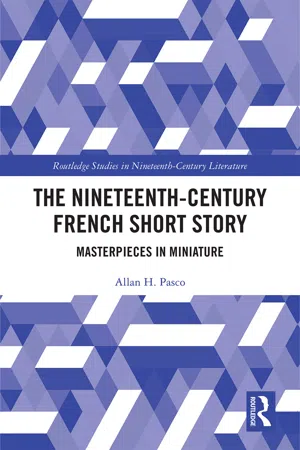
The 19th-Century French Short Story, by eminent scholar, Allan H. Pasco, seeks to offer a more comprehensive view of the definition, capabilities, and aims of short stories. The book examines general instances of the genre specifically in 19th-century France by recognizing their cultural context, demonstrating how close analysis of texts effectively communicates their artistry, and arguing for a distinction between middling and great short stories. Where previous studies have examined the writers of short stories individually, The 19th-Century French Short Story takes a broader lens to the subject, and looks at short story writers as they grapple with the artistic, ethical, and social concerns of their day. Making use of French short story masterpieces, with reinforcing comparisons to works from other traditions, this book offers the possibility of a more adequate appreciation of the under-valued short story genre.
eBook - ePub
The Nineteenth-Century French Short Story
Masterpieces in Miniature
- 198 pages
- English
- ePUB (mobile friendly)
- Available on iOS & Android
eBook - ePub
About this book
Information
1On Defining Short Stories
Compared to the novel, the short story has had remarkably little criticism devoted to it, and what theory exists reveals few definitive statements about its nature. During the last quarter of the twentieth century, critics neglected generic questions and turned to the consideration of narration or storyline or récit. They hedged on definitions, origins, major traits, and just about everything having to do with the short story as a genre. For them, the concept of genre was not important. I make this observation without censure, for one is doubtless wise to be circumspect with anything of unequaled antiquity and adaptability. I am less tolerant of post-structuralist claims that exceptions invalidate generic rules.1 As Gullason, May, and many others have pointed out, the short story may be an “underrated art,” but it remains remarkably hardy,2 so much so that Mary Doyle Springer and Elisabeth Bowen have attempted to distinguish “modern” and “artistic” short stories of the last one hundred years from more antiquated, inartistic predecessors,3 though the case is difficult to make. We remember, with H. E. Bates, that “the stories of Salome, Ruth, Judith, and Susannah are all examples of an art that was already old, civilized, and highly developed some thousands of years before the vogue of Pamela.”4 And while Geoffrey Brereton is quite right that the French have excelled in the short story or nouvelle since the sixteenth century, Clements and Gibaldi have argued convincingly that recent masterpieces continue in an age-old genre.5 Indeed, without parti pris it is difficult to read certain Milesian tales or stories from the Arabian Nights, not to mention subsequent masterpieces by such writers as Marguerite de Navarre, Chaucer, or Boccaccio, without being struck by the modernity of these creations from long ago. The subject matter may be different, the devices at variance, but no substantive trait or quality distinguishes their tales from the products of nineteenth- and twentieth- or twenty-first century practitioners. I do not say there is no difference. I argue rather that, similar to archetypes, which have certain key elements that are combined with other traits specific to a given epoch and are thus reconstituted, the short-story genre has a central, identifiable set of characteristics most of which each age and each author deploy in different ways and with different variables. The result is generically recognizable, allowing for parallel and oppositional play, but specific to the author, age, and culture.
Just as claims for the recent origin of the short story are difficult to defend, most of us would agree that we cannot be decisive about any suggested birthplace or time. It surely takes its source in the earliest days of civilization. We all know that, just as children tend to ask “Why?”, so too do human beings tell stories in their idle moments, but we cannot explain why some individuals choose to write them down, or why certain epochs have more such individuals than others. We only note that it began occurring rather early.
It might help if we could agree on a definition for the short story. Unfortunately, every time critics and theoreticians reach a modicum of agreement, some writer apparently takes it as a challenge and invents a contradiction to disrupt our comfortable meeting of minds. Certain post-structuralists have used the lack of really stable definitions, the absence of universally accepted conventions, and the difficulty of firmly establishing an undeviating external reality to justify denying credence to all but the reader. In their hands, the texts, like other objectively verifiable truths, become mere pretexts of little ultimate importance. Genre, which has no physical existence, since it consists of a shared concept of a generalized collective, thus non-individualized reality, has fared even worse. A few recent reconsiderations may signal a change,6 but, for the most part, critics continue to view the matter of fictional genres with indifference. In the words of Harry Steinhauer: “[T]here are tasks of greater substance to engage [members of the scholarly community] than the search for the phantom traits of the ideal novella.”7 Perhaps it is time to suggest that this position may make interesting theory, but it represents an extreme that is too far removed from the actual mechanics of reading literature. When readers are reading, they quite properly act as though conventions, language, texts, civilization itself do exist, and they manage rather well to reach an understanding within such contexts.
E. D. Hirsch, Jr. pointed to perhaps the most significant obstacle to defining genre:
Aristotle was wrong to suppose that human productions can be classified in a definitive way like biological species. [… A] true class requires a set of distinguishing features which are inclusive within the class and exclusive outside it; it requires a differentia specifica. That, according to Aristotle, is the key to definition and to essence. But, in fact, nobody has ever so defined literature or any important genre within it.8
Hirsch’s position raises several issues. Most important, despite an indiscriminate admiration of science and the scientific which unfortunately pervades humanistic studies, biological typology does not benefit from a differentia specifica. The distinctive features are distinctive only in their plural congruence, when they function successfully to isolate—more or less and for the most part—a locus. As any good biologist knows, biological typology is rife with problems; every class has its own variation on the duck-billed platypus.
That said, I do suspect aesthetic genres are more problematic than biological species. In the latter case, only the definition is of human invention. The external referent may change, but that alteration is at worst very slow. In aesthetics, however, both the classification and the objects under study come from the creative hearth of man and are subject to constant, sometimes revolutionary change. Moreover, no aesthetic definition can be anything but retrospective, and it must be revised and updated to accommodate innovations. The old distinction between novel and romance on the basis of the presence of realistic or fantastic material is no longer helpful, for example, and current definitions of the novel need not, and indeed should not, take subject matter into account. The hope of contriving a definition of the short story that will remain useful until the end of time will be possible only when the short story dies as a genre. Although that has happened with the epic poem, it has not done so with the short story, and I shall be content to point to common ground. The indistinct, problematic outer edges of that defined area may be safely left for individual exploration.
Lexicographers are basically collectors. After gathering as many samples of usage as possible, and discarding the outliers, they compose a definition which comes as close to standard usage as possible. If the norm changes, adaptations or completely new formulations must be devised. Just as the reality referred to by linguistic signs is neither ab ovo nor ad vitam aeternam, so too definitions must shift, change, and adjust to reflect the reality circumscribed. Definitions are not God-carved and imposed from above. Rather, they reflect shifting, communal agreement. It may be unsettling that this accord is subject to change, has exceptions, and is seldom more than approximate, but it is a well understood and accepted fact of linguistics. It should not keep us from reaching that modicum of agreement necessary for perceiving and identifying almost any human and all social activity. Such accord is certainly a sine qua non of reading. On remembering Heinreich Wölfflin’s magnificent effort, one might draw comfort from the realization that even topological failures may be helpful in understanding art. Though Wölfflin failed in his intention to categorize all art, he went far toward delineating both “classical” and “baroque.”9
No generic definition of science or literature can hope to do more than draw attention to the dominant aspects of the system, which will inevitably include elements used elsewhere. As Tynjanov explains with particular reference to literature,
Since a system is not an equal interaction of all elements but places a group of elements in the foreground—the “dominant”—and thus involves the deformation of the remaining elements, a work enters into literature and takes on its own literary function through this dominant. Thus we correlate poems with the verse category, not with the prose category, not on the basis of all their characteristics, but only of some of them.10
The problems that cause difficulty in arriving at definitions of human creations should not cause us to join Leon Roudiez in concluding, “[T]he concept of genre is not as useful as it was in the past.”11 Acceptable definitions are even more needed these days, since most, though not all, of the generically controversial works (I think in particular of creations by Godard and Sollers) were meant to disrupt categories. To deny the existence of the novel genre, for example, deprives Sollers of the opportunity to attack bourgeois society by undermining one of its conceptual categories. Surely, part of the enjoyment of works which fall on the edge of—or between—well-established generic boundaries comes from their problematic nature as genre.12
There comes a time when human cleverness, on the one hand, and stubborn ineptitude, on the other, must be reckoned with. It may be impossible to define a genre, but readers do it all the time, and they use their own definitions as guides. That such readers are consequently led astray on occasion does not impede their behavior in the slightest. A reader may not know a lesson of the ancients and of modern psychology: that we see only what we are prepared for; we understand only what is within our ken. Nonetheless—however unconsciously—readers look for congruences with what they know. History is replete with the disasters caused by those whose expectations did not correspond with their experience and who nonetheless clung to their misconceptions. As just one example, we might remember the bizarre misreadings that several centuries of readers accorded Boccaccio’s tenth tale of the tenth day about Griselda, because they did not know the story of Job.13 Perhaps such misreadings are unimportant. Perhaps. I would rather conclude that there may be wisdom in laying groundwork which aids perception and understanding. Not only does it lead to communication, thus civilization rather than the jungle, in art it can lead to the enjoyment of great beauty.
The work of defining a genre succeeds when the definition corresponds to general practice and understanding, when it includes the samples generally present, and excludes those normally left out, when its categories do not erroneously focus on elements that cause misapprehensions. No one element will ever serve as a discretionary touchstone. One hopes that the various traits together will provide a means of discrimination. The fact that both flies and snakes are cold-blooded, for example, does not prevent using “cold-blooded” in definitions of both. There will be problem cases which present intentional or unintentional difficulties, but until such exceptions become commonplace, they should be appreciated for the significance raised by their very deviations. They should not be allowed to negate existing definitions and certainly not the possibility of arriving at an accord.
If, then, one is justified in distinguishing short stories from the vast sea of narrations, the following definition might be advanced: a short story is an artistically designed, short, prose fiction. At first glance, such a formula seems uncontroversial, but whether it proves useful depends upon what it truly means, for, at second remove, one realizes that every one of the definition’s four key terms covers a library of controversy. I leave the more important problem of assessing value for later. Here I wish only to distinguish the short story from other genres. The Dick and Jane primary text readers may exploit the short story, for example, but they constitute a pathetically inartistic example of the genre, however useful they may be pedagogically. Likewise, hundreds of short stories populate literary reviews, commercial magazines, anthologies, and even the collections of oral storytellers. While everyone may reveal the intent to make art, there may not be one single work of aesthetic excellence in the lot. Masterpieces are rare. Those devices and tactics that raise the occasional work of superior art above its generic contemporaries are the focus of the following chapters, where I center on the short story that came of age in France of the nineteenth century. I have attempted to choose example...
Table of contents
- Cover
- Half Title
- Series Page
- Title Page
- Copyright Page
- Dedication
- Table of Contents
- Preface
- 1 On Defining Short Stories
- 2 Sequential Uncertainty in Vivant Denon’s “Point de lendemain”
- 3 Huysmans and the Bifocal Dilemma
- 4 Sequence Denied in Barbey’s “Don Juan” and “Le Dessous de cartes”
- 5 Sequence Framed in Mérimée’s “Carmen”
- 6 Reforming Society and Genre in Hugo’s “Claude Gueux”
- 7 Flaubert’s Talking Heads in the CyclicalTrois Contes
- 8 The Power of Ambiguity in Balzac’s Open Closures
- 9 Maupassant’s Exploding Closures
- 10 Conclusion
- Works Cited
- Index
Trusted by 375,005 students
Access to over 1.5 million titles for a fair monthly price.
Study more efficiently using our study tools.
Frequently asked questions
Yes, you can cancel anytime from the Subscription tab in your account settings on the Perlego website. Your subscription will stay active until the end of your current billing period. Learn how to cancel your subscription
No, books cannot be downloaded as external files, such as PDFs, for use outside of Perlego. However, you can download books within the Perlego app for offline reading on mobile or tablet. Learn how to download books offline
Perlego offers two plans: Essential and Complete
- Essential is ideal for learners and professionals who enjoy exploring a wide range of subjects. Access the Essential Library with 800,000+ trusted titles and best-sellers across business, personal growth, and the humanities. Includes unlimited reading time and Standard Read Aloud voice.
- Complete: Perfect for advanced learners and researchers needing full, unrestricted access. Unlock 1.5M+ books across hundreds of subjects, including academic and specialized titles. The Complete Plan also includes advanced features like Premium Read Aloud and Research Assistant.
We are an online textbook subscription service, where you can get access to an entire online library for less than the price of a single book per month. With over 1.5 million books across 990+ topics, we’ve got you covered! Learn about our mission
Look out for the read-aloud symbol on your next book to see if you can listen to it. The read-aloud tool reads text aloud for you, highlighting the text as it is being read. You can pause it, speed it up and slow it down. Learn more about Read Aloud
Yes! You can use the Perlego app on both iOS and Android devices to read anytime, anywhere — even offline. Perfect for commutes or when you’re on the go.
Please note we cannot support devices running on iOS 13 and Android 7 or earlier. Learn more about using the app
Please note we cannot support devices running on iOS 13 and Android 7 or earlier. Learn more about using the app
Yes, you can access The Nineteenth-Century French Short Story by Allan H. Pasco,Allan Pasco in PDF and/or ePUB format, as well as other popular books in Literature & Literary Collections. We have over 1.5 million books available in our catalogue for you to explore.