- 294 pages
- English
- ePUB (mobile friendly)
- Available on iOS & Android
eBook - ePub
About this book
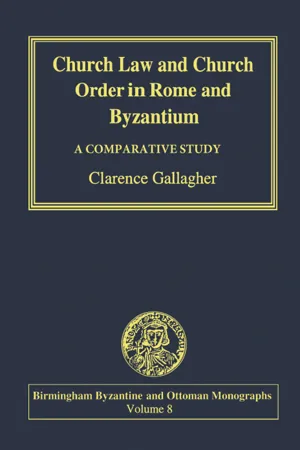
This book presents a comparative study of church order in the East and West of the Christian world. It deals with the development of canon law from the 6th century, the time of Dionysius Exiguus and John Scholastikos, up to the period of Balsamon and Gratian. While the focus is upon Rome and Constantinople, the author includes in his discussion the churches under Islamic rule, in Syria and Persia, and describes the beginnings of Slavonic canon law in Moravia. The issues of church government, the discipline of the clergy (married or celibate), and the question of divorce and re-marriage are key themes. By illustrating how these were faced in the canon law of the Christian churches of late antiquity and the earlier Middle Ages, the book highlights questions of unity and diversity within the Christian tradition.
CHAPTER ONE
Dionysius Exiguus and John Scholastikos: Rome and Constantinople in the Sixth Century
I begin by making a comparison of the canonical collections compiled by two sixth-century canonists: the Dionysiana by Dionysius Exiguus in Rome and the Synagoge in Fifty Titles by patriarch John III Scholastikos in Constantinople. It is particularly appropriate that a study of this kind should begin with these two men. First of all, each of them laid the foundations for a systematic study of canon law in Rome and in Constantinople respectively. Secondly, both men were outstanding canonists who made distinguished, not to say decisive, contributions to the development of church law. The collections they compiled became the foundation for most later canonical collections in their Churches. Thirdly, the law-books produced by them provide an interesting picture of the structure and discipline of the Church in Rome and in Constantinople in the sixth century. These early canonical collections provide a clear picture of the common law of the Church in the mid-sixth-century and they indicate the main concerns of that law. In the comparison of the two collections I pay particular attention to three specific questions: church government, marriage legislation and clerical celibacy. It also happens to be the case that the sixth century is a particularly interesting and important century from the point of view of relations between Rome and Constantinople.
Rome at the beginning of the sixth century1
At the beginning of the sixth century the city of Rome and the whole of Italy had been conquered by the Ostrogoths and was ruled by Theoderic (ruler in Italy, 493–526). Having made peace with the Emperor Zeno in Constantinople, Theoderic governed Italy from Ravenna. He governed wisely, restored prosperity and encouraged arts and letters. Although he himself was an Arian, he was very tolerant of Catholics and was reluctant to interfere in church matters. With the support of the senatorial aristocracy, the traditional Roman forms of government were kept intact and Romans remained in charge of the magistrature. Military control was kept firmly in the hands of the Goths. Theoderic’s reign saw a period of peace and prosperity in Italy with the restoration of old buildings and the construction of new monuments, particularly in Ravenna.2 He had a great admiration for Greco-Roman culture. Cassiodorus, for example, the senator, was quaestor and secretary to Theoderic and in this position worked for the reconciliation between the conquered Romans and the ‘barbarian’ Ostrogoths.
When Dionysius came to Rome from Constantinople towards the end of the fifth century, the Church was experiencing its first ever schism between Rome and Constantinople. For years there had been serious divisions within the Church in the Eastern part of the Roman Empire. Those who sympathized with the teaching of Nestorius formed one group, which was very numerous in East Syria and Persia. Nestorius, patriarch of Constantinople (428–431), had been condemned at the Council of Ephesus (431), accused of teaching that there were two separate persons in the Incarnate Christ (the heresy called ‘Nestorianism’).3 Another group was formed by those who could not accept the terminology of Chalcedon – the teaching that in Christ there is one Person in two Natures. These were called ‘Monophysites’ by their opponents because they held to the expression ‘one nature’ as this had been used by St Cyril of Alexandria, but the label ‘Monophysite’ is misleading because it gives the impression that they agreed with the teaching of Eutyches of Constantinople, which they rejected. They professed to be faithful to St Cyril of Alexandria, according to whom, in Christ there was μία φύσις τοῦ Θεοῦ λόγοῦ σεσαρκωμένη (one incarnate nature of the Word of God).4 Cyril was clearly using the word φύσις, in a way that differed from the way it was later used in the Chalcedonian definition. His followers were very numerous in Western Syria and in Egypt. The Church in Rome and the Church in Constantinople accepted the teaching of Chalcedon and so, in this respect, were divided from their Christian brethren in Western Syria and in Egypt.5
The Emperor Zeno, in an attempt to restore unity within the Empire, encouraged Akakios, patriarch of Constantinople (472–489), to produce a doctrinal statement that would be acceptable to all and so heal the divisions between the Chalcedonians and the ‘Monophysites’. Akakios accepted the challenge and drew up a christological statement of belief that, while affirming that Jesus Christ is truly God and truly man, avoided the terminology of Chalcedon that had caused the difficulties. The document was formally promulgated by the emperor in 482. It was an instrument of imperial authority addressed to the Christians of Egypt. It became known as ‘Zeno’s Edict’, and later as the Henoticon, and was sent to all the bishops in Alexandria, Egypt, Libya and Pentapolis. The Henoticon quotes from the first three ecumenical councils and affirms’ the consubstantiality of Christ with God and man, but it avoids the Chalcedonian use of the terms ‘nature’ and ‘person’.6 The Henoticon was unacceptable to the ‘Monophysites’ in Egypt – the very people it had been drawn up to reconcile. In Rome it was taken as a clear denial of the Council of Chalcedon’s teaching and the rejection of the Tomus of Leo the Great. Pope Felix III, therefore, in 484, wrote a letter of protest to Constantinople and, at a synod held in Rome that same year, patriarch Akakios was excommunicated. The reply of Akakios was to remove the name of the bishop of Rome from the diptychs.7 The first schism between Rome and the patriarchate of Constantinople had begun. It is known as the Acacian Schism and was to last for the next thirty-five years (484–519).8 Zeno’s attempt at reconciliation had resulted in total disaster, with his Empire more divided than ever.9
This was the state of affairs when the monk, Dionysius Exiguus, came to Rome towards the end of the fifth century. Little is known about the personal life and origins of Dionysius. In the preface to his canonical collection he refers to himself as ‘exiguus’, but it is not at all certain what this epithet is meant to convey.10 For the little we do know about him we are dependent on a few paragraphs in praise of him by his friend Cassiodorus. Flavius Magnus Aurelius Cassiodorus (485–580), statesman and scholar, belonged to an aristocratic Roman family and became consul in 514. He would have been an important person to have as a friend in Rome at that time. Dionysius was very highly thought of by Cassiodorus who described him in his Institutiones as follows:
The Catholic Church even today produces distinguished men, gloriously illustrious for their sound doctrine. In our own day there was the monk, Dionysius, Scythian by race, but thoroughly Roman in his way of life. He was very learned in both languages and he displayed in his behaviour the tranquillity that he had read in the books of the Lord. He had studied the divine Scriptures with such a thirst for knowledge and had understood them so well that, when questioned on any topic, he had ready at once a suitable answer. He studied logic along with me and, by the grace of God, he spent very many years of his life in glorious and exemplary teaching. I feel ashamed to talk about qualities in a colleague that I am unable to find in myself. For he was a person who combined simplicity with deep wisdom, humility with learning, moderation in speech with eloquence. Without a doubt he was worthy of conversing with kings, yet he never considered himself to be above even the lowest of the servants. May he, who used to pray with us, intercede for us so that, supported here by his prayer, we may now be helped through his merits. At the request of Stephen, Bishop of Salona,11 with brilliance and style, he made a collection of church canons from the original Greek which displays a clarity and skill in keeping with his character. These canons are today in frequent use by the Roman Church. You also should study them diligently lest you are seen to be culpably ignorant of such salutary rules.12
So he was a monk from Scythia,13 who came to Rome from Constantinople. At this time there was an active group of Scythian monks in Constantinople from the Danube delta in the Dobrudja.14 Vitalian, army commander under Emperor Anastasius, was also a Goth from the same region. Dionysius may well have been a member of this group of monks. He seems to have arrived in Rome around 497. He states in the preface to his collection of papal decretals that he never knew Pope Gelasius personally, but he expresses great admiration for that pope.15 Pope Gelasius died in November, 496. It has been suggested that it was Pope Gelasius who invited Dionysius to come to Rome in the first place to work in the Roman Curia because of his mastery of Latin and Greek. From what we know of the character of Gelasius, the dominant figure in the Roman Curia in the eighties and nineties of the fifth century, even before he was elected to the papacy, this seems not unlikely.
He was received at the monastery of St Anastasius, which housed the papal chancery as well as the papal archives. The head of this monastery was at that time the priest Julian, cardinal of St Anastasius, to whom Dionysius later dedicated his collection of papal decretals. It is thought by some historians that Dionysius was put in charge of the papal archives by the pope and that it was in this capacity that he produced his canonical collections. We do not hear of him after 526, and he must have died before 555, when Cassiodorus, writing his Institutiones, as we have just seen, refers to Dionysius as already dead. Some think that he may have retired to Vivarium, Cassiodorus’s monastery in Calabria. Dionysius was a fine scholar in both Latin and Greek. Cassiodorus tells us that his command of these languages was such that he could translate at sight from one to the other in such a way that his listeners thought he was reading from a carefully prepared written translation.
Dionysius also translated many other works from Greek into Latin which can be of use to the Church; he had such a facility in Latin and Greek that he would take in his hands any Greek books and put them into fluent Latin and again translate Latin books into the Attic tongue in such a way that you would think what flowed with such rapid fluency from his lips was what he had written down in front of him.16
His knowledge of Greek was particularly important in the Rome of that time, since there were fewer and fewer there who knew any Greek. This praise of Dionysius by Cassiodorus shows that it was unusual for a person to be bilingual in Greek and Latin in the Rome of the early sixth century. There had in fact been a steady decline in Greek speakers since the fourth century. The ignorance of Greek in Rome and of Latin in Constantinople was a serious cause of misunderstanding between the two cities. This mutual ignorance of the languages had been the result of a gradual process. At the beginning of Christianity, knowledge of Greek was widespread both in the East and in the West. Greek was the language of the Scriptures and of the liturgy. The Eucharist in Rome continued to be celebrated in Greek until the second half of the fourth century. It was only when early Christian Latin was fully developed as a literary and biblical language that it was permitted to replace Greek as the sacral language for the liturgy. This happened towards the end of the fourth century. Writers of the calibre of St Hilary of Poitiers (315–368), St Ambrose (339–397) and St Augustine (354–430) produced a polished Christian literary Latin, and St Jerome (345–420) provided the Church in the West with an excellent Latin translation of the Bible. The foundations had been laid for the development of a Roman liturgical language and style. ‘In this liturgical style, early Christian devotion, the Bible in its unique gr...
Table of contents
- Cover
- Half Title
- Title Page
- Copyright Page
- Dedication
- Table of Contents
- Abbreviations
- Preface
- Chapter One Dionysius Exiguus and John Scholastikos: Rome and Constantinople in the Sixth Century
- Chapter Two The Nomokanon and the False Decretals: Constantinople and Rome in the Ninth Century
- Chapter Three St Methodios the Canonist: The Greek Origins of Slavonic Canon Law
- Chapter Four Gratian of Bologna: The Consolidation of Pontifical Law
- Chapter Five Theodore Balsamon: The Orthodox Church in Twelfth-Century Constantinople
- Chapter Six Bar Hebraeus and Ebedjesus: The Development of Canon Law outside the Empire
- Conclusion
- Appendices
- Bibliography
- Index
Trusted by 375,005 students
Access to over 1.5 million titles for a fair monthly price.
Study more efficiently using our study tools.
Frequently asked questions
Yes, you can cancel anytime from the Subscription tab in your account settings on the Perlego website. Your subscription will stay active until the end of your current billing period. Learn how to cancel your subscription
No, books cannot be downloaded as external files, such as PDFs, for use outside of Perlego. However, you can download books within the Perlego app for offline reading on mobile or tablet. Learn how to download books offline
Perlego offers two plans: Essential and Complete
- Essential is ideal for learners and professionals who enjoy exploring a wide range of subjects. Access the Essential Library with 800,000+ trusted titles and best-sellers across business, personal growth, and the humanities. Includes unlimited reading time and Standard Read Aloud voice.
- Complete: Perfect for advanced learners and researchers needing full, unrestricted access. Unlock 1.5M+ books across hundreds of subjects, including academic and specialized titles. The Complete Plan also includes advanced features like Premium Read Aloud and Research Assistant.
We are an online textbook subscription service, where you can get access to an entire online library for less than the price of a single book per month. With over 1.5 million books across 990+ topics, we’ve got you covered! Learn about our mission
Look out for the read-aloud symbol on your next book to see if you can listen to it. The read-aloud tool reads text aloud for you, highlighting the text as it is being read. You can pause it, speed it up and slow it down. Learn more about Read Aloud
Yes! You can use the Perlego app on both iOS and Android devices to read anytime, anywhere — even offline. Perfect for commutes or when you’re on the go.
Please note we cannot support devices running on iOS 13 and Android 7 or earlier. Learn more about using the app
Please note we cannot support devices running on iOS 13 and Android 7 or earlier. Learn more about using the app
Yes, you can access Church Law and Church Order in Rome and Byzantium by Clarence Gallagher in PDF and/or ePUB format, as well as other popular books in History & World History. We have over 1.5 million books available in our catalogue for you to explore.