This book explores how intellectuals of the later Soviet decades – the 1970s and 1980s – sought to bring about the socialist utopian world. It argues that the last two decades of the Soviet Union were not characterised by state withdrawal and malaise, as some scholars have argued; attempts to envisage and enact Utopia remained as imaginative and creative as ever. The book considers what these utopian ideas looked like through housing schemes, layouts of districts and cities, design of objects and interiors, and proposals for the organisation of family and social life. Relating developments in the Soviet Union to evolving social theory and postmodernism more broadly, the book draws transnational parallels between the intellectual history of east and west in the late twentieth century.
eBook - ePub
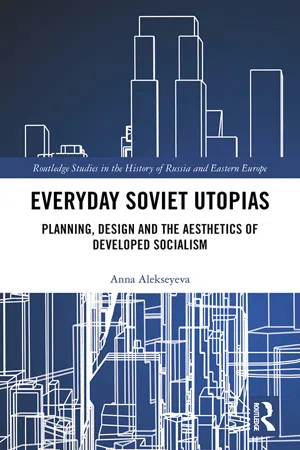
Everyday Soviet Utopias
Planning, Design and the Aesthetics of Developed Socialism
- 274 pages
- English
- ePUB (mobile friendly)
- Available on iOS & Android
eBook - ePub
About this book
Information
1 Introduction
But what distinguishes the worst architect from the best of bees is this, that the architect raises his structure in imagination before he erects it in reality.
(Marx, Capital (1867))
The everyday is a space of contradictions. It is simultaneously a site of alienation and liberation; its rhythms encompass both mundane cyclicality and the transformative potential of linearity. The everyday – or, put differently, the common place – was considered a glorified physical and discursive field dating back to the ancient Greeks: Aristotle deployed common places (topics) as instruments of skilful rhetoric, Renaissance authors used the common place to refer to a verse of ancient wisdom, and Kant’s principle of common sense (sensus communis) connected personal aesthetic tastes to the universal design of nature. Svetlana Boym traces this genealogy in her book, Common Places, and describes how reverence for the everyday dissipated in the eighteenth century as the quotidian degenerated from a figurative ideal to a literal cliché.1 Even in the face of this fall in status, a yearning for the original idyll of the everyday remained. It is no coincidence, writes Boym, that the descent of the everyday was “accompanied by a resurgence of utopian thought”.2
This book proceeds from the notion that the everyday is an instructive lens through which to study a society’s material, social and aesthetic ideals. It explores professional visions for everyday life in a developed socialist society and investigates how these ideals could have been imagined even amidst the seeming sclerosis of the last two Soviet decades. The everyday was the original staging ground from which Marx’s communist utopia flourished. The underlying principle of Marx’s materialist philosophy lay in the proposition that consciousness derives from matter, and that the transformation of society would therefore have to derive from a transformation of the material conditions of everyday life. Following in the Marxist tradition, twentieth-century European intellectuals such as Henri Lefèbvre, Michel de Certeau and Guy Debord interpreted the everyday as a realm of empowerment and resiliency against various apparatuses of social control.3 According to Maurice Blanchot, this capacity for subversion designates the everyday as a utopia – as a map for discovering what the future might look like.4
In Russia, the intellectual history of everyday life (byt) diverged from that of the western Marxist tradition, which glorified the everyday as a site of great potential. The Russian intelligentsia assumed an ‘anti-byt’ stance beginning in the nineteenth century, which associated the everyday with banality, stasis and lowbrow tastes.5 This antagonistic attitude towards the everyday has been rationalised as a manifestation of Russia’s unique ontology of everyday life. Rooted in Orthodox Christianity, this distinctive ontology was premised on the binary opposition between byt and bytie: whereas the former refers to “the ordinary flow of life … the sphere of practicality [and] above all the world of things”, the latter connotes higher spiritual or intellectual endeavours.6 As the inferior half of this cultural binary, byt was necessarily evil and profane.7 It was from this anti-byt starting point that the Bolsheviks began their pursuit of social transformation. Social progress in the Soviet context could not emerge from within the degraded substance of the everyday; it had to destroy this very substance and start anew. The Soviet notion of social progress – embodied in the image of collectivist, modernist utopia – was therefore inextricably linked to a demiurgic drive to completely reconstruct everyday life.
This book considers how Soviet professionals wrote and thought about everyday spaces and objects. It focuses on three spheres of everyday life: the urban residential area, the home and goods for household consumption. The analysis presented in the following chapters is oriented around two basic considerations: first, what visions did the intelligentsia (i.e. professional specialists) articulate for what the socialist everyday should look like; and second, what role did professionals see for themselves in controlling and configuring the everyday environment? In other words, what was the ideal socialist everyday, and how was it to be planned? These questions respectively set up the two core relationships considered throughout the following chapters: the relationship between the individual and the collective on the one hand, and between the intellectual and the Soviet public on the other. The evolution of these relationships provides insight into the changing motivations and objectives of Soviet power over time.
The Soviet everyday in historical context
The transformation of byt was a core principle of the socialist project from its very inception. In the 1920s, the revolutionary avant-garde asserted the need to attack byt and radically remake it in the process of constructing a new socio-political order. The new byt imagined by this early avant-garde prescribed alternative forms of domestic life, family structure and social relations premised on an ideal of radical communalism. Designs for collective housing and plans to comprehensively socialise domestic functions such as cooking and childcare were accompanied by progressive legislation on marriage, divorce and child rearing. Taken together, these initiatives intended to explode the physical and social dimensions of bourgeois everyday life.8 A campaign against ‘domestic trash’, inspired by Vladimir Mayakovsky’s poetry and sponsored by the Central Committee’s press arm, lambasted domestic bric-a-brac and comfort (uiut), condemning them as a sign of anti-revolutionary philistinism.9
This early period of revolutionary euphoria was followed by the Stalinist era of ‘retreat’, which allowed petit bourgeois tastes to return to the home and accommodated populist sensitivities in the domestic sphere.10 Vera Dunham termed this policy Stalin’s ‘Big Deal’, because it tolerated the family hearth, social stratification and more traditional and comfortable domestic aesthetics in exchange for a contented middle-class citizenry.11 Yet even during this assumed period of retreat, the notion that everyday life needed to be, if not necessarily transformed, then at least carefully managed, remained intact. The continued drive to control byt for ideological ends – particularly to promote labour efficiency and civic involvement – was prominently expressed in Stalin’s kul’turnost’ campaign, which prescribed proper conduct in the domestic, labour and civic spheres.12 In its attempt to align everyday norms amongst the lower strata more closely to those of the cultured intelligentsia, the kul’turnost’ programme was imbued, according to Sheila Fitzpatrick, with a “sense of becoming [and] striving”.13 Even with the capitulation to popular norms, the Stalinist Party-State never lost sight of the original Bolshevik mission of transformation.
With Nikita Khrushchev’s ascent to power in 1953, the Party’s impetus to reconstruct byt returned to the urgency and grandiose ambition of the 1920s. Khrushchev’s programme of byt reform was central to his de-Stalinising agenda, which was first coherently expressed by the Party leader at the Twentieth Party Congress in 1956. As histories of Khrushchev’s byt reform – most notably those by Susan Reid, David Crowley, Victor Buchli and Christine Varga-Harris – illustrate, Khrushchev endorsed a version of byt rooted in egalitarianism, collectivism and universal material abundance.14 The Party and specialists endeavoured to modernise and rationalise everyday life, particularly through the design of the material environment. Consumer satisfaction supplanted war and industrialisation at the top of the government’s agenda. These efforts to reform the material and social conditions of everyday life were pursued with the promise of an imminent transition to full-scale communism, which was written into the Third Party Programme of 1961. Khrushchev’s modernising dogma found its most emblematic expression in the government’s housing programme, which was inaugurated in 1957 and pledged to provide an individual apartment for every family by 1980. By the 1960s, Khrushchev’s housing scheme had more than doubled the rate of housing construction over 1950 levels, transforming the fabric of Soviet cities, neighbourhoods and domestic life in the process.15 Susan Reid has written that Khrushchev’s byt reformism created an intimate relationship between the organisation of daily life and politics, as the expert-state coalition under Khrushchev attempted to rationalise everyday life according to technocratic and scientific norms.16 In this way, the ethos of Khrushev’s byt reform effort aligned with the high-modernist planning characteristic of the post-war period in many western states.17 Here, I use the word ‘modernism’ to denote a type of lifestyle and aesthetics defined by functionalist and utilitarian norms, as well as a way of thinking. This way of thinking is encapsulated in the social and ethical perspective that posits, as Sarah Goldhagen explains, that the rational and scientific design of spaces and objects by experts can lead to a better world.18
Yet, despite the government’s ambitious intervention into residential life, the better world imagined by Khrushchev’s promise of communist utopia failed to materialise. By the 1970s, it had become evident that Khrushchev’s promises with respect to living standards and egalitarianism were unattainable in the imminent (or perhaps even distant) future. Khrushchev’s housing programme had moved many Soviet families into their own individual apartments, but the quality of housing was poor, the design of residential areas was inconvenient, and the look and feel of the emerging everyday reality was drab, monotonous and impersonal. In short, the everyday environment had become dehumanised. Faced with stagnating economic growth and waning public morale, Khrushchev’s successor – Leonid Brezhnev – had to recalibrate public expectations: in place of the earlier emphasis on communist transition, Brezhnev introduced the doctrine of developed socialism in 1971 to denote “a long-term intermediary stage preceding the emergence of full communism”.19 Khrushchev’s focus on living standards gave way to a moderation of consumerist tendencies and an emphasis on ‘socialist morality’, defined by the excision of bad habits, philistine lifestyles and anti-social behaviours, under developed socialism.20 According to the common historical narrative of the Brezhnev era, this period sa...
Table of contents
- Cover
- Half Title
- Series Page
- Title Page
- Copyright Page
- Dedication
- Table of Contents
- List of illustrations
- Acknowledgements
- 1 Introduction
- 2 Social and economic control under developed socialism: themes and context
- PART I: Everyday urbanity
- PART II: Domesticity and khoziaistvo
- PART III: Everyday objects
- Sources and references
- Index
Trusted by 375,005 students
Access to over 1.5 million titles for a fair monthly price.
Study more efficiently using our study tools.
Frequently asked questions
Yes, you can cancel anytime from the Subscription tab in your account settings on the Perlego website. Your subscription will stay active until the end of your current billing period. Learn how to cancel your subscription
No, books cannot be downloaded as external files, such as PDFs, for use outside of Perlego. However, you can download books within the Perlego app for offline reading on mobile or tablet. Learn how to download books offline
Perlego offers two plans: Essential and Complete
- Essential is ideal for learners and professionals who enjoy exploring a wide range of subjects. Access the Essential Library with 800,000+ trusted titles and best-sellers across business, personal growth, and the humanities. Includes unlimited reading time and Standard Read Aloud voice.
- Complete: Perfect for advanced learners and researchers needing full, unrestricted access. Unlock 1.5M+ books across hundreds of subjects, including academic and specialized titles. The Complete Plan also includes advanced features like Premium Read Aloud and Research Assistant.
We are an online textbook subscription service, where you can get access to an entire online library for less than the price of a single book per month. With over 1.5 million books across 990+ topics, we’ve got you covered! Learn about our mission
Look out for the read-aloud symbol on your next book to see if you can listen to it. The read-aloud tool reads text aloud for you, highlighting the text as it is being read. You can pause it, speed it up and slow it down. Learn more about Read Aloud
Yes! You can use the Perlego app on both iOS and Android devices to read anytime, anywhere — even offline. Perfect for commutes or when you’re on the go.
Please note we cannot support devices running on iOS 13 and Android 7 or earlier. Learn more about using the app
Please note we cannot support devices running on iOS 13 and Android 7 or earlier. Learn more about using the app
Yes, you can access Everyday Soviet Utopias by Anna Alekseyeva in PDF and/or ePUB format, as well as other popular books in Social Sciences & Asian American Studies. We have over 1.5 million books available in our catalogue for you to explore.