Entrepreneurs play a central role in economic growth and development, but how they do so is the subject of considerable debate. This book explains that process through an historical case study of an automobile insurance entrepreneur, Samuel P. Black, Jr., and Erie Insurance, the company he helped build. It also recounts the largely untold history of American automobile insurance.
One of this study's central themes is the role of innovation in the entrepreneurial process. The rise of Erie Insurance from a four-person enterprise in Erie, Pennsylvania, in 1925 to the fourteenth largest property-casualty insurer today was the result, in part, of Black's relentless push to innovate. His continual efforts to cut costs, develop new products, satisfy customers, increase sales, and improve operations, all contributed greatly to the company's growth. A second theme is the automobile's dramatic impact on modern America. Its takeover of mass transportation provided the basis for the development of the automobile insurance industry and created many of the opportunities that Black and Erie Insurance capitalized on. These themes combine in the history of Black and Erie Insurance to illuminate the dynamic process by which the cultural, social, economic, and technological environment creates opportunities that entrepreneurs and entrepreneurial firms exploit, and how entrepreneurial actions stimulate economic growth.
eBook - ePub
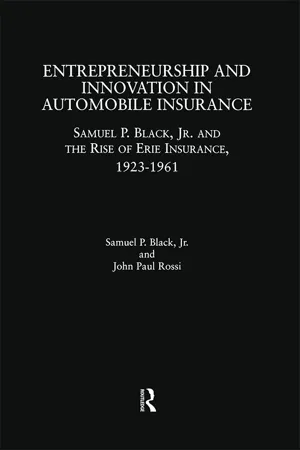
Entrepreneurship and Innovation in Automobile Insurance
Samuel P. Black, Jr. and the Rise of Erie Insurance, 1923-1961
- 304 pages
- English
- ePUB (mobile friendly)
- Available on iOS & Android
eBook - ePub
Entrepreneurship and Innovation in Automobile Insurance
Samuel P. Black, Jr. and the Rise of Erie Insurance, 1923-1961
About this book
Chapter 1
Introduction Entrepreneurship—Theory and Practice
[I]nnovation is the outstanding fact in the economic history of capitalist society.1
Joseph A. Schumpeter, 1939
This is a story that began with one man's desire to attain success. Samuel P. Black, Jr.'s yearning to achieve the American Dream—to take advantage of economic opportunities and rise in society—led him into automobile insurance in the 1920s. The industry was attractive to young people on the make because the motor car fired the imagination of his generation. The rapid, almost breathtaking, adoption of this mode of transport opened countless opportunities in the automotive and related industries. As America's "car culture" grew, so too did the auto insurance business.
Sam Black started in automobile insurance during this growth period. In 1921 he joined a rapidly expanding Philadelphia based insurer, Pennsylvania Indemnity, as a nineteen-year-old claims adjuster. In 1927 Black's big break came, Horatio Alger-like, with the offer to join a newly started automobile insurer, Erie Insurance Exchange, in Erie, Pennsylvania. Despite rapid promotion and a series of raises by his current employer, Black moved to a tiny and fragile new venture because Erie Insurance offered him the opportunity to purchase some shares of its stock. The chance to become a stockholder in the fledgling enterprise gave the young claims man the chance he was looking for. As part-owner of the new company he would be free to exercise his talents to the fullest.
Holding a variety of positions—claims manager, secretary, district sales manager, vice-president and board director, Black helped build a serviceoriented culture at Erie Insurance in his thirty-four full-time years with the company (he continued on as a board member until April 1997). His most important contribution, however, was a relentless focus on innovation. Black constantly sought a competitive advantage for the firm in an industry dominated by much larger, stronger and wealthier rivals. Applying his entrepreneurial talents to insurance underwriting (risk assessment and the design of insurance policies), Black regularly revised Erie Insurance's automobile insurance policy so that it provided policyholders with better and more extensive coverage than the policies offered by other companies. He also pushed the firm into different insurance product lines, wrote the policies to get into them, and led Erie Insurance out of Pennsylvania into new markets in other states. In the process, Black organized new departments and trained a group of managers who embraced his emphasis on customer service and continual innovation. Through all these activities, Sam Black helped make Erie Insurance an entrepreneurial firm.
As a result of the work by Black and the company's co-founder and long-time president (1931-1976), H. O. Hirt, Erie Insurance earned an enviable reputation in the industry which endures today. The company's automobile and homeowners insurance policies consistently rank high in Consumer Reports' and other consumer publications' ratings. Erie Insurance is also, according to Robert Levering and Milton Moskowitz's The 100 Best Places to Work in Ainerica, one of the U.S.'s top-rated employers.2 Indeed, the innovative service-oriented culture that Black did so much to create was essential to Erie Insurance's successful evolution from a small start-up firm in the 1920s to the U.S.'s twelfth largest auto insurer (1999).3
The History of Automobile Insurance
While this is a study of entrepreneurship, it is also one of a business, automobile insurance. For many insurers the auto line is their most important business. Historically the U.S. insurance industry was fragmented into a number of different "lines" or types of insurance—fire, life, marine, casualty, and surety. Insurance companies were, for the most part, restricted by law and custom to selling a single line of insurance until the end of World War II. After 1945 the insurance industry coalesced into two main groupings: Life-Health and Property-Casualty. Companies in the property-casualty group write automobile insurance, and today it is a $134 billion business. The automobile line generates nearly half of all the premiums (insurance sales) earned by property-casualty insurers. To provide some perspective on this figure, at the same time American automobile insurers took in $134 billion in premiums, automotive manufacturers produced and sold approximately $185 billion worth of motor vehicles and car bodies in the U.S.4 As the figures suggest and as most drivers know, automobile insurance is a costly proposition. Indeed, in some areas of the country during the 1990s, the cost of, and even access to, automobile insurance has been a major concern for many driving Americans.5
Despite the economic importance of automobile insurance, the historical literature on the topic is at best paltry.6 While fire and life insurance have received relatively widespread attention from historians, there are few serious studies of automobile insurance. The works in the field can be divided into two main groups: 1) industry analyses, and 2) corporate histories. Industry analyses have been undertaken primarily by economists, insurers, regulators, or journalists. While there are many books and articles in this area, they tend to be highly specialized and focus on cost, rate structures, and coverage. The majority of these studies have been conducted since 1960 and few provide any historical background which would be useful to understand the industry they discuss.7
The corporate histories are limited in number and vary greatly in quality. Most of them have been written at the behest of insurance companies. Even the best in this group tend to suffer from a concentration on corporate executives and internal policies, while they ignore broader social, economic, political, and technological changes.8 These changes placed motor vehicles at the center of American transportation and laid the foundation for the automobile insurance business. Consequently, they are essential to understanding the industry.
This impoverished history of automobile insurance is reflected in the study of the automotive and related industries. The fine works of John Rae and James Flink on the role of the automobile in American life largely miss the accident and insurance side of the story.9 In short, few studies cover the historical development of this important industry.
One key component of this study is its examination of the socio-economic and political environment of entrepreneurship. In many ways the rise of Sam Black, Erie Insurance, and the automobile insurance industry was tied to other factors: the tremendous expansion of the U.S. economy, the dramatic impact of the automobile on American life, and the rapid growth of its supporting physical and legal infrastructure from roads to driver licensing—all form an integral part of this story.
Unfortunately, the rise of an American "car culture" in the first half of the twentieth century was accompanied by appalling carnage on the roadways. The bloodbath on the highways produced several political reactions. During the 1920s and thereafter the states and the federal government spent increasing sums on improving roadways and traffic control. States also increased regulation of both motor vehicles and drivers in the 1920s and subsequent decades. Increasingly strict driver and vehicle licensing requirements were imposed to cut traffic accidents.
Insurance, of course, had always offered to ease the socio-economic losses that attended the widespread adoption of the automobile as the nation's preferred means of transportation. Ultimately, the ever growing number of motor vehicle-related fatalities resulted in the state-imposed requirement that drivers cover the liability they incurred while operating their cars. Most states passed these laws in the 1940s and motorists most easily satisfied them by carrying automobile insurance.
This socio-economic and political-legal infrastructure surrounding the car and the road created a supportive environment for the development of the automobile insurance industry. The proliferation of cars, trucks, and accidents created a demand for insurance, and that demand was dramatically increased by state legislation that strongly encouraged or required motorists to carry insurance. At the same time state regulation of drivers and cars, along with better design and policing of the roads, lessened the risk insurers had to bear. Financial responsibility and mandatory insurance coverage laws combined with a rapidly expanding post-war economy, to create a tremendous boom in the business after 1945.
As the foregoing makes clear, government activities had a tremendous impact on the insurance companies. Insurance is one of the most heavily regulated businesses in U.S. history, something missed by most histories of the industry. Despite the current strain of thought on the subject, government regulation of the insurance business was not all bad. Government action helped expand the market for automobile insurance and the legal and regulatory structures surrounding the insurance industry provided opportunities for new ventures to enter the field and innovate in it.
Sam Black took advantage of the openings provided by this legal-regulatory structure to develop new insurance products that helped expand Erie Insurance's market share. Utilizing Erie Insurance's reciprocal form of organization (see chapter 5 for an explanation of the various organizational forms of insurance companies), Black created new and different types of policies that combined fire, theft, property damage and liability coverages. At the same time, the company's reciprocal form kept the cost of these policies down. These policies, combined with Black's emphasis on cost and customer service, helped position Erie Insurance to take advantage of the growing opportunities in automobile insurance after World War II. His entrepreneurial work with its focus on innovation helped create and sustain a corporate culture that made the company "the competition" in the insurance industry.
The Contemporary Relevance of Entrepreneurship
This study, however, has implications far beyond Sam Black's career and that of the company he helped build. One of the central questions confronting the post-industrial societies of the West and Japan today is: how to generate economic growth along with secure and rewarding employment? One of the answers is entrepreneurial innovation. It is central to a company's, an industry's, and a country's competitiveness; and it is one of the keys to economic development which in turn drives growth and employment in capitalist economies. This reality is what makes the history of the rise of Erie Insurance relevant to some of the fundamental problems confronting business today.
By the end of the 1980s economic growth in most western European states and Japan had slowed down dramatically. At the same time these countries confronted increasing unemployment and de-industrialization (Europe was hit much harder by these trends than Japan). By the 1990s a number of the countries in the European Economic Community had unemployment rates of ten percent or higher.10
One seeming exception to this trend among the world's developed economies was the United States. Although de-industrialization was and continues to be a problem, during much of the 1980s and 1990s, the U.S. economy became one big job machine, creating millions of new jobs and billions of dollars in wealth. This economic growth enabled the American economy to absorb an expanding work force and increasing immigration. While many of these new jobs paid lower wages and were far less secure than those they replaced, particularly those positions that were lost in the unionized industrial or white collar management sectors, America's problems seemed to pale in comparison with countries such as France, Germany and Japan.11 Whatever other structural problems post-industrial growth in the United States entailed, employment (at least in the short term) was not one of them.
Some economic analysts have suggested that one of the more important reasons...
Table of contents
- Cover
- Original Title
- Title
- Copyright
- Dedication
- Contents
- Preface
- Acknowledgments
- CHAPTER 1 Introduction: Entrepreneurship—Theory and Practice
- CHAPTER 2 The Motor Age
- CHAPTER 3 Getting Ahead
- CHAPTER 4 The Romance of Claims
- CHAPTER 5 "Push This Thing Along": The Rise of Erie Insurance
- CHAPTER 6 The Challenge of the Depression
- CHAPTER 7 Adversity and Innovation
- CHAPTER 8 Sales, World War II, and Managing the Northwest Territories
- CHAPTER 9 Underwriting and Problems of Growth
- CHAPTER 10 Questions of Strategy and Rewards
- CHAPTER 11 Epilogue—Samuel P. Black, Jr., Entrepreneurship, and Erie Insurance, 1961-1997
- Bibliography
- Appendices
- Index
Trusted by 375,005 students
Access to over 1.5 million titles for a fair monthly price.
Study more efficiently using our study tools.
Frequently asked questions
Yes, you can cancel anytime from the Subscription tab in your account settings on the Perlego website. Your subscription will stay active until the end of your current billing period. Learn how to cancel your subscription
No, books cannot be downloaded as external files, such as PDFs, for use outside of Perlego. However, you can download books within the Perlego app for offline reading on mobile or tablet. Learn how to download books offline
Perlego offers two plans: Essential and Complete
- Essential is ideal for learners and professionals who enjoy exploring a wide range of subjects. Access the Essential Library with 800,000+ trusted titles and best-sellers across business, personal growth, and the humanities. Includes unlimited reading time and Standard Read Aloud voice.
- Complete: Perfect for advanced learners and researchers needing full, unrestricted access. Unlock 1.5M+ books across hundreds of subjects, including academic and specialized titles. The Complete Plan also includes advanced features like Premium Read Aloud and Research Assistant.
We are an online textbook subscription service, where you can get access to an entire online library for less than the price of a single book per month. With over 1.5 million books across 990+ topics, we’ve got you covered! Learn about our mission
Look out for the read-aloud symbol on your next book to see if you can listen to it. The read-aloud tool reads text aloud for you, highlighting the text as it is being read. You can pause it, speed it up and slow it down. Learn more about Read Aloud
Yes! You can use the Perlego app on both iOS and Android devices to read anytime, anywhere — even offline. Perfect for commutes or when you’re on the go.
Please note we cannot support devices running on iOS 13 and Android 7 or earlier. Learn more about using the app
Please note we cannot support devices running on iOS 13 and Android 7 or earlier. Learn more about using the app
Yes, you can access Entrepreneurship and Innovation in Automobile Insurance by Samuel P. Black,John Paul Rossi in PDF and/or ePUB format, as well as other popular books in Business & Business General. We have over 1.5 million books available in our catalogue for you to explore.