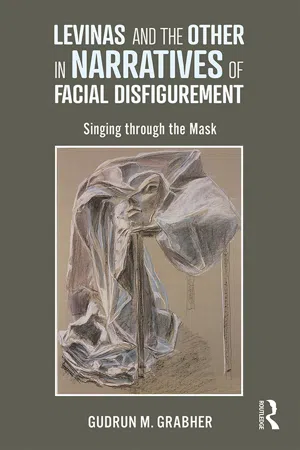
Offering readings of a range of fictional and biographical texts, including work by Richard Selzer, Nathaniel Hawthorne, Gaston Leroux, Willa Cather, Natalie Kusz, and Lucy Grealy, this book examines reactions to facially disfigured people on the basis of Emmanuel Levinas' ethics of the face. Drawing on Levinas' concern with the holistic dimension of the face as an encounter with the other's "whole person" and the sense of moral obligation that this instils in us—a sense that disfigurement disrupts by drawing our attention to the disfigurement as a "spectacle" and threatening to limit our view of that individual—the author explores how we react to the facially disfigured and how we ought to react.
eBook - ePub
Levinas and the Other in Narratives of Facial Disfigurement
Singing through the Mask
- 214 pages
- English
- ePUB (mobile friendly)
- Available on iOS & Android
eBook - ePub
Levinas and the Other in Narratives of Facial Disfigurement
Singing through the Mask
About this book
Information
1 Emmanuel Levinas
1.1 His life and works
Emmanuel Levinas, one of the most important twentieth-century European philosophers, was born in Lithuania in 1905,1 where he received a traditional Jewish education. He studied philosophy first in France and later in Germany. In Strasbourg, he became friends with the philosopher Maurice Blanchot. This friendship would prove to be of vital importance during World War II, when it was due to Blanchot’s intervention that Levinas’ wife and daughter could spend the years of war in a monastery, which spared them from the Holocaust (unlike his father and brothers, who were killed in Lithuania). In the 1930s, Levinas became a French citizen and in the 1960s was appointed professor of philosophy at Sorbonne University.2 He wrote and published his books and articles in French. It is only during the past decades that they have been translated into English and German. Levinas was a student of Edmund Husserl and Martin Heidegger in 1927 and 1928 (cf. Mosès 13) and was therefore strongly influenced by phenomenology3 as well as by existentialism.4 However, he liberated himself from his teachers and began to move away from the phenomenologist’s emphasis on the constituting consciousness and the existentialist’s focus on Being as the central issue of philosophy, replacing it with ethics. Ethics, according to him, is the prima philosophia. With his teachers, he not only rejected metaphysics, especially ontology, but criticized the Greek and Western tradition of theoretical thinking as a whole. His moral theory is not based on the human subject as the Cartesian ego, that is to say, not on the human I as the center of the world; rather, Levinas starts out with the Other, who is, for him, “my teacher.” Levinas breaks with the existentialists: “It is the Other, not I, that is undefinable. The Other produces responsibility in me: the responsibility to learn from the Other and to answer not just for myself but also for the Other” (Gibbs 219). Levinas not only breaks with the existentialists; he unmasks the tradition of egology as a system of power: “For theoretical thinking is egology. It is self-centered totalistic thinking which organizes being into a power system, and which has forever closed the door to exteriority, infinity, and the Other” (Dhondt 273). And yet, Levinas never completely abandons the issue of Being. Rather, he is concerned with the question of how the human subject may transcend Being, how they exist (cf. Krewani, “Der Wandel” 279).5 Craig Vasey diagnoses two major points of criticism that Levinas holds against the Western philosophical tradition; first, that Being is treated as totality that even includes otherness, and second, that the preferred mode of access to the world is knowing (cf. 318). Levinas concludes that “Western philosophy is allergic to the otherness of the Other” (319), while he himself insists that we encounter the Other on their own terms. The face becomes his most important vehicle for this encounter. Moreover, his philosophy needs to be seen against the backdrop of his Jewish heritage. This influence will become particularly obvious in regard to his concept of the “trace” in connection with the face-to-face encounter.
Of his numerous works, the following are his most important: Totality and Infinity (Totalité et Infini: essai sur l’extériorité, 1961) and Otherwise than Being or Beyond Essence (Autrement qu’être ou au-delà de l’essence, 1974). His central concern of the Other and his ethical theory of the face-to-face encounter are also the subject of Time and the Other (Le Temps et l’Autre, 1948) and of Humanism of the Other (Humanisme de l’autre homme, 1972).
Because of this emphasis on the Other, his philosophical theory has also been compared to the philosophy of dialogue, such as by, in particular, Martin Buber, but also Franz Rosenzweig and Gabriel Marcel. In this context, it is the deviations and differences from these philosophers that are essential, rather than the parallels that can be drawn to them. While mutuality characterizes the encounter between I and You according to the philosophers of dialogue, Levinas’ concept of the encounter with the Other is basically and principally marked by asymmetry: “Levinas wishes to emphasize the initial and ineradicable ‘asymmetry’, the ‘difference of identity and difference’ or of ‘same and other’ implicit in the infinity presented in the face of the Other” (Surber 305).
Emmanuel Levinas’ philosophy is a philosophy of the Other and, more specifically, a philosophy of the human face. His theory of the face can only be understood against the backdrop of his approach to the Other, which differs fundamentally from the tradition of Western philosophy. The very approach to the question of the Other has puzzled philosophers for centuries, and there is hardly any agreement as to how to access this unfathomable issue:
There is not only disagreement between different philosophical systems, there is also no agreement about the relations between the different philosophical disciplines and their competence in the questions of the Other. Granted that the encounter with the Other is the central philosophical issue, what comes first: ethics, metaphysics or theory of knowledge? And what is the most appropriate attitude: respect, understanding of a difference in the mode of being, insight into a reality as it is in itself?(Bernet, “Encounter” 89)
1.2 The Other: a crucial philosophical issue
No one has more persistently and passionately confronted us with the ethical responsibility of thinking of the human Other in their otherness than Emmanuel Levinas (cf. Surber 294). In the history of philosophy before him, numerous philosophers tackled this issue. One of the most thorough and profound studies on the conception of the Other in Western philosophy since Descartes’ work is Michael Theunissen’s book Der Andere, which was first published in German in 1977 and later translated into English by Christopher Macann and printed in 1984 by MIT Press in Cambridge, Massachusetts. Marcel Poorthuis has called it a “monumental book” (63). As the subtitle reveals, it provides an in-depth analysis of the “Social Ontology of Husserl, Heidegger, Sartre, and Buber.” In his introduction to the English version, Fred Dallmayr praises the book as “remarkable not only for its broad scope but also for its philosophical subtlety and rigor” (xi). Theunissen claims that the Other is one of the most important and fundamental issues of twentieth-century philosophy. A topic throughout history, the Other has occupied the minds of anthropologists, ethicists, political scientists, and others, and has taken center stage, especially in philosophy, since the twentieth century. Basically, the question of the Other seeks to establish the difference between the I and the Thou. Whether the former or the latter is chosen as the starting point largely determines the philosophical approach to the Other. Accordingly, Theunissen distinguishes between the transcendental and the dialogical approach (cf. 2). The former views the Other as an “alien I” or alter ego, the latter turns the Other into the second person singular, Thou. There are, of course, other positions as well, as he points out, but these two are not only fundamentally central but, especially when compared, they shed light on the crucial problematics involved in the philosophical inquiry about the concept of the Other. Moreover, “with reference to the present situation of philosophical thought, all nontranscendental and nondialogicalist attempts to develop a theory of the Other come across either as derivative modifications or as mixed forms of transcendentalism and dialogicalism” (3). However, Theunissen admits that it remains open “whether the disjunction of the Thou and the alien I suffices to cover the field in its entirety” (Theunissen 3). As is to be demonstrated, Levinas indeed adds a crucial dimension to the dialogicalist approach that is not considered by Theunissen. For a better understanding of Levinas’ perspective on the Other, it is essential to delve into these two diametrically opposed positions on the issue of the Other. A focus on Husserl’s transcendental view and on Buber’s dialogical mindset and an abbreviated and simplified summary of their positions will thereby be sufficient for this purpose.
1.2.1 Traditional roads to the Other
1.2.1.1 Constituting the Other: the transcendental way
Theunissen concentrates on transcendental philosophy as inaugurated by Husserl and argues that it is the subjective constitution of the world that makes Husserl’s philosophy transcendental (for the following analysis, cf. also Grabher, 48–53). He bases his treatment of Husserl’s egology and theory of intersubjectivity on the latter’s fifth (and last) of the Cartesian Meditations (cf. Theunissen 13). Husserl himself calls the transcendental ego the “sole theme” of phenomenology (qtd. in Theunissen 14). The fundamental concept of phenomenology is the intentionality of consciousness (cf. Krewani, “Einleitung” 15). The Cartesian I does not only think, the I also thinks something: cogito cogitatum. As a result, the world is constituted by the I. It is this aspect of transcendental philosophy, “the subjective constitution of the world,” which has led to “the confounding problem of the Other” (D. Klemm 403). Two other key terms in Husserl’s phenomenology are the phenomenological reduction (going back to the origin) and the epoché (bracketing, that is, the theoretical moment when all judgments about the existence of the external world are suspended). Husserl uses these two terms both as interchangeable and as different, but, as Theunissen points out, they are actually
two sides of one and the same reality. The reduction is a reduction to, and so emphasizes the origin to which it leads back. The epoché is a holding off … from … and so is immediately directed to that which is reduced.(25)
According to Husserl, I experience the surrounding world; the totality of being is around me, and I am at its very center (cf. Theunissen 25). This world is both independent of and dependent on the I, independent because it is there prior to my existence, and I find myself existing in this world, and dependent in the sense that I bring order to it (cf. Theunissen 28). Theunissen claims that for the natural attitude, there is no contradiction contained in this simultaneity of dependence and independence. I posit myself in this world as one among otherworldly beings and relate to it, but I am also present to myself as the one who perceives this world. It is the world of the natural attitude, the naively apprehended world, that needs to be suspended through the epoché.
The point of departure for Husserl is the I or ego, while for Buber it is the Thou. Even though Husserl offers a theory of intersubjectivity, he is not able to escape the trap of the I. To begin with, his concept of phenomenological subjectivity must be clarified. Husserl first defines it as extramundane subjectivity, that is, as not belonging to the factual world, but he then characterizes it through ownness, individuality, and facticity. By ownness he means that the subjectivity which is made the object of my reflection is my very own, and it is in no way related to a Thou. The personal pronoun I is not declinable. This extramundane subjectivity relates to the world in that it constitutes it and thus gives meaning to it. But before the act of constitution can take place, the so-called phenomenological reduction must occur. What Husserl means is that the (non-transcendental) subject finds themselves in a natural attitude towards the world surrounding them. In the epoché, this naively perceived world is excluded. As a result, the human being is deprived both of the world and of human beings. This phenomenon has also been designated as a “unique philosophical loneliness” (Theunissen 163). And Levinas himself “charges phenomenology with transcendental solipsism, in which a world-constituting ‘I’ is incapable of assuring the independent reality of the Other or the social world” (D. Klemm 403). From this “loneliness” ensues the constitution of the world, in regard to both the world of things and that of other human beings. It is the latter that concerns us here and which makes up Husserl’s theory of intersubjectivity. The basic structure of Husserl’s theory consists of the three parameters of ego-cogito-cogitatum. It is the consciousness of the I that constitutes the world in which the I finds themselves. The issue of the Other becomes problematic as soon as subjectivity is defined as “my own.” The verb “constitute” is to be understood in two ways: as receiving the world and as creating it. The world surrounding the I also encompasses other human beings. Husserl, therefore, finds himself in the position of solving the dilemma of rescuing the other human being from merely being perceived and constituted as one among the other objects of this world. In his scheme of intersubjectivity, Husserl attempts to solve this dilemma as follows: The Other’s body at first appears to me as merely another thing. Due to its similarity to my own body, I differentiate this particular “thing” from other objects by recognizing it as another body (Leib) rather than as another thing or object (Körper). This analogy between the Other’s body and my own marks the first step towards the Other. Since I can only perceive parts of my own body but never my body as a whole, I recognize in the Other my own body as if it were there. Simultaneously, I know that this Other is not me because it is impossible for me to be there and here at the same time. After the apperception of the other body, the second step takes place on a psychological level and entails empathy. Trying to feel myself into the Other, I realize that the Other’s intention is the same as mine: to constitute the world. Thus, the Other transcends the whole primordial world, which is mine. Identifying our primordial worlds leads to the appresentation of the alter ego. In a fourth step, the other body and the alter ego are united. As a result, the Other is no longer simply an other but turns into another human being. Finally, I become aware of how the Other perceives me. When, in the fifth step, the I makes themselves the object of perception of the Other, this implies both the alienation of the I and the de-alienation of the Other. This is supposed to suggest an approximation between I and Other. But the problem is more complex. The Other manifests themselves both as an object of the world (in analogous relation to things) and as a subject in relation to the world (in analogous relation to me). In my naturalistic attitude towards the Other, they are already present to me as a subject. However, from the transcendental point of view, the Other first appears in this dis-unity of object and subject, which Husserl synthesizes in an all but convincing manner. Theunissen criticizes, along the line of the double meaning of the word constitution, which is so central to Husserl’s philosophy, that in the sense of “receiving,” I first experience the Other as an object or thing and ...
Table of contents
- Cover
- Half Title
- Title Page
- Copyright Page
- Dedication
- Table of Contents
- List of figures
- Acknowledgements
- Introduction
- 1. Emmanuel Levinas
- 2. Face value
- 3. Facial disfigurement and its repairs
- 4. Elephant people
- 5. Narratives on facial disfigurement
- Conclusion
- Index
Trusted by 375,005 students
Access to over 1.5 million titles for a fair monthly price.
Study more efficiently using our study tools.
Frequently asked questions
Yes, you can cancel anytime from the Subscription tab in your account settings on the Perlego website. Your subscription will stay active until the end of your current billing period. Learn how to cancel your subscription
No, books cannot be downloaded as external files, such as PDFs, for use outside of Perlego. However, you can download books within the Perlego app for offline reading on mobile or tablet. Learn how to download books offline
Perlego offers two plans: Essential and Complete
- Essential is ideal for learners and professionals who enjoy exploring a wide range of subjects. Access the Essential Library with 800,000+ trusted titles and best-sellers across business, personal growth, and the humanities. Includes unlimited reading time and Standard Read Aloud voice.
- Complete: Perfect for advanced learners and researchers needing full, unrestricted access. Unlock 1.5M+ books across hundreds of subjects, including academic and specialized titles. The Complete Plan also includes advanced features like Premium Read Aloud and Research Assistant.
We are an online textbook subscription service, where you can get access to an entire online library for less than the price of a single book per month. With over 1.5 million books across 990+ topics, we’ve got you covered! Learn about our mission
Look out for the read-aloud symbol on your next book to see if you can listen to it. The read-aloud tool reads text aloud for you, highlighting the text as it is being read. You can pause it, speed it up and slow it down. Learn more about Read Aloud
Yes! You can use the Perlego app on both iOS and Android devices to read anytime, anywhere — even offline. Perfect for commutes or when you’re on the go.
Please note we cannot support devices running on iOS 13 and Android 7 or earlier. Learn more about using the app
Please note we cannot support devices running on iOS 13 and Android 7 or earlier. Learn more about using the app
Yes, you can access Levinas and the Other in Narratives of Facial Disfigurement by Gudrun Grabher,Gudrun M. Grabher in PDF and/or ePUB format, as well as other popular books in Social Sciences & Sociology. We have over 1.5 million books available in our catalogue for you to explore.