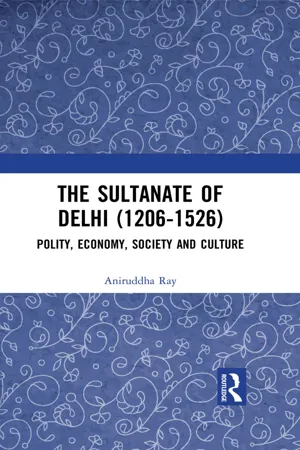
This book provides an integrated view of the Delhi Sultanate government from 1206 to 1526. It is divided into two parts. The first part deals with the political events and the dynastic history of the Sultans and the second part with the administration, different land issues, social life including two major religious movements and other cultural aspects including architecture and sculpture. The growth of the city of Delhi has been shown here perhaps for the first time.
Most of the books on Delhi Sultanate mainly narrate the political events. Here other aspects have been included to show the real character of the Sultanate. It may be mentioned that the English officials from the end of the eighteenth Century had termed the medieval period of India as a 'dark age' – a statement that has been accepted by several Indian writers. It is to negate this view that an integrated narrative has been provided here.
Please note: Taylor & Francis does not sell or distribute the Hardback in India, Pakistan, Nepal, Bhutan, Bangladesh and Sri Lanka
- 438 pages
- English
- ePUB (mobile friendly)
- Available on iOS & Android
eBook - ePub
About this book
Information
Chapter 1
Sources
The principal theme of the history of India till Independence was the accounts of the kings and their kingdoms. This was political history, of wars and conquests, rise and fall of dynasties. From a broad point of view this was necessary since it builds the framework or a structure of the period. The exception was provided by W.H. Moreland during the early years of the twentieth century by providing a structure of economic history. While the writing of dynastic history or in a broader sense political history continued after Independence, other subjects like agrarian history, history of urbanization, social condition of people and other such related subjects began to preoccupy the Indian scholars. Along with these there began to lay an emphasis on what is known today as Area Studies, study of a particular area in which the local language sources helped to create a new dimension. But the contemporary Persian and Arabic sources were not neglected and these were believed to be the essential elements for the study of the history of the medieval period. The narratives of the travellers from abroad were mostly taken with caution. In any case there were not many travellers during the pre-Mughal period compared to those of the later days. In this chapter we would first see some important Persian and Arabic writings and then have a brief look at the narratives of some travellers from abroad.
Various writings on the history of India began to appear since the conquest of Sind by the Arabs in eighth century AD. Ibnal Asir wrote Kamilat Tarikh in the thirteenth century in which many facts of the conquest of Muhammad Ghuri were available. The information on the Mongol attacks on Western Asia could be found from the writing of Ata Malik Juayani. He used to work under the Mongol leader Ilaku. The book Chachnama written in Arabic was a very important book on the eve of the expedition of Muhammad bin Qasim to Sind. The book was later translated into Persian. Later the history of the conquest of Sind was written on the basis of this book. The information on Sultan Sabuktagin of Ghazni and of Sultan Mahmud could be found from the book Qitabul Yemeni written by Abu Nasser bin Utbi.
Al-Beruni was a courtier at the court of Sultan Mahmud. He visited India and wrote his account known as Tarikh-i Hind. This is undoubtedly a primary source on contemporary India. Al-Beruni wrote about contemporary Hindu religion and society sympathetically. The military events in India from the end of the twelfth century to the third decade of the thirteenth century could be seen in Hasan Nizami’s book Taj-ul Masir. The early period of the Delhi Sultanate could be found here. Fakre Mudabbir wrote Adabul Harb that dealt with the strategy of Iltutmish and informed us of the proper duties of the king. The primary document on the Turkish invasion of Bengal in early thirteenth century had been given by Minhaj-i Siraj in his book Tabaqat-i Nasiri. Minhaj, a religious scholar, came to Bengal in 1243 and wrote on the conquest of Nadia by Ikhtiyaruddin Muhammad bin Bakhtiyar Khalji. He wrote it in 1260 from the Nasiria Madrasa in Delhi. Later historians writing in Persian accepted his account as correct and have taken information from this book.
The important infortmation on the Sultanate period can be found in the literature of the fifteenth and the sixteenth centuries in Bengali poets who had written the Mangal poems or Vaishnava poems which contains Sultanate period. Some of the writings of Amir Khusrau in Persian also contain useful information of this period. Amir Khusrau (full name Abul Hasan Aminuddin Khusrau) was a poet during Jalaluddin Khalji and Muhammad bin Tughluq’s times. His book Diwal Rani-Khizir Khan is a love story but at the same time it contains information on the military activities of Alauddin Khalji and his predecessors. Khusrau had in a letter written by him to his friend from Awadh which is included in his book Ghunautul Kamal gives us a picture of the cultural life of Delhi during his time. In his book Hast Bihit he has given more information on Alauddin Khalji. A picture of the contemporary culture and education can be gleaned from his letters compiled under the title Ijaz-i Khusrauvi. From the point of view of historical events perhaps the most important of his works is Khazain-ul Futu. It contains an account of Alauddin Khalji’s Deccan expedition. Khusrau had accompanied Alauddin Khalji in most of his expeditions. In his book Kiranus Sadain Khusrau gives us an account of the historic meeting between Boghra Khan and his son Kaikobad. He had accompanied the Sultan up till Awadh. Khusrau had praised Balban and other Sultans. Khusrau’s poems have been put together in a collection known as Hayastul Hayat. In his book Tughluqnama he has given an account of the ascendency on the throne by Giyasuddin Tughluq.
Descriptions of the different military expeditions and political events along with their dates can be considered authentic in the writings of Amir Khusrau as he accompanied the Sultans in most of their expeditions. Also, the picture he gives of the cultural life and the religious world of the Sultanate in his works remains unparalleled and practically rare.
However, the most important book on the history of the period of the Sultanate is Tarikh-i Firuz Shahi by Ziauddin Barani. He completed this book in 1359 and dedicated it to Sultan Firuz Shah Tughluq with a purpose. During Muhammad bin Tughluq’s rule Barani was linked to various injustices and after Muhammad Tughluq’s death Barani was practically ostracized. He wrote this book solely with the hope of becoming a favorite of the Sultan. Later he wrote from memory and as a result there was not only a lack of proper information but several inaccuracies too. Despite these shortcomings it may be stated that the picture of cultural life and religious world he paints during the reigns of Khaljis and the Tughluq’s remains unsurpassed. Barani began where Minhaj left. Possibly he tried to write the later portion of this book in his Fatwa-i Jahandari. But here he discusses fully only the nature of the State, about which he had mentioned in different places in his earlier book. From the point of view of economic history, the value of the writings of Barani is of tremendous value. He was the first contemporary historian of his time to show that the imposition of excessive taxation hampered agricultural production, thus reducing the revenue. He highlighted this relationship between taxation, production and revenue during the time of Muhammad bin Tughluq. Later scholars had accepted the price range given by him.
Shamshuddin Siraj Afif, a contemporary of Barani is believed to have written three books. Among these only Tarikh-i Firuz Shahi has been found. The book was written in the background of the terrible days of the invasion of Taimur Lang, particularly in contrast to the peace and prosperity during the reigns of Firuz Shah.
An inscription has been found in a tower of the Jami Mosque of Firozabad which has been identified as from Firuz Shah’s Futuhat-i Firuz Shahi, and contains the policies of Firuz Shah. A slightly later historian Isami, who belonged to the Bahmani period has written about the time of the Ghazni rulers till the Bahmani period in his book Futuhat-us Salatin. The ancestors of Isami were close to the Ilbari Turks, the ruling class of the Sultanate. It may be mentioned that the character of Muhammad bin-Tughluq has been depicted as a cruel monster, which we will discuss later. This piece was the only written document which the last few years of Nasiruddin Mahmud.
Khairat Majlis written by Sheikh Nasiruddin Chiragh of Delhi, on the control of the market by Alauddin Khalji is another important document. It may be mentioned that he had given the price range which tallied with that of Barani. Few torn pages kept in the British Museum, London has been identified by Mahdi Hasan as from the autobiography of Muhammad bin Tughluq, although correct is yet to be found. There is another such a torn manuscript known as Sirat-i Firuz Shahi completed in AD 1370. Here different aspects of Firuz Shah’s life has been discussed. In 1384 Syed Maulana bin Muhammad Kirmani wrote Niyarul Aulia on the Chisti sect and particularly on Sheikh Nizamuddin Aulia and his relationship with Muhammad bin Tughluq. Yahiya bin Sirhindi’s book Tarikh-i Mubarak Shah gives a general history from Sabuktagin to Mubarak Shah of the Syed dynasty. It is of great importance as it contains the information about the later Tughluq and Syed dynasties. Not many writings are found on the Lodi dynasty. Prominent among these is Ahmad Yadgar’s Tarikh-i Salatin-i Afghan on the reign of Bahlul Lodi. From Niyamatullah’s Maqjan-i Afghani and from Abdullah’s Tarikh-i Daudi we get information on Sur and Lodi dynasties.
Many mosques, caravanserais, towers, hammams (baths) had been constructed during the course of the establishment and growth of the Sultanate. Many inscriptions have been found in these places. Even the areas conquered by the Sultans, though some of those areas had later become independent, the inscriptions have remained. These ‘evidences in stone’ have mostly been translated and published. Still there are a large numbers of inscriptions which remain untouched. The historian Noburo Karashima has complained that out of 50,000 inscriptions of south India only one-third has been published.
The coins of the early Sultans had been taken as horse and bull coins. There were Devanagari scripts in some of these coins. After some time the coins bearing the name of the Sultan began to be issued. The changes in the economic condition of the Sultanate may be known from a study of the coins. Although the years of rule of the provincial Sultans could be ascertained from these coins yet for various reasons these were not found to be completely satisfactory. It is necessary to take the same precaution for the inscriptions. Yet it is accepted that a lot of information on the rule of the Sultans could be known from the inscriptions.
The Arab geographers had given us some information on the coastal areas of India since the eighth century AD. But the information of some areas became clearer from the writing of Marco Polo. But Marco Polo did not stay in India for long and did not travel far. The first foreign traveller who had stayed long years in India and had travelled widely inside the country was Ibn Battuta of Morocco. Before him Al-Beruni, the courtier of Sultan Mahmud of Ghazni had written on India and had a very sympathetic attitude towards Hindu religion and society. Battuta, who was an eyewitness to many events, had lost his notes in the sea while returning to his country and later wrote from memory.
During the fifteenth century we have four Chinese delegations coming to India. They travelled mainly in the coastal areas including Bengal and their writings were edited by another Chinese delegate Ma Huan whose book has been translated into English. Ma Huan came to India in 1436 and from his book we come to know of the condition of Bengal and the coastal areas of south India.
From the second decade of the fifteenth century there are several accounts of foreign travellers. One may mention the description of Nicolai Conti on south India. Unfortunately the documents of the Portuguese archives are yet to be translated and published. Excepting a few publications by Gulbenkien Foundation we are still in the dark. An account of a visit of a Portuguese interpreter to Gaur, the then capital of Bengal, in 1521 has been translated and published in several languages. At the end of the nineteenth century Robert Sewell had translated and published two Portuguese accounts of early sixteenth century Vijayanagar. One also finds the narratives of the Russian traveller A. Nikitin and that of Hieronomo de Santo Stephano, an inhabitant of Genoa, of fifteenth century. One also gets information on south India and Vijayanagar from the writings of Nicolai Conti, an inhabitant of Venice. They all give valuable information on the contemporary towns.
From the beginning of the sixteenth century, with the growth of the Portuguese Empire in Asia, we get the narratives of the Portuguese travellers and historians. Apart from the diary of Vasco da Gama, the Commentaries of the great Afonso D’Alboquerque, written by his son, also contains information on the condition of south India, although the first few Portuguese narratives dwell on Vijayanagar and Calicut. The historian Camoens too travelled to India from 1553 to 1569 and documented it.
Ludvico di Varthema did not have this limitation. He was an inhabitant of Bologna in Italy. He visited Chaul, Mangalore and other places on the western coast and also took the trouble to go into the interior of the country by land route. His description of the commerce by land is very rare.
The narrative of Duarte Barbosa in early sixteenth century is very interesting although it has been proposed without much evidence that it was actually the narrative of the traveller Magellan. Also the question has been raised regarding his claim that he had visited many regions of India and South-East Asia for sixteen years. Historians say it is the work of someone else from whom Barbosa had heard the details. In fact it is conjectured that much of the writings of Barbosa were taken from the writings of others.
The limitation of the narratives of the foreign travellers during the Sultanate period easily comes to the fore. These travellers did not know the local languages and were dependent on somebody else. Their stay was also for a limited time. The main aim of their writings was to narrate their glorious conquests, perhaps to attract the attention of the Portuguese king and their nobles.
Another well known Portuguese writer was Tomé Pires, from Lisbon, who wrote on India from Malacca in the early sixteenth century. He had obviously collected information from other sources since his facts on India seem muddled and also of an earlier era. On the other hand Joao de Barros’s account is much more modern and has done us a significant favour by illustrating his work with drawings. He was at Goa and perhaps used earlier illustrations like that of Lopo Homens. Excepting the Portuguese narrative of 1521 and that of Duarte Barbosa, the writings of foreigners add only a flavour to the sources of the period. One may not place the narrative of Ibn Battuta here. It may be mentioned that details about the condition of the people are almost absent in the writings by Indians who have written in Persian since it was in their interest to curry favour with the court power. There are of course exceptions to this. For a lively discussion on the writings of modern historians on the Sultanate of Delhi see the recent work of Sunil Kumar.
Chapter 2
Background
It is said that the Indian merchants in the seventh century AD of the west coast of Indian continent were astonished to see the bearded merchants with long robes. They saw them praying together at a place where there was no idol. They came to konw that their religion was called Islam. It was a new culture that did not believe in the caste system, thus attracting the lower classes and the Dalits who welcomed them to India.
After its rise, Islam conquered West Asia and Iran. It then expanded into Khurasan and Central Asia including Transoxiana – the area between rivers Oxus and Syr. As a result, the Indian influence, mainly Buddhist was reduced there and the overland trade with China was affected. The overseas commerce of India would have been affected too but the Arab sea traders revived it and helped to strengthen the Indian commerce with West Asia, countries of South-East Asia and China. Contrary to the popular belief, the Indian traders were not driven away from the sea nor did they stop going to the sea for fear of the loss of caste. It has been found in recent years that not only the Indian traders but also the Indian physicians and craftsmen settled around the Persian Gulf areas. The powerful Rashtrakuta dynasty welcomed the Arabs to settle in India and permitted them to build mosques. Some Arab traders also settled in Malabar.
The Abbasid empire, at the height of the ninth century AD, ruled from Constantinople and Egypt to Central Asia and the Arabian Peninsula. But they were mostly interested in subduing the heathen Turks (generally called Turkomans) and expanding towards the West. The rise of some aggressive states began with the disintegration of the Abbasid Empire at the end of the ninth century. These States accepted the nominal suzerainty of the Caliph in return for his formal letter of approval. Gradually the rulers of these States came to be called Sultans. Most of them were Turks. Their ancestors had been nomads who lived in Mongolistan and Sinkiang and had migrated to the region of Transoxiana, often called Transitional Zone. The Iranian rulers of the area and the Abbasid Caliphs often recruited them as mercenaries. The Turkish commanders learnt the Persian language and adopted the Persian culture quickly. The Turks were also taken as slaves and palace guards and were converted to Islam. The ruling class used both Arabic and Persian languages but in the administrative practices were influenced by the Persian culture.
After the fall of the Abbasids, the most powerful dynasty was the Samanid (874–999) founded by a recently converted Iranian nobleman. This dynasty was followed by the Ghaznavids (962–1186) founded by Alaptagin, a former Turkish slave. He was also a Samanid officer. The Ghaznavids were displaced by the Seljuk Turks who were in turn dispossessed by the Khwarizimi Empire which in turn was dispossessed by the Mongol leader Chenghiz Khan in the thirteenth century. Like the Rajput States in India these States too fought with each other as well as with other smaller States often for glory and possession of land. Since the military efficiency was considered the best asset, the danger to India had increased which had not been Islamized till then.
In Sind not only the priests and the merchants arrived but also ships full of troops brought by the Arabs. During the rule of the second Caliph this kind of expedition was undertaken to the Konkan coast. Later the victorious expedition of Muhammad bin Qasim grew out of this kind of expedition. But the victory in Sind did not take the Arabs to the interior of India. As a result the Arabs could not establish an empire in the East. The new culture that had emerged in the Indian continent became sluggish by the tenth century AD. The kings in India merely looked upon them as merchants. The first responsibility of establishing an empire in the East fell upon the Turks who had the finest horses in the world. These Turkish horses were far more swifter and stronger than those bred in India. The Turks were also skilled horsemen. Till then, they were not fully Islamized and their principal weapon was the sword.
There had been rapid changes in Central Asia since the eighth century AD. Many Turkish tribes like the Seljuks, Ghuz, Khitai, Ilbari and Karmukhs had come again and again and settled in different parts of Central Asia. They had established small states in these areas and began to advance due to the pressure from behind. They began to occupy extended areas in Iran, Iraq, Afghanistan and India. Only in some areas they had to retreat due to the Mongol attacks.
The Turks had made contact with the Hindu Shahi kings of Kabul on the other side of the Sind River. This kingdom vanished within fifty years of the establishment of the Ghazni kingdom. The Turks came up to the banks of river Ravi and another Muslim State was established on the east of the Sind River. The Turks did what the Arabs h...
Table of contents
- Cover
- Half Title
- Title
- Copyright
- Dedication
- Contents
- Preface
- PART I
- PART II
- Bibliography
- Index
Trusted by 375,005 students
Access to over 1.5 million titles for a fair monthly price.
Study more efficiently using our study tools.
Frequently asked questions
Yes, you can cancel anytime from the Subscription tab in your account settings on the Perlego website. Your subscription will stay active until the end of your current billing period. Learn how to cancel your subscription
No, books cannot be downloaded as external files, such as PDFs, for use outside of Perlego. However, you can download books within the Perlego app for offline reading on mobile or tablet. Learn how to download books offline
Perlego offers two plans: Essential and Complete
- Essential is ideal for learners and professionals who enjoy exploring a wide range of subjects. Access the Essential Library with 800,000+ trusted titles and best-sellers across business, personal growth, and the humanities. Includes unlimited reading time and Standard Read Aloud voice.
- Complete: Perfect for advanced learners and researchers needing full, unrestricted access. Unlock 1.5M+ books across hundreds of subjects, including academic and specialized titles. The Complete Plan also includes advanced features like Premium Read Aloud and Research Assistant.
We are an online textbook subscription service, where you can get access to an entire online library for less than the price of a single book per month. With over 1.5 million books across 990+ topics, we’ve got you covered! Learn about our mission
Look out for the read-aloud symbol on your next book to see if you can listen to it. The read-aloud tool reads text aloud for you, highlighting the text as it is being read. You can pause it, speed it up and slow it down. Learn more about Read Aloud
Yes! You can use the Perlego app on both iOS and Android devices to read anytime, anywhere — even offline. Perfect for commutes or when you’re on the go.
Please note we cannot support devices running on iOS 13 and Android 7 or earlier. Learn more about using the app
Please note we cannot support devices running on iOS 13 and Android 7 or earlier. Learn more about using the app
Yes, you can access The Sultanate of Delhi (1206-1526) by Aniruddha Ray in PDF and/or ePUB format, as well as other popular books in Social Sciences & Indian & South Asian History. We have over 1.5 million books available in our catalogue for you to explore.