- 44 pages
- English
- ePUB (mobile friendly)
- Available on iOS & Android
eBook - ePub
Fibre Materials for Advanced Technical Textiles
About this book
This paper tries to give an overview on technologies using fibrous materials for contributing to environmental and resource matters. The technologies for water treatment include bio-reactive treatment system using membrane hollow fibre, desalination using Ro hollow fibre, purification of water work using UF or MF hollow fibre, purification of recyc
Fibre materials for advanced technical textiles
In this article, most kinds of fibre materials used for advanced technical textiles are systematically introduced. The definition of advanced technical textiles and the scope of fibre materials used for advanced technical textiles are given in the introductory chapter, PET, nylon and PP fibres are explained as three major conventional fibres for advanced technical textiles. High mechanical performance fibres such as carbon fibre and aramid fibre, and high heat resistance fibres such as SiC fibre are introduced in chapters 3 and 4, respectively. Several kinds of function fibres such as separation function, optical, electric conductive, adhesive are introduced in chapters 5 to 10. Specialty material fibres such as PVA and PLA, modified fibres for specific function and modified fibres for specific end-use are also introduced in chapters 11 to 13. The final chapter is assigned to introduce nano-fibres which include three kinds of organic nano-fibres manufactured by bottom-up way, by electro-spinning and by top-down way, and also carbon nano-tube and nano-fibre.
Keywords: advanced technical textiles, fibre materials, high performance fibres, several kinds of function fibres, specially material fibres, nano-fibres
1. Introduction
1.1 The content and objective of this article
This article consists of 13 major chapters. In chapter 2, conventional fibres are explained, because they can quite often be fibre materials for advanced technical textile products. Chapters 3 and 4 are assigned to fibre having high performance in mechanical properties, and fibre having high performance in heat resistance. In chapters 5 to 10, several kinds of functional fibres are introduced. In chapter 11, fibres made of some specialty materials are explained. Modified fibres for specific properties and for specific end-uses are described in chapters 12 and 13. In chapter 14, several kinds of nano-sized fibres are introduced.
Objective concept for writing this book is to provide a wide view, and systematic/comprehensive knowledge source on fibre materials for advanced technical textiles, specifically for young professionals and graduated students.
1.2 What is advanced technical textiles?
It is difficult to give a strict definition for “advanced technical textiles”. According to “Textile Terms and Definitions” [1], “technical textiles are: textile materials and products manufactured primarily for their technical performance and functional properties rather than their aesthetic or decorative characteristics”. On the other hand, “industrial textiles” is often used in almost the same meaning as technical textiles. In this book, “technical textiles” is used as “textiles for non-apparel, non-household/furnishing uses. The values of technical textiles are highly based on their technical performance and functional properties”. The term “advanced technical textiles” in this book means “technical textiles which have at least some technological advancement in the material and/or in the application”.
1.3 Why are fibre materials used for technical products?
Generally the reason why fibre materials among several forms of materials are used for certain specified technical products is that the textile products in which some of the configurational functions of fibre are effectively utilized can have the highest value in terms of the ratio (performance/cost). The configurational functions of fibre consist of the following four elements:
(1) it is flexible (pliable),
(2) it has high ability in its axial transmission of such a physical quantity as mechanical load,
(3) it has high specific surface area, and
(4) it has technological easiness in transformability into textile structures such as weaves and non-wovens.
In apparel use, items (1), (2) especially in mechanical transmission properties, and the item (4) are generally fully used. On the other hand, in technical textiles, the item (3) often becomes the most important element.
For advanced technical textiles, the maximization in the value of the ratio (performance/cost) is pursued in their developmental process using advanced materials and/or advanced application technologies.
The performance of textiles is generally dependent on (a) material of fibre, (b) configuration of fibre and (c) assembly structure of fibre including hybrid structure with other kinds of materials/parts. It must be noted that the range in selecting these three structural elements in advanced technical textiles is by far wider than in apparel textiles.
1.4 General scope on fibre materials for advanced technical textiles
Fibre materials used for apparel textiles are quite concentrated to some specific kinds of fibres.
Cotton and polyethylene-terephthalate (PET) fibre are overwhelmingly used. Nylon fibre and acrylic fibre succeed to the above two fibres as conventional man-made fibre materials. Wool, silk, some bast fibres, some chemical fibres based on cellulose, elastane fibre, and polytrimethylene terephthalate fibre are also mentioned as minor fibre materials for apparel use. It must be noted that there are almost no other kinds of fibre than these fibre materials mentioned above. On the other hand, the aspect of fibre materials used for technical textiles is different from that for apparel textiles.
In technical textiles, PET, nylon and polypropylene (PP) are three major conventional fibre materials. But besides these conventional fibres, fibre materials for technical textiles are much diversified by their performances, functions and specialty uses. As described above, an optimization targeting for raising the value of the ratio (performance/cost) for a specific product is strongly pursued in technical textiles, which causes the selection of the optimum fibre material in terms of the ratio. The performance required is quite diversified according to the wide variety range of application products. Hence the co-existence of so many kinds of fibre materials is possible.
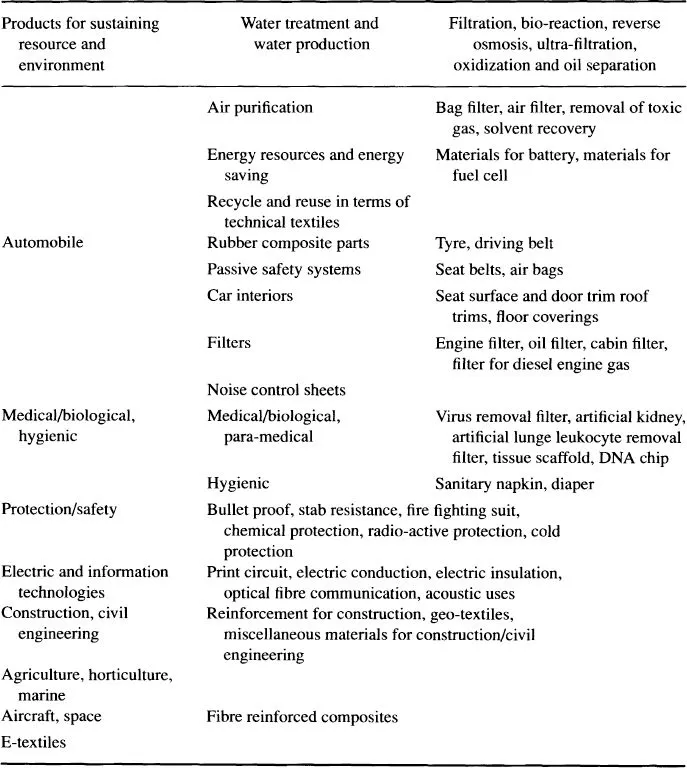
Table 1. Selective List of Technical Textile Products.
1.5 General scope on technical textile products as the application items of fibre materials
In Table 1, technical textile products as the end-uses of fibre materials are selectively listed. Details of their applications to these products will be written in the successive book of advanced technical textiles series. Table 2 which shows worldwide consumption amount statistics of technical textiles reported from an investigation company [2] must be useful to ...
Table of contents
- Cover
- Title Page
- Copyright Page
- Table of Contents
- Fibre materials for advanced technical textiles
Trusted by 375,005 students
Access to over 1.5 million titles for a fair monthly price.
Study more efficiently using our study tools.
Frequently asked questions
Yes, you can cancel anytime from the Subscription tab in your account settings on the Perlego website. Your subscription will stay active until the end of your current billing period. Learn how to cancel your subscription
No, books cannot be downloaded as external files, such as PDFs, for use outside of Perlego. However, you can download books within the Perlego app for offline reading on mobile or tablet. Learn how to download books offline
We are an online textbook subscription service, where you can get access to an entire online library for less than the price of a single book per month. With over 1.5 million books across 990+ topics, we’ve got you covered! Learn about our mission
Look out for the read-aloud symbol on your next book to see if you can listen to it. The read-aloud tool reads text aloud for you, highlighting the text as it is being read. You can pause it, speed it up and slow it down. Learn more about Read Aloud
Yes! You can use the Perlego app on both iOS and Android devices to read anytime, anywhere — even offline. Perfect for commutes or when you’re on the go.
Please note we cannot support devices running on iOS 13 and Android 7 or earlier. Learn more about using the app
Please note we cannot support devices running on iOS 13 and Android 7 or earlier. Learn more about using the app
Yes, you can access Fibre Materials for Advanced Technical Textiles by T. Matsuo in PDF and/or ePUB format, as well as other popular books in Business & Business General. We have over 1.5 million books available in our catalogue for you to explore.