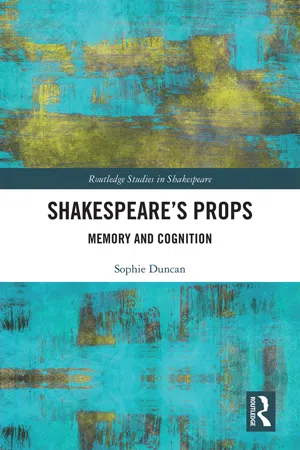
Cognitive approaches to drama have enriched our understanding of Early Modern playtexts, acting and spectatorship. This monograph is the first full-length study of Shakespeare's props and their cognitive impact. Shakespeare's most iconic props have become transhistorical, transnational metonyms for their plays: a strawberry-spotted handkerchief instantly recalls Othello; a skull Hamlet. One reason for stage properties' neglect by cognitive theorists may be the longstanding tendency to conceptualise props as detachable body parts: instead, this monograph argues for props as detachable parts of the mind. Through props, Shakespeare's characters offload, reveal and intervene in each other's cognition, illuminating and extending their affect. Shakespeare's props are neither static icons nor substitutes for the body, but volatile, malleable, and dangerously exposed extensions of his characters' minds. Recognising them as such offers new readings of the plays, from the way memory becomes a weapon in Hamlet's Elsinore, to the pleasures and perils of Early Modern gift culture in Othello. The monograph illuminates Shakespeare's exploration of extended cognition, recollection and remembrance at a time when the growth of printing was forcing Renaissance culture to rethink the relationship between memory and the object. Readings in Shakespearean stage history reveal how props both carry audience affect and reveal cultural priorities: some accrue cultural memories, while others decay and are forgotten as detritus of the stage.
- 278 pages
- English
- ePUB (mobile friendly)
- Available on iOS & Android
eBook - ePub
About this book
Information
1 ‘Must I remember?’
Objects, Recollection, and Grief in Hamlet
Hamlet is a play profoundly preoccupied with objects’ revelatory power: above all, as containers, and as archives of change. The stage objects in Hamlet frequently seem like one thing, but in fact contain or bear another more determinative entity or significance. Early in Act I, costumes establish the precedent: Hamlet himself sets up this distinction in 1.2, forcing Claudius and Gertrude to look beyond the ‘inky cloak’ (I.2.77) of apparently ostentatious, sulky mourning to his grief ‘within’ (I.2.85).1 In Q1 the Ghost’s armour (1.49) and nightgown (11.57) both suggest a dynamic, vulnerable corporeal identity. These are garments that both highlight and defend the fragility of the body, whether from warfare (the armour) or immodesty and cold (the nightgown). Material phenomena in Hamlet call attention to pasts and interiors. The skull Hamlet holds in V.1 is revealed as that of Yorick, with its nauseating smell and remembered lips. The bier, gravesite, and corpse are an ecosystem of objects which occasion comedy, curiosity, and then violent tragedy as they turn out to contain Ophelia. In Hamlet’s final scene, both sword and cup masquerade as the accoutrements of chivalrous combat but have a more decisive property: the sword is ‘unblunted and envenomed’, while the cup’s inside carries the fatal ‘union’ (V.2.249).
The stage properties of Hamlet’s textual and material contexts call attention to interiority, making them enticing cognitive containers for the scholar. But the materiality of Hamlet’s props is not straightforward. Many of the objects associated with the play very definitely appear, tangibly, onstage, such as Yorick’s skull, seen and discussed by Hamlet, Gravedigger, and Horatio, and handled by the former two. But others may or may not appear. As Lina Perkins Wilder makes clear in her discussion of offstage and imaginary props, and their cuing of audience desire, many objects vividly described in Shakespeare stay unseen.2 In Hamlet, Ophelia’s ‘coronet weeds’ at the moment of her drowning (IV.3.144) are a prime example. In I.5, Hamlet vows to memorialise his father and ‘set down’ his uncle’s treachery in his newly-cleared ‘tables’, brought literally onto the stage by some visibly scribal Hamlets but deployed only metaphorically by others. In the twentieth- and twenty-first-century theatre, Ophelia has frequently given out invisible or hallucinated flowers (Rosenberg calls them ‘pure imaginations’): the stage direction in the 2008 Royal Shakespeare Company edition of the play states ‘gives real or imaginary flowers’ (at IV.4.186), acknowledging the legacy of directors such as Arthur Hopkins and Tyrone Guthrie, and the interpretations of actresses like Julia Marlowe. Additionally, much psychoanalytical writing on the play takes the flowers’ hallucinatory status for granted.3
Other props ostensibly ‘appear’ but may remain unseen by all or part of the audience. Hamlets including David Tennant (2008) have confirmed through touch the presence of an unblunted sword-point unlikely to pass stage safety regulations. Similarly, in large audiences, how many spectators will actually glimpse the ‘union’ furtively dropped from Claudius’s hand into the cup at or around V.2.264? This tension between seen and unseen props makes total sense in a revenge tragedy catalysed by a Ghost who makes the capricious but theatrically- effective decision to become visible to his son, Horatio, and some guards but not to his widow (with whom he appears onstage), his murderer, his army, or his palace staff. In III.4, Hamlet begs his mother to ‘see’ his dead father both figuratively and literally: if remembering can only be achieved by seeing, Gertrude fails to remember.
Predictably, then, in Hamlet objects connected with memory are especially elusive. If Hamlet’s ‘tables’ can appear onstage, what about the ‘book and volume of [his] brain’? What ‘remembrances’, precisely, does Ophelia pluck from thin air at III.1.92? And if Ophelia’s flowers might be ‘pure imaginations’, how do they relate to the box-like memory she implies to us at I.3.84–5, when she tells Laertes that his advice is ‘in my memory lock’d/And you yourself shall keep the key of it’? These objects’ complex triggering, deployment, and redeployment to manipulate memory reiterate how, in Hamlet, characters are asked or forced to act as memory-bearers. This, then, is a chapter about how both objects and people deploy and bear memory in Hamlet, and how the objects which bear memory reveal the play’s conceptions of memory and grief as mental states.
In Act I, Ophelia and Hamlet both reach for ways to reify memory through material items. The objects they choose not only tell us something about the way the Early Modern stage conceptualised memory, but also illuminate memory’s status and function within the specific environment of Hamlet. Hester Lees-Jeffries argues that Hamlet ‘confronts and participates in a crisis of memory’ and is ‘deeply troubled’ by memory itself.4 This makes good sense. In Elsinore, memory is a weapon. Thus, the objects which characters force on each other to induce recollection and present their own memories become weapons too.
Remembering and Forgetting
Remembering, in Hamlet, is always painful. Hamlet makes this clear in his first soliloquy, asking ‘Heaven and earth,/Must I remember?’ (I.2.140–1); Gertrude experiences recollection of her former husband, induced by Hamlet’s ekphrastic commentary on the portraits (see Chapter 3) as agony akin to ‘daggers’ (III.4.86) or having her heart ‘cleft in twain’ (III.4.147). Ophelia, in her madness, offers fragmentary songs which potentially express her traumatic memories of betrayal and bereavement via the therapeutic displacement of song. The only coherent memory she shares, not through song, is a metacognitive commentary on the pain of remembrance: ‘But I cannot choose but weep, to think they should lay him i’the cold ground’ (IV.5.69).5 Grief, the commonest kind of remembrance in Hamlet, is of course agonising. Catherine Richardson identifies Hamlet’s ‘wider project’ as that of ‘not forgetting’ and scholars have paid much attention to the possibility of ‘forgetting’ in Hamlet.6 Rhodri Lewis highlights the importance of erasure both to Hamlet and to wider Renaissance ars memoriae, distinguishing erasure as ‘a deliberate […] effacement, the conscious obliteration of what one has learned or experienced in the past’ from forgetting, which is ‘involuntary and accidental’.7 A.C. Bradley argued that Hamlet was in genuine danger of ‘forgetting’ the Ghost due to his exceptional mental turmoil, while Lewis justifies Hamlet’s preoccupation with creating memory-space – which seems to Lewis ‘incongruous’ since the Ghost ‘by no means demands that Hamlet store large amounts of data and ensure that he can recall them with ease’ on the grounds that ‘a version of voluntary erasure is provided for within the ars memoriae’ of Cicero, Quintilian, and the anonymous auctor ad Herenium (617, 620). I think, however, that far from being hyperbolic, Bradley’s Hamlet recognises that he must force himself to cling to the Ghost’s words, and not only because erasure is an element of the ars memoriae in which Lewis’s Hamlet is so well -versed. Rather than being the ‘wider project’ of the play, ‘not forgetting’ in Hamlet is a deeply counter-cultural act. If – and perhaps because – remembrance in Hamlet is so painful – it is also a play where forgetting is endemic.
Polonius is the prime offender. As well as notoriously forgetting what he was ‘about to say’ to Reynaldo, mid-sentence (II.1.49), he twice experiences memory lapses in relation to Ophelia. Despite, in his first scene, issuing venomous injunctions that she end her relationship with Hamlet, based on the family’s reputation and vicious court gossip, his initial reaction to Ophelia mentioning ‘the lord Hamlet’ is ‘Marry, well bethought’ (I.3.89–90), suggesting that he had forgotten even this crucial issue.
By II.1, asking Ophelia if she has ‘given [Hamlet] any hard words of late’ (II.1.105), he seems momentarily to have forgotten or erased the fact that he forced Ophelia onto this course. Later in the same scene, Hamlet, the keen theatre fan, initially stumbles over the players’ speech that he so admires (II.2.446–8). In the aftermath of the closet scene, Gertrude forgets that her only child has been banished to England (III.4.185). Ophelia sings about forgotten, or at least mistaken identity; the answer to her question ‘How should I your true love know/From another one?’ (IV.1.23–4) suggests a kind of recollection through objects like the ‘cockle hat’ and ‘staff’ (IV.1.25–6). In the graveyard scene, Hamlet remembers the forgotten Yorick only through the device of recollection. Defined by Aristotle, recollection is imaginative remembrance and rediscovery triggered by an object: a ‘reconstructive and heuristic act’.8 Hamlet’s ‘recollection’ is prompted by the identification of Yorick’s skull, and the process is painful and nauseating: ‘abhorred’ and inducing Hamlet’s ‘gorge’ to ‘rise’ (V.1.185).
Notably, whereas in 1.2 Hamlet’s ostentatiously prolonged mourning, which offends Claudius and Gertrude, is, in Hamlet’s eyes, a defensible act of remembrance, by Act V, Hamlet identifies himself as a transgressive forgetter. When he becomes violently angry with Laertes, he ‘forgot [him]self’ (V.2.76); his mugging of Rosencrantz and Guildenstern to read their ‘grand commission’ is characterised as ‘fears forgetting manners’ (V.2.17–18). He ironically or performatively ‘forgets’ the time since his father’s death at III.2.123, and rather than seeing his culture’s ‘wider project’ as ‘not forgetting’, from his first soliloquy onwards his fury is that his father has been forgotten so soon, despite remembrance’s pain.
On stage, productions of Hamlet have reinforced Elsinore’s cultural amnesia, especially in the matter of names. Greg Doran’s 2008 Hamlet made explicit the suggestion that Patrick Stewart’s Claudius misnamed ‘Rosencrantz, and gentle Guildenstern’ when thanking them, as Gertrude (Penny Downie) tactfully corrected them (II.2.32–3). In the same production, Gertrude’s benevolent wish that Ophelia’s ‘virtues’ would ‘bring [Hamlet] to his wonted way again’ began awkwardly as Gertrude struggled to remember what Polonius’s daughter was called (III.1.40–2).
Given this endemic culture of forgetfulness, it is perhaps surprising that Hamlet’s ploy to determine the king’s guilt rests on recollection. The Mousetrap itself misremembers in that it misrepresents Old Hamlet’s murder. The King’s nephew, not his brother, murders him; the King is killed at night, not in the afternoon, and the queen yields to Lucianus after considerable persuasion evidently unnecessary before Gertrude and Claudius’s ‘o’er-hasty marriage’ (II.2.56), which even Horatio agrees ‘followed hard upon’ Old Hamlet’s funeral (I.2.176). Has Hamlet misremembered the play’s plot? The second line of his instructions to Lucianus, ‘Leave thy damnable faces and begin. Come,/The croaking raven doth bellow for revenge’ (III.2.247–8) sounds like a line-prompt, continuing Hamlet’s role as stage-manager and players’ adviser. In fact, the lines misquote the anonymous True Tragedie of Richard the third (1594): ‘The screecking Raven sits croking for revenge./Whole heads of beasts comes bellowing for revenge’. This speech inverts the situation in Hamlet: Richard, not his accuser, acknowledges that ‘every one cries, let the tyrant die’, and it is his ‘Nephues bloods, Revenge, revenge, doth crie’, rather than that of his brother.9 Teri Bourus describes Hamlet as ‘mockingly misquote[ing]’ the original, but it is equally plausibly one genuine memory lapse among many.10 The play fails as a stimulus to recollection in its intended sense. Although Hamlet and Horatio are convinced of Claudius’s guilt, Hamlet originally referenced the belief that dramatised crime prompts such unendurable recollection that Claudius would be forced to confess:
That guilty creatures sitting at a play
Have by the very cunning of the scene
Been struck so to the soul that presently
They have proclaim’d their malefactions
(II.2.584–7)
Claudius is sufficiently disturbed to leave and thus terminate the performance, but the recollection is insufficiently intense to make him ‘proclaim’ his ‘malefactions’, and as his soliloquy at prayer makes explicit shortly thereafter, he has not been ‘struck so to the soul’ that he is willing to forgo ‘the effects for which [he] did the murder’ (III.3.54). He is unable to remember in the way that Hamlet wishes. Forgetting does occasionally happen elsewhere in Shakespearean tragedy, but only rarely. The one calamitous exception is King Lear, where Albany’s ‘Great thing of us forgot!’ fatally delays Lear and Cordelia’s reprieve (V.3.225). But as Lewis notes, Shakespeare’s characters more commonly long to forget, including Richard II who wishes ‘that I could forget what I have been/Or not remember what I must be now!’ (III.3.138–9).11
Arguably, it is because Hamlet recognises the ecliptic ubiquity of forgetting in the court that he so prizes and respects the players’ function as rememberers, the ‘abstracts and brief chronicles of the time’ whose ‘ill report while you lived’ is more determinative than a ‘bad epitaph’ (II.1.520–2).With such pol...
Table of contents
- Cover
- Half Title
- Series Page
- Title Page
- Copyright Page
- Dedication Page
- Table of Contents
- List of Figures
- Acknowledgements
- List of Abbreviations
- Introduction: Props and Cognition
- 1 ‘Must I remember?’: Objects, Recollection, and Grief in Hamlet
- 2 ‘Washing the Ethiope white’: Biography of a Handkerchief
- 3 ‘Picture[s] in Little’: Hamlet the Curator
- 4 Babies and Corpses
- 5 Broken Props and the Battle to Forget
- Epilogue: The Politics of Props
- Bibliography
- Index
Trusted by 375,005 students
Access to over 1.5 million titles for a fair monthly price.
Study more efficiently using our study tools.
Frequently asked questions
Yes, you can cancel anytime from the Subscription tab in your account settings on the Perlego website. Your subscription will stay active until the end of your current billing period. Learn how to cancel your subscription
No, books cannot be downloaded as external files, such as PDFs, for use outside of Perlego. However, you can download books within the Perlego app for offline reading on mobile or tablet. Learn how to download books offline
Perlego offers two plans: Essential and Complete
- Essential is ideal for learners and professionals who enjoy exploring a wide range of subjects. Access the Essential Library with 800,000+ trusted titles and best-sellers across business, personal growth, and the humanities. Includes unlimited reading time and Standard Read Aloud voice.
- Complete: Perfect for advanced learners and researchers needing full, unrestricted access. Unlock 1.5M+ books across hundreds of subjects, including academic and specialized titles. The Complete Plan also includes advanced features like Premium Read Aloud and Research Assistant.
We are an online textbook subscription service, where you can get access to an entire online library for less than the price of a single book per month. With over 1.5 million books across 990+ topics, we’ve got you covered! Learn about our mission
Look out for the read-aloud symbol on your next book to see if you can listen to it. The read-aloud tool reads text aloud for you, highlighting the text as it is being read. You can pause it, speed it up and slow it down. Learn more about Read Aloud
Yes! You can use the Perlego app on both iOS and Android devices to read anytime, anywhere — even offline. Perfect for commutes or when you’re on the go.
Please note we cannot support devices running on iOS 13 and Android 7 or earlier. Learn more about using the app
Please note we cannot support devices running on iOS 13 and Android 7 or earlier. Learn more about using the app
Yes, you can access Shakespeare’s Props by Sophie Duncan in PDF and/or ePUB format, as well as other popular books in Literature & Shakespeare Drama. We have over 1.5 million books available in our catalogue for you to explore.