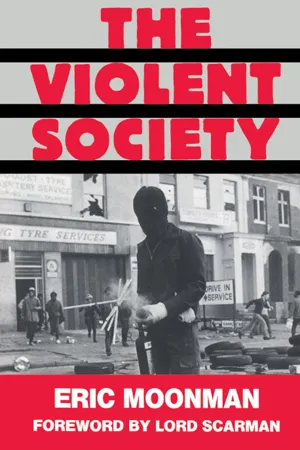
From the Foreward: Each chapter of this work is in truth a separate essay or article in which an author distinguished in his field treats a different aspect or manifestation of violence in human society. I doubt whether so complete a treatise in so short a compass has been previously attempted. The reader will be left in no doubt when he reflects on what he has read that violence is, and always has been, a feature or a threat in human society- and will remain so. The reason why this must be so is made plain in the early chapters. Violent behaviour is a display of man's aggressive instinct: without that instinct, which he (and she) shares with the rest of the animal kingdom, the human species would not survive. First published in 1987. Routledge is an imprint of Taylor & Francis, an informa company.
- 167 pages
- English
- ePUB (mobile friendly)
- Available on iOS & Android
eBook - ePub
The Violent Society
About this book
Information
CHAPTER ONE
VIOLENCE: MYTHS AND REALITY
Television and the other modern media have fulfilled a very positive function over the last decade or two in making more people aware of the wider world in which they live. News reporting of crises, from earthquakes to terrorist acts, may be witnessed on television within hours or even as they occur. The consequences of this presentation of world news as it is made is that images of violence are disseminated constantly and indiscriminately.
One aspect of violence, namely terrorism provides a vivid example of the negative effects of this phenomenon. Fringe groups, fanatics and their exploiters learn from the activities of their equivalents across the world. Defiance of the law and confrontation become commonplace – a necessary part of extremist politics.
Assassinations, hijackings and riots have all taken place on television before an audience of millions. The issues become obscured by the sheer drama of the events being played out; frequency breeds contempt or, at the very least, indifference. Hijackings are still sufficiently rare to attract huge ratings; overturned cars, stone throwing and burning cars have become so familiar as to be boring. It is an appalling comment on contemporary society that matters which should revolt the consciousness have become models for the criminal, the terrorist and the desperate judged in terms of their entertainment value by the general public.
There is obviously a relationship between terrorism, small-scale war waged by bands of undisciplined recruits on civilian targets and regular wars between nation states fought with sophisticated and devastating weapons. Vietnam was the first war to be televised though it was not until the 1982 war in Lebanon that modern technology brought a war into our living rooms as it was happening. There is no question that this new dimension to warfare heightens international tension and stimulates the political debate surrounding any conflict. There are many ways in which this is ‘a good thing’ but we should not blind ourselves to the dangers of the greater involvement of huge numbers of people through mass communications in international conflict. Violence is seen to be a necessary part of survival from the level of the local neighbourhood to the world arena. Neither should we ignore the enormous responsibility the whole phenomenon places on the media. Television cannot yet decide who wins a war but it can already decide who we think is winning.
On the other hand, consider the iniquities of the exclusion of the mass communications element. Look at the Soviet involvement in Afghanistan or the bloody and protracted conflict in the Gulf. Limited media access has not reduced the bloodshed or the injustice and has had the effect of producing amnesia among the general public.
The soviets calculated on a world that would lose ‘interest’ in Afghanistan as the opportunities for the media to report were made virtually impossible. In fact, the reports that were ‘allowed’ were usually stories of Soviet military successes or improvised informal reports from Western cameramen and reporters without Soviet permission. But a violent and brutal action was committed by a nation and it was, although to a limited extent, observed.
To the public, then, conditioning in terrorism has taken place whether by individual groups or superpowers. They have seen and they may well have experienced personally, some of these ‘international’ disorders. In the United Kingdom a family on the mainland will know of the tension and terror experienced directly if they have family or friends living in Northern Ireland.
Along with the conditioning comes the direct personal experience. Whether it is mugging in your neighbourhood; a burglary of an old age pensioner with precious little to take; a hit-and-run driver who wrecks a family by killing a father or child. Or the soccer hooligan who terrorised the streets at Luton (before the cup tie with Millwall in the Spring of 1985) both before and after the game. It is all seen, felt, personally. No longer is it a detached film on T.V. It is here and now with terrible consequences for families, in which the destroyers have no respect for age or children nor circumstances.
What the chapters in this book will seek to examine is the connection between this type of violence, warfare and terrorism, and whether measures taken to curb or even eradicate the phenomenon in the domestic context will have any effect at the other end of the scale. Does one feed the other?
Is violence an inevitable, even necessary part of human existence? If so, can ways be found of channelling it into constructive as opposed to destructive activity? It turns out that the basic question with which we are concerned centres on the difference between aggression and violence, life-giving energy and death-dealing force. Thus we have moved from the specific to the general, from the pragmatic to the philosophical, an inevitable process if this collection of essays is to throw any light at all on the nature of contemporary violence.
The aim of this book is threefold. First, to examine the past, to assess the various trends and malfunctions which create disorder and violence and, second, to relate this historical perspective to the contemporary scene: is there a greater degree of violence today, and, if so, what form does it take? Third, what can be done to reassure a growing, anxious public as they observe hooligans and brutalities within their neighbourhoods affecting their families and friends as many of our social institutions appear to be breaking down?
Professor Pearson indicates the nature and gives a historical assessment of the subject. He describes the roots of violence, and how and why street violence has troubled successive generations of police and government. Yet it is not only that the scale of violence is greater today, on whatever index we may care to choose, but perhaps, most important, that with the growth of knowledge and self-awareness it had been assumed that a more civilised and rational society would emerge.
The violence and rioting on British streets in the summer of 1981 is a relevant case study. It is totally unlike anything most people in this country had experienced before. Many reasons have been given for this breakdown in law and order in so many cities – economic conditions, unemployment, racial discrimination, for instance – and no doubt all these factors have contributed. But if there is one single influence which, more than any other, dictated the form of action when smouldering frustrations was sparked into violence, my enquiries suggest that it is the copy-cat or halo effect of observing confrontations and rioting such as are to be found in Northern Ireland, that long-running saga of social breakdown in Britain which nightly fills the television screens with violent defiance of authority, with street fighting and neighbourhood strife.
The conditions which may create urban violence are to be found on Merseyside. The frustration of unemployment and its accompanying poverty is exacerbated by thirty years of muddled planning which has left large parts of the district derelict – if not literally, spiritually so. Long before the riots I wrote in The Times (30 May 1977) of the over-ambition of the planners and their lack of foresight, of the planning blight which drove out small businesses and pushed down the rate revenue, of the drop in population due to rehousing outside the city, and the consequences in social terms:
By the time any action was taken to counteract this urban decay, it was too late. The downturn in the economy added large-scale unemployment to Liverpool’s problems, and if new industry was going to go anywhere, it would be to the new centres of population, not to areas which had been denuded of a large part of their potential workforce. And in the wake of dereliction came all the social problems of today – poor schools whose replacement was long overdue attracting fewer and fewer good teachers, an ageing population, vandalism and crime.
Stephen Gardiner later (The Observer, 2 August 1981) wrote of Liverpool’s ‘mindless post-war building experiments’, of ‘towers and slabs looming above an eerie wasteland of unkempt grass that was once countryside’, of design showing ‘total loss of contact with people … in acres of grey concrete and black tarmac and in the seemingly arbitrary location of identical blocks’; above all he identified the disappearance of the street as having adverse effects on the life of community, so that there was no continuity with the past, no identity with surroundings.
THE SIGNIFICANCE AND EXAMPLE OF NORTHERN IRELAND
One way and another, the frustration was certainly there, allied with a sense of alienation from society as a whole and a distrust of the establishment in all its forms; it needed only a spark and an example. The spark came in different ways – an arrest, a fight, it varied from place to place – the example was Northern Ireland. The parallel is not an artificial one. Northern Ireland is part of Britain and many mainland families have relatives there. There is no substantial difference between parts of Liverpool and parts of Belfast, while the emotional differences between Catholic and Protestant exist in some parts of the mainland as they do in the Province, or have their local equivalent. Looking back to the beginning of the current period of Northern Ireland unrest the same factors can be seen at work – high unemployment, regional neglect, a minority discriminated against, a Government which failed to see the problems. But in Northern Ireland the story has been different – for years open warfare has replaced frustration. Arbitrary killing, kidnapping, brutality, and the wholesale destruction of buildings, with as little regard for hospitals and schools as in a conventional war, have become the means for communication; and the frustrations of ordinary decent people have provided a field day for the bully boys, the criminals and the psychopaths.
And as the thugs take over, the rights and wrongs of the situation get lost. Horror and helplessness combine in rejection not only of the violence but also of those whose sufferings are made worse, not lessened, by it. Already we have seen the same response to Brixton, Toxteth and Tottenham; but we must try to understand before it is too late.
For if the destruction practised in Northern Ireland is condemned by most people in Britain, it nevertheless offers something to those whose own sense of alienation and frustration has reached breaking-point. For our access to news today is such that we can see in our own homes the destruction and the killing within minutes of its happening, and sometimes even while it is happening; so that we know not only that it can be done – even here in Britain – but also how it’s done.
ENQUIRIES ON MERSEYSIDE
My enquiries in support of this thesis arise from a series of reports, albeit dealing with football violence, and Fascist recruitment in schools and at rock concerts, undertaken by the Centre of Contemporary Studies, all stressing the seriousness of such action committed against a background of public interest and viewing participation.1
Second, and more specifically, on the question of the 1981 summer’s riots, I visited a number of the trouble centres where, during interviews, the significance of the copy-cat crime became clear to me from many points of view. As part of this investigation I interviewed youngsters in Toxteth in August, immediately after the riots. The influence of television on their response to the situation could not be doubted – TV made it look easy, they knew what kind of things to do. Aged between 13 and 15, half of them white and half black, bored, brought up to distrust police and, in four cases, with parents away, when the opportunity to riot came, they took it; they weren’t scared because such happenings were not ‘unthinkable’; they are, indeed, part of the media wallpaper of their everyday lives.
Further enquiries, both in Liverpool and later in South London again, emphasised the significance to this age group of television viewing. One comment from a 16-year-old in South London makes the point:
I’m out of work. I’m bored with everything around me. To try out for real what I see on the box is good thinking. I’ve been into all the fights, with the shop windows, the pigs, the lot. It’s so bloody easy. That’s what’s so funny. It’s as easy as watching it happen in Ireland…. This is the London show….
Further evidence for the existence of the copy-cat response to media events is well documented, particularly in America where universities have encouraged examination of such questions as part of their long history of media analysis. Links between the media and imitative events have been established in such diverse examples as suicides by Russian roulette following showings of the film The Deer Hunter, and a correlation between the monthly suicide rates and front-page coverage of suicides in The New York Times taken over a period of 20 years.
The susceptibility of young people in the 10 to 13 age group is particularly high, as a 1978 Harvard and Yale2 research project demonstrated. This is the age when children begin to move into the adult world and, as the Annan Committee on the Future of Broadcasting3 pointed out, for the disadvantaged child television is the main source from which he draws his knowledge of how adult society behaves. This factor was clearly recognised in the nationwide outbreak of copy-cat street violence which followed Brixton and Toxteth, but has been overlooked as a factor in Brixton and Toxteth themselves. Yet the similarity to the Northern Ireland scene was remarked on by many commentators without recognising that the similarity was neither superficial nor coincidental. The wearing of balaclavas and plastic bags to conceal identity, the firing of dustbins, the commandeering of milk floats, the petrol bombs, the looting – all this was a clear reflection of the pictures of life in Northern Ireland as we see it on our television screens, torn from the total context of Northern Ireland, in which the majority of people abhor the violence as much as any mainlander and carry on their day to day lives as normally as possible, and where many people work quietly behind the scenes to bring peace and reconciliation. For the response of the media to the copy-cat phenomenon lies not in censorship, but in balance, in putting the news into its proper perspective as the exceptional rather than the norm.
At the mention of any restraint of the broadcasting authorities there are a lot of knee-jerks. ‘It smells of censorship’, said a trade union leader when I tentatively suggested the matter. But the issue is now being faced as it will not go away. For the first time, in December 1985, the Home Secretary convened a meeting with the heads of the BBC and the Independent Broadcasting Authority to discuss the level of violence shown on television.
The meeting provided the Home Secretary with an opportunity to convey public concern to the two broadcasting chair men. Earlier, at a conference of trade unionists in Blackpool, the Prime Minister had told her audience that ‘violence on television was damaging to young people who watched it night after night. She said the government was considering what further could be done.’ Her concern was then reinforced in an interview by the Home Secretary on BBC television. He said the broadcasters should ‘set their house in order’ over violence. He went on: ‘Concern about this is very real. I think the most emotional meeting I have had in my constituency in recent years was on this subject, from parents who came together regardless of party to hammer away at me, the MP and BBC and ITV representatives.’
It would be desirable for the broadcasting authorities rather than the government to take measures themselves to reduce the level of violence on television. At present, commercial television is under a statutory duty to ensure that programmes do not offend against good taste and decency or incite crime. Similar obligations are imposed on the BBC under its charter. But the opponents of any form of restraint on the media argue from different motives. Political extremists say – whether on the left or right – that there should be no control of the media, but in reality, and from experience in other countries, it is clear that they would not hesitate to use such powers against their opponents if they were in government.
Opposition to restraint of the media also comes from the artistic. This is from the talented playright Hanif Kureishi (in The Times, 28 December 1985):
Since there is already adequate provision to prevent ordinary people being shocked by unusual or unlikely sex or violence, it is increasingly apparent that this renewed call for censorship is a figleaf concealing the desire to suppress work which is morally or politically challenging. The extent to which the authoritarian suppression of dissent – be the dissenters trade unions, artists or the BBC – is becoming more general in our society now is already worrying enough. But this fresh attack is deeply dangerous.
As it is through the imaginative arts that we tell the truth to ourselves, writers and directors who seek to explore the serious and difficult issues of sex and violence are essential to any society that considers itself tolerant, sceptical, pluralist and self-aware.
This is not only a question of the freedom of artists, but one about the importance a society attaches to criticism.
Mr Kureishi was answering correspondence on the showing of violence in television serials. But whilst he stressed the ‘rights’ of artists and writers to express themselves freely he offers no guidance to help an audience to understand, to relate or even to refute what it sees. Besides, it is one thing for writers to intellectualise on the Royal Court stage for a minority few hundred each evening, but it is a very different thing when the message is transmitted on TV to millions of young people, indiscriminately, able to see in their own living room a harrowing se...
Table of contents
- Cover
- Half Title
- Title Page
- Copyright Page
- Table of Contents
- Foreword
- 1. Violence: Myths and Reality
- 2. Short Memories: Street Violence in the Past and in the Present
- 3. Violence in the Home
- 4. Stress and the Individual
- 5. Violence and Public Disorder
- 6. Pathways out of Terrorism for Democratic Societies
- 7. Is there a Meaningful Response?
- Notes on Contributors
Trusted by 375,005 students
Access to over 1.5 million titles for a fair monthly price.
Study more efficiently using our study tools.
Frequently asked questions
Yes, you can cancel anytime from the Subscription tab in your account settings on the Perlego website. Your subscription will stay active until the end of your current billing period. Learn how to cancel your subscription
No, books cannot be downloaded as external files, such as PDFs, for use outside of Perlego. However, you can download books within the Perlego app for offline reading on mobile or tablet. Learn how to download books offline
Perlego offers two plans: Essential and Complete
- Essential is ideal for learners and professionals who enjoy exploring a wide range of subjects. Access the Essential Library with 800,000+ trusted titles and best-sellers across business, personal growth, and the humanities. Includes unlimited reading time and Standard Read Aloud voice.
- Complete: Perfect for advanced learners and researchers needing full, unrestricted access. Unlock 1.5M+ books across hundreds of subjects, including academic and specialized titles. The Complete Plan also includes advanced features like Premium Read Aloud and Research Assistant.
We are an online textbook subscription service, where you can get access to an entire online library for less than the price of a single book per month. With over 1.5 million books across 990+ topics, we’ve got you covered! Learn about our mission
Look out for the read-aloud symbol on your next book to see if you can listen to it. The read-aloud tool reads text aloud for you, highlighting the text as it is being read. You can pause it, speed it up and slow it down. Learn more about Read Aloud
Yes! You can use the Perlego app on both iOS and Android devices to read anytime, anywhere — even offline. Perfect for commutes or when you’re on the go.
Please note we cannot support devices running on iOS 13 and Android 7 or earlier. Learn more about using the app
Please note we cannot support devices running on iOS 13 and Android 7 or earlier. Learn more about using the app
Yes, you can access The Violent Society by Eric Moonman in PDF and/or ePUB format, as well as other popular books in Politics & International Relations & Politics. We have over 1.5 million books available in our catalogue for you to explore.