![]()
1 What is service?
Service and economies
The importance of services in national and global economies is increasing significantly. “Our welfare and the welfare of our economy now are based on services. The activities of manufacturing and agriculture always will be necessary, but we can eat only so much food and we can use only so many goods” (Fitzsimmons, Fitzsimmons, & Bordoloi, 2008).
During the last two decades, the contribution of the service sector, communication services, food services and health services to the Gross Domestic Product (GDP) has been significantly increasing in both developed and developing economies. Table 1.1 shows shares of the service sector in the GDPs of industrialized countries (United States, Japan, UK and Germany) and developing BRIC countries (Brazil, Russia, India and China).
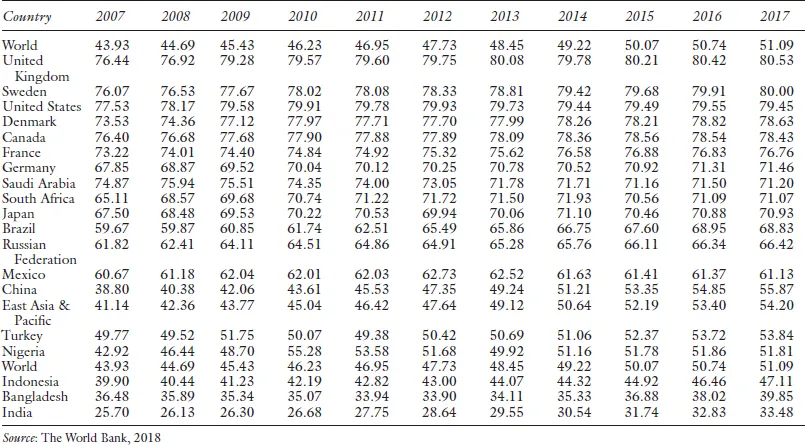
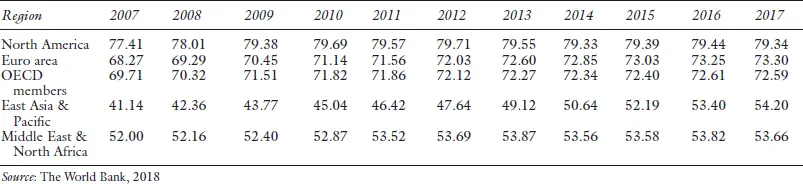
The service sector has a huge proportion of local and global employment, too. Hence, because of its fast and continual growth, the scope and the economic potential of this sector have not yet been researched extensively (Wamboye & Nyaronga, 2018). Table 1.2 shows how the service industry has a significant impact on world employment and in selected countries with large economies, while Table 1.3 shows the overall employment contribution of the service industry in different world regions.
Table 1.1 Share of services in GDP | % of world GDP | % share services in GDP | % share manufacturing in GDP |
UK | 3.9 | 79.94 | 9.76 |
US | 27.89 | 78.92 | 12.27 |
Japan | 5.98 | 70.4 | 20.55 |
China | 15.09 | 50.24 | 29.78 |
Russia | 1.86 | 62.65 | 13.77 |
Germany | 4.59 | 68.88 | 22.81 |
India | 2.88 | 52.93 | 16.57 |
Brazil | 2.46 | 72.68 | 11.76 |
Source: The World Bank, 2018
Table 1.2 Employment in services by country (% of total employment)
Table 1.3 Employment in services by region (% of total employment)
Definition of service
Oxford Living dictionaries define the word “service” as “the action of helping or doing work for someone”. Another definition is “[S]ervice is deeds, process and performance” (Zeithaml, Bolton et al., 2006). This definition looks to service from perspective of organizational management systems. Yet another definition of service – as an economic activity – is “Service is an economic activity that creates values and provides benefits for customers at specific times and places” (Talib, Rahman, & Qureshi, 2012). This definition looks at service from the broader theory of economics.
A service can also be defined as “a process of applying the competencies and skills of a provider for the benefit of, and in conjunction with, the customer” (Agarwal, Selen, Roos, & Green, 2015). The concept of added value has been also used to define service as “the application of resources for the benefit of another, centres on the concept of value cocreation” (Vargo & Akaka, 2012). The two definitions just presented were based on the concept of benefits and value creation between service provider and the customer. The concept of benefits and value creation is originated by the definition of service that empathizes on performance offered by a provider to a customer through economic activities aim to create value and deliver benefits at explicit time and location (Haksever & Render, 2013; Heidrich & Réthi, 2012; Lovelock & Patterson, 2015).
A definition used that refers to the intangible characteristics of service is:
[A] service is an activity or series of activities of more or less intangible nature that normally, but not necessarily, take place in interactions between the customer and service employees and/or physical resources or goods and/or systems of the service provider, which are provided as solutions to customer problems.
(Grönroos, 1990)
Classification of the service industry
Based on the literature on classifications of the service sector, there are two main trends: narrow-scope classification and broad-scope classification. Narrow service-sector classification includes all organizations that have economic activities other than manufacturing, agriculture, construction, mining, forestry, quarrying, fishing and hunting, public administration and defense, and utilities. The broad classification extends the scope of excluded industries to construction, public administration and defense, and utilities (Kanapathy, 2003).
The phrase “service industry” refers to economic activity that takes the form mainly of a personal service rather than a physical industrial commodity. This physical industrial activity is represented by a group of industries that provide goods commodities, for example, the agriculture industry, the manufacturing industry, the mining industry and the construction industry. However, the differences between industry divisions were not clear, and there were difficulties in differentiating the process of assembling goods parts from the process of serving food in a restaurant (Stigler, 1956). According to Stigler (1956) service industry classification was as follows:
- Wholesale trade
- Medical and health
- Retail trade
- Government education
- Banking and finance
- Domestic service
- Insurance and real estate
- Medical and health (private)
- Laundries, cleaning, and so on.
- Automobile repair
- Armed forces
- Hotels and lodging places
- Welfare, religious and membership organizations
- Entertainment and recreation services
- Legal, engineering and miscellaneous professional services
- Education (private)
- Business services
- Barbers and beauty shops
- Miscellaneous repair services
- Other personal services
Manufacturing industries were classified long before the service industry was, and they have historically been censused and analyzed more frequently as well. Manufacturing industries have been classified occasionally according to two classification methods: by their original raw materials and by their final developed products. Examples of the classification method used with respect to raw material are wood, oil and rubber products. Examples of the classification method used with respect to final developed products are cars and machines. However, the classification methods keep changing because they are usually technology-based classifications, and technology changes quickly.
However, using the same classification methods in the service industries would result in unpractical classification, because services do not generally end by creating physical products. Therefore, service industry classification methods started by following occupational structure (Stigler, 1956). According to the occupational structure, services industries include:
- Food
- Medical care
- Clothing
- Education
- Automobiles
- Trade
- Household operation (domestic servants)
- Entertainment and recreation
- Household furnishing
- Community welfare and religious
- Personal care
- Fuel, light and refrigeration
- Insurance
- Miscellaneous personal services
- Non-profit membership
- Government
The North American Industry Classification System (NAICS), Canada 2017 version, classifies service industries into 15 subcategories:
- Wholesale trade
- Retail trade
- Transportation and warehousing
- Information and cultural industries
- Finance and insurance
- Real estate and rental and leasing
- Professional, scientific and technical services
- Management of companies and enterprises
- Administrative and support, waste management and remediation services
- Educational services
- Health care and social assistance
- Arts, entertainment and recreation
- Accommodation and food services
- Other services (except public administration)
- Public administration
Wholesale trade industry
NAICS defines the wholesale industry in this way: “This sector comprises establishments primarily engaged in wholesaling merchandise, generally without transformation, and rendering services incidental to the sale of merchandise”.
Under this sector there are two main types of wholesalers: merchant wholesalers and brokers. The merchant wholesalers sell and buy merchandise for their own accounts and possess the goods they sell. They usually have their own locations, offices and warehouse. They deal with suppliers or they have their own shipping system and autos to operate from their warehouse to their distribution centers and customer locations. They also usually have additional businesses such as marketing and support services, logistics services, packaging, labeling, handling of warranty claims, inventory management, shipping and product training. Examples of merchant wholesalers are wholesale distributors, drop shippers and import-export merchants. Sales branches or offices, excluding retailers, used by manufacturing, refining, or mining organizations for showing and marketing their products are considered merchant wholesalers. Additionally, merchant wholesalers include units that do not own the input materials and that completely outsource the process of developing and producing goods.
Brokers includes business-to-business electronic markets and agents. Brokers arrange for the operations of purchasing or selling of goods owned by other parties, usually for an agreed fee. Their other names are import-export agents, commission merchants, manufacturer’s representatives and auction companies. They generally operate from their own offices.
More detailed wholesale sector subsectors are as follows:
- Farm product merchant wholesalers
- Petroleum and petroleum products merchant wholesalers
- Food, beverage and tobacco merchant wholesalers
- Personal and household goods merchant wholesalers
- Motor vehicle and motor vehicle parts and accessories merchant wholesalers
- Building material and supplies merchant wholesalers
- Machinery, equipment and supplies merchant wholesalers
- Miscellaneous merchant wholesalers
- Business-to-business electronic markets, and agents and brokers
Retail trade
This sector includes establishments primarily involved in retailing and selling merchandise that usually needs no transformation. Since retailing is the last step of distributing goods, retailing deals with relatively small quantities of goods. This sector has two sub-retailer types, store and non-store retailers.
Store retailers
Store retailers have fixed locations that try to attract large numbers of custo...