eBook - ePub
Deterrence
About this book
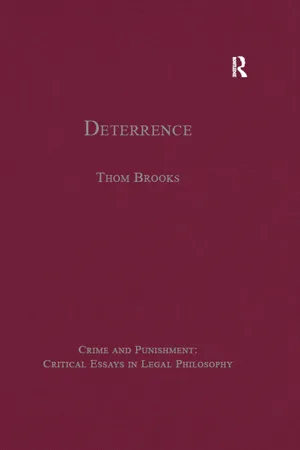
Deterrence is a theory which claims that punishment is justified through preventing future crimes, and is one of the oldest and most powerful theories about punishment. The argument that punishment ought to secure crime reduction occupies a central place in criminal justice policy and is the site for much debate. Should the state deter offenders through the threat of punishment? What available evidence is there about the effectiveness of deterrence? Is deterrence even possible? This volume brings together the leading work on deterrence from the dominant international figures in the field. Deterrence is examined from various critical perspectives, including its diversity, relation with desert, the relation of deterrence with incapacitation and prevention, the role deterrence has played in debates over the death penalty, and deterrence and corporate crime.
Part I
Deterrence Theory
[1]
The Role of Deterrence in the Formulation of Criminal Law Rules: At Its Worst When Doing Its Best
PAUL H. ROBINSON* AND JOHN M. DARLEY**
TABLE OF CONTENTS
INTRODUCTION
I. | GROWING REASONS TO BE SKEPTICAL OF CRIMINAL LAW DETERRENCE A. KNOWLEDGE HURDLE B. PERCEIVED NET-COST HURDLE C. RATIONAL DECISIONMAKING HURDLE D. CUMULATIVE EFFECT |
II. | THE TRADITIONAL ASSUMPTION THAT THE FORMULATION OF CRIMINAL LAW DOCTRINE WILL INFLUENCE CONDUCT A. DOCTRINAL FORMULATIONS CALCULATED TO DETER, OR TO AVOID UNDERCUTTING DETERRENCE 1. Prohibitions 2. Culpability Requirements, Mitigations, and Excuse Defenses 3. Grading Judgments 4. Sentencing Decisions B. DOCTRINAL FORMULATIONS CALCULATED TO REQUIRE OR AUTHORIZE CONDUCT 1. Justification Defenses 2. Duties and Liability for Omissions C. “DETERRENCE SPEAK” VERSUS DEVIATIONS FROM JUSTICE 1. Deterrence Speak 2. Deterrence Rationales that Do Real Work: Deviations From Justice |
III. | THE CASE AGAINST USING DETERRENCE AS A DISTRIBUTIVE PRINCIPLE A. THE DIFFICULTIES OF DETERRENCE: THE INFORMATION AND COMPLEXITY PROBLEM B. A COMPARISON OF DETERRENT EFFECTS C. WHERE DETERRENCE DEVIATES FROM JUSTICE, IT CONFRONTS SPECIAL DIFFICULTIES D. CREATING CRIMINALS: THE PROBLEM OF OFFSETTING CRIMOGENIC EFFECT |
IV. | THE POSSIBILITIES AND IMPOSSIBILITIES OF IMPROVING DETERRENT EFFECT A. ENSURING THAT THE TARGET AUDIENCE KNOWS, DIRECTLY OR INDIRECTLY, OF THE RULE DESIGNED TO INFLUENCE THEIR CONDUCT B. ENSURING THAT THE TARGET AUDIENCE PERCEIVES A MEANINGFUL NET COST TO A VIOLATION 1. Probability 2. Delay 3. Amount C. ENSURING THAT THE TARGET AUDIENCE IS CAPABLE OF AND WILLING TO BRING A PERCEIVED THREAT OF PUNISHMENT TO BEAR ON THEIR CONDUCT DECISIONS |
V. | SUMMARY AND CONCLUSION |
INTRODUCTION
For the past several decades, the deterrence of crime has been a centerpiece of criminal law reform. Lawmakers have sought to optimize the control of crime by devising a penalty-setting system that assigns criminal punishments of a magnitude sufficient to deter a thinking individual from committing a crime. Although this seems initially an intuitively compelling strategy, we suggest it is a poor one; poor for two reasons. First, its effectiveness rests on a set of assumptions that on examination cannot be sustained. Second, deterrence strategies may have hidden crimogenic costs—that is, they may generate crime in unexpected ways.
Experience has taught us to be precise about exactly what we are saying about the effectiveness of a deterrence strategy. There seems little doubt that having a criminal justice system that punishes violators, as every organized society does, has the general effect of influencing the conduct of potential offenders. This we concede: Having a punishment system does deter. But there is growing evidence to suggest skepticism about the criminal law’s deterrent effect—that is, skepticism about the ability to deter crime through the manipulation of criminal law rules and penalties. The general existence of the system may well deter prohibited conduct, but the formulation of criminal law rules within the system, according to a deterrence-optimizing analysis, may have a limited effect or even no effect beyond what the system’s broad deterrent warning has already achieved. We suggest that, while it may be true that manipulation of criminal law rules can influence behavior, it does so only under conditions not typically found in the criminal justice systems of modern societies. In contrast, criminal lawmakers and adjudicators formulate and apply criminal law rules on the assumption that they always influence conduct. And it is this taken-for-granted assumption that we find so disturbing and so dangerous. In Part I we briefly summarize the social science literature that prompts our skepticism as to whether the criminal law deters, showing that potential offenders do not know the law, do not make rational choices, or do not perceive an expected cost for a violation that outweighs the expected gain.
In sharp contrast, the assumption that legal formulation decisions will have a direct deterrent effect on conduct, has been used in crafting nearly every aspect of criminal law, from defining the rules of conduct, to formulating principles of liability, to determining offense grades, to setting sentencing rules and practice.1 On close inspection, we conclude that much of this is more a style of conversation—“deterrence speak”—than a true reliance upon deterrence analysis. But true reliance on deterrence is evident in a variety of rules that produce substantial deviations from what other principles for distributing liability and punishment, such as just deserts, would provide. We document these two phenomena in Part II.
Even if one concludes that deterrence skepticism overstates its case, there remain reasons for serious concern. We argue that, even on the most cautious reading of the available studies, enough is known to urge an end to the past practice of formulating criminal law based on a deterrence-optimizing analysis. In Part III we offer four primary arguments. First, a disabling problem for deterrence as a principle for the distribution of liability and punishment is its need for information that is neither available nor likely to be available any time in the foreseeable future. Formulating criminal law rules according to a deterrence analysis can produce erroneous results if based upon missing or unreliable data. In fact, inadequately informed analyses could produce criminal law rules that reduce, rather than increase, the possibility of deterrence. In such an informational void, we argue, it makes sense to follow a distributive principle that at the very least can achieve its objectives.
Further, even if full and perfect information were available, we argue that the dynamics of deterrence are dramatically more complex than has been supposed. The deterrent process involves complex interactions, like substitution effects, that make deterrent predictions enormously difficult. And the deterrent process is a dynamic rather than a static one. The manipulation of a criminal law rule may well increase its deterrent effect as hoped, but that effect can itself change the existing conditions and require a new and different deterrence calculation. Part III.A examines deterrence’s informational and complexity problems.
Second, once it is recognized that any distributive principle for criminal liability and punishment will produce some deterrent effect—if any is to be had—a deterrence-based distribution makes sense only if it can provide meaningfully greater deterrent effect than that already inherent in competing distributions that advance other valuable goals, such as doing justice.
Third, the important implication of our argument is that deterrence can do better than another distribution—such as a justice distribution2—only if and where the two distributive principles deviate. Thus, a deterrence-based distribution can deter better than a justice-based distribution only if and where it deviates from a just result. But it is just these instances of deviation from justice in which it is most difficult to achieve a deterrent effect. People assume the law is as they think it should be, according to their own collective notions of justice. Thus, the simple prerequisite of making the deterrence-based rule known becomes a serious task. Further, it is in these deviation-from-justice cases that the system’s deterrence-based rules are least likely to be followed. Because people commonly think of criminal liability and punishment in terms of justice rather than deterrence, the exercise of police, prosecutorial, and judicial discretion, as well as jury nullification, commonly subvert application of deterrence-based deviation rules, thus subverting the deterrence program and confusing the deterrence message. Parts III.B and C detail these arguments.
Fourth, even if one assumes for the sake of argument that a deterrence-based distribution produces a greater deterrent effect than a justice-based distribution—despite the former’s special deviation problems—there is reason to be concerned that the deterrence-based distribution simultaneously produces crime. Because it deviates from the community’s shared intuitions of justice, the deterrence-based distribution can undercut the criminal law’s moral credibility, lessening its own crime-control power as a moral authority—a dynamic that we suspect can have significant crimogenic effect. Thus, even if a deterrence-based distribution did successfully produce a greater deterrent effect than a justice-based distribution, that greater deterrent effect might be offset by its greater crimogenic effect in undercutting the moral authority of the criminal law. These are the potential costs, referred to above, that are incurred by a deterrence-based system. Part III.D details these arguments.
We believe that optimizing deterrence through doctrinal manipulation is possible, but only under narrow conditions not typical in American criminal justice. There are possibilities for reform that might broaden these conditions, but also serious limitations, due in large part to the sacrifices such reforms would demand: in greater financial cost, in infringing upon interests of privacy and freedom from governmental intrusion, in compromising basic notions of procedural fairness, and in doing injustice and failing to do justice. Our conclusion is that if one takes a realistic view of deterrence, even after plausible reforms are ma...
Table of contents
- Cover
- Half Title
- Title Page
- Copyright Page
- Table of Contents
- Acknowledgements
- Series Preface
- Introduction
- PART I DETERRENCE THEORY
- PART II DETERRENCE AND DESERT
- PART III DETERRENCE, INCAPACITATION AND PREVENTION
- PART IV DETERRENCE AND CAPITAL PUNISHMENT
- PART V DETERRENCE AND CORPORATE CRIME
- PART VI CRITICS
- Name Index
Trusted by 375,005 students
Access to over 1.5 million titles for a fair monthly price.
Study more efficiently using our study tools.
Frequently asked questions
Yes, you can cancel anytime from the Subscription tab in your account settings on the Perlego website. Your subscription will stay active until the end of your current billing period. Learn how to cancel your subscription
No, books cannot be downloaded as external files, such as PDFs, for use outside of Perlego. However, you can download books within the Perlego app for offline reading on mobile or tablet. Learn how to download books offline
Perlego offers two plans: Essential and Complete
- Essential is ideal for learners and professionals who enjoy exploring a wide range of subjects. Access the Essential Library with 800,000+ trusted titles and best-sellers across business, personal growth, and the humanities. Includes unlimited reading time and Standard Read Aloud voice.
- Complete: Perfect for advanced learners and researchers needing full, unrestricted access. Unlock 1.5M+ books across hundreds of subjects, including academic and specialized titles. The Complete Plan also includes advanced features like Premium Read Aloud and Research Assistant.
We are an online textbook subscription service, where you can get access to an entire online library for less than the price of a single book per month. With over 1.5 million books across 990+ topics, we’ve got you covered! Learn about our mission
Look out for the read-aloud symbol on your next book to see if you can listen to it. The read-aloud tool reads text aloud for you, highlighting the text as it is being read. You can pause it, speed it up and slow it down. Learn more about Read Aloud
Yes! You can use the Perlego app on both iOS and Android devices to read anytime, anywhere — even offline. Perfect for commutes or when you’re on the go.
Please note we cannot support devices running on iOS 13 and Android 7 or earlier. Learn more about using the app
Please note we cannot support devices running on iOS 13 and Android 7 or earlier. Learn more about using the app
Yes, you can access Deterrence by Thom Brooks in PDF and/or ePUB format, as well as other popular books in Law & Criminal Law. We have over 1.5 million books available in our catalogue for you to explore.