Our work began again in earnest in the spring of 2008 when we and a member of the PWC of BC (now designated as writers) began to work with a dramaturge, Martin Kinch. Alex Ferguson (now the director) took us (along with five professional actors, a stage manager, a scenographer, an additional set designer, lighting and costume designers, and three Filipino youth apprentices) through a two-week development workshop in July of that year, from which emerged Nanay: A Testimonial Play.
The play was developed and first performed in Vancouver’s Downtown Eastside at Chapel Arts, located across from Oppenheimer Park, a place that reverberates with memories and historical incident. In the park, a community-carved totem pole commemorates the many Indigenous people who have lived and died in the neighbourhood,1 and the documentary film, The Battle of Oppenheimer Park,2 situates the present-day life in the park within a violent history of dispossession of the Musqueam First Nation from the unceded territory on which the park stands. An ill-maintained baseball diamond was – many years ago – home field for the famed Asahi Tigers, a Japanese Canadian baseball team that was permanently disbanded during World War II, when members (and the entire Japanese Canadian community) were displaced from Vancouver and interned in camps.3 The Kalayaan Centre, where the PWC of BC was located until 2010, lay on the other side of the park, a proximity that allowed for steady traffic between the theatre and the PWC of BC during the two-week development workshop in July 2008, and through periods of rehearsal and performance in January and February 2009.4 Reopened in 2007 as a performance space, Chapel Arts was formerly a chapel and funeral home. We collectively created the nine scenes of the play in relation to the building’s ambience and architectural form.5
A guided tour of Nanay: melancholic realism, disidentification and strangeness to oneself
The audience experienced the play in small groups, guided from room to room to hear Canadian employers and Filipino domestic workers speak about their lives; Canadian employers in the public areas upstairs where funeral receptions would have been held, domestic workers in the unheated, dank spaces below previously used for the delivery and care of corpses. At a PWC of BC community assessment after the event, one activist spoke of “feel[ing] the contrast – you know, the damp, the dark atmosphere downstairs, the cold and no [theatrical] lighting. So when you go up: the luxurious, you know, the well-appointed rooms. So it was really the best portrayal of the two solitudes: of the slavelike conditions, and the richness of the society that exploits these women.”
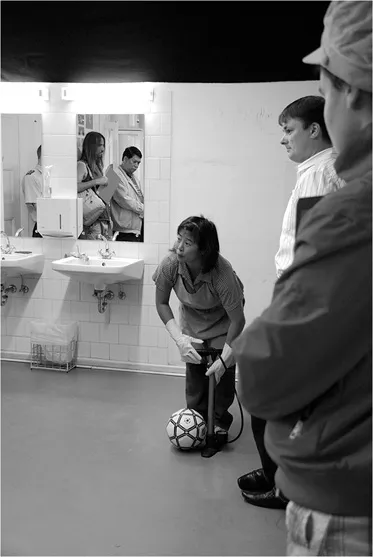
Memories and loss run through the testimonial stories and performance spaces. Audiences saw domestic workers’ monologues in one of the two sequences; one sequence began in the former embalming room, still fragrant with the scent of its previous function.6 And while the Filipino Canadian actor Hazel Venzon told in her monologue – as she scrubbed and cleaned this place – of her great optimism, gratitude and joy leaving the Philippines to do domestic work, her departure is grounded in loss (Figure 1.1). She testifies to being abandoned by her husband when he left to do overseas contract work in the Middle East, which created the necessity of leaving her children, her mother, her father and her siblings in order to try her luck as a migrant worker, first in Hong Kong and then in Vancouver.7 With a gruelling schedule of 16 performances on one of the performance days,8 Hazel told us afterwards that she maintained her own stamina as an actor by silently dedicating each performance to a different female family member living in distant cities around the world: “this is for my mother, this is for my aunt…”
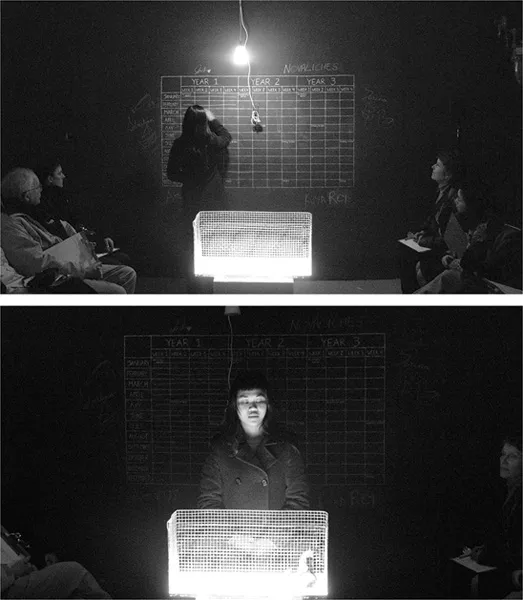
The audience was then guided into an adjacent garage-like room where the mechanism for raising coffins and corpses through the ceiling for public- viewing upstairs is still evident. The room was uninsulated and so cold that the actor was, of necessity, dressed in an overcoat. The actor, Lissa Neptuno, delivered the testimony of Joanne in a compressed space, wedged between a small mounted cage and a calendar-grid drawn on the wall behind, upon which she charted her progress through the LCP (Figure 1.2). The director explains the rationale for the set: “the nanny had gone AWOL from an exploitative job situation that was no longer tolerable […] so she was hiding out when she gave the original interview. I had hoped to imply vaguely that the scene was taking place in a safe house.”9 Joanne’s angry monologue is about her treatment, as a professionally trained nurse, under the LCP, and it too is punctuated by loss, absence and defeat: of her husband and two children left in the Philippines; of being dismissed by her first employer; of the death of another elderly employer, which again left her temporarily unemployed; and of the revelation by the guide,10 after her monologue is finished, that she failed, because of the succession of employers, to complete the programme within the required 36 months11 and was obliged to return to the Philippines. She is absent. She is gone. We cannot alter her situation, even if we wish.
Figure 1.1 Ligaya speaks of leaving her children and “finding her luck” in Canada.
Figure 1.2 Joanne testifies.
The audience was then moved to a narrow-darkened hallway to sit and listen to an eight-minute audio recording of mothers’ and children’s recollections of separation.12 This is the only testimony delivered directly by domestic workers and their children (and not by professional actors). We hear only voices, symptomatic of their disembodied experiences of connection. The tearful voice of a domestic worker describing leaving her children is interrupted and overlain with the less impassioned voices of children recalling their memories of their mother coming and going, leaving and returning, and simply staying away for years at a time. At one moment, for instance, a mother speaks: “Four years and eight months. I never went home in-between these years. It’s so I could have a better life in the future….” This is interrupted by a young woman’s voice: “My mom would take care of me in ways that … she would send money and letters. But it’s hard to connect when you’re just sending letters, right? It takes a month before it gets to the Philippines.” The mother’s tearful voice resurfaces: “I did receive letters. Like if I sent them letters. I’d receive … up to two months, I’d receive an answer. And then I can answer that back after six months again. That’s the only comfort I have there. You just cry every time you will miss your family … It took me awhile, like six months, before I stopped crying when I get there. It was very hard.” A young man, again in a more matter-of-fact tone, begins to speak over her voice: “She was writing letters, but we just get to see the letter. We don’t really get to read it. We just see, ‘Okay, she wrote letters.’ But to us it’s just like: ‘Okay, yeah.’ We were like … we want to know how she is, but we didn’t know how to show it kind of thing.”13
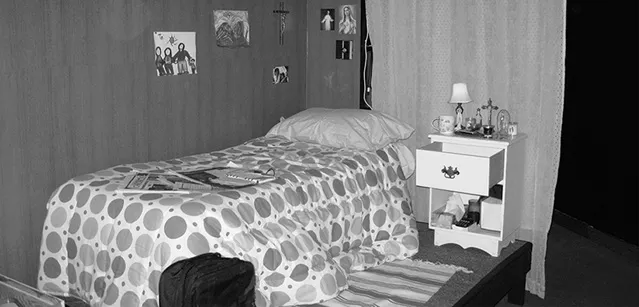
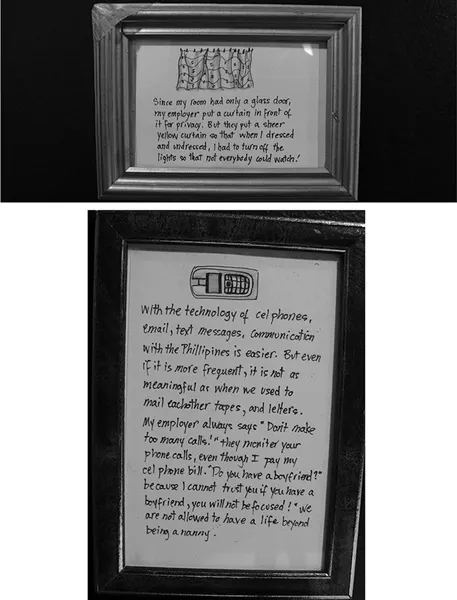
The final scene in this sequence of domestic worker monologues was a space we called “the storied objects room.” Domestic workers from the PWC of BC took charge creating the installation: it was a model bedroom assembled from memories of their rooms (Figure 1.3). An exact replica of a domestic worker’s daily journal lay on the bedside table, inspirational and devotional religious passages interspersed with an unrelenting schedule of domestic duties. Christian iconography – images of Pope John Paul and a rosary draped on a small figurine of Christ – was carefully arranged in the small space. A small, ancient black-and-white television was turned on, positioned on a dresser at the end of her bed. (Oblivious of trespass, when a hockey game was on during one performance, some audience members perched on the end of the bed to watch it.) Around the edges of the room were framed, hand-written and drawn descriptions of different domestic workers’ Canadian bedrooms (Figure 1.4), and on one wall, we installed a large collage of actual letters, cards and photographs sent between family members in the Philippines and Canada.14
Figure 1.3 A model bedroom.
Figure 1.4 Framed memories.
As a tangible fully sensory container of memory, the bedroom was richly evocative for many who attended the play. Glecy, whose description of her Canadian bedroom as a domestic worker informed the piece, said that even though “I shared some of my experience there, I am still wounded [when I saw it] and I could still… It’s a flashback in my memory when I hear [an audio recording of] the water splashing down [through pipes in the wall]. Oh, it reminds me of how noisy my room was.” From Coretta, who was not part of constructing the room, “like the bedroom … I really can’t control my tears. Because at the moment I can really feel the environment, the temperature, the smell of the room, as well as the materials around the room.” Even those who had no direct memory of such a room felt moved by it. Leah, a PWC of BC organiser whose son was born in Canada, spoke of its impact on her son: “But my son said that for him the one that impacted him the most was going into that bedroom because he felt it was so heavy. Like you couldn’t breathe [because it felt so claustrophobic and the air was very stale], and it was quiet but not at the same time because of all the noise [of simulated water running through pipes in the wall] and the air. And the darkness. So it made a lot of the stories we hear tangible and sort of … you are stepping into their space.” Non-Filipino audience members wrote on an audience feedback survey of “a dreaded sense of hopelessness looking through the nanny’s room” and that “the little bedroom with all the photos, letters and the like really affected me.” “The replica bedroom was the most touching,” wrote another; “the little room montage [of letters, pictures, and postcards] was so very sad.” Before proceeding upstairs to hear testimony from Canadian employers, we pause to consider what kinds of ethical situations we sought to generate with these domestic worker monologues and take some measure of how they were received.
One reading is that these spaces of relics and embodied monologue set in motion what Ian Baucom has identified as a distinctive “knowledge grammar” for apprehending the world.15 Baucom draws a distinction between what he calls speculative and melancholic realism, arguing that each operates in a distinctive epistemological register to create different kinds of observers. In what is undoubtedly a rough caricature of social science, Baucom argues that scientific facts are constructed in relation to the population or aggregate, and through a process of abstraction: by being emptied of local significance and networked into a system of thought. Melancholic realism operates differently, mimicking the process of melancholy. Within psychoanalytic theory, melancholy is understood as a process of refusing to mourn and relinquish what has been lost or to substitute it with other attachments. What has been lost is swallowed and preserved, and the subject constructs a “cryptic vault” of memory.16 A melancholic insistence on the non-exchangable singularity of what has been lost has implications for how it can be expressed. In particular, because any representation is a form of substitution, representation itself is suspect, and melancholic realism thus operates through a “mode of reference that aims to pass itself off not as a representation of the lost thing but as that lost thing itself.”17 Consider also John Tagg’s point that framing realism within melancholy “may help us think about the character of those practices of representation that will not give way to the demand for efficient communication but resist the arrival of meaning, while mourning a real that does not lend itself to representation.”18 That is, it might slow the witness down to prevent easy absorption.
The theatrical experience that we created is arguably working within the terms of melancholic realism, and the embodied, performative spaces of theatre are particularly powerful vehicles for it. The ghostly remains of Joanne are brought back to life: the organiser at the PWC of BC who did this interview spoke of the visceral impact of “seeing it alive again.” In a community assessment organised by the PWC of BC after the Vancouver production, she spoke of the force of seeing this interview transformed into a theatrical performance: