This book presents a carefully constructed framework for teaching and learning informed by philosophical and empirical foundations of phenomenology. Based on an extensive, multi-dimensional case study focused around the 'lived experience' of college-level teaching preparation, classroom interaction, and students' reflections, this book presents evidence for the claim that the worldviews of both teachers and learners affect the way that they present and receive knowledge. By taking a unique phenomenological approach to pedagogical issues in higher education, this volume demonstrates that a truly transformative learning process relies on an engagement between consciousness and the world it 'intends'.
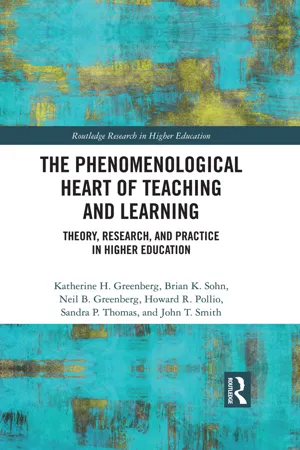
eBook - ePub
The Phenomenological Heart of Teaching and Learning
Theory, Research, and Practice in Higher Education
- 204 pages
- English
- ePUB (mobile friendly)
- Available on iOS & Android
eBook - ePub
The Phenomenological Heart of Teaching and Learning
Theory, Research, and Practice in Higher Education
About this book
Information
1
The Lifeworld of the Classroom
Rarely do we teachers in higher education consider the dynamic processes involved in the lifeworld (Lebenswelt) of the classroom: “[T]he world of lived experience inhabited by us as conscious beings and incorporating the way in which phenomena (events, objects, emotions) appear to us in our conscious experience or everyday life” (Brooks, 2015, p. 642).
For the primary job of higher education teachers is to impart to students the objective, analytical, and abstract knowledge of our fields of study. Hence, this objectivism turns our attention away from our subjective perceptions. And we contend (along with many phenomenologists) these subjective perceptions are the only way we initially connect with the world and what we know of it. Indeed, we authors (who are also higher education teachers) believe attention to the lifeworld in relation to course content opens teachers and their learners to a deeper realization of abstract knowledge and its meaning in their personal and professional lives.
Picture these brief descriptions of experiences shared by a professor and his students:
Students: I feel I am in it. I am helping to create it and it is helping to create me…. It is seeping into a lot of other areas of my life. (Sonia) I really didn’t feel like a student. I felt like a learner. (Lois)
Professor: My intent is to go somewhere—where students want to go—[to focus on] what stands out to them. To find an answer to some BIG question related to the topic of that session…. I know certain places that I want to go. We go, and we get there. My job is to show them how they can get themselves there. It’s the revelation of self.
Students: I think there’s a challenge to be more engaged with everything … like little things throughout your day even, and just kind of like seeing those things in your life. (James) It’s given me a different way to look at the world. (Lois)
Professor: It flows and most everybody’s looking at you or toward the person who is talking. And they’re not talking to anybody else. And I think that basically, there is no resistance in the class. It’s going better than you would ever hope. You’ve got someplace where you never expected.
What could be more gratifying to any teacher than for students to experience a course as these student quotes indicate? And how can we as teachers understand the teaching that fostered such experiences? We, the authors, have explored the answers to these questions through detailed descriptions of the lifeworld of the classroom. By hearing the voices of students and teachers, by foregrounding their first-person perspectives, we believe that research can uncover the heart of teaching and learning.
Lived experiences of students and teachers are frequently ignored by researchers focused on pedagogy. Some of these researchers consider such accounts too subjective or anecdotal. Hence, the implications for evidenced-based methods for teaching are presented objectively, as if those methods represented universal truths. Yet in this book we present an existential phenomenological approach to teaching and learning in higher education. It is an approach in which the science of teaching does not supersede its art, an approach based primarily in the philosophy of Maurice Merleau-Ponty (1945/1962) that fosters deep connections between the personal subjective experiences of teachers and students and the abstract theoretical knowledge of course content.
Our approach and the way we present it is intended to provide principles that encourage every teacher to determine their own intuitive style to address the fluid context that is the lifeworld of their particular classroom (see Chapter 9). Unlike much literature offering approaches for higher education pedagogy, where rationality receives attention while intuition is ignored, in our approach we honor both. For teachers who aspire to use best practices frequently find that recommended techniques do not work as planned because they ignore the lifeworld of a specific classroom and the intermingled, subjective perspectives of a unique group of students. The science of teaching without the art can never be truly successful. On the other hand, combining the lifeworld with best practices can lead to startling improvements in teaching (see Box 1.1).
Box 1.1 Reflection, Kathy Greenberg
I experienced a powerful transformation in my teaching after participating on a research team focused on the lived experience of black university students on a predominately white campus (Davis et al., 2004; see also Chapter 8). Prior to that research project, I had spent 20 years teaching, researching, and consulting on the effectiveness of an educational approach to help marginalized students, primarily African Americans, develop personalized strategies for school learning. Nevertheless, with the Davis et al. research, I felt I was able for the very first time to walk in the shoes of marginalized students, if only for a few brief moments. Through this research project I developed a much deeper level of understanding as I reflected on the students’ lifeworld from their perspectives. It dramatically changed my teaching.
To be sure, traditional research in teaching and learning has led to an extensive and valuable literature related to higher education pedagogy. Some of these texts offer principles or techniques derived from implications of research findings about effective learning (e.g., Ambrose, Bridges, DiPietro, Lovett, & Norman, 2010). Some texts share pedagogical approaches based on implications from fields of study such as brain research (e.g., Taylor & Marienau, 2016). Still others combine implications from personal experience and related research (e.g., James & Brookfield, 2014; Weimer, 2013). These authors discuss their pedagogical ideas from their unique perspectives and often provide examples from classroom settings.
We the authors of this book do not reject such research. But when we examine phenomenological research based on teachers’ and students’ first-person descriptions of their experiences in teaching and learning contexts, we discover a broader focus on aspects of learning beyond the utilitarian focus of acquisition of knowledge and skills. In this book, we look beneath the surface—to the phenomenological heart of teaching and learning—to provide a balanced approach to researching the living, dynamic, and sensitive system of the lifeworld of the classroom. (Note: Some readers may be wondering why we use the term teacher to describe higher education “instructors” and/or “professors.” See Box 1.2 for our explanation.)
Box 1.2 Labels Matter: Teacher vs. Instructor
We chose to focus on the more concrete role of teaching and move away from the underlying meaning of instructing. For instructing implies lack of interest in the lifeworld of the classroom. It also implies lack of balance between first-person experience and the utilitarian focus on mastery of abstract knowledge and skills. The only exception in labels we chose to use when referring to those who teach in higher education is our use of professor when referring to our case study teacher. We want to make clear when we are referring to our teacher who served as our research participant and whose practice is at the heart of this text.
The case study research we conducted permits a more intimate glimpse of what is actually happening from the teacher’s preparation for class to the moments of mutual excitement and discovery during class interactions, as well as the first-person descriptions shared by the professor and his students. We believe our work allows teachers to make both personal and professional connections that will enhance teaching and learning.
Using the phenomenological research methodology developed at The University of Tennessee, Knoxville (UTK) (Sohn, Thomas, Greenberg, & Pollio, 2017), this book provides an opportunity for readers to walk in the shoes of our case study professor and his graduate students. But we also include teachers and students’ first-person descriptions in a variety of higher education settings that demonstrate the feasibility of our approach in other contexts.
We do not recommend a set of techniques or activities. Instead, we share a phenomenological approach that can inform the unique connoisseur-ship of good teachers—the sensitivity to subtle variations of the lifeworld of the classroom—informed by a phenomenological attitude (Churchill, 2012; Dirkx, 1998; Finlay, 2008). We include in-depth examples of the approach from the case study (Chapters 3, 4, 5, 6, and 7) but also descriptions of our approach and its use in community college and university settings across numerous fields of study (Chapter 8). We also compare and contrast our findings and framework to that of more mainstream research and other pedagogical approaches (Chapter 9).
Our Case Study
We began our case study because of consistent anecdotal reports that students of a certain graduate seminar were telling other people, “take this course, it will change your life.” Throughout the 30 years it was taught, a sizeable number of students and also faculty members participated in the course more than once. Although the professor taught graduate courses focused on learning theory, he claimed little interest in any of the related pedagogical research that might inform his teaching. Clearly, something special was happening in this course—unaffected as it was by mainstream pedagogy—that led to students’ reports of transformative learning.
Our curiosity developed into a study of the lived experience of this professor and his students in the graduate seminar—as it occurred—week by week. Our case study was empirical—in the sense of using data based on first-hand experience. It was descriptive—in that for most of our data, participants were asked to describe their experience in careful detail, while with our analysis of transcribed classroom episodes, we provide evidence of the way in which teaching and learning occurred during class sessions. It was personal—in that our findings are presented in the first-person language of participants before we discuss our interpretation of them in more abstract language. Finally, it was comprehensive—in that we studied the course in its entirety (over two sections of the course in subsequent years) and focused on the experiences of the professor, his students, and third-person observations.
The case study had five goals:
- Describe the lived experience of a professor and his students in a semester-long, graduate level seminar derived from transcribed interviews and excerpts of class sessions.
- Derive implications from findings that illuminate a framework of teaching principles.
- Explore the potential contributions of existential phenomenology to the science and art of teaching and learning.
- Compare and contrast this approach to teaching and learning with evidence-based practices and theory regarding other approaches to higher education pedagogy.
- Determine the applicability of this approach in other higher education teaching/learning settings by exploring the experiences of other teachers and learners in community college and university settings at undergraduate and graduate levels and in diverse programs of study.
With these goals in mind, we undertook a phenomenological study combined with case study methods. Our hermeneutic phenomenological approach is built on years of development at The University of Tennessee, Knoxville (Thompson, Locander, & Pollio, 1989; Pollio, Graves, & Arfken, 2006; Pollio, Henley, & Thompson, 1997; Sohn et al., 2017; Thomas & Pollio, 2002). There are many approaches to phenomenological research discussed in the literature (see Finlay, 2012 for an overview). Nevertheless, Natanson (1973) described features of phenomenological research that apply to all or most of these approaches:
one learned what phenomenology is step by step, through reading, discussion, and reflection…. What is needed is rather simple: to learn what is meant by the natural attitude, to practice epoché, to attempt descriptions of presentations without prejudicing the results by taking for granted the history, causality, intersubjectivity, and value we ordinarily associate with our experience, and to examine with absolute care the fabric of the world of daily life so that we may grasp its source and its direction….
(p. 8)
The UTK approach stands out from others most clearly in three ways. First, research participants are given freedom to describe what stood out to them as meaningful in their experience. At UTK we ask one open-ended question and only include additional questions for clarification as the interview proceeds. Second, a significant amount of analysis is conducted through dialogue in our Transdisciplinary Phenomenology Research Group (TPRG) that provides multiple perspectives on the transcribed texts. Third, thematic findings are typically reported in the first-person words of participants—that represent a common essence of the experience shared by all par...
Table of contents
- Cover
- Half Title
- Series Page
- Title
- Copyright
- Dedication
- Contents
- List of Figures, Tables, and Boxes
- Foreword
- Acknowledgments
- List of Contributors
- Abstract
- 1 The Lifeworld of the Classroom
- 2 Getting DEEP: The Integrative Biology of Teaching and Learning
- 3 Preparation for Teaching: “What Can They Experience in Class?”
- 4 Teaching as Improvisational Jazz: “To Go Somewhere to Answer a BIG Question”
- 5 Free to Learn: A Radical Aspect of Our Approach
- 6 Student Experiences of Other Students: “All Together in This Space”
- 7 Transcending the Classroom: Student Reports of Personal and Professional Change
- 8 Messing Up and Messing About: Student Needs and Teachers’ Adaptation of Our Phenomenological Approach
- 9 Contributions of Our Existential Phenomenological Approach to Higher Education Pedagogy: Implications for Theory, Research, and Practice
- References
- Index
Trusted by 375,005 students
Access to over 1.5 million titles for a fair monthly price.
Study more efficiently using our study tools.
Frequently asked questions
Yes, you can cancel anytime from the Subscription tab in your account settings on the Perlego website. Your subscription will stay active until the end of your current billing period. Learn how to cancel your subscription
No, books cannot be downloaded as external files, such as PDFs, for use outside of Perlego. However, you can download books within the Perlego app for offline reading on mobile or tablet. Learn how to download books offline
Perlego offers two plans: Essential and Complete
- Essential is ideal for learners and professionals who enjoy exploring a wide range of subjects. Access the Essential Library with 800,000+ trusted titles and best-sellers across business, personal growth, and the humanities. Includes unlimited reading time and Standard Read Aloud voice.
- Complete: Perfect for advanced learners and researchers needing full, unrestricted access. Unlock 1.5M+ books across hundreds of subjects, including academic and specialized titles. The Complete Plan also includes advanced features like Premium Read Aloud and Research Assistant.
We are an online textbook subscription service, where you can get access to an entire online library for less than the price of a single book per month. With over 1.5 million books across 990+ topics, we’ve got you covered! Learn about our mission
Look out for the read-aloud symbol on your next book to see if you can listen to it. The read-aloud tool reads text aloud for you, highlighting the text as it is being read. You can pause it, speed it up and slow it down. Learn more about Read Aloud
Yes! You can use the Perlego app on both iOS and Android devices to read anytime, anywhere — even offline. Perfect for commutes or when you’re on the go.
Please note we cannot support devices running on iOS 13 and Android 7 or earlier. Learn more about using the app
Please note we cannot support devices running on iOS 13 and Android 7 or earlier. Learn more about using the app
Yes, you can access The Phenomenological Heart of Teaching and Learning by Katherine Greenberg,Brian Sohn,Neil Greenberg,Howard R Pollio,Sandra Thomas,John Smith in PDF and/or ePUB format, as well as other popular books in Education & Education General. We have over 1.5 million books available in our catalogue for you to explore.