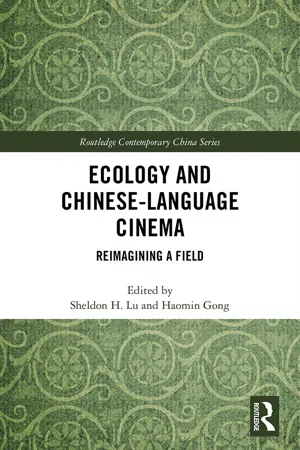
This edited collection explores new developments in the burgeoning field of Chinese ecocinema, examining a variety of works from local productions to global market films, spanning the Maoist era to the present.
The ten chapters examine films with ecological significance in mainland China, Hong Kong, and Taiwan, including documentaries, feature films, blockbusters and independent productions. Covering not only well-known works, such as Under the Dome, Wolf Totem, Tie Xi Qu: West of the Tracts, and Mermaid, this book also provides analysis of less well-known but critically important works, such as Anchorage Prohibited, Luzon, and Three Flower/Tri-Color. The unique perspectives this book provides, along with the comprehensive engagement with existing Chinese and English scholarship, not only extend the scope of the growing field of ecocinematic studies, but also seeks to reform the means through which Chinese-language eco-films are understood in the years to come.
Ecology and Chinese-Language Ecocinema will be of huge interest to students and scholars in the fields of Chinese cinema, environmental studies, media and communication studies.
Politics of aesthetics and environmental ethics in Taiwanese ecodocumentaries
Kuei-fen Chiu
“Ecocinema” under debate
In 2013, the documentary Beyond Beauty: Taiwan from Above 看見台灣 (2013, d. Chi Po-lin 齊柏林, hereinafter referred to as Beyond Beauty), took Taiwan by storm with its astounding aerial photography and strong environmental message. It garnered the “Best Documentary Award” at the Fiftieth Golden Horse Film Festival and became the highest grossing documentary since Taiwanese documentaries began to be screened in theaters in 1997. In spite of its record-breaking box office gross and popularity, Beyond Beauty was regarded by some critics as a disappointing eco-film for its emphasis on emotive effect rather than in-depth analysis of the devastating environmental problems presented in the film (Lin 2013; Kuo 2014, 117–24).
The debate on this popular documentary raises important questions about the definition of “ecocinema” and eco-film criticism. At the heart of this debate is the popular mode adopted by Beyond Beauty in its attempt to reach a wider audience. Furthermore, the criticism of Beyond Beauty implies that rational analysis, rather than affect or emotion, is essential to an eco-film. The case of Beyond Beauty draws attention to critical issues under debate in ecodocumentary studies. What form should ecocinema assume? What constitutes the so-called “ecocinema experience”? Should ecocinema try to offer a film experience alternative to the kind of media spectatorship found in most popular films (MacDonald 2013, 19–20)? Or, should there be room for a pluralistic eco-aesthetic, to borrow the term from David Ingram, that recognizes the value of commercial films for promoting environmental awareness (Ingram 2013, 58–9)?
The debate generated by Beyond Beauty invites us to think more critically about what it means to make, view and study ecodocumentaries. Paying special attention to the politics of aesthetics and environmental ethics, this chapter investigates how Taiwanese documentary makers and critics engage critical issues of ecocinema and contribute to ecocinema studies in general.
Ecodocumentary making in Taiwan
“Taiwan had discovered ‘nature’ sometime in the mid-1980s,” so says Robert P. Weller in his Discovering Nature: Globalization and Environmental Culture in China and Taiwan (Weller 2006, 2). Although the 1970s witnessed environmental deterioration in Taiwan due to rapid economic growth, there was little visible environmental activity from the government during that time (Weller 2006, 1). Taiwanese ecodocumentaries that addressed environmental issues and promoted environmental consciousness began to appear in the mid-1980s. They can be regarded as a sub-category of oppositional social documentaries that sought to empower the emergent civil society in Taiwan at that time. In its early stages, ecodocumentary-making in Taiwan was marked by a strong activist agenda and, generally speaking, was anthropocentric in its approach. Arguably, documentary makers engaged the issue of environmental protection mainly to defend the interests of economically underprivileged local people. Activist ecodocumentary making has remained vibrant in Taiwan since then.
The Lukang Anti-DuPont Movement 鹿港反杜邦運動 (1987, d. the Green Team 綠色小組, hereinafter referred to as Anti-DuPont Movement), and National Bandits: A Beautiful Mistake 國家共匪: 美麗的錯誤 (2000, d. Mayaw Biho 馬躍·比吼, hereinafter National Bandits) serve as illustrative examples for our analysis here. The former was produced by the “Green Team”—allegedly “the father of the New Taiwan Documentary.” The latter was made by Mayaw Biho, an indigenous documentary maker of the Ami tribe who has used the documentary as the main medium for championing the rights of the indigenous people in Taiwan. Both documentaries are concerned with land rights. Anti-DuPont Movement documents the movement against the proposal by the transnational DuPont company to build a titanium dioxide plant in Lukang—a coastal town in western central Taiwan. National Bandits highlights the indigenous perspective to intervene in the national park debate and throws into relief the thorny issue of “rival environmental ethics”—i.e. the interests of endangered humans and their culture vs. the protection of endangered species (Buell 2001, 230).
These two activist documentaries address the following issues that also find resonance in ecocinema worldwide: What is the relationship between humans and the land? Who owns the land? How should the land be used by humans? Who has the right to make these decisions? As the two activist documentaries put these questions in the spotlight, they implicitly define Taiwanese ecodocumentary making as a filming practice intersected with geopolitics, race and ethnicity. The factor of gender, however, has not come into the picture yet. Although these two documentaries focus on land rights in their intervention in environmental debates, they are quite different in the choice of documentary style. Anti-DuPont Movement employs the expository mode, whereas National Bandits eschews voiceover or captions. The indigenous filmmaker’s position is revealed through his careful selection of juxtaposed interviews, shots and songs, instead. We shall show how the documentary makers experiment with documentary aesthetics and form to convey their messages.
With their focus on the impact on underprivileged people in the transformation of the environmental landscape, Anti-DuPont Movement and National Bandits are anthropocentric in the sense that they are concerned more with the interests of humans than with those of nonhumans. The turn of the twenty-first century witnessed the increasing prevalence of non-anthropocentric environmental discourse in Taiwanese ecodocumentaries. Three ecodocumentaries are chosen for discussion to illustrate this new direction of thinking about the relationship between humans and nature on the Taiwanese documentary scene. In all three documentaries, nonhumans are placed in the limelight. The main characters in Swing 擺盪 (2010, d. Ke Jinyuan 柯金源) are orangutans imported to Taiwan from Southeast Asia through transnational animal trafficking. The interests of animals, rather than human interests, are the main concerns of this non-anthropocentric ecodocumentary. The highly stylized documentary Nimbus 帶水雲 (2009, d. Huang Hsin-yao 黃信堯) celebrates landscape aesthetics with a strong focus on nature images. Human actions and voices are minimized in this film. The filmmaker Huang Hsin-yao actually defines this work as a bio-centric ecodocumentary. Beyond Beauty, a theater-released popular film, also foregrounds ‘nature’ as the main subject in its attempt to spread the message of environmental protection.
The notion of environmental ethics surfaces in these three ecodocumentaries. The celebration of aesthetics, particularly in the cases of Nimbus and Beyond Beauty, throws into relief the politics of aesthetics, inviting us to examine critically the intertwining of aesthetics and ethics in the making, viewing and study of ecocinema. If ecocinema is defined as “ecocinema with an ecological consciousness” that “articulates the relationship of human beings to the physical environment, earth, nature, and animals from a biocentric, non-anthropocentric point of view” (Lu 2009, 2), does the art film aesthetics of Nimbus promote ecological consciousness more effectively than the popular film aesthetics of Beyond Beauty? If the deployment of aesthetic devices in both films is meant to generate a specific “ecocinema experience,” arguably that aesthetic experience would lead to ethical engagement with environmental problems. If so, the question as to how aesthetics intersect with ethics certainly should be placed squarely on the table of ecocinema studies.
Laying the foundation for Taiwanese ecodocumentary making: The Lukang Anti-DuPont Movement
As has been noted, the environmental movement in Taiwan began to gain momentum in the mid-1980s (Hsiao 1999, 33; Grano 2015, 42–6). It was about the same time that independent documentary filmmaking appeared on the Taiwanese scene. Working in close alignment with social protesters, a group of independent documentary filmmakers who identified themselves as “The Green Team” made documentaries that vividly captured a growing Taiwanese civil society at that specific historical juncture (Chiu and Zhang 2015, 42–3). A significant category of these documentaries is environmental documentaries—broadly defined as documentaries concerned with environmental issues. Anti-DuPont Movement is representative of this corpus of environmental documentaries produced in late-1980s Taiwan.
Just as its title suggests, this documentary depicts the anti-DuPont movement that was launched in 1986 and ended in 1987. This movement is often taken to be a watershed in the history of Taiwan’s social movements because, in the words of the sociologist Ming-sho Ho (2013, 701), “the unexpected victory of a small town over an American chemical giant enhanced the morale of Taiwan’s nascent environmentalism.” The documentary in itself is also a landmark in the history of Taiwanese ecodocumentary making in that it laid the foundation for activist Taiwanese ecodocumentaries.
The structure of the documentary consists of two parts. The first part builds up an environment discourse with interviews with local people and experts who support the environment movement. Local people provide a micro-view of the potential threats of the DuPont plan to the livelihoods of local farmers and fishermen and stress their responsibility to future generations. Experts, on the other hand, uphold the notion of “environmental rights” and situate the transnational investment plan in Taiwan within a broader context of the neo-colonial international division of labor in the Cold War structure. The second part is dominated by actions: on-the-spot documentation of street protest vis-à-vis riot police, a press announcement of DuPont’s decision to withdraw the plan and finally a religious ritual with strong local color held in Lukang in celebration of the victory of the movement.
It is noteworthy that this foundational Taiwanese ecodocumentary strikes a rudimentary note of environmental justice—an environmentalism that recognizes the uneven distribution of environmental burdens and the need for social justice (Hartley 2003, 478–9; Yu 2010, 100), even though the term “environmental justice” was not known to the documentary maker or the protesters in the film. Anti-DuPont Movement, in a sense, defines Taiwanese ecodocumentary making as a geopolitical filming practice that addresses environmental problems in Taiwan in terms of the interplay between the global and the local. In addition to the introduction of basic environmental justice issues, a significant contribution of this documentary is its innovative use of formal audio-visual devices to highlight “the voice of the people.” For example, the main language used in the documentary, including the female voiceover, is local Taiwanese rather than Mandarin—the official language in Taiwan after the end of World War II. The use of the camera in the street demonstration scenes also identifies the camera-holder as one among the protesters, suggesting that the documentary is telling the story from the perspective of “the people.”
“The Green Team” is widely considered as the forerunner of ecodocumentary making in Taiwan. Anti-DuPont Movement embodies the legacy of Taiwanese ecodocumentary that the Green Team has passed down to the later generations. The documentary’s strong interventional, activist character continues to define a very strong strand of Taiwanese ecodocumentary making. It also throws into relief the relevance of ecodocumentary making, viewing and study as geopolitical practices in a dynamic planetary context. Figure 1.1 captures vividly the vitality of activist documentary making in the late 1980s.
Anti-DuPont Movement shows the close tie between a particularly strong strand of Taiwanese documentary making and environmental movements in Taiwan. The documentary is concerned with the rights of local residents and their struggles to protect their own interests by warding off environmental pollution and contamination. Human characters dominate the pictures. The rights of nonhumans are hardly mentioned, nor is there any reflection on the intrinsic value of nonhumans independent of the interests of the human characters.
Figure 1.1 “The Green Team” filming anti-DuPont street demonstration in 1986.
Endangered humans versus endanger nature: National Bandits
Lest we underestimate the complexity of activist ecodocumentary making in Taiwan and misunderstand it in simplistic terms of “civil society vs. the state/corporate,” we shall take a look at the indigenous documentary National Bandits by the indigenous documentary maker Mayaw Biho. Just like the 1960s in many Western countries, the 1980s was an era of social movements in Taiwan. The environmental movement and independent documentary making were taking shape. So was the indigenous movement. While literary magazines and indigenous writers played a significant role in the indigenous movement in the 1980s, indigenous documentary makers—e.g., Mayaw Biho of the Ami tribe and Pilin Yapu of the Atayal tribe—began to appear on the scene in the late 1990s. The intersection of indigenous movement with the environmental movement provides a very interesting case for testing the boundaries of “ecocinema.”
Like Anti-DuPont Movement, National Bandits tackles the problem of land rights. But while the former frames the debate in terms of “environmental protection vs. development,” the indigenous documentary problematizes the environmental protection discourse by calling attention to the factors of ethnicity and class in green dispossession. The main issue is the establishment of national parks for environmental preservation. From the perspective of indigenous people, national parks exemplify another form of colonization that denies indigenous people’s rights to their land (Bayet-Charlton 2003, 176).
The documentary opens with the scene of a small group of indigenous people hunting in a national park against the law. From the perspective of these indigenous hunter-interviewees, they are practicing a traditional indigenous mode of existence to safeguard their own culture. The implementation of laws against hunting in national parks, in their view, violates indigenous rights. As Fabienne Bayet-Charlton (2003, 171) points out in his discussion of the case of Australian aboriginal dispossession, “wilderness” conceived as wild, uninhabited or inhabited by nonhumans only, actually si...
Table of contents
Cover
Half Title
Series Page
Title Page
Copyright Page
Table of Contents
List of figures
Notes on contributors
Acknowledgments
Introduction: revisiting the field of Chinese ecocinema
PART I: Ecodocumentaries and eco-festivals
PART II: Contemporary ecologies
PART III: Humans and animals
PART IV: Landscape and nation
Index
Trusted by 375,005 students
Access to over 1.5 million titles for a fair monthly price.
Study more efficiently using our study tools.
Frequently asked questions
Yes, you can cancel anytime from the Subscription tab in your account settings on the Perlego website. Your subscription will stay active until the end of your current billing period. Learn how to cancel your subscription
No, books cannot be downloaded as external files, such as PDFs, for use outside of Perlego. However, you can download books within the Perlego app for offline reading on mobile or tablet. Learn how to download books offline
Perlego offers two plans: Essential and Complete
Essential is ideal for learners and professionals who enjoy exploring a wide range of subjects. Access the Essential Library with 800,000+ trusted titles and best-sellers across business, personal growth, and the humanities. Includes unlimited reading time and Standard Read Aloud voice.
Complete: Perfect for advanced learners and researchers needing full, unrestricted access. Unlock 1.5M+ books across hundreds of subjects, including academic and specialized titles. The Complete Plan also includes advanced features like Premium Read Aloud and Research Assistant.
Both plans are available with monthly, semester, or annual billing cycles.
We are an online textbook subscription service, where you can get access to an entire online library for less than the price of a single book per month. With over 1.5 million books across 990+ topics, we’ve got you covered! Learn about our mission
Look out for the read-aloud symbol on your next book to see if you can listen to it. The read-aloud tool reads text aloud for you, highlighting the text as it is being read. You can pause it, speed it up and slow it down. Learn more about Read Aloud
Yes! You can use the Perlego app on both iOS and Android devices to read anytime, anywhere — even offline. Perfect for commutes or when you’re on the go. Please note we cannot support devices running on iOS 13 and Android 7 or earlier. Learn more about using the app
Yes, you can access Ecology and Chinese-Language Cinema by Sheldon H. Lu,Haomin Gong in PDF and/or ePUB format, as well as other popular books in Media & Performing Arts & Film & Video. We have over 1.5 million books available in our catalogue for you to explore.