Leo Tolstoy (1828–1910), besides writing famous novels such as War and Peace, also wrote on political issues, especially later in his life, putting forward a political philosophy which might be termed 'Christian anarchism'. This book provides a comprehensive overview of Tolstoy's political thought. It outlines in a systematic way Tolstoy's thought, which was originally articulated unsystematically in diverse, often informal writing, such as pamphlets, letters, and speeches, as well as books, and in his novels, where Tolstoy's thinking is put forward implicitly through the novels' characters. The book sets out the basic themes of Tolstoy's political thought: his acceptance of the teachings of Jesus, his criticism of the way in which Jesus' teachings have been relayed by the church through traditional creeds and dogma, his passionate rejection of political violence by both the state and those working for reform, his plea for a nonviolent response to violence and injustice, and his call for society to forego its institutional shackles and enact a community of peace, love, and justice. The book also includes background information on the Russia of Tolstoy's time, including the religious context, and a discussion of how Tolstoy's political thought has been received by his admirers, who included Gandhi, and his critics.
eBook - ePub
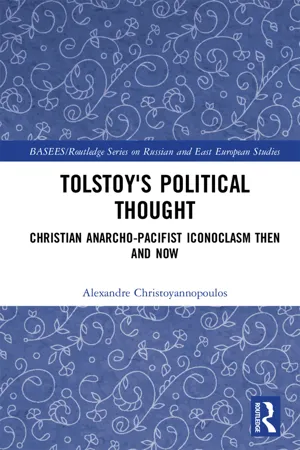
Tolstoy's Political Thought
Christian Anarcho-Pacifist Iconoclasm Then and Now
- 268 pages
- English
- ePUB (mobile friendly)
- Available on iOS & Android
eBook - ePub
Tolstoy's Political Thought
Christian Anarcho-Pacifist Iconoclasm Then and Now
About this book
Information
1 Tolstoyan pacifism
Tolstoy’s anarchism and activism are rooted in his pacifism. Some of his asceticism is informed by it too, and his anticlericalism stems from his disappointment in the church’s failure to fully embrace it. In short, Tolstoy’s views on violence inform his position on most other spheres of life – whether private, social, economic, religious, or political. It is appropriate therefore to begin the journey into the depths of Tolstoy’s political thought with his pacifist critique of violence.
The context of Tolstoy’s pacifism
Tolstoy articulated his pacifism in late nineteenth-century Russia. It is fairly clear from his writing that he saw his reflections as applicable beyond his narrow historical context and certainly beyond Russia. Yet his specific historical and geographical context does help explain why it is that someone like Tolstoy might have been driven to articulate the kind of pacifist reflections which are his.
To begin with the broad picture, by the late nineteenth century war was becoming increasingly industrialised, and states were increasingly established as holders of powerful tools for meting considerable violence on domestic deviants and dissenters (Joll 1979; Kropotkin 1896; Tilly 1985). Reports about political violence were conveyed further and faster with the help of newspapers and rising literacy. The Industrial Revolution was transforming rural and urban landscapes. Socialist and other revolutionary ideas were spreading across the industrialising world, as were associated debates about the efficacy of violent methods to achieve such change – indeed in the 1880s the ‘anarchist wave’ of terrorism was spreading across Europe and North America (Rapoport 2004). Nationalism was spreading. A new wave of colonialism infatuated by the ‘scramble for Africa’ gripped European powers. Compulsory military conscription was increasingly widespread. Pacifist-leaning arguments had long been aired in rare pockets of dissent, but pacifism was often confined within particular religious denominations, and a more coherent, systematic, and ‘universal’ pacifist doctrine and school of thought were yet to emerge (Brock 1972; Hobsbawm 1989).
In Tolstoy’s Russia, an autocratic regime was dealing with subversives with exemplary repression. Progressive, reformist, and liberal ideas were spreading, as was revolutionary fervour. The 1812 war with Napoleon’s France had unleashed pressures to modernise Russia, pressures which could not be ignored after the 1825 Decembrist revolt and which would ultimately lead to the ‘failed’ 1905 revolution and the successful 1917 revolutions. The Russian intelligentsia was looking to Enlightenment Europe for political ideas and engaged in its debates, though by no means was Europe universally held up as an enviable model. Rather, the ‘West’ was something of ‘an adventure playground of the imagination in which they could disport themselves’ (Hosking 1997, 277). There were (overlapping and intermingling) tensions between ‘Westerners’ and Slavophiles, between Imperial Nationalists and Panslavists, and between Enlightenment rationalists and Romantic idealists, over what Russia and its soul were or should or could be. Russian literature, which had entered a golden age from the 1830s, was a vehicle through which many of these yearnings and themes were explored. Whatever their preferences, however, most considered political violence to be necessary, whether in dissent, in maintaining order, or in pursuing the national interest. Meanwhile, Russia had established a large empire through territorial expansion and sometimes shorter-lived colonial projects, for instance in Anatolia, the Caucasus, Central Asia, and Manchuria (Florinsky 1947; Hobsbawm 1989; Hosking 1997; Masaryk 1919; Moss 2002; Riasanovsky and Steinberg 2018, part 5; Rogger 2014; Saunders 2014; Seton-Watson 1967).
Many more aspects of Tolstoy’s context could be mentioned here, but those which relate more to the state, to religion, to moral asceticism, and to questions of revolutionary methods will be outlined in later chapters. With regard to questions of violence and pacifism, suffice it to note that political violence of all kinds was increasingly visible to many (whether in Russia or elsewhere, domestically or internationally), and the mechanics of political violence were being transformed by the latest technologies and methods of administration (Joll 1979; Killingsworth, Sussex, and Pakulski 2016).
It is in this context that Tolstoy articulated his pacifist critique of violence. He had long been fascinated by war, revolution, and industrialisation. He had fought both counter-insurgency and siege warfare. He had written War and Peace and was now writing his second major novel, but he found himself looking for meaning in life. Only with his pacifist reading of Jesus’ teaching did he manage to appease his depressive inclinations, but it landed him with a worldview which would have uncompromising implications for political and religious institutions.
Tolstoy’s pacifism
The core ethical appeal of Christianity for Tolstoy was the pacifist stance taught and exemplified by Jesus. Tolstoy’s broader take on religion is the subject of Chapter 3. The purpose here is to articulate Tolstoy’s pacifism, which begins by his reading of Jesus and quickly extends beyond the confines of Christianity.
Taking a cue from Jesus
There are many verses in the Gospels where Jesus returns to the importance of love and forgiveness. The passage which Tolstoy claims most influenced him, indeed the passage which Jack Miles remarks ‘has rightly been taken to be [Jesus’] signature teaching’ (quoted in Rancour-Laferriere 2007, 93; Miles 2001, 102), is the one where Jesus recommends turning the other cheek when smitten on the right one. That passage is presented in the Sermon on the Mount, which is in the Gospel according to Matthew, as the fourth of five instructions which Jesus gives that appear to revise the previous covenant. It is further echoed in the Sermon on the Plain, in the Gospel according to Luke, where what were two separate instructions in Matthew (turn the other cheek and love your enemies) are conflated into one.
Both in his commentary and in his citation of this teaching from Jesus, Tolstoy tends to incorporate some further remarks on judging which Jesus makes a little later in the Sermon on the Mount. Given the centrality of that teaching for Tolstoy’s political thought, it is worth citing in full Tolstoy’s rendering in his own reworked and abbreviated version of the Gospel. It reads as follows:
In the former law it was said that if a man killed another he must give a life for a life, an eye for an eye, a tooth for a tooth, an arm for an arm, an ox for an ox, a slave for a slave, and much else.
But I say to you: Do not fight evil by evil, and not only do not exact at law an ox for an ox, a slave for a slave, a life for a life, but do not resist evil at all. If anyone wishes to take an ox from you, give him another; if he wants to take your coat by law, give him your shirt as well; if anyone knocks out a tooth on one side, turn the other side to him. If he would make you do one piece of work for him, do two. If men wish to take your property, let them have it. If they owe you money and do not return it, do not demand it.
And therefore: Do not judge or go to law, do not punish, and you yourself will not be judged or punished. Forgive everyone and you will be forgiven; but if you judge others they will judge you also.
You cannot judge, for men are all blind and do not see the truth. How can you see a speck in your brother’s eye when there is dust in your own? You must first get your own eyes clear – but whose eyes are perfectly clear? Can a blind man lead the blind? They will both fall into the pit. And those who judge and punish are like blind men leading the blind.
Those who judge, and condemn others to violent treatment, wounds, mutilation, or death, wish to correct them, but what can come of their teaching except that the pupils will learn to become just like their teacher? What then will they do when they have learnt the lesson? Only what the teacher does: violence and murder.
And do not expect to find justice in courts. To entrust one’s love of justice to men’s courts is like throwing precious pearls to swine: they will trample on them and will tear you to pieces.
And therefore the fourth commandment is: However men may wrong you, do not return evil, do not judge or go to law, do not sue, and do not punish.
(1933b, 165–166)
Immediately following this fourth ‘commandment’ in the Sermon on the Mount, altogether blended into it in the Sermon on the Plain, and indeed often evoked in the same breath in Tolstoy’s political thought, is the instruction to love one’s enemies. It elaborates further the themes of love and nonviolence, therefore Tolstoy’s rendering of this fifth ‘commandment’ is worth quoting as well:
In the former law it was said: Do good to men of your own nation and do harm to foreigners.
But I tell you: Love not only our own countrymen, but people of other nations also. Let others hate you, attack you, and wrong you, but speak well of them and do good to them. If you are attached only to your countrymen, remember that all men are attached to their own countrymen, and wars result from that. But behave equally well to men of all nations, and you will be sons of the Father. All men are His children, so they are all brothers to you.
And so this is the fifth commandment: Treat foreigners as I have told you to treat one another. To the Father of all men there are no separate nations or separate kingdoms: all are brothers, all sons of one Father. Make no distinctions among people as to nations and kingdoms.
(1933b, 166–167)
The first remark to make is that Tolstoy’s rendering of both these passages is noticeably longer than the originals in Matthew and Luke, and this is because Tolstoy seeks to encapsulate in them several of his own reflections on violence that were sparked by his reading of Jesus’ teaching. Tolstoy therefore puts some of his own words in Jesus’ mouth, but he clearly sees those words as completely faithful to the spirit, if not the letter, of Jesus’ instructions as relayed by Matthew and Luke. Tolstoy sees his arrangement of Jesus’ words as merely consolidating and updating them, but faithfully so, and he provides numerous Biblical references in the margins to provide evidence of this authenticity.
It might be worth stressing that although in these quoted passages Tolstoy singles out public authorities for particular criticism, his broader claims extend beyond such authorities and are aimed at all those who are tempted to use violence to achieve particular goals and at all those who consent to certain people (whether ‘legitimate’ authorities or revolutionaries) inflicting violence upon others. Tolstoy’s specific arguments about political authorities and revolutionaries are discussed in Chapters 2 and 5. The focus in this chapter is more narrowly on the critique of violence which underlies those ensuing arguments. Tolstoy’s anarchism and his activism are based in his pacifism, but his arguments about violence stand independently from his anarchism and activism and can be discussed and analysed separately from the implications which may well follow for political hierarchies and dissenters.
Once he converted to this reading of the Sermon on the Mount after what he liked to portray as something of a eureka moment, Tolstoy spent the rest of his life publishing a variety of reflections on violence in numerous texts, from long treatises to plays, novels, short stories, diary entries, and letters to correspondents. As noted in the Introduction, much of what he wrote is echoed with slight variations across his writings, and there is no single, systematic summary of each of the main claims and arguments he makes on violence and nonviolence. What follows therefore seeks to extract and separate out some of the main claims and arguments, and to thereby systematise Tolstoy’s reflections. The next section of this chapter lists Tolstoy’s main problems with violence, and the subsequent one his main reasons for preferring an approach inspired by Jesus.
Ethical arguments against violence
In his various denunciations of violence, Tolstoy develops arguments that speak to all three main traditions of normative ethics: deontology, consequentialism, and virtue ethics – although mostly the first two. Several of his arguments are chiefly deontological: They consider violence to be wrong or immoral as a general rule, out of principle. Most of his other arguments are basically consequentialist: they reject violence because of its consequences, and in particular its tactical and strategic counter-effectiveness. In some cases, there is an element of virtue ethics where Tolstoy is concerned with the character of the perpetrator. In the presentation that here follows, the first four main arguments are deontological, the fifth is arguably more concerned with virtue ethics, and the next five are mostly consequentialist, although the categorisation is not rigid and several arguments can be read as relevant to more than one tradition of normative ethics.
The first and most obvious problem with violence is the violence itself: it causes physical harm, in some cases even death. Tolstoy does not propose a single definition of ‘violence’ which he settles on throughout his writings, but it is obvious from these writings that what he has in mind primarily is physical injury to others, and especially murder. This need not mean that some of his arguments cannot be extended to other kinds of violence (as discussed subsequently), but Tolstoy’s primary concern is physical injury to fellow human beings. Inflicting such harm is obviously a very serious matter as such, and Tolstoy’s numerous comments on murder and depictions of violent scenes across his post-conversion writings are clearly intended to convey the (deontological) revulsion he feels for it (1937n, 1967a, 9–11, 1948, 133, 1987l, 41–43, 1987o, 349–350, 1937f, 395–397).
Second, as discussed in Chapter 2, Tolstoy considers that to force others to comply with one’s preferences through violence amounts to ‘slavery’ (1948, 120, 1990b, 27). There is, for him, no ethical high ground behind which to shelter when relying on physical harm (or the threat of it) to extract from others the behaviour one prefers. Whatever the justification, enforcing any compliance through violence is a form of enslavement, which for Tolstoy is (deontologically) unacceptable.
Third, since according to Tolstoy it is impossible to all agree on a ‘universal’, ‘absolute and indubitable criterion’ to determine (deontologically) what is ‘evil’, we might prefer to refrain from using violence against what some of us consider evil which some others might consider good or acceptable (2001d, 53 – see also 206). Nor is Tolstoy satisfied that this ‘can be solved by relegating to certain persons or assemblies of persons … the right to determine what is evil and to resist it by violence’ (2001d, 54). Only if we could genuinely and consciously all agree on a criterion for ‘evil’ (which he insists we cannot) would the infliction of violence to resist such evil be acceptable in Tolstoy’s eyes.
Fourth, by using violence as a method to achieve a higher aim, we implicitly consent to others using violence to achieve high aims too. The adoption of violence as our method legitimises (deontologically, and somewhat consequentially) the adoption of violence as a method (1937f, 404–406, 2001a, 541). In Tolstoy’s words: ‘all the arguments put forward by those who employ [violence] can with equal or even greater justification be used against them’ (2001d, 269). That is why, in turn, since ‘there is in human society an endless variety of opinions as to what constitutes wrong and oppression’, authorising violence for any one cause inevitably guarantees a vicious cycle of tit-for-tat violence, ‘a universal reign of violence’ (Tolstoy, quoted in Kennan 1887, 259). Our resort to violence to redress an injustice authorises everyone else’s resort to violence to redress injustices.
Fifth, violence brutalises and ‘depraves’ its perpetrator. Performing violent acts that would have at first seemed shocking normalises and habitualises that very behaviour. It desensitises the perpetrator, who instead gets in the habit of relativising the act and thus becomes more ready and willing to be violent again in the future. Violence thus has a noxious (hence precisely not virtuous) effect on the character of the perpetrator (1937b, 213–215, 1937f, 399–401, 1990b, 24).
Sixth (and now moving to more consequentialist arguments), one can never be sure to have judged the situation correctly. We all make errors, in part because we are not omniscient. We could always therefore be making a mistake when identifying particular targets for violence. We cannot be completely confident that a desired outcome will be achieved by inflicting violence on a particular selection of victims (1937o, 390–391, 1902, 213–215). We cannot even know with certainty for instance whether someone with a knife would have ultimately used it to attack us (1987e, 214, 1967e, 186–187). Yet our own violence ( just like anyone else’s) cannot be undone: once inflicted, it cannot be reversed.
That we can never be certain we judged a situation correctly thus gives Tolstoy this sixth (arguably predominantly consequentialist) reason why we ought to be cautious in inflicting any violence. This is why Tolstoy sometimes tackles together Jesus’ request not to judge one another with that to turn the other cheek (1933b, 165–166, 269, 286–288, 1902, chap. 3). He furthermore reads teachings such as not to criticise others for the mote in their eye when there is a beam in ours and Gospel stories such that of the adulteress about to be stoned as precisely about that (1902, chap. 3, 1933b, 165–166, 228–229, 1966, 417). Since we are all imperfect and sinful ourselves, not only ought we to be hesitant to presumptuously condemn each other, we also better refrain from using violence (and instead turn the other cheek) to act upon that potentially erroneous and hypocritical judgement.
Indeed, to develop this sixth theme a little further still, the impossibility to make a totally accurate judgement about the full picture means that violence risks being inflicted on people who are themselves victims of the broader causes of violence and injustice, which aggravates the situation even further. Tolstoy gives the example of soldiers that have been compulsorily conscripted as ‘not free agents’ but ‘subject to military discipline’ and ‘acting under orders’ which it is dangerous to disobey (Kennan 1887, 257). Conversely, violence used to quash violent protests fails to address the causes of the injustices that lead to the upheaval in the first place (Tolstoy 1937f, 402–403). Again, therefore, whether in dissent or order-maintenance, inflicti...
Table of contents
- Cover
- Half Title
- Series
- Title
- Copyright
- Contents
- Acknowledgements
- Introduction: the background to Tolstoy’s political thought
- 1 Tolstoyan pacifism
- 2 Tolstoyan anarchism
- 3 Tolstoyan anticlericalism
- 4 Tolstoyan asceticism
- 5 Tolstoyan activism
- Conclusion: Tolstoy as a political thinker
- Bibliography
- Index
Trusted by 375,005 students
Access to over 1.5 million titles for a fair monthly price.
Study more efficiently using our study tools.
Frequently asked questions
Yes, you can cancel anytime from the Subscription tab in your account settings on the Perlego website. Your subscription will stay active until the end of your current billing period. Learn how to cancel your subscription
No, books cannot be downloaded as external files, such as PDFs, for use outside of Perlego. However, you can download books within the Perlego app for offline reading on mobile or tablet. Learn how to download books offline
Perlego offers two plans: Essential and Complete
- Essential is ideal for learners and professionals who enjoy exploring a wide range of subjects. Access the Essential Library with 800,000+ trusted titles and best-sellers across business, personal growth, and the humanities. Includes unlimited reading time and Standard Read Aloud voice.
- Complete: Perfect for advanced learners and researchers needing full, unrestricted access. Unlock 1.5M+ books across hundreds of subjects, including academic and specialized titles. The Complete Plan also includes advanced features like Premium Read Aloud and Research Assistant.
We are an online textbook subscription service, where you can get access to an entire online library for less than the price of a single book per month. With over 1.5 million books across 990+ topics, we’ve got you covered! Learn about our mission
Look out for the read-aloud symbol on your next book to see if you can listen to it. The read-aloud tool reads text aloud for you, highlighting the text as it is being read. You can pause it, speed it up and slow it down. Learn more about Read Aloud
Yes! You can use the Perlego app on both iOS and Android devices to read anytime, anywhere — even offline. Perfect for commutes or when you’re on the go.
Please note we cannot support devices running on iOS 13 and Android 7 or earlier. Learn more about using the app
Please note we cannot support devices running on iOS 13 and Android 7 or earlier. Learn more about using the app
Yes, you can access Tolstoy's Political Thought by Alexandre Christoyannopoulos in PDF and/or ePUB format, as well as other popular books in Politics & International Relations & Politics. We have over 1.5 million books available in our catalogue for you to explore.