The eleventh century in Byzantium is all about being in between, whether this is between Basil II and Alexios Komnenos, between the forces of the Normans, the Pechenegs and the Turks, or between different social groupings, cultural identities and religious persuasions. It is a period of fundamental changes and transformations, both internal and external, but also a period rife with clichés and dominated by the towering presence of Michael Psellos whose usually self-contradictory accounts continue to loom large in the field of Byzantine studies. The essays collected here, which were delivered at the 45th Spring Symposium of Byzantine Studies, explore new avenues of research and offer new perspectives on this transitional period. The book is divided into four thematic clusters: 'The age of Psellos' studies this crucial figure and seeks to situate him in his time; 'Social structures' is concerned with the ways in which the deep structures of Byzantine society and economy responded to change; 'State and Church' offers a set of studies of various political developments in eleventh-century Byzantium; and 'The age of spirituality' offers the voices of those for whom Psellos had little time and little use: monks, religious thinkers and pious laymen.
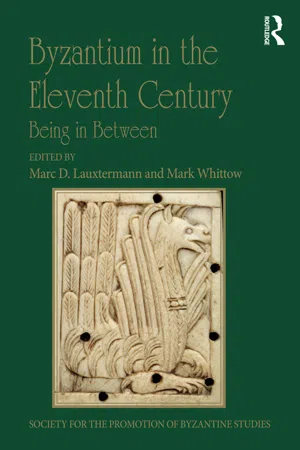
eBook - ePub
Byzantium in the Eleventh Century
Being in Between
- 252 pages
- English
- ePUB (mobile friendly)
- Available on iOS & Android
eBook - ePub
Byzantium in the Eleventh Century
Being in Between
Section III
State and Church
8
The Second Fall
The place of the eleventh century in Roman history
It is almost obligatory in any discussion of Byzantium to point out that the people we label Byzantines called themselves Romans, and the state we call the Byzantine empire was in fact the empire of the Romans.1 Obligatory – but, with a few exceptions, rapidly passed over.2 Edward Gibbon may have seen the decline and fall of the Roman empire as a process that already had its seeds in the age of Augustus, that played out in a series of themes repeated over the centuries, and that only ended in 1453, but no modern historian has taken up the challenge.3 It is symptomatic that when volume four of the Cambridge Medieval History first appeared in 1923, it did so with the title The Eastern Roman Empire (717–1453), and its general editor, J.B. Bury, himself an editor of Gibbon, began his introduction with ‘the capital fact that throughout the Middle Ages the same Empire which was founded by Augustus continued to exist and function’, but when it was reissued in a new edition in 1966, it did so as The Byzantine Empire; Bury’s introduction remained, but only for reasons of pietas.4 The framing narrative of modern Byzantine studies is not one of continuity but of radical change, with the seventh century usually seen as decisive.5 We now talk of late antiquity and the Middle Ages, with Byzantium as a medieval empire; of the transformation of the Roman world and the end of the ancient economy; of the fall of Rome and the making of Byzantium. A dynastic and comparative history of China stretching from the Qin to the Qing seems an intellectually coherent project; a modern history of Rome written in the same way apparently does not.6 The eleventh-century Byzantines may have called themselves Romans but we know that they were wrong.
Byzantium for Rome?
Our confidence in saying this rests in part on the archaeological turn of the 1980s, that moment when, Clive Foss to the fore, we realized that any notion of simple material continuity could not be sustained.7 The combined evidence from urban excavations, standing buildings, coins and ceramics, made it clear that the empire was a much poorer place in 800 than it had been in 500, and a rather different place in 1050 than in either 800 or 500 – let alone 300 or 100. Somewhere like Ephesos or Thessaloniki in 1050 was a city of scattered knots of settlement in a way that the same places in 500 were not; churches like the eleventh-century Panagia Chalkeon in Thessaloniki could not be confused with any building of the age of Justinian; stray coin finds, which had become so rare in the eighth century, were common again by the eleventh century, but of a rather different nature to the system in 500; and in a way most striking because so universal, the ubiquitous red slip pottery and cylindrical transport amphorae of the sixth century had been replaced by glazed wares and globular amphorae, or even by barrels.8 In these facts, a transition from Rome to Byzantium seemed to be encapsulated.
Poorer in 800, smaller too. Size seems to matter. The empire in 300 stretched from Hadrian’s Wall to the deserts of Arabia, and from the Rhine to the Sahara. The empire in 600 still stretched from Italy to Arabia, and from the Danube to the Sahara. The empire in 1050 was much larger than it had been in the eighth century when it was limited to Anatolia and the fringes of the Balkans, plus Sicily and some Italian fragments, but even so it was still no more than a quarter of the size of the empire Constantine ruled in 330. To call both the Roman empire could seem wilfully misleading.9
Yet while these facts are true, the conclusion that Byzantium was not Rome is a non sequitur. To begin with the material evidence, quite clearly this tells a story of contraction and recession in the seventh and eighth centuries, and recovery by the eleventh; quite clearly too the empire’s material culture in 1050 was different from what it had been half a millennium earlier; but neither fact says anything significant about political systems or identity.10 No complex material culture on earth has remained substantially unchanged over such a period of time, certainly not that of China whose political continuity we take for granted.11 What matters more are the deep structures that lie behind the surface phenomena of church architecture, ceramic types and the like.
Here size would seem to be crucial, and to an extent it is, but not in any absolute sense. Size matters to human beings in terms of experienced space – the sort of geography we have in mind when we say such things as ‘the world is getting smaller’ – and by that standard the empire of Constantine IX in 1050 was, contrary to the impression given by maps, still a very similar size to that of Constantine I, seven centuries before.12
This is counterintuitive so let me say more. Obviously Constantine I’s empire was larger in the sense that it covered an area perhaps four times that of Constantine IX. At nearly 4,500 km as the crow flies, it is also true that the distance from Hadrian’s Wall to the deserts of Arabia was some 2,000 km greater than from the equivalent extremities of the eleventh-century empire, but those figures are in practice beside the point. To go from one end of the empire to the other is an unlikely journey few can be imagined to have taken at any period. The real distances that matter, and hence the effective size of the empire, are those from the provinces and frontiers to the capital, and from that perspective a radius of a little over 1,000 km applies as well to the empire in 330 as 1050. In human terms a traveller setting out from Antioch, the eleventh-century empire’s Syrian bastion, or from Trier, the fourth-century empire’s watch on the Rhine, would have expected to have arrived in either Constantinople or Rome respectively, about six or seven weeks later.13 At 1,000 km the journey from Aquitaine to Rome was appreciably longer than that from Cappadocia to Constantinople, but if the imperial court was based at Milan, Ravenna or even Trier, as it was for much of the fourth and fifth centuries, then the distance and journey time was not very different. In either case a month and a half would usually have brought supplicants to the feet of power.
So far I have assumed travel by land, but thinking about the sea makes the same point. Two thousand kilometres, or just over ten days’ continuous sailing, was about the maximum required to reach an imperial capital from almost anywhere in the Mediterranean.14 In practice sailing was not continuous and winds were not reliable, but the fact remains that the journey times by sea between a capital and the empire’s main Mediterranean ports were much the same in the fourth as in the eleventh century. The loss of territorial area had paradoxically made little difference.
With that issue put to one side, we can return to deep structure, which must be the crucial point. First, however, let us look west. In the 1970s and 1980s a series of mostly French historians, writing mostly about what is now France, made the case that the ancient world only came to an end in the eleventh century – the revolution of the year 1000. It is an idea often associated with Georges Duby, who certainly first established the notion of a revolutionary moment either side of the millennium, but Duby himself, to begin with at least, thought of the revolution of the year 1000 as only one among many, and he certainly did not see this as the single ‘end of the ancient world’.15 That should be credited instead to Pierre Bonnassie and Guy Bois, to Michel Zimmerman and Christian Lauranson-Rosaz, and to the so-called fiscalists, Jean Durliat and Elisabeth Magnou-Nortier.16
All of these historians draw attention to the survival of apparently Romanizing features in the social and political culture of the Midi and Catalonia – Roman naming patterns, Roman-style slavery, Roman law – and the argument is that this adds up to the persistence of deep structures that equate with a definition of the ancient world. Not everyone has been convinced, especially not in the English-speaking world.17
In part that reflects a language gap. Although Bonnassie’s important paper ‘Du Rhône à la Galice’, first given at the Rome conference on feudal societies in 1978, was reissued in English translation in 1991, and Guy Bois’s book on the Maconnais village of Lournand, appeared the following year as The Transformation of the Year 1000, almost nothing by Zimmerman, Lauranson-Rosaz, Durliat and Magnou-Nortier has appeared in English, and Bonnassie’s wonderfully readable magnum opus on Catalonia has only done so in disjointed extracts.18 But more important, the lack of impact reflects a resistance to the central claims being made by all these historians about deep structures. Thanks to their work the persistence of Roman names, of slavery, of written Roman law cannot be ignored, but that hardly adds up to the survival of the ancient world as a system.
What would do that, in many people’s eyes at least, would be evidence for the survival of the Roman fiscal system. At its most fundamental, what differentiated the Roman state from any in the high medieval west was the fact that Rome was based on taxation. Tax levied on the population at large paid for a standing army that permitted the existence of a civilian landowning elite, and a corps of paid officials who worked with the landed elite to administer the empire. Those with power looked to the imperial centre because it was from there that the military was controlled, and there where rewards and offices were handed out to the obedient. Tax demands and military expenditure stimulated the economy, and the existence of wealthy transregional elites created the sort of connected economy that multiplied economic potential. Without taxation the Roman world as such, its capitals, it culture, its identity, would have been impossible.19
Durliat and Magnou-Nortier take this head on, and argue that Roman fiscal structures did survive effectively intact until the tenth century, but insofar as anybody this side of the Channel has engaged with their work, it has only been to dismiss it.20 On one level that is a pity because their publications express an original point of view backed by powerful erudition, but I must confess that I am no more persuaded by their basic argument than anyone else. I can see that conceptually some aspects of the later language of property have their roots in that of the late Roman fiscal system, but otherwise I can see no evidence for the functional survival of taxation on a Roman model. Some of the epiphenomena of the Roman world may have survived – indeed given the persistence of Latin and Christianity it would be hard to imagine how that could not have happened – but the fundamental structures of the Roman empire in the west had gone, to my mind long before the tenth century.
This western story matters to Byzantinists because the contrast between east and west serves to highlight the essential fact that in the east the deep structures of the Roman state incontrovertibly did survive. Eleventh-century architecture had little in common with that of the fourth; eleventh-century naming patterns did not preserve those of the Roman past; but the fundamental structures of the Roman...
Table of contents
- Cover
- Half Title
- Series Page
- Title
- Copyright
- CONTENTS
- List of figures
- Notes on contributors
- Acknowledgements
- Abbreviations
- Introduction
- SECTION I The age of Psellos
- SECTION II Social structures
- SECTION III State and Church
- SECTION IV The age of spirituality
- Index
Trusted by 375,005 students
Access to over 1.5 million titles for a fair monthly price.
Study more efficiently using our study tools.
Frequently asked questions
Yes, you can cancel anytime from the Subscription tab in your account settings on the Perlego website. Your subscription will stay active until the end of your current billing period. Learn how to cancel your subscription
No, books cannot be downloaded as external files, such as PDFs, for use outside of Perlego. However, you can download books within the Perlego app for offline reading on mobile or tablet. Learn how to download books offline
Perlego offers two plans: Essential and Complete
- Essential is ideal for learners and professionals who enjoy exploring a wide range of subjects. Access the Essential Library with 800,000+ trusted titles and best-sellers across business, personal growth, and the humanities. Includes unlimited reading time and Standard Read Aloud voice.
- Complete: Perfect for advanced learners and researchers needing full, unrestricted access. Unlock 1.5M+ books across hundreds of subjects, including academic and specialized titles. The Complete Plan also includes advanced features like Premium Read Aloud and Research Assistant.
We are an online textbook subscription service, where you can get access to an entire online library for less than the price of a single book per month. With over 1.5 million books across 990+ topics, we’ve got you covered! Learn about our mission
Look out for the read-aloud symbol on your next book to see if you can listen to it. The read-aloud tool reads text aloud for you, highlighting the text as it is being read. You can pause it, speed it up and slow it down. Learn more about Read Aloud
Yes! You can use the Perlego app on both iOS and Android devices to read anytime, anywhere — even offline. Perfect for commutes or when you’re on the go.
Please note we cannot support devices running on iOS 13 and Android 7 or earlier. Learn more about using the app
Please note we cannot support devices running on iOS 13 and Android 7 or earlier. Learn more about using the app
Yes, you can access Byzantium in the Eleventh Century by Marc D. Lauxtermann, Mark Whittow, Marc D. Lauxtermann,Mark Whittow in PDF and/or ePUB format, as well as other popular books in History & European History. We have over 1.5 million books available in our catalogue for you to explore.