This book draws together international contributors to analyse a wide range of aspects of mining history across the globe including mining archaeology, technologies of mining, migration and mining, the everyday life of the miner, the state and mining, industrial relations in mining, gender and mining, environment and mining, mining accidents, the visual history of mining, and mining heritage. The result is a counter balance to more common national and regional case study perspectives.
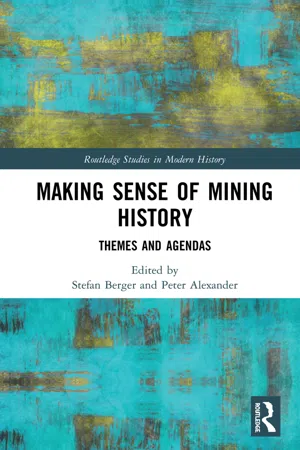
eBook - ePub
Making Sense of Mining History
Themes and Agendas
- 330 pages
- English
- ePUB (mobile friendly)
- Available on iOS & Android
eBook - ePub
Making Sense of Mining History
Themes and Agendas
1 Mining history
Sub-fields and agendas
Stefan Berger
Introduction
Mining history has been a thriving sub-field of historical writing for many decades. This volume attempts to provide a survey of key aspects of 11 important fields in mining history that the editors believe have been particularly vibrant and important over the years and where we can expect innovative new work to emerge in the future. In any undertaking like this, there is always the danger of overlooking sub-fields and being wrong about those subjects that really matter within mining history. What we present is therefore preliminary, tentative and, as all historical writing, subject to criticism and revision. Nevertheless, I hope that the pages of this volume will be helpful to mining historians to consider where the subject is at and how it may best progress into the future.
In this first chapter, I shall endeavour to introduce the 11 themes, subsequently to be elaborated at greater length by experts in those fields of mining history. I have connected each theme to a particular date. In other words, each of the subsequent 11 dates symbolizes an event in mining history that stands for a particular theme of great significance for mining and its history. Within the themes chosen, other historians may well regard different dates to be of much greater significance than the ones I have chosen, but I hope that we can at least agree on the importance of the themes that are, of course, overlapping and interconnected – like a system of communicating tubes.
One of the giants of mining history, Klaus Tenfelde, established a comparative framework for the study of mining societies, which was based on the assumption of a great commonality of social conditions. Mining, he argued, was ultimately dependent on geology; it needed huge investments and was often subject to early state legislation. The work processes in mining were quite similar and there was a strong connection between the work environment and the wider lifeworld, making for densely knit mining communities.1 More than ten years ago I attempted to develop this idea further in the hope of providing a basis on which mining histories could be compared.2 By identifying what I regard as the most important themes in mining history I am also hoping to contribute to the foundations of a more developed transnational and comparative history of mining. Many of the subsequent chapters attempt to survey their respective themes with a view to transnational and comparative dimensions underlining the fruitfulness of looking beyond one specific locality, region or nation.
Let me introduce the 11 dates and the themes they are associated with. First, there is the archaeology of mining and its attempts to tell us more about how the extraction of raw materials from the earth has been an activity shaping human existence for tens of thousands of years. About 40000 BC the first traces of underground mining can be found in Africa and ever since, archaeologists have contributed in vital ways to our knowledge of mining. Simon Timberlake’s chapter in this volume introduces the research landscape of pre-industrial mining in particular.
The second theme is about technological progress that has played, again from early on, a central part in the development of mining. The date I have chosen here lies somewhere between AD 960 and 1127, when the blast furnace was invented under the Sung dynasty in China. The development of technological progress is subsequently at the heart of Jeremy Mouat’s chapter on the importance of engineering changes to the development of modern mining in the US, South Africa and Australia. It should, however, also be noted that mining was one of those industries where technological progress was at times limited by natural geological conditions. This was nowhere more the case than in gold mining, which always remained incredibly labour-intensive precisely because of the limits of technological change. Dunbar Moodie’s chapter compares the consequences of this for workers’ lives in gold mines in South Africa and India.
Third, there is the science of mining that has had such important repercussions on the organization of work processes in the industry. An iconic early publication for the increasing scientificity of mining is Georg Agricola’s De Rerum Metallica, first published in 1556. The knowledge of mining and the science of mining was institutionalized in mining academies in early modern Europe, from where they travelled across the globe – together with Western imperialism. In her chapter, Alma Parra looks at the importance of knowledge transfer in the silver mining of Mexico, highlighting the importance of local knowledge adapting the more universal scientific recipes that were imported from abroad.
The fourth theme to be explored in this volume is migration. The iconic date chosen to illustrate that theme is the discovery of the first major diamond in South Africa, the ‘Eureka Diamond’ in 1866. It was found in river gravels from the Orange River near Hopetown in the Cape Colony. It initiated a massive migration of miners to the diamond-fields of South Africa and is illustrative of the importance that migration played in the history of mining. Ad Knotter’s chapter speaks to the global ramifications of migration to a history of mining.
Fifth, mining produced particular forms of working-class culture. The leisure pursuits of miners were part and parcel of miners’ culture, which has been an extremely fruitful area for research for many years. The date I have chosen here is 1900, when Cornish miners in Mexico played, for the first time in Mexico, a game of football. Peter Alexander’s chapter in this volume compares the impact of miners’ culture on what he calls ‘classed identities’ and the emergence of a trade union consciousness in the Ruhr, South Wales, West Virginia, Alabama, Jharia (India), Enugu (Nigeria), the Zambian Copperbelt and the Transvaal (South Africa). His chapter provides tantalizing glimpses onto a vast tableau of research that opens up in the field of culture.
The sixth theme is gender. Of course, all the other themes identified here as key themes also benefit from using gender as a category of historical analysis.3 But it is true that few areas have seen such exciting and innovative work being produced as is the case with the gender history of mining. The iconic date chosen here is 1933, when underground work for women was officially prohibited in Japan. Kuntala Lahiri Dutt surveys the diverse ways in which gender perspectives have, over recent years, enriched the field of mining history.
The seventh theme focuses on one of the saddest aspects of mining – mining accidents. It has long been recognized that mining is a particularly dangerous form of economic activity and bad accidents litter its history. The iconic date chosen is 1942, when 1,954 miners lost their lives at the Benxihu colliery in China in what is to date the biggest accident in mining history – in terms of loss of life in one incident. Mine accidents devastated whole communities and the ever-present threat of accidents is often seen as one of the reasons for the legendary solidarity of miners – they had to rely on each other if they wanted to be safe. This volume has two contributions focusing on mining accidents. Michael Farrenkopf’s contribution focuses on global mining accidents caused by explosions and how the international scientific community over time sought to reduce this risk to the miners’ lives. Dagmar Kift and Paul Stewart’s chapter looks at the miners’ experiences of accidents through the lens of oral history – also taking into account the positions of the coal companies and the state in their comparison of South Africa and Germany.
The eighth theme returns to the importance of the state to mining history. State action proved vital to the miners’ existence at several key junctures in history. The iconic moment chosen here is the nationalization of the coal mines in Britain in 1946 – the realization of long-held aspirations of many miners in Britain. Chris Wrigley’s chapter provides a comparative argument around the role of the state in labour conflicts in mining which highlights the benefits of ‘bringing the state back in’4 when dealing with mining history. Almost like gender, the state comes into almost every aspect of mining history. Another area where it has been prominent is the area of land rights. They have been key to the expansion of mining companies, and Pavithra Narayanan’s chapter reminds us of the many struggles of indigenous populations against mine companies’ insatiable hunger for land and for expansion.
Ninth, there is the visual history of mining. The visual turn in history writing5 has also reached mining history. More and more historians are paying attention to the diverse ways in which mining has been pictorialized and in which images of mining have played a key role in shaping and understanding the mining industry. The iconic date chosen here is here is 1978 – the death of Australian miner and artist Samuel Michael Byrne, whose naïve paintings, in particular of mining in Broken Hill, are reminiscent of a wider trend that connected naïve painting to mining, not only in Broken Hill, but also in Upper Silesia and the Ruhr, among other places. Stefan Siemer’s chapter focuses on how diverse visualizations of coal have framed diverse memory cultures of mining in different parts of the world.
The tenth and penultimate theme deals with the environmental consequences of mining which have, of course, been manifold and the source for strong moral condemnation of the industry. The iconic date chosen here is 1992, when the first Earth Summit was held in Rio de Janeiro. Here carbon dioxide emissions were blamed for destroying the ozone layer and contributing to global warming, threatening the planet with self-destruction. Tim Le Cain’s chapter introduces a new materialist reading of the relationship between mining and the environment, which has attracted much attention in recent years and promises more fruitful research in years to come.
The eleventh and final theme has to do with mining heritage. Globally there is no end in sight for mining. Yet in many parts of the world mining has come to an end – often after decades of an active history which determined the physical and mental outlook of whole communities. The fate of t...
Table of contents
- Cover Page
- Half Title
- Series Page
- Title Page
- Copyright Page
- Table of Contents
- Foreword
- Notes on Contributors
- List of Abbreviations
- 1 Mining History: Sub-Fields and Agendas
- 2 Archaeology of Mining in the Pre-Industrial Age: The Recognition and Interpretation of Ancient Mines
- 3 Engineering Changes: The Cause and Consequence of Modern Mining Methods at Butte, Montana; Johannesburg, South Africa; and Broken Hill, New South Wales
- 4 A Comparative Account of Deep-Level Gold Mining in India and South Africa: Implications for Workers’ Lives
- 5 Local Moments in Mining History: Some Ideas on the Relationship Between Foreign and Native in Mexican Silver Mining
- 6 Coal Mining, Migration and Ethnicity: A Global History
- 7 Culture and Classed Identity in Shaping Unionisation on Mines
- 8 Feminising an Ancient Human Endeavour: Gendered Spaces in Mining
- 9 Accidents and Mining: The Problem of the Risk of Explosion in Industrial Coal Mining in Global Perspective
- 10 On Fatalities, Accidents and Accident Prevention in Coalmines: Colliers’ Safety Discourse in Oral Testimony from the Ruhr in Germany and the Witbank Collieries in South Africa
- 11 The State, Labour Conflicts and Coal Mining
- 12 This Land is My Land: Global Indigenous Struggles and the Adivasi Resistance in Muthanga (Kerala, India)
- 13 Black Gold and Environmental Enemy No. 1: Towards a Visual History of Coal
- 14 Environmental History and Global Mining: Towards a Neo-Materialist Approach
- 15 Mining Heritage: Comparative Perspectives
- Index
Trusted by 375,005 students
Access to over 1.5 million titles for a fair monthly price.
Study more efficiently using our study tools.
Frequently asked questions
Yes, you can cancel anytime from the Subscription tab in your account settings on the Perlego website. Your subscription will stay active until the end of your current billing period. Learn how to cancel your subscription
No, books cannot be downloaded as external files, such as PDFs, for use outside of Perlego. However, you can download books within the Perlego app for offline reading on mobile or tablet. Learn how to download books offline
Perlego offers two plans: Essential and Complete
- Essential is ideal for learners and professionals who enjoy exploring a wide range of subjects. Access the Essential Library with 800,000+ trusted titles and best-sellers across business, personal growth, and the humanities. Includes unlimited reading time and Standard Read Aloud voice.
- Complete: Perfect for advanced learners and researchers needing full, unrestricted access. Unlock 1.5M+ books across hundreds of subjects, including academic and specialized titles. The Complete Plan also includes advanced features like Premium Read Aloud and Research Assistant.
We are an online textbook subscription service, where you can get access to an entire online library for less than the price of a single book per month. With over 1.5 million books across 990+ topics, we’ve got you covered! Learn about our mission
Look out for the read-aloud symbol on your next book to see if you can listen to it. The read-aloud tool reads text aloud for you, highlighting the text as it is being read. You can pause it, speed it up and slow it down. Learn more about Read Aloud
Yes! You can use the Perlego app on both iOS and Android devices to read anytime, anywhere — even offline. Perfect for commutes or when you’re on the go.
Please note we cannot support devices running on iOS 13 and Android 7 or earlier. Learn more about using the app
Please note we cannot support devices running on iOS 13 and Android 7 or earlier. Learn more about using the app
Yes, you can access Making Sense of Mining History by Stefan Berger, Peter Alexander, Stefan Berger,Peter Alexander in PDF and/or ePUB format, as well as other popular books in History & British History. We have over 1.5 million books available in our catalogue for you to explore.