Geordie Stylizations is a short-focused research work which builds on the renovated interest on the nexus between accent-identity-prestige-prejudice, offering an analysis of celebrities' use of the Geordie variety in a series of public performances as a reflection instrument for scholars, but also for neophyte readers with an interest in Sociolinguistics, Pragmatics, Celebrity Studies, Cultural Studies, Anthropology, Sociology and Gender Studies. Of interest are the individual instances of Geordieness performed on specific occasions, i.e. the ways in which people construct their unique and constantly evolving language repertoires sometimes appropriating some, other times distancing themselves from, linguistic traits that would characterize them as members of specific communities in other people's perceptions. The material investigated is provided by the artistic world: engaging with the arts and culture, and in particular with music, is not just a solitary event, but also a participatory one which many people feel is worthwhile sharing through ordinary conversation and interaction via social networks every day.
eBook - ePub
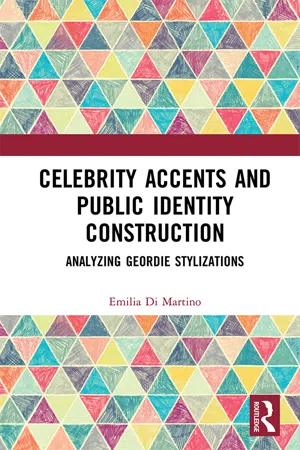
Celebrity Accents and Public Identity Construction
Analyzing Geordie Stylizations
- 160 pages
- English
- ePUB (mobile friendly)
- Available on iOS & Android
eBook - ePub
About this book
Information
1 Introduction
This introductory chapter is addressed to the expert reader with an interest in more general methodological issues. It argues for the methodological choices at the basis of the study carried out here. It may be skipped by the general reader, as well as by readers with a specific interest in the Geordie accent/dialect. The section specifically focusing on Geordie (Chapters 2–7) is self-standing.
1.1 Aim of the Volume
Reflecting on the Socio-political Values of Geordie Stylizations
The aim of this volume is to reflect on the socio-political values of the stylistic practices enacted in a number of high performances (i.e. pre-announced, planned, public communicative events)1 that are perceived to encapsulate the quality of being Geordie or of having characteristics regarded as typically Geordie, where Geordie should be looked upon as an identity, before being identified as the language variety2 both shaping and emerging from it: the ‘commonly used name for people from the city of Newcastle-upon-Tyne in north-east England, and by extension the dialect of English spoken in and around the conurbation of Tyneside’ (Pearce 2007: 77, emphasis in the original). Indeed, the Tyneside area of north-east England ‘has developed its unique local identity which is essentially borne by the distinctiveness of the spoken traditional dialect’ (Nickel 2017: 2).
This would basically seem to mean reflecting on the dynamics and social meanings associated with some public figures’ performances of Geordieness only (an aspect of language in society as discussed in Romaine 2000 [1994]: x). However, research conducted in other areas of Europe and the world (Pooley 1996; Johnstone 2009, 2013b) has shown that similar phenomena to the ones Geordie has undergone so far3 actually situate this accent/dialect4 in a global context. This volume sets out to demonstrate that Geordie is currently undergoing further developments. In particular, a process of further enregisterment5 appears to have been occurring around it since the turn of the millennium, contributing to its growing popular recognition through association with individuals and social practices perceived to be desirable in terms of affiliation by a wide public.6 This process has lifted the variety out from its previous associations and stigma, producing an indexicality shift and making it an object of consumption that has been detached from its source and re-used in other contexts in a process of stylistic bricolage. This may well apply to other varieties around the world. Readers should bear this in mind when reflecting on the phenomena discussed in this volume and mentally apply them to realities closer to their interests.
The high performances of Geordieness identified here will be investigated in some of the detachable and transportable identity sets they have generated in order to see how these verbal and non-verbal ‘manifestations’ have become resources that viewers can draw on as suitable additions to their personal means of expression. The focus will be on the ‘loading’ of such performances, i.e. on the level of specific speakers’ investment in their identities being negotiated (see Coupland 2007: 114): the degree of awareness of such speakers’ interventions on other people’s perceptions of the personas they are constructing through language. Essentially, then, of interest are the individual instances of Geordieness performed on specific occasions: what Coupland refers to as ‘contextual framings and keying’ (Coupland 2007: 114); indeed, a handful of local contextualizations of Geordieness will be presented and dealt with rather than the abstract idea of Geordieness that a model of community-based speech variation research may convey. The core of this volume is not therefore constituted by the exploration of the processes through which individuals create their ‘systems’ of language ‘behaviour’ so as to resemble those belonging to the group/s with which they wish to be identified, but of the ways in which people construct their unique and constantly evolving language repertoires at times appropriating some, at other times distancing themselves from, linguistic traits that would characterize them as members of specific communities in other people’s perceptions in order to respond to specific communicative events and negotiate meaning-making with their perceived interlocutors. The assumption behind this choice of focus is that, as Eckert argues, ‘(v)ariation does not simply reflect a ready-made social meaning; it is part of the means by which that meaning emerges’ (Eckert 2000: 43). As Coupland emphasizes, variation is ‘made meaningful in, and embedded in, social interaction, rather than just being an attribute of speakers or a group tendency’ (Coupland 2007: 178).
The model of variation such a choice implies is one focusing on the ‘performative arenas of linguistic styling’ (Coupland 2007: 178): a model based on the assumption that speakers constantly mould unique, evolving voices for themselves through appropriating and/or challenging other people’s voices or linguistic traits in order to respond to continually changing contexts, situations and communicative needs – as Bucholtz and Hall argue, ‘identity is a discursive construct that emerges in interaction’ (Bucholtz and Hall 2010 [2005]: 19).
1.2 The Object of Analysis
Style in Discourse
The object of analysis is the identity dimension of style, an aspect first emphasized by Coupland (1980), who – as Eckert and Rickford clearly sum up – ‘treats stylistic variation as a dynamic presentation of the self’ (Eckert and Rickford 2001: 4). Sociolinguistic style, then, is the object of investigation in this volume, understood as ‘the making of social meaning through deploying and recontextualizing linguistic resources’ (Coupland 2007: 177), namely the construction of one’s voice through appropriating and distancing oneself from other people’s linguistic choices or traits in order to respond to ever new communicative events and needs, as already hinted at above. This means style will not be sought in indexical relationships between language forms and membership of social groups but in the whole of discourse, which implies considering language forms both as part and parcel of a specific context and but one component of a larger unit of meaning which includes non-verbal language (Coupland 2007: 178). Moreover, as anticipated in the general title and in section 1.1, this volume examines high, or staged, performances. As a consequence of this decision to examine high rather than ‘mundane’ events (Coupland 2007: 146–149), the focus is not on styling, i.e. on ‘mere’ performed discursive practice, which characterizes everyone’s communication, but on stylization, which Coupland identifies as the product of ‘strong’ performances, ‘where the gap between a speaker’s social incumbency (his or her ‘natural’ social position) and targeted identities is larger, i.e. where ‘cross-category social identification is more radical and more spectacular’ (Coupland 2007: 145), and where considerable, conscious effort is required to bridge the gap between the speaker’s present position and his or her target identities.
As for the domain, the material to be investigated will be taken from the artistic world, particularly the world of music: engaging with the arts and culture, especially music, is not just a solitary event. It is also a participatory one which many people feel is worthwhile sharing through ordinary conversation and interaction via social networks every day. This means it may have very broad resonance and thus a potentially crucial impact on people’s verbal and non-verbal choices and on their general communicative repertoires.
1.3 Methodology Adopted
Bakhtinian Stylistics as a Sociolinguistics of Stylistic Performance
With its focus both on the uniqueness and on the creative potential of every utterance in a dialogic relationship, the methodology that seems to best apply to the proposed aim and object of research is a form of Bakhtinian stylistics, i.e. a study of texts aiming to analyse the ‘addressivity’ and ‘answerability’ of each utterance and investigating its heteroglossic and interindividual nature as well as its positioning within a community, a time and a place (Bakhtin 1981 [1935], 1984 [1929], 1986 [1979], 1990 [1974], 1992 [1975]; Holquist 1983, 1990; Todorov 1984; Volosinov and Bakhtin 1986). Bakhtin saw that each utterance or word is always addressed to someone and always anticipates (that is, generates) an answer: he grasped that words and utterances considered in chains (discourse) are dialogic in nature (they are networks that presuppose earlier chains and anticipate future ones) and historically contingent (they are inseparable from the community, the time and the place that have generated them). In this, he certainly finds himself at the basis of the sociolinguistics of stylistic performance that can be said to have been formally introduced by Eckert and Rickford’s 2001 collective volume and that Coupland considers to be the primary methodology for understanding the ‘authentic speaker’ (Coupland 2003: 429).
The data analysed are drawn from episodes of TV shows and TV and radio interviews collected between 2002 and 2018 and transcribed verbatim. The thread running through all the excerpts is that they all focus explicitly on such matters as accent/dialect and identity. A selection of passages from newspaper and magazine articles and books published between 2002 and 2018 are also analysed or commented upon to provide evidence of metadiscourses on the Geordie variety floating in the public sphere. Using the methodology of Bakhtinian stylistics as a sociolinguistics of stylistic performance, as clarified just above, this study is a piece of discourse analytic research based on constructionist and critical sociolinguistics. The perspective is constructionist (rather than constructivist) in the sense that the focus is on the peculiarity of each individual’s (verbal and non-verbal) product rather than on the individual itself, whose identity appears to be unpredictable, constantly created and re-created in communicative practice (Hernández-Campoy 2016). This product, strategically designed by individuals to produce an image of themselves aimed at satisfying specific needs of communication and representation, is here the object of analysis focusing on its capacity to appear authentic ‘in the sense of normalised and standardised by a relevant group of speakers and from whose perspective the speakers are evaluated as being authentic’ (Lacoste, Leimgruber and Breyer 2014: 9). This ‘authenticity indexing’ manifests itself in a process of authenticity construction whereby each individual negotiates his or her authenticity (Eira and Stebbins 2008) inhabiting or rejecting ‘others’ original, authentic sociolinguistic behaviours and identities’ (Lacoste, Leimgruber and Breyer 2014: 8) and producing a dose of resources that is ‘enough – enough to produce a recognisable identity as an authentic someone’ (Blommaert and Varis 2011: 8), i.e. to authenticate the individual in question. In other words, and considering the specific context of this volume, the analytic focus will be on the interplay between Geordie accent/dialect and self-representational discourse (Coupland 2001): individuals do not ‘inherit authenticity from the social circumstances of their birth and socialization’ (Coupland 2003: 428); they have to perform authenticity. This ‘authenticity in performance’ can take many different forms, ranging from the quotation of old authenticities to the parody of the latter: ‘increasingly, authenticity needs to be earned rather than credited’ (Coupland 2003: 428).
In addition to being constructionist, this study adopts a critical (as opposed to structural) perspective in the investigation of identities by ‘articulating the lived social world of meaning-making through language’ (Coupland 2007: 178), i.e. it concentrates on styling as a social practice. By virtue of its critical view of language and communication, discourse research requires reflexivity in the researcher, shedding light on the messiness, complexity and contingency of the interpretive world of social practice rather than re-affirming the security of simple explanatory models of style-shifting. As a consequence, the focus of discourse research is not on what most people do but on what a specific individual seems to be doing at a precise moment in time; individual social identity as it is expressed though variation in specific local contextualizations and on how context emerges in and through individual performance. One such discourse, from the analytical perspective, aims to identify the signalling devices by which language functions to evoke context (Gumperz 1996: 365). This means the methodology applied here can also be described as a form of sociolinguistic stylistics like the one developed in Coupland’s sophisticated theory of variation (sociolinguistics as a social theory of practice, Coupland 2007: 178), which in turn refers to Weber:
Meaning and stylistic effect are […] a potential which is realized in a (real) reader’s mind, the product of a dialogic interaction between author, the author’s context of production, the text, the reader and the reader’s context of reception – where context includes all sorts of sociohistorical, cultural and intertextual factors.
(Weber 1996: 3)
While drawing on Weber’s considerations on literary stylistics, Coupland invites us to substitute ‘a more complex notion of “participants” for “reader” […] including speakers, listeners and analysts as parties engaged with and impacted by stylistic meaning’ (Coupland 2007: 177). The substitution of literary stylistics readers for sociolinguistic stylistics listeners may allow us to take the opposite pa...
Table of contents
- Cover
- Half Title
- Title Page
- Copyright Page
- Table of Contents
- List of illustrations
- Acknowledgements
- Foreword
- 1. Introduction
- 2. High Performances of Geordieness
- 3. Detachability of Geordie Indices
- 4. Transportability of Geordie Indices
- 5. Public Acceptance in the Construction of Geordie Identity
- 6. Local Meanings and Politics of Geordie Styling
- 7. Conclusions
- Index
Trusted by 375,005 students
Access to over 1.5 million titles for a fair monthly price.
Study more efficiently using our study tools.
Frequently asked questions
Yes, you can cancel anytime from the Subscription tab in your account settings on the Perlego website. Your subscription will stay active until the end of your current billing period. Learn how to cancel your subscription
No, books cannot be downloaded as external files, such as PDFs, for use outside of Perlego. However, you can download books within the Perlego app for offline reading on mobile or tablet. Learn how to download books offline
Perlego offers two plans: Essential and Complete
- Essential is ideal for learners and professionals who enjoy exploring a wide range of subjects. Access the Essential Library with 800,000+ trusted titles and best-sellers across business, personal growth, and the humanities. Includes unlimited reading time and Standard Read Aloud voice.
- Complete: Perfect for advanced learners and researchers needing full, unrestricted access. Unlock 1.5M+ books across hundreds of subjects, including academic and specialized titles. The Complete Plan also includes advanced features like Premium Read Aloud and Research Assistant.
We are an online textbook subscription service, where you can get access to an entire online library for less than the price of a single book per month. With over 1.5 million books across 990+ topics, we’ve got you covered! Learn about our mission
Look out for the read-aloud symbol on your next book to see if you can listen to it. The read-aloud tool reads text aloud for you, highlighting the text as it is being read. You can pause it, speed it up and slow it down. Learn more about Read Aloud
Yes! You can use the Perlego app on both iOS and Android devices to read anytime, anywhere — even offline. Perfect for commutes or when you’re on the go.
Please note we cannot support devices running on iOS 13 and Android 7 or earlier. Learn more about using the app
Please note we cannot support devices running on iOS 13 and Android 7 or earlier. Learn more about using the app
Yes, you can access Celebrity Accents and Public Identity Construction by Emilia Di Martino in PDF and/or ePUB format, as well as other popular books in Languages & Linguistics & Linguistics. We have over 1.5 million books available in our catalogue for you to explore.