- 248 pages
- English
- ePUB (mobile friendly)
- Available on iOS & Android
eBook - ePub
About this book
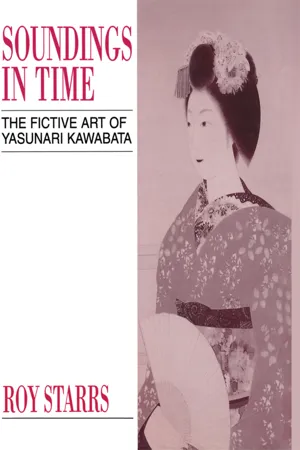
This first full length, and long overdue, study of Kawabata, Japans first Nobel laureate for literature and the most widely known for his novels Snow Country (1960) and Sound of the Mountain (1970).
Information
Chapter One
An Orphan Psychology
1. The Diary of a Sixteen-Year-Old
Readers of Kawabata often come away with a general impression of coldness - as if 'snow country', the title of one of his most famous novels, were also an appropriate description of the whole world of his fiction. His novels possess a certain beauty, such readers usually agree, but it is a cold, inhuman beauty, a beauty of surfaces, of an exclusively aesthetic world in which the fine sheen of a woman's skin is savored in exactly the same way as the fine sheen of a piece of pottery.1 These readers seem tempted to say of Kawabata what Cezanne once said of Monet: 'He is only an eye ...' - though they too may allow, as Cézanne did: 'but what an eye!'
Other readers, more sympathetic and perhaps more perceptive, speak not so much of coldness as of a longing for warmth, a longing in itself 'warm' enough to melt the ice of aesthetic detachment which forms the surface glaze of Kawabata's work. The aesthetic detachment itself, in fact, is seen as only the obverse side of a profoundly human sensitivity: either in a negative sense, as a defence mechanism against further emotional wounds, or, in a more positive sense, as a compensation in the currency of beauty for the major losses Kawabata sustained in the currency of love. Such 'sympathetic' readers often notice too that Kawabata's 'longing for warmth' also assumes, quite early in his writings, a spiritual and even a religious dimension: as if universal love, or the mystical experience of union with all creation, might replace the lost love of his mother. In this spiritual search which seems to animate Kawabata's work at its deepest level, there is also, such readers feel, a profoundly human pathos which belies the pose of aesthetic detachment.
Whichever of these very general views of Kawabata's work one takes, in trying to account for either the 'coldness' or the 'longing for warmth' one is inevitably led back to his childhood. Frequent readers of literary biography no doubt have heard enough of the unhappy childhoods of great writers, of Dickens' blacking factory and Proust's hay fever, and of the lasting effect of these childhood traumas on both the writer's character and work. But Kawabata's childhood sufferings certainly were not merely the product of the kind of abnormal sensitivity common among future artists. Even by the extreme standards of literary biography, his childhood was an unusually painful one. Though it is always impossible to measure such things with anything like scientific accuracy, the conclusion seems as inescapable as it is obvious that this 'wounded childhood'2 had a profound and lasting impact on both the man and his writings. And one may see this impact in its most explicit form, of course, in Kawabata's more directly autobiographical writings, such as his very first publication of significance, The Diary of a Sixteen-Year-Old (Jurokusai no nikki, 1925).
The title of this early Kawabata work may seem self-explanatory in a rather bland way, but actually it is deceiving on several counts. In the first place, the work should not be regarded as a mere piece of juvenalia. To say that it is not an ordinary 'teenager's diary' is an almost humourous understatement. Kawabata, of course, was no ordinary teenager: if the Diary itself is to be credited, already at fourteen he possessed, to an almost frightening degree, the necessary detachment of the artist from the object he would depict - even if that object happened to be his own grandfather. On the other hand, the actual age of the author when he wrote the work is a matter of dispute, in spite of the open declaration of the title. Some critics are convinced that the Diary is a kind of literary fraud, that it was written, by and large, the same year it was published, eleven years after the events it describes, by an ambitious twenty-six-year-old up-and-coming writer, eager to prove himself, retroactively, to have been a child prodigy.3 There is a further complication, in fact, in that the author was 'sixteen' at the time of his grandfather's death only by kazoedoshi, the old Japanese way of computing age, according to which a person is one at birth and two at the start of the following new year. By Western and modern Japanese count, Kawabata was fourteen. Thus one critic, who accepts the author's assurances that the diary proper was written contemporaneously with the events it describes, suggests that the title should now be changed to The Diary of a Founeen-Year-Old.4
More significant, though, than these questions regarding the author's age are the ambiguities which arise from the other term of the title, 'diary'. The work hardly conforms to our usual (Western) notions of what constitutes a diary, although many precedents for it could be found in the long Japanese tradition of 'diary literature' (nikki bungaku). It is more like a short story in the way it focuses on a single dramatic action the death of the diarist's grandfather - and presents vivid portraits of two 'characters' distinct from the diarist himself: his grandfather and the maid, Omiyo. Regardless of the age at which it was written, this is a work which deals with weighty themes and is the product of a mature, disciplined artistry. Published in a leading literary journal, the Bungei Shunjii (Literary Times) just four months before the publication of The Dancing Girl of Izu (.Izu no Odoriko, 1926) catapulted the young author to overnight fame, the Diary is Kawabata's first really significant creative work. Though in some ways unique, it may justifiably be regarded, when viewed in the context of his total oeuvre, as the fountainhead of much that was to follow.
2. The Boy Diarist
Of the Diary's three portraits, the liveliest and fullest is not, as we might expect, of the boy diarist himself but of his grandfather. This has led some critics to assign the boy an entirely subordinate role, comparing him to the waki or deuteragonist in a Nō drama, vis-à-vis his grandfather as shite or 'doer'.5 Though both the boy and the maid, Omiyo, do perform the waki-like role of drawing the old man's 'story' out of him (perhaps Omiyo more so than the boy), in the work as a whole the grandson's role is surely more central and active than this. Much of the drama, in fact, arises from the clash of two male egos, the boy's and his grandfather's. This is a rare thing in Kawabata, since generally he is more interested in male-female than in male-male relations, and it is exactly this which gives the Diary more open dramatic tension than the usual Kawabata story or novel. Another conspicuous exception, of course, is a much later work, The Master of Go (Meijin, 1954), in which also two males clash - only, in this case, over a game of go.
If the Diary is concerned, as is the typical No play, with spiritual salvation, then it is the spiritual salvation of the boy at least as much as of his grandfather. This is not true of the waki, who is usually a Buddhist priest who brings salvation to the shite, often a discontented ghost. Indeed, if the boy's role were confined to that of a mere 'witness', as Arthur Waley calls the waki,6 then Kawabata's claim that the Diary was his 'one and only frank autobiography'7 would be a strange one indeed. In an autobiography, needless to say, one expects a little more self-revelation. I do not wish to argue that an author is always the final authority on his own work, but it seems to me that, in this case at least, the author's claim is not so greatly exaggerated. The Diary does tell us much about the diarist, albeit often in an indirect way. To be sure, we are told far more about his grandfather but, after all, this is partly a function of their respective ages: there is inevitably more to tell about a seventy-five-year-old man than about a fourteen-year-old boy. Thus, whereas we are given an impression of the whole life and character of the old man, the boy's life and character are defined mainly in relation to his grandfather. While it is true, as some critics have pointed out,8 that the boy does not often give free vent to his thoughts and feelings, there is enough in what he says and does to give us an adequate idea of these, and there is much that we can read 'between the lines'. Furthermore, in the two postscripts - which, as several critics have argued,9 form an integral part of the total work - the thoughts and feelings of the now mature diarist are presented explicitly as one of the major themes.
From the very beginning of the Diary's first entry, for 4 May [1914], we are quickly and vividly introduced to the boy and his unfortunate situation: he returns home from school to a closed, silent house in which his blind, ailing grandfather is asleep all alone. No-one answers his friendly call of tadaima ('I'm home!'), making him feel, as he tells us, 'sad and lonely'.10 The boy must repeat this greeting several times before the grandfather finally responds. But, rather than answering with the usual warm greeting of okaeri nasai ('welcome back!'), the old man immediately begins to complain: no-one has helped him to relieve himself since morning, he has been waiting in agony, and he needs to be turned to face another direction. He then demands impatiently that the boy make some tea and bring him the glass urinal. Confronted by this irascible, demanding old invalid, the boy understandably begins to lose his temper. He makes it clear that the duty of fitting the old man's penis into the glass urinal and holding it while he urinates is particularly distasteful to him. But, since 'it. can't be helped', he performs this onerous task with admirable equanimity. Then, as he is doing so, there seems to occur a sudden and remarkable transformation in his psychological state:
'Ahh, ahh, it hurts! ouch! ouch! ahh! ahh!'
It hurts when he urinates. Along with his voice,
which sounds like that of a man whose painful
breathing is about to stop, the sound of the clear
water of a valley stream on the bottom of the glass
urinal.
It hurts when he urinates. Along with his voice,
which sounds like that of a man whose painful
breathing is about to stop, the sound of the clear
water of a valley stream on the bottom of the glass
urinal.
'Ahh, xt hurt!
Hearing his voice, which sounds as if he can't bear
the pain, I am moved to tears.11
Hearing his voice, which sounds as if he can't bear
the pain, I am moved to tears.11
In the small drama of this opening scene, which reaches a 'mini-climax' in the above passage, we may see that, while the grandfather plays the role of passive sufferer and insensitive provoker of the boy's suffering, it is with the boy's feelings and psychology that we are mainly concerned. And these are by no means simple, even in so short a scene. Already, in fact, the basic pattern which they will assume throughout the entire work is clearly evident: the pendulum swings between anger, resentment and despair on the one side and shame, pity and compassion on the other.
Actually, there are two forms of tension here, each of which contributes to the overall dramatic tension which structures the Diary into a literary work. Firstly, there is the overt tension between the boy, a mere fourteen years old, who has his own legitimate boyish needs and desires, and the old man, as helpless and demanding as any infant. It should be noted that this is in addition to the in-built, natural opposition which already exists between the boy and the old man merely by their being juxtaposed against each other: innocent, healthy youth opposed to corrupt and decrepit old age. This kind of passive, contrastive opposition would become an important part of Kawabata's method in his later works. And, even in the Diary, it is used to good effect. As the work progresses, the contrast is strengthened and clarified, and it functions not only on a physiological level, as in the above scene of the boy taking the old man's urine, but also morally and intellectually: the boy seems strong-willed, unsentimental and clear-sighted in contrast to his weak-willed, n'er-do-well, self-pitying and self deluded grandfather. Thus we can see that, in this sense also, the boy's role is indispensable: he is one side of a polar opposition at the core of the work's structure. As already noted, though, to an extent rare in Kawabata this 'passive' opposition erupts into an active and dramatic one. And, secondly, there are the tensions in the boy himself: between, on the one hand, his sense of duty and the love and compassion he feels for his grandfather, and, on the other, his natural desire to escape from a terrible burden. But what is also of great significance is the psychological process by which both these overt and inner tensions are momentarily resolved in the above passage.
The sentence which contains the implied metaphor equating the sound of urine with the sound of stream water has probably been more commented on than any other part of the Diary, and, indeed, is one of the most celebrated sentences in the whole of Kawabata. How each critic interprets this metaphor depends ultimately, of course, on his or her view of the work as a whole. But most seem to agree, at least, that it contains an important key to the overall significance of the Diary. Indeed, one could even argue, without too much exaggeration, that Kawabata, throughout his entire career, never strayed far from the poetic and philosophic vision embodied in this metaphor contained in a single sentence written, supposedly, when he was fourteen years old.
Donald Keene may betray a characteristically Western viewpoint when he calls the metaphor 'ironic'.12 Japanese interpreters seem to consider it anything but that. In general, they tend to take it more seriously, and more literally. Hasegawa Izumi, for instance, who was the first critic to analyse the Diary at length, views the metaphor first as a manifestation of the extraordinary poetic sensibility of the young Kawabata. But, more than that, he sees it as an example of how the writer's indomitable spirit, through poetic inspiration, may rise above the sorrows of life.13 A number of early critics, in fact, assign to the metaphor this double-edged moral/ aesthetic function: it is an 'aestheticization' of an ugly reality which, at the same time, serves to strengthen and purify the boy's spirit.14 Yamamoto Kenkichi makes the poetic quality of the metaphor seem even more convincing by showing how it anticipated a modernist haiku of Ishida Hakyo (1913-69): 'Autumn dusk: the chamber pot sounds with the voice of spring water'. ('Aki no kure shubin izumi no koe o nasu'.15)
Perhaps the most thorough treatment of the psychological and philosophical basis of the metaphor is given by Sasabuchi Tomoichi. According to this critic, the metaphor is not merely an example of 'beautification' but reveals a Buddhist/surrealist 'metamorphosis', realized in the deepest part of the imagination, and necessitated by the boy's unconscious desire to resolve the dualism between pure water (representi...
Table of contents
- Cover
- Half Title
- Title
- Copyright
- Contents
- Acknowledgements
- Introduction
- 1 An Orphan Psychology
- 2 An Ambiguous Redemption
- 3 Experiment and Expansion
- 4 Between Tradition and Modernity
- 5 Elegies for A Dying Tradition
- 6 Time and Anti-time
- 7 Narcissus in Winter
- Notes
- Bibliography
- Index
Trusted by 375,005 students
Access to over 1.5 million titles for a fair monthly price.
Study more efficiently using our study tools.
Frequently asked questions
Yes, you can cancel anytime from the Subscription tab in your account settings on the Perlego website. Your subscription will stay active until the end of your current billing period. Learn how to cancel your subscription
No, books cannot be downloaded as external files, such as PDFs, for use outside of Perlego. However, you can download books within the Perlego app for offline reading on mobile or tablet. Learn how to download books offline
Perlego offers two plans: Essential and Complete
- Essential is ideal for learners and professionals who enjoy exploring a wide range of subjects. Access the Essential Library with 800,000+ trusted titles and best-sellers across business, personal growth, and the humanities. Includes unlimited reading time and Standard Read Aloud voice.
- Complete: Perfect for advanced learners and researchers needing full, unrestricted access. Unlock 1.5M+ books across hundreds of subjects, including academic and specialized titles. The Complete Plan also includes advanced features like Premium Read Aloud and Research Assistant.
We are an online textbook subscription service, where you can get access to an entire online library for less than the price of a single book per month. With over 1.5 million books across 990+ topics, we’ve got you covered! Learn about our mission
Look out for the read-aloud symbol on your next book to see if you can listen to it. The read-aloud tool reads text aloud for you, highlighting the text as it is being read. You can pause it, speed it up and slow it down. Learn more about Read Aloud
Yes! You can use the Perlego app on both iOS and Android devices to read anytime, anywhere — even offline. Perfect for commutes or when you’re on the go.
Please note we cannot support devices running on iOS 13 and Android 7 or earlier. Learn more about using the app
Please note we cannot support devices running on iOS 13 and Android 7 or earlier. Learn more about using the app
Yes, you can access Soundings in Time by Roy Starrs in PDF and/or ePUB format, as well as other popular books in Social Sciences & Ethnic Studies. We have over 1.5 million books available in our catalogue for you to explore.