eBook - ePub
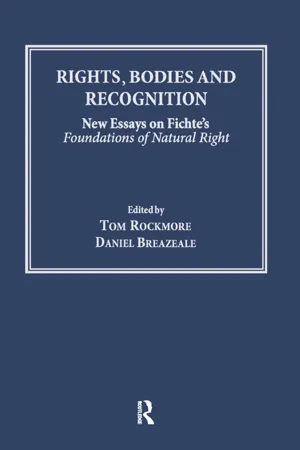
Rights, Bodies and Recognition
New Essays on Fichte's Foundations of Natural Right
- 276 pages
- English
- ePUB (mobile friendly)
- Available on iOS & Android
eBook - ePub
Rights, Bodies and Recognition
New Essays on Fichte's Foundations of Natural Right
About this book
The German philosopher, Johann Gottlieb Fichte (1762-1814), has long been recognized as an important and original figure in the history of philosophy and Western thought and as a seminal influence upon the Romantic tradition. The essays in this book focus on Fichte's contributions in political theory as set out in his Foundations of Natural Right. Fichte was notorious as a political radical and his ideas in in political theory proved to be decisive influences upon his contemporaries and of striking relevance to current political dispute. This volume of essays, which examine such issues as Fichte as a social contract theorist, his theory of gender relations and his theories on punishment and the criminal law among many other topics, remedies what has been a striking lacuna in the existing scholarly literature.
Information
Chapter 1
Is Fichte a Social Contract Theorist?
After a long period of neglect, the philosophy of J.G. Fichte has returned to the attention of English-speaking scholars. No longer simply viewed as a stepping stone on the way from Kant to Hegel, his philosophical writings have been subjected to close analysis and sympathetic reconstructions, and his reputation has been at least partly salvaged from the influential distortions and caricatures that date back to his own contemporaries. Until very recently, however, this revival of anglophone attention to Fichtean philosophy has focused mainly on his controversial epistemology and metaphysics, particularly on what might nowadays be called his philosophy of mind – his account of the structures of self-conscious subjectivity.1 Fichte’s political philosophy, by contrast, has been largely neglected. Certainly there have been exceptions,2 but for the most part Fichte’s reputation as a political philosopher still finds its beginning and end with his role as a forerunner of German Nationalism. Fortunately this neglect has now begun to be rectified, and the recent appearance of the first modern English translation of Fichte’s main work of political philosophy – The Foundations of Natural Right (1796–97) – has helped turned scholarly attention to Fichte’s broadly liberal political philosophy from his Jena period. What has yet to be recognized, I shall argue, is how radically Fichte departs from traditional approaches to the central problems of political philosophy.
The discussion that follows is divided into three parts. In the first section I introduce what I take to be a standard conception of contractarian strategies in political philosophy, and undertake a preliminary survey of the conflicting evidence regarding Fichte’s commitment to such strategies. In the second section I suggest an interpretative strategy for resolving the tensions that emerge in that survey. In the final section I draw on a claim from Husserl’s phenomenology of intersubjectivity to suggest the shape of Fichte’s alternative to the contractarian approach.
1 Conflicting Evidence
From Locke and Rousseau to Rawls and Scanlon, the mainstream of political philosophy has been broadly contractarian. I begin with a brief (and I hope boringly uncontroversial) characterization of social contract approaches in political philosophy. The most basic and central questions of political philosophy, I shall assume, are as follows:
1) What is the basis of political obligation?
2) What constitutes a just political order?
The first question in effect asks why I or anyone ought to obey civic authorities (laws, officers of the state, etc.); the second asks what forms of civic authority are legitimate and therefore deserving of my respect, allegiance, and obedience. A social contractarian approach in political philosophy, as I shall use the term, is any approach that seeks answers to these two central questions by appeal to some notion of a contract – whether among citizens or between citizens and the state. In particular, a social contract theory is one which finds the basis of civic authority in an implicit contract in virtue of which the members of a community agree to terms by which each can benefit from the fruits of social cooperation. In answer to the second basic question of political philosophy, the social contract theorist proceeds by considering whether this underlying implicit contract is fair and rational, and in that sense merits the assent of rational self-interested agents.
It is worth noticing that the contractarian approach is in a sense reductionist about political obligation. Its strategy in answering the first basic question of political philosophy in effect treats political obligation as a special (if rather puzzling) case of the moral obligation to keep one’s promises. Its approach to the second question treats the evaluation of political arrangements as a special (if again rather puzzling) case of the ordinary assessment of alternatives undertaken by a rationally self-interested individual. The two cases are puzzling instances of their types because, in the first case, I find myself with an obligation to keep a promise that I never explicitly undertook, while in the latter case it is unclear which agent is meant to be engaged in rationally self-interested deliberation, given that every actual individual will have rationally self-interested motives to ride free. Many of the philosophical oddities of the social contract tradition – whether the metaphysics of Rousseau’s general will or the epistemic boundaries in Rawls’ original position – are motivated by the need to navigate these puzzles.
Our question, then, is whether Fichte’s political philosophy, as developed in the 1796–97 Foundations of Natural Right (hereafter: “the Naturrecht”), should be considered a contractarian position in the sense just outlined.
Now there is certainly no shortage of evidence to suggest an affirmative answer to this question. In particular in Fichte’s earliest political writings, we find repeated insistence that a contract provides the only legitimate basis of political authority. Most notably, his anonymously published pamphlet supporting the French Revolution (1793) is premised upon an unambiguous and characteristically rhetorical endorsement of a contractarian answer to the first of the two basic questions of political philosophy:
[A] civil society can justly be grounded on nothing other than a contract [Vertrag] among its participants[.]… That much can easily be proved for even the dimmest wit. (SW, VI: 81)3
Moreover, there would seem to be strong evidence to suggest that this early commitment to a contractarian approach is carried over – despite a number of other prominent changes – into the more mature work. Thus in the Introduction to the Naturrecht we find a repetition of the insistent claim from 1793:
[T]he association of the state can be constructed only on the basis of a contract that is original, but necessarily entered into …. (SW, III: 13)
In the body of the work, a substantial discussion is devoted to a detailed analysis of what Fichte calls the “civil contract” [Staatsbürgervertrag].4
Such concrete textual evidence is reinforced by a more abstract line of philosophical reasoning. Among all the controversies about Fichte’s philosophical positions, one point beyond dispute is that freedom – in particular freedom construed as autonomy – is central to his conception of human subjectivity. Given this emphasis on individual autonomy, it is natural to turn to contractarian answers to the basic questions of political philosophy. For part of the promise of the contractarian approach is that it respects the fundamental freedom of individual citizens while at the same time underwriting state authority. Essentially this line of reasoning is expressed concisely by Beiser in connection with Fichte’s early endorsement of the contractarian position:
Autonomy means that we cannot be bound by anything but our sovereign will, that all our laws must be self-given. Hence we are obliged to obey the laws of a constitution only insofar as we have consented to them. (Beiser 1992: 81)
If we can make sense of the idea that we freely enter into a civil contract, then we can legitimately claim to be at once free individuals and at the same time obligated to the state. The contractarian approach would thus seem to answer directly to some of Fichte’s deepest philosophical commitments.
Given all this evidence, the answer to our question would seem to be straightforward: Fichte is a contractarian, at least in his liberal period, and if there is any distinctively Fichtean contribution to liberal political philosophy it must be found in the particulars of a broadly orthodox contractarian approach. Understandably, the limited but growing scholarship on Fichte’s liberal political philosophy has tended to follow this assumption.5
Two pieces of evidence should at least displace the sense of inevitability about the contractarian interpretation of Fichte’s political philosophy. The first concerns Fichte’s insistence that there is a radical division between the domains of moral and political obligation. As Fred Neuhouser has argued in detail, this is one of the major shifts in Fichte’s political thought between the 1793 pamphlet on revolution and the mature liberal political doctrines of 1796.6 In the earlier position, Fichte holds that the demands of morality – understood along orthodox Kantian lines – suffice to underwrite the basic authority of the state:
The answer to this question [concerning the highest end of the state] is purely moral and must be grounded in the moral law, which alone … prescribes a final end to the human being.7
By 1796, however, Fichte’s position on this point has changed. He no longer sees political right as a special application of moral right; political obligation is now held to be sui generis. In Fichte’s preferred formulation, the science of political right is to be seen as “eine eigene, für sich bestehende Wissenschaft” – an individual, self-sustaining science (SW, III: 10). This shift in Fichte’s position should at least give us pause in assuming that the contractarianism of the revolution pamphlet is carried over into the later work. For as we have seen, the contractarian approach in effect reduces political obligation to a species of the moral obligation to keep one’s promises. It would thus not seem to satisfy Fichte’s claims about the independence of political obligation and political science.
The second piece of evidence against the contractarian interpretation is mundanely textual: through the first seven sections of the Naturrecht there is simply no appeal to the notion of a social contract, and indeed no use of the word, Vertrag. Certainly the Naturrecht does include extensive discussion of a social contract, but this discussion begins only after the seventh section, and occurs mainly in the second main part, published separately under the title “Applied Natural Right.” Fichte’s original readers, working through the first published volume of the Naturrecht, had to read as far as the sixteenth and final section of the volume to find any substantive invocation of a social contract. And they had to wait until the following year (for the publication of the second volume) to see Fichte’s substantive treatment of the workings of such a contact. This back-loading of the appeal to a contract does not of itself rule out the contractarian interpretation. But it certainly suggests that much of the distinctive work of Fichte’s political philosophy is carried out independently of appeal to a contract. Here it is particularly worth noticing that by the end of the seventh section – prior to any appeal to the notion of a social contract – Fichte claims already to have established two of his main results:
The applicability of the concept of right is now completely secured, and its limits have been precisely determined. (SW, III: 90)
In short, Fichte’s deduction of natural right is carried out entirely without reliance on the notion of a social contract.
Now by itself there is nothing particularly unorthodox about invoking a conception of right prior to the introduction of an appeal to a social contract. Indeed in one sense this is the standard procedure in the contract tradition. In the Second Treatise, for instance, Locke simply assumes that the state of nature is “a state of liberty yet not a state of license.”8 But he is famously elusive about the warrant for this assumption.9 What is distinctive about Fichte’s procedure is, first, that he sees an independent problem here to be solved, and second, that so much of his political position is “deduced” in advance of the appeal to contract. I turn now to consider the significance of this strategy.
2 Contract Without Contractarianism
There can be no question here of mounting a full positive interpretation of Fichte’s position in the Naturrecht. In the balance of my discussion, however, I take up two questions raised by the conflicting evidence outlined above. First, what alternative is there to a contractarian reading of Fichte’s liberal political philosophy? And second, if Fichte is not best understood as a social contract theorist then why is so much of his political philosophy couched in contractarian language?
We can approach these questions in two stages. The first step is to understand Fichte’s framing of the problems of political philosophy in terms of a demand for a deduction. Significantly, each of the first two main subdivisions of the Naturrecht (which together comprise the first seven sections of the work) are described as deductions – in the first case of the concept of right (Recht) and in the second case of the applicability of that concept. Within the text, little is said to explain or motivate the need for a deduction, but if we can understand this framing then we will be well on our way to seeing what is most distinctive about Fichte’s political thought.
The strategy of Fichte’s argument comes into relief when we consider it as closely modeled on Kant’s deduction of the categories in the first critique. Recall four central features of the Kantian deduction. The deduction is required in order to meet a distinctive skeptical challenge – roughly the challenge of the Humean skeptic, understood as denying that we can legitimately deploy a necessitarian concept of causality. Its aim is to secure the legitimacy of the application of pure a priori categories such as cause and effect, while at the same time establishing the limits within which such concepts can be legitimately applied. Finally, the strategy of the Kantian deduction is to argue that the application of the concepts in question is a condition on the possibility of experience – in particular a condition on the possibility of apperceptive self-consciousness.
The case of political philosophy, as Fichte approaches it, provides analogs for each of these points. We might think of the problem of anarchism as a political variant on Hume’s skepticism about causality. The Humean skeptic does not of course doubt that events of one type are regularly followed by events of another type, but he denies that such conjunction can ever warrant the claim that one event necessitates another. Analogously, we can think of the anarchist as granting t...
Table of contents
- Cover
- Half Title
- Title Page
- Copyright Page
- Table of Contents
- List of Contributors
- List of Abbreviations
- Introduction
- 1 Is Fichte a Social Contract Theorist?
- 2 Fichte’s Impossible Contract
- 3 Recognition, Right, and Social Contract
- 4 On the Fundamental Connection between Moral Law and Natural Right in Fichte’s Contribution (1793) and Foundations of Natural Right (1796/97)
- 5 Fichte’s Hypothetical Imperative: Morality, Right, and Philosophy in the Jena Wissenschaftslehre
- 6 The Role of the Human Body in Fichte’s Grundlage des Naturrechts (1796–97)
- 7 Fichte’s Foundations of Natural Right and the Mind–Body Problem
- 8 Fichte’s Materialism
- 9 The “Mixed Method” of Fichte’s Grundlage Des Naturrechts and the Limits of Transcendental Reellephilosophie
- 10 An Aesthetics of Influence: Fichte’s Foundations of Natural Right in View of Kant’s Third Critique
- 11 Fichte’s Theory of Gender Relations in his Foundations of Natural Right
- 12 Political Obligation and the Imagination in Fichte’s Naturrecht
- 13 The Universality of Human Rights and the Sovereignty of the State in Fichte’s Doctrine of Right
- 14 Schelling’s Aphorisms on Natural Right (1796/97): A Comparison with Fichte’s Grundlage des Naturrechts
- 15 Transcendental Conditions and the Transcendence of Conditions: Fichte and Schelling on the Foundations of Natural Right
- 16 Fichte, Heidegger and the Nazis
- 17 Rights, Recognition, and Regulative Ideas: On the Relationship Between Fichte’s Theory of Rights and Contemporary Liberation Philosophies
Trusted by 375,005 students
Access to over 1.5 million titles for a fair monthly price.
Study more efficiently using our study tools.
Frequently asked questions
Yes, you can cancel anytime from the Subscription tab in your account settings on the Perlego website. Your subscription will stay active until the end of your current billing period. Learn how to cancel your subscription
No, books cannot be downloaded as external files, such as PDFs, for use outside of Perlego. However, you can download books within the Perlego app for offline reading on mobile or tablet. Learn how to download books offline
Perlego offers two plans: Essential and Complete
- Essential is ideal for learners and professionals who enjoy exploring a wide range of subjects. Access the Essential Library with 800,000+ trusted titles and best-sellers across business, personal growth, and the humanities. Includes unlimited reading time and Standard Read Aloud voice.
- Complete: Perfect for advanced learners and researchers needing full, unrestricted access. Unlock 1.5M+ books across hundreds of subjects, including academic and specialized titles. The Complete Plan also includes advanced features like Premium Read Aloud and Research Assistant.
We are an online textbook subscription service, where you can get access to an entire online library for less than the price of a single book per month. With over 1.5 million books across 990+ topics, we’ve got you covered! Learn about our mission
Look out for the read-aloud symbol on your next book to see if you can listen to it. The read-aloud tool reads text aloud for you, highlighting the text as it is being read. You can pause it, speed it up and slow it down. Learn more about Read Aloud
Yes! You can use the Perlego app on both iOS and Android devices to read anytime, anywhere — even offline. Perfect for commutes or when you’re on the go.
Please note we cannot support devices running on iOS 13 and Android 7 or earlier. Learn more about using the app
Please note we cannot support devices running on iOS 13 and Android 7 or earlier. Learn more about using the app
Yes, you can access Rights, Bodies and Recognition by Tom Rockmore, Daniel Breazeale in PDF and/or ePUB format, as well as other popular books in Philosophy & Ethics & Professional Responsibility in Law. We have over 1.5 million books available in our catalogue for you to explore.