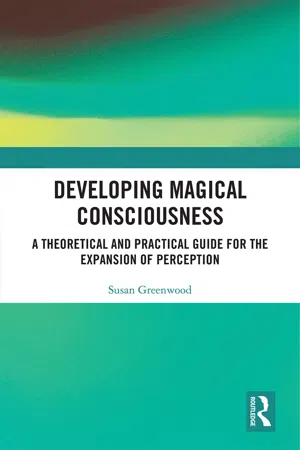
Offering a new template for future exploration, Susan Greenwood examines and develops the notion that the experience of magic is a panhuman orientation of consciousness, a form of knowledge largely marginalized in Western societies.
In this volume she aims to form a "bridge of communication" between indigenous magical or shamanic worldviews and rationalized Western cultures. She outlines an alternative mythological framework for the latter to help develop a magical perception, as well as giving practical case studies derived from her own research.
The form of magic discussed here is not fantastic or virtual, but ecological and sensory. Magical knowledge infiltrates the body in its deepest levels of the subconscious, and unconscious, as well as conscious awareness; it is felt and understood through the connection with an inspirited world that includes the consciousness of other beings, including those of plant, animal and the physical environment.
This is anthropology from the heart rather than the head, and it engages with the messy area of emotions, an embodiment of the senses, and struggles to find a common language of listening to one another across a void of differences. The aim is to provide a non-reductive structure for the creative interplay of both magical and analytical modes of thought. Passion is a motivator for change, and a change in attitude to magic as an integrative force of human understanding is the main thread of this work.
Rather than being a more conventional ethnography of participant observation with Aboriginal people, this research uses my encounter with Australian land to hold a mirror to Western attitudes to magic. The rationale is to look at Western cultures to find a ‘language’ that makes communication possible with indigenous peoples. Western cultures have largely lost a common magical language through a rationalisation process that has been progressive over a few hundred years, and we have much to gain by a reconsideration of what we call ‘magic’. I offer a mirror to reflect Western culture back on itself (Figure S1.1).
Figure S1.1 Inside the sandstone cave of the Darug Aboriginal ancestors. Photo: Susan Greenwood.
Chapter 1 details the impressions of my own ‘stream of consciousness’ connection with the land of the Aborigines in Australia as ‘ethnography of place’. Using the metaphor of the Rainbow Serpent, I made tentative approaches towards finding a place of connection through art and the opening up of my senses occurring through walking some Aborigine songlines with an Aborigine guide. The second chapter goes deeper into the process of developing magical consciousness, utilizing Lucien Lévy-Bruhl’s notion of ‘participation’. What is needed to participate with the non-material domain, the province of spirits, ancestors and other supernatural beings such as in sacred sites (Figure S1.2)?
The third chapter pushes this line of questioning further by exploring the act of perception through the ‘lens’ of analytical thinking and magical feeling. Using photographic examples, it seeks to give some idea of the different but related orientations of awareness. The fourth chapter seeks to ‘liberate’ the Western imagination, which is curtailed by notions that the imagination is not ‘real’, as well as free the imagination from categories of logical classification. The imagination from a magical perspective operates as a form of access to a creative and expansive dimension of human thought, one not restricted by either logic or material boundaries.
Figure S1.2 Sacred Meeting Place, part of the songlines of the Darug territory, Blue Mountains. Photo: Susan Greenwood.
A language of magic can be construed as originally being held in oral stories, such as the Dreaming, perhaps by the very earliest human ancestors as Stone Age cave paintings and rock engravings would seem to suggest. Language, in this sense, is used as a method of human communication, either spoken, written, or as a non-verbal mode of expression through the body. The language of magic has to capture the very essence of being, both in material as well as non-material reality. Figure S1.3 indicates how water can be a medium for reflection between different dimensions through the imagination, as will be explored later in this volume.
Figure S1.3 Detail of a ripple in pond water at William Blake’s house, Felpham. Photo: Susan Greenwood.
1 On the trail of the Rainbow Serpent
The red-orange rawness of the Australian earth with its songlines pulses with life as I look out of the aeroplane window. Flying over the Northern Territory, I feel a sense of deep excitement; I have never seen anything like it before. Sinuous rivers with their tributaries and valleys intersect like veins on human flesh, manifestations of the Rainbow Serpent, an Aboriginal living metaphor of the Dreaming as can be seen in Figure 1.1 below. I can feel it but I do not really understand.
Figure 1.1 West Arnhem Land from the air. Photo: Susan Greenwood.
My first aim was to try and find a sense of opening communication, not in the first instance by a more traditional anthropological position of fieldwork with Aboriginal communities, but of trying to look at my own culture to find a place of resonance through magical consciousness, for it seemed to me that magical consciousness was a key. If we in Western cultures have lost our own mythologies, then we need to find ways of ‘re-dreaming’. I felt that the metaphor of the Rainbow Serpent might well provide a connection point. My emphasis was on reclaiming and rekindling a Western magical worldview, not appropriating Aboriginal cultures. I wanted to show how the language of magic involves myths and metaphor as a form of analogical knowing common to human beings.
Even though I had an empathetic magical connection, I still felt that I could only admire the land from a distance – I did not know how to communicate. I felt an intruder. No wonder, because songlines are complex embodiments of Aboriginal life:
Songlines are not just sung poems. They are also legal documents, genealogical records, maps and the legends of maps, documentations of flora and fauna, systems of navigation, religious rites, spells, history books, memory places, and endless other combinations of ceremony, knowledge and philosophy that cannot be readily analogised into another culture. Anthropologists have dedicated their lives to obtaining only the most peripheral glimpses of them. Some have resisted further insights, knowing they are bought through a system of law, obligations and initiation that is not entered into lightly.1
The songlines are alive. There are songlines that accurately describe the landscape from the end of the Pleistocene period and their provenance might go further back in time to the last Ice Age.2 Aboriginal land still vibrates with stories of the Dreaming. First coined by Spencer and Gillen, the Dreaming is a ‘complex of meanings’: it is a totem, a place where spirit comes from, as well as custom and the law of life. Magic, as an interconnected way of perceiving the Dreaming, is embedded within individual and community experiences of the inspirited land. This magical perception weaves Aboriginal life into the pulse of the living earth through its Dreaming mythologies, its stories that connect people with place. Australia is a country that still has an embedded mythological culture, albeit one that has been decimated by European incursion. The Dreaming, or Tjukurrpa, says psychotherapist Craig San Roque, is a matrix for holding and revealing the continual becoming and rebirth of human life, it shapes thinking for Aboriginal communities, but we are all shaped by our environments:
What shapes thinking? The shapers are many, but I am intrigued, for instance, with the way ‘country’ forms symbolic imagery in the human mind and how established geographic places and accustomed bodily spaces help form a language. In English there are many words and concepts formed, for example, around a common knowledge of boundaries and fences, of walls and roof, foundations and fortress, etc., all patterned upon long association with specific and constructed human boundaries to space. In such ways, certain forms encode our thinking. And further, there is some kind of evolutionary mystery to be unravelled around the continuum of being, which we, as humans, internalize. I speak of the continuum from site to flora to fauna, in multitude forms and activities, and the way in which this continuum of being suffuses, penetrates, fertilizes, and explores the mind of the human being, and especially of those who live in long association with natural worlds and forms, be they in conversation with arid lands and the long horizons of the desert or the expanses of the sea or the surge of rivers, jungles, mountains, volcanoes. Might not desert dwellers have geographically specific images as the geographically specific creators of their specific thought and language patterns?3
But what of those of us cut off from a meaningful symbolic imagery, those of us feeling alienated by the fast-paced lack of connection paradoxically induced by modern communication systems? Are we strongly feeling the weight of accumulation of thousands of years of unbroken Aborigine tradition? In Australia, I became acutely aware of the contrasting harsh reality of modern life. The mainstream general attitude seemed to be either largely unaware of its native inhabitants’ traditional worldviews or consisting of a thinly veiled racism, despite political lip service.
Today most of white Australia manages to ‘assiduously ignore’ the songlines. Early anthropologist Francis Gillen reflected expert opinion at the turn of the nineteenth century when he said, ‘The songs of this tribe [the Arrente] … are merely a collection of sounds’.4 In some ways, catastrophically not much has changed. Some of the difficulties experienced by contemporary Aboriginal people were expressed in art displayed in Canberra’s National Art Gallery of Australia. One of these by Daniel Boyd, of the Kudjla/Gangalu people, was an oil painting entitled ‘Jolly Jack’, which depicted a skull and crossbones emblazoned on the British Union Jack flag. Another, titled ‘austracism’ by Vernon A.H. Kee of the Kuku Yalanji/Yidinji/Waanyi/Gugu Yimithirr/Koko Berrin people, consisted of the large word ‘austracism’ in the centre of a large rectangle of plain paper. Behind this large word smaller sentences ran across the paper reading
I’m not racist but… I don’t know why Aboriginal people can’t look after their houses properly and… I’m not racist but… Aboriginal people weren’t doing anything with the land before we came and… I’m not racist but… they never even wore any clothes before we came and…
Continuing in hundreds of similar small sentences and ending ‘I’m not racist but… it is with deep and sincere regret…’.
These two works are but two examples that speak to a gulf of misunderstanding and racism that exists between Aboriginal and mainstream Australian or settler culture. They express widely conflicting worldviews. The breakdown of which, according to Kim Mahood in an article ‘Kartiya are like Toyotas: white workers on Australia’s cultural frontier’, due to the lack of essential mentoring and support of white workers in settled indigenous communities. Mahood asks the rhetorical question of whether Aboriginal Australia is ‘still felt to be a retrograde country not fit for white people, a wounded, contaminated place to be avoided for fear of being contaminated oneself? Does it still occupy the dark corners of the collective white imagination?’5 This is a breach of communication that needs healing for the good of the fate of global human relationships.
The source this gulf of misunderstanding started with the British establishment of a penal colony at Botany Bay on the east coast of Australia in 1788. The British Crown had formally laid claim to the continent of Australia on the basis of the legal doctrine of Terra Nullius, or ‘belonging to no one’, despite the fact that Aboriginal people had lived there for thousands of years. At the time of colonisation, it is estimated that there were between 300,000 and 750,000 indigenous inhabitants, but by 1930, this had been reduced to some 60,0006 due to the impact of settler expansion and its associated dispossession of land, as well as massacres and the spread of disease. There followed policies of vigorous suppression of languages and cultures, but there are no major accounts of organized mass resistance, as was the case with the Maori wars in New Zealand, ‘Rather, the erosion had a character of off-handedness which present-day Australian reactionaries use to sustain an agenda of disremembering and disavowal of accountability’.7 The Aboriginal tribes retreated inland and gathered around cattle stations or missions established in the nineteenth and early twentieth centuries by Lutherans, Catholics and Methodists as the ...
Table of contents
Cover
Half Title
Title Page
Copyright Page
Dedication Page
Table of Contents
List of figures
List of table
Preface
Prologue: a new template for magic
Section 1 A bridge of communication
Section 2 Lifting ‘mind forg’d manacles’
Section 3 Working with magical consciousness
Epilogue: coming full circle
Index
Trusted by 375,005 students
Access to over 1.5 million titles for a fair monthly price.
Study more efficiently using our study tools.
Frequently asked questions
Yes, you can cancel anytime from the Subscription tab in your account settings on the Perlego website. Your subscription will stay active until the end of your current billing period. Learn how to cancel your subscription
No, books cannot be downloaded as external files, such as PDFs, for use outside of Perlego. However, you can download books within the Perlego app for offline reading on mobile or tablet. Learn how to download books offline
We are an online textbook subscription service, where you can get access to an entire online library for less than the price of a single book per month. With over 1.5 million books across 990+ topics, we’ve got you covered! Learn about our mission
Look out for the read-aloud symbol on your next book to see if you can listen to it. The read-aloud tool reads text aloud for you, highlighting the text as it is being read. You can pause it, speed it up and slow it down. Learn more about Read Aloud
Yes! You can use the Perlego app on both iOS and Android devices to read anytime, anywhere — even offline. Perfect for commutes or when you’re on the go. Please note we cannot support devices running on iOS 13 and Android 7 or earlier. Learn more about using the app
Yes, you can access Developing Magical Consciousness by Susan Greenwood in PDF and/or ePUB format, as well as other popular books in Social Sciences & Anthropology. We have over 1.5 million books available in our catalogue for you to explore.