This book analyzes top-down and bottom-up strategies of framing the nation and collective identities through commemorative practices relating to events from the Second World War and the 1990s "Homeland War" in Croatia. With attention to media representations of commemorative events and opinion poll data, it draws on interviews and participant observation at commemorative events to focus on the speeches of political elites, together with the speeches of opposition politicians and other social actors (such as the Catholic Church, anti-fascist organizations and war veterans' and victims' organizations) who challenge official narratives. Offering innovative approaches to researching and analyzing commemorative practices in post-conflict societies, this examination of a nation's transition from a Yugoslav republic to an independent state – and now the newest member of the European Union – constitutes a unique case study for scholars of cultural memory and identity politics interested in the production and representation of national identities in official narratives.
eBook - ePub
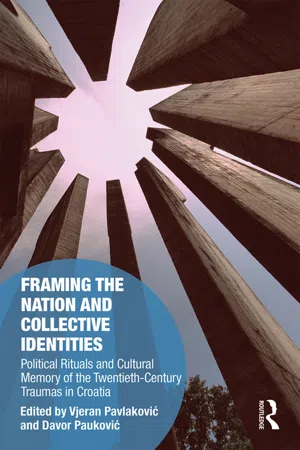
Framing the Nation and Collective Identities
Political Rituals and Cultural Memory of the Twentieth-Century Traumas in Croatia
- 246 pages
- English
- ePUB (mobile friendly)
- Available on iOS & Android
eBook - ePub
Framing the Nation and Collective Identities
Political Rituals and Cultural Memory of the Twentieth-Century Traumas in Croatia
About this book
Information
Part 1
Sociocultural, philosophical and linguistic approaches to Croatia’s commemorative culture
1 The sociocultural and ideological determinants of memory culture in Croatian society
Introduction
The bipolar division of the world created after the fall of communism and the end of the Cold War initiated the processes of democratization, not only the democratic transition of postcommunist societies but also the democratization of advanced democracies (Giddens, 1998: 69–77; Beck, 2001). In this context, the process of confronting the past takes place in both democratic Western societies and in new, postcommunist ones, in equal measure. Old democracies, freed from the role of defenders of the free world, have openly started to critically question their political history. There has been an evolution of collective memory, particularly in contemporary Europe. Processes of creating nation-states in parallel with joining the EU also revived historical legacies that were once consigned to the “dustbins of history” during the Cold War, raising the question of the (de)construction of collective identities and the (re)definition of national, political and cultural relations (Langenbacher et al., 2012: 2–5). This was the reflection of democratic maturity in old democracies and their internal strength to face the uncomfortable aspects of their national political past, especially those related to fascism and Nazism. In postcommunist societies, on the other hand, the disappearance of the authoritarian communist regimes and the ideologically based official interpretation of history has led to the opening of a pluralist political arena, and along with it the possibility of alternative interpretations of political history and political discourses, especially by those political and social actors that were stigmatized and suppressed under the previous regimes.
These processes of confronting the past started with the goal of revealing crimes and punishing offenders, issuing apologies for past crimes, and finally seeking some kind of reconciliation. Such endeavors have become a part of the democratic process by which the democratic political order is legitimized, in both the domestic and the international political public. In this context, the history of memory is developed as a subdiscipline in the field of history, as well as the politics of history as a subdiscipline of political science. Both of them stem from the need to understand and explain precisely these political processes, i.e., the politics of memory, which political elites establish through historical-political discourses, using them to legitimize their own political positions. It is primarily about the symbolic and identity aspects of politics (Cipek, 2011: 18; Đurašković, 2008; Delaye, 2015).
In this context, memory culture changes and moves its focus from national heroes and winners to national victims, which become an object of respect. This shift to a focus on the victims can be seen in the commemorative practices and their contents (particularly in the analysis of commemorative practices within the FRAMNAT project). On this basis, which includes respect toward all victims, the process of reconciliation within a nation begins (Cipek, 2011: 26). However, this process does not necessarily lead to reconciliation. Reviving a previously suppressed history generates resentment, or even conflict, which are politically articulated and have a substantial impact on the political actors’ constellation and relations within society. In this way, confronting the past has in some cases deepened existing social rifts or/and opened new ones.
Modern Croatian society is no exception. In the specific situation of constituting a nation-state and democratic order, a (re)definition of collective identity has imposed itself as an important issue. This in turn opened processes of (re)interpreting political history. Aside from having many instances of a common historical-political legacy (primarily the experience of fascism and communism), Croatian political history is additionally burdened by the legacy of the Homeland War,1 which substantially affected the country’s constitution as a nation-state and its democratic transition. Precisely because of the importance of political history in shaping a sense of collective identity (ethnic, political, cultural), equally at the individual and collective levels, the question of political history is extremely present in Croatia’s public political space, substantially affecting the articulation of political stances and the structure of political relations.
The success or failure of the processes of confronting the past – as an indispensable segment of the process of democratization and political modernization – is essentially determined by the level of society’s democratization, i.e., by its historical-political heritage and inherent sociocultural determinants, like political culture, the characteristics of political elites, and the structure of social cleavages. Commemorative practices and historical-political narratives analyzed by FRAMNAT pronouncedly summarize this heritage. Since they are a very important segment of the political discourse and ideological conflict in Croatian society, their understanding and decoding is not possible without knowing the structure and functions of the historical and political context that shape them. Therefore, this chapter attempts to show the key influence of these determinants on the processes of confronting the past, the shaping of memory culture, and the construction of ideological and political discourses as a function of legitimizing political actors and their policies in Croatian society.
Political discourses and the (re)construction of collective identities
Commemorative practices, historical anniversaries and collective celebrations – as the components (contents and forms) of memory culture – are certainly an important factor for building, maintaining and strengthening collective identities, especially national political ones. Precisely because of this, they reflect a desirable image of the political history through which political actors attempt to legitimize their policies, interests and values. In this sense, memory culture is susceptible to being shaped and instrumentalized and is mediated by political interests and ideological filters. In this way, it becomes a part of the political discourse.
In the context of postauthoritarian and postconflict societies – which are burdened by a nondemocratic political legacy, including the prescribed collectivist patterns and official interpretations of political history – political rituals have special meaning. On the one hand, they are nece...
Table of contents
- Cover
- Half Title
- Series
- Title
- Copyright
- Contents
- List of figures
- List of tables
- List of abbreviations
- List of contributors
- Framing the nation: an introduction to commemorative culture in Croatia
- Part 1 Sociocultural, philosophical and linguistic approaches to Croatia’s commemorative culture
- Part 2 The Second World War commemorations: contested sites of the shared past?
- Part 3 The Homeland War commemorations
- Part 4 Transnational dimensions of memory
- Index
Trusted by 375,005 students
Access to over 1.5 million titles for a fair monthly price.
Study more efficiently using our study tools.
Frequently asked questions
Yes, you can cancel anytime from the Subscription tab in your account settings on the Perlego website. Your subscription will stay active until the end of your current billing period. Learn how to cancel your subscription
No, books cannot be downloaded as external files, such as PDFs, for use outside of Perlego. However, you can download books within the Perlego app for offline reading on mobile or tablet. Learn how to download books offline
Perlego offers two plans: Essential and Complete
- Essential is ideal for learners and professionals who enjoy exploring a wide range of subjects. Access the Essential Library with 800,000+ trusted titles and best-sellers across business, personal growth, and the humanities. Includes unlimited reading time and Standard Read Aloud voice.
- Complete: Perfect for advanced learners and researchers needing full, unrestricted access. Unlock 1.5M+ books across hundreds of subjects, including academic and specialized titles. The Complete Plan also includes advanced features like Premium Read Aloud and Research Assistant.
We are an online textbook subscription service, where you can get access to an entire online library for less than the price of a single book per month. With over 1.5 million books across 990+ topics, we’ve got you covered! Learn about our mission
Look out for the read-aloud symbol on your next book to see if you can listen to it. The read-aloud tool reads text aloud for you, highlighting the text as it is being read. You can pause it, speed it up and slow it down. Learn more about Read Aloud
Yes! You can use the Perlego app on both iOS and Android devices to read anytime, anywhere — even offline. Perfect for commutes or when you’re on the go.
Please note we cannot support devices running on iOS 13 and Android 7 or earlier. Learn more about using the app
Please note we cannot support devices running on iOS 13 and Android 7 or earlier. Learn more about using the app
Yes, you can access Framing the Nation and Collective Identities by Vjeran Pavlaković, Davor Pauković, Vjeran Pavlaković,Davor Pauković in PDF and/or ePUB format, as well as other popular books in Social Sciences & Sociology. We have over 1.5 million books available in our catalogue for you to explore.