"Excellent study which moves back and forth between theory and empirical observations. It looks at religious groups from several different theoretical positions as well as raises a number of significant issues about the conduct of eld research."--Russell R. Dynes, American Sociological Association
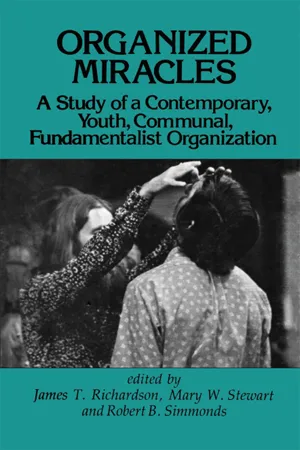
eBook - ePub
Organized Miracles
Study of a Contemporary Youth Communal Fundamentalist Organization
- 368 pages
- English
- ePUB (mobile friendly)
- Available on iOS & Android
eBook - ePub
Organized Miracles
Study of a Contemporary Youth Communal Fundamentalist Organization
About this book
Information
PART A
AN ORGANIZATIONAL ANALYSIS
In this part we will deal with Christ Communal Organization (CCO) at an organizational level, leaving information on more individual and social psychological levels of analysis for later sections of the book. A first requirement for an analysis of CCO as an organization is a recounting of its history. The history is presented in enough detail to make clear what kind of organization CCO is and how it developed. Another essential feature of an organizational analysis is a discussion of group beliefs or ideology, and chapter 1 also contains an attempt to explain the modified form of fundamentalism that has been adopted and implemented by CCO. Chapter 1 closes with a descriptive delineation of major organizational differentiation that has occurred during the short history of CCO.
In chapter 2, we focus on changes in some major features of CCO as an organization. This chapter, which contains a number of diagrams that we think will be helpful to readers, focuses on changes in five major facets of CCO. These include (1) group aims and goals; (2) the leadership and authority structure of CCO; (3) CCO group and individual methods of financial support; (4) living arrangements; and (5) methods of member training and resocialization. While other areas of CCO organizational life might have been chosen for our analysis, these were felt by us to be major elements that should be examined, and we think such a focus allows readers to gain an understanding of the type of organization that CCO was and has become in just a few short years. Also in this chapter are brief discussions of the CCO organization from the point of view of “church-sect” theory, commune typology theory, along with an analysis of the so-called “integrative hypothesis” vis-à-vis CCO.
In chapter 3 we examine, based particularly on the material from chapter 2, the CCO organizational changes in the light of the “movement organization” literature, which was given impetus by the widely-reprinted Zald and Ash (1966) paper. This chapter represents the first direct contribution of this book to sociological theory, for we think that our “test” of the ideas of Zald and Ash and others (Zurcher & Curtis, 1973; Curtis & Zurcher, 1974) in this tradition furnishes considerable useful information on which to build theory in the area of movement organizations. The material of chapter 3 is dealt with in more detail in Appendix B, which is a specific testing of the many hypotheses from the three major “movement organization” papers examined in chapter 3.
1
History and Beliefs of the Organization
GROUP HISTORY
The early history of this organization, herein called Christ Communal Organization (CCO), began in that cauldron of new social movements, Southern California in the late 1960s. It developed at about the time that several other prominent groups within the so-called Jesus movement were starting in the Southern California area. Among these are the Children of God (COG) led by Moses David Berg and fostered for a time by a television evangelist, the Alamo’s Christian Foundation, and several others. The early history of the movement on the West Coast is best chronicled in Enroth, Ericson, and Peters (1972), and we will not attempt another detailed explanation of the exact relationship of the various groups, as our intent in this chapter is to focus on one as yet unchronicled organization’s early history. It is worth noting, however, that there was some contact among these groups in the late 1960s, and that they were involved in doctrinal disputes and competition for members early in the movement’s history. An understanding of this contributes to an understanding of the amazing differentiation within the movement during its early days—a little-understood heterogeneity that continues to this day. A history of CCO written especially for the organization’s journal by the initial leader of the group (who still is the leader) documented some of these disputes. Two especially important disagreements were with the local Teen Challenge group (one of the offshoots of Wilkerson’s The Cross and the Switch-Blade, 1968, approach), and with the Children of God, back before they were even called the COG.1 Many other disagreements and leadership battles were also discussed in this history—battles that took place as CCO was attempting to define itself and establish boundaries of accepted beliefs and behaviors. That these battles were successful in the sense that a strong, well-defined organization resulted is evidenced by the size and strength of the organization, which now has over one thousand full-time members, established groups in about twenty-five states, and capital assets of nearly $2 million. How such a large and strong organization developed will be the focus of this first part of chapter 1 (along with a discussion of the theology or ideology of the group), with the latter part of the chapter being a somewhat more detailed description of the major financial and material holdings and operations of the organization as it exists today.
Early History2
The young man who still serves CCO as president of their nonprofit corporation and head of their “spiritual body” was converted in 1966 while living in Southern California.3 For the first eighteen months of his new Christian existence (he was previously Catholic), he claims to have had no contact with other Christians who believed as he did. Subsequently, a person with similar beliefs started to work with the same firm, and a friendship built on the similarity of beliefs developed. This other person, still a CCO member in a leadership capacity, invited the leader-to-be to meet some other friends who agreed with them on doctrine, thus establishing contact with a now well-known person, Charles (Chuck) Smith, pastor of the famous Calvary Chapel Church in Costa Mesa, California. The CCO leader-to-be went along to a Bible study and was delighted to hear a group of people and a pastor who shared his beliefs. An immediate rapport was established between Pastor Smith and the leader-to-be. This bond continues to the present, with Pastor Smith being referred to by the leader as a “personal Elder,” who serves as an advisor in times of “trials” and tough decisions.4 This leader became involved with the developing ministry of Smith at his church, which was still quite small at the time of the initial encounter, and it was here that the leader received his training in a particular interpretation of Scripture. The experience of the leader of “baptism of the Holy Spirit” or “speaking in tongues” (glossolalia) also took place under Smith’s tutelage, and it was Smith who later encouraged the leader to serve as elder in the first Christian commune opened and supported in part by Calvary Chapel. Smith encouraged the leader to minister to the hippie types in the area, a ministry that was already a “burden” of the leader. This first Christian house was called the House of Miracles, and it was opened on May 17, 1968, with Calvary Chapel furnishing the first $50 of the $90 monthly rent payments. Living expenses were also furnished by the church and friends of the church, as the leader was not working. The leader explained that he had felt led to grow a beard, which was a great “tool for witnessing” to the street people, but which effectively kept him from getting any kind of work in the area.
This house was an immediate success, and droves of youth began coming to get a meal, find a place to sleep, and to hear the “gospel message.” Contact was established with another Christian house—the House of Acts in San Francisco, and one of the leaders in that group came for a while to aid in the new house ministry in Costa Mesa. During the first week, twenty-one people were converted, and by the end of the second week some fifty people were living in the house. The decision to establish a Christian house had obviously “struck a nerve,” and converts continued to pour out of the drug subculture of the area and into this and other “Christian houses.” One piece of dramatic evidence of the rapid growth and type of response involved one runaway young woman who was converted and then brought over fifty people to the house during the next three weeks! An early decision by the new elder to have all new converts begin to witness and evangelize immediately further increased the pressure on the meager facilities, a pressure aggravated by complaining neighbors who objected to “hippies” living in the area and sleeping “wall-to-wall” and in the backyard of the house.
During these early months of frequent conversion, overcrowding, and feverish activity, the basic structure and life-style of the organization began to emerge. Every day involved street witnessing by nearly all occupants, except those who were ill, working, or who were preparing food, and so on. Some new members quickly found jobs which would help support the group. The emphasis on work, which sharply distinguishes this group from some organizations that are a part of the Jesus movement, grew out of a Bible study on commitment. The group had been led earlier to accept the view that they should sell all their goods and depend on God for support. After they did this and were destitute, to quote the elder, “God ministered to us that we should go to work.” And go to work they did, accepting any kind of work that required little skill, for few of the converts had any useful skills at all. This aspect of group life will be more fully discussed later, as it has greatly contributed to the continuance and success of the organization. Nightly Bible studies, usually led by the elder, also developed, during which those who were gathered in as a result of beach and street witnessing during the day were challenged to “accept Christ.” These studies continue to this day throughout CCO, with all of its communes and families participating in a unified plan of nightly Bible study, supplemented now with some technical media aids, and led by many different “house pastors” who have been “raised up” within the group.
The success of the first House of Miracles led to the desire to establish others, and one was opened in Riverside when a derelict motel owned by a sympathetic businessman was rented and refurbished by members. This commune had four “elders,” two of whom were youths of nineteen and seventeen years of age. The inexperience of its leadership notwithstanding, the house was made liveable quickly, with friends furnishing materials and the youthful members doing the work. During the first week of operation, some sixty-five youths were converted and baptized in the fish pond of the motel. By the end of summer 1968, over five hundred young people had been converted through this ministry, and the commune had outgrown its quarters.
New communal “Christian houses” were opened in several places soon thereafter. (Calvary Chapel is credited with helping to establish and support dozens of such Christian houses in the years that followed the first House of Miracles, but we will not attempt to describe all of these, as our interest is mainly on those that eventually formed the beginnings of CCO, on which we started research in late 1970). The next one of these “Christian houses” which was under the at first informal control (or at least influence) of the leader opened in Santa Ana in September of 1968. This facility actually replaced the first house in Costa Mesa since some neighbors there were complaining so strongly about the commune. Again the “brothers” and “sisters” had to repair the place and make it liveable, but by now they were getting used to this technique of obtaining housing. They were quite happy with this new house, as it “had a nice freeway not too far away … on a hitchhiking route,” furnishing them with ready access to the itinerant youth population moving about the area. The house at Santa Ana also had a small garden plot, and it was here that the group got its first taste of such work.
At the end of the summer of 1968, the Riverside motel “house” was closed down due to disputes within the group. Such disputes were commonplace in the early history of the group (as with other such groups), and we have read and been told of arguments over such occurrences as new converts continuing to use and sell drugs while living in a house; members trying to gain control of part of the “body” (group) through “false doctrines” and direct challenges to the authority of the original leader; the use of alcohol; and an ambitious member trying to usurp authority over work teams and thereby control the money earned. Other difficulties arose because of critical neighbors, and at least once, members living at the house were attacked by a motorcycle gang trying to “sell protection.” But in the face of all these problems, CCO persisted and began to establish boundaries of behavior and belief—boundaries that are now quite well-defined.
We will discuss in greater depth the authority structure that eventually developed and how it functions, but it should be noted here that many, if not most, of the present leaders of CCO (and their wives) came into the group by being converted in one of these early houses in 1968 and 1969. Some extremely energetic and talented young men and women were attracted to the group, and some have remained in the group, maintaining positions of top leadership ever since. We have met most of this cadre of leaders and can state unequivocally that they could be successes at about any endeavor they chose. Instead of becoming “secular” businessmen, teachers, or accountants, they committed themselves to the beliefs and goals of the original leader and became a strong and dependable team of workers ready to “try anything.” This is not to say that only these young men could have accomplished what they have, or that only the “failures” and “weaklings” dropped out of the group. We are simply claiming that a dozen or so very capable people came together in the late 1960s and committed themselves to each other and to a way of life that has worked remarkably well for them since.5
Also in the fall of 1968, a new house was opened in Fontana, California, an important step for the new organization because of a two-acre garden plot, which caused some more CCO members to gain more experience in agriculture, an experience that was to prove invaluable later. Some married couples in Santa Ana also opened their homes to new converts. This first house outside California was established in November 1968, in Phoenix, Arizona. Both the Fontana and Phoenix houses were successful in attracting many converts. At one point, a person who was an elder in the Fontana house tried to take control of it and the Phoenix house, separating them from the other houses, but this plan was thwarted by energetic intervention of the original leader and other members.
Other new houses included one in Corona which was established in January 1969 and lasted six months, and another in Riverside. Bible study groups which were noncommunal were also developed in some homes in the area. The new house in Riverside, which operated until September 1969, is especially interesting because it was opened in a unique way that has been used since a time or two in the expansion of the organization.6 Some Christians who were part of the “body” of the House of Miracles houses made a deliberate decision to move into a commune full of “dopers.” They immediately began witnessing to people and leading Bible studies, and soon converted a few residents. The other “unbelievers” decided to move, leaving the Christians with the facility. Meanwhile the Phoenix house had “backslid” and ceased to be a part of the informal group of communes being guided by the original leader (with the counsel of Reverend Smith).
Getting Organized
At this time the original leader asked for a more formal commitment from the four communal Christian houses that were involved so closely with each other—Fontana, Riverside, Corona, and Santa Ana. The pastors of all the houses gave a commitment, including even the Fontana house, which was still coheaded by a person with his own designs on leadership of the confederation of the four communes. Armed with these commitments, the leader solicited Reverend Smith to endorse his leadership and “to take oversight of us as a bishop and give us counsel; and he agreed.” In a crucial meeting that followed, however, a great argument broke out as the Fontana leader tried to fight the attempt to organize four houses under the original leader. The Fontana leader used a strong attack accusing the leader of being too liberal about cigarette smoking (his wife, a new convert, still smoked, and also the leader allowed smoking areas for new members in the communes). Smith stopped this attack by simply disallowing it and led a Bible study instead. This instance of the exercise of authority by a member of the so-called institutional church was quite important to the establishment of this organization, a fact that should not be ignored. This kind of key involvement of “the institution” with such groups seems much more typical than some care to admit, but such ties exist nonetheless. In the case of Calvary Chapel’s pastor, we accept that he is somewhat “on the fringe” of the traditional institutional church, but still would point out that his authority, which was at least partially derived from and legitimated by his position as pastor of the church, was very valuable in settling the internal dispute over control of the several houses. Only when such differences were settled and the leader was implicitly but effectively “anointed” by Smith could the organization begin to act more independently and take the actions that have led it to its present strong and solid position. As we have said, this tie with Calvary Chapel has loosened considerably since then, but the relationship was of great importance in the early history of the group.
The Big Move
Houses were still being opened in Southern California, an outreach which continues to this day, with houses presently in San Diego, Sacramento, and San Francisco (which has two houses—one for a “crash pad” and the other for quarters for new members). However, shortly after the leader was anointed he began to investigate a move to another Western state. In April 1969, the leader and several members moved from California, leaving some of the “stronger brothers” as pastors in the several California houses and Bible study fellowships that had been established there.
The move to the new state was made “under the guidance and protection of the Holy Spirit,” according to the leader,...
Table of contents
- Cover
- Half Title
- Title Page
- Copyright Page
- Dedication
- Table of Contents
- Illustrations
- Preface
- Acknowledgements
- Introduction
- Part A: An Organizational Analysis
- Part B: Group Life and Culture
- Part C: Individual Characteristics
- Part D: Conversion and Affiliation
- Part E: Future of the Organization
- Appendix A: The Research Project: Methods, History,and Special Features
- Appendix B: Testing Specific “Movement Organization”Hypotheses
- About the Authors
- Bibliography
- Index
Trusted by 375,005 students
Access to over 1.5 million titles for a fair monthly price.
Study more efficiently using our study tools.
Frequently asked questions
Yes, you can cancel anytime from the Subscription tab in your account settings on the Perlego website. Your subscription will stay active until the end of your current billing period. Learn how to cancel your subscription
No, books cannot be downloaded as external files, such as PDFs, for use outside of Perlego. However, you can download books within the Perlego app for offline reading on mobile or tablet. Learn how to download books offline
Perlego offers two plans: Essential and Complete
- Essential is ideal for learners and professionals who enjoy exploring a wide range of subjects. Access the Essential Library with 800,000+ trusted titles and best-sellers across business, personal growth, and the humanities. Includes unlimited reading time and Standard Read Aloud voice.
- Complete: Perfect for advanced learners and researchers needing full, unrestricted access. Unlock 1.5M+ books across hundreds of subjects, including academic and specialized titles. The Complete Plan also includes advanced features like Premium Read Aloud and Research Assistant.
We are an online textbook subscription service, where you can get access to an entire online library for less than the price of a single book per month. With over 1.5 million books across 990+ topics, we’ve got you covered! Learn about our mission
Look out for the read-aloud symbol on your next book to see if you can listen to it. The read-aloud tool reads text aloud for you, highlighting the text as it is being read. You can pause it, speed it up and slow it down. Learn more about Read Aloud
Yes! You can use the Perlego app on both iOS and Android devices to read anytime, anywhere — even offline. Perfect for commutes or when you’re on the go.
Please note we cannot support devices running on iOS 13 and Android 7 or earlier. Learn more about using the app
Please note we cannot support devices running on iOS 13 and Android 7 or earlier. Learn more about using the app
Yes, you can access Organized Miracles by James T. Richardson in PDF and/or ePUB format, as well as other popular books in Theology & Religion & Religious Intolerance, Persecution & Conflict. We have over 1.5 million books available in our catalogue for you to explore.