eBook - ePub
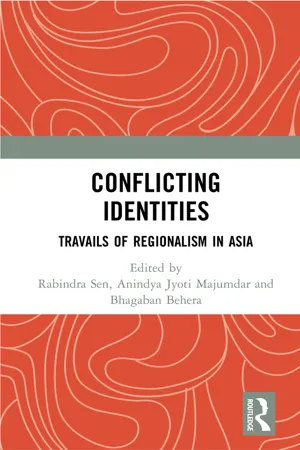
Conflicting Identities
Travails of Regionalism in Asia
- 272 pages
- English
- ePUB (mobile friendly)
- Available on iOS & Android
eBook - ePub
Conflicting Identities
Travails of Regionalism in Asia
About this book
In the era of globalization, regionalism aims at a practical compromise between global governance and national aspirations. Attempts have been made by states, in varying degrees, to advance cooperation towards mutual benefit in different parts of the world. However, the very process of regional cooperation in a defined geographical area adopts unique ways and special characters to accommodate the particularities of the region and does not lead to similar consequences when compared with the processes in motion in other areas. This volume is the culmination of the brainstorming exercise of a National Seminar on 'Asian Regionalism in the Twenty First Century' at the Department of International Relations, Jadavpur University, Kolkata. The task is to fulfil two main objectives: to join the debate on the efficacy of regionalism today and make a meaningful contribution to an understanding of the subject; and also to suggest ways of tiding over the problems faced by the countries in various regions or sub-regions of the Asian continent in their attempts to advance towards the goal of regional cooperation and integration.
The essays in this book are envisioned to benefit not only a wide community of scholars involved in teaching and research in general and the students of international relations in particular but would also be of interest to any avid reader who intends to explore the patterns of contemporary world politics.
Please note: Taylor & Francis does not sell or distribute the Hardback in India, Pakistan, Nepal, Bhutan, Bangladesh and Sri Lanka
Information
CHAPTER 1
Regionalism and Security: Bridges Over Fault-lines
ANINDYA JYOTI MAJUMDAR
LIKE MANY OTHER concepts in international relations, regionalism too can be understood from different angles and accordingly, the inferences, assumptions and subsequently the conclusive observations too would change. Regionalism is typically understood as a scale of significant coordination of policies of states within a definite geographical area for certain mutual benefits. It is a process through which states in close proximity within a geographical region form a framework of collective strength with the predominant purposes of ensuring security and promotion of economic interests. States are the primary units of international relations; hence, bilateral or multilateral options of coordination of policies are exercised to achieve goals when unilateral measures appear as inadequate. Within the framework of international cooperation towards a better world, regionalism aims to bring together the component states under one umbrella towards creating a better region in terms of development and security priorities. The supporters of regionalism argue that regional arrangements are natural outgrowth of international cooperation as global organizations are too big, diffused and ambitious and therefore largely ineffective to cater to the practical needs of the local issues of a region. Thus, regionalism operates between two extremes: the separateness of sovereign states on the one hand and the possibility of subordination to a centralized world government.
Mutual benefit on the basis of the principle of functional cooperation is the leading motivation of regionalism. States are strictly autonomous in nature and too sensitive to yield decision-making to some other authority that might influence the fate of the state interests. On the other hand, mutual convenience pushes them to create mechanisms for coordinating their activities in order to protect better the same state interests. As a result a supranational structure comes into being to which the member state agrees to submit. No wonder, such supranational structures are marked with undercurrents of nationalism because the right compromise and a correct balance between state sovereignty and the jurisdiction of the higher authority is to be maintained at every step. The legitimacy of the regional organization depends on the scale of benefits accrued from the activities of the organization for its members. Very broadly, three types of regional organizations exist: viz. regional defence organizations, regional economic organizations and regional multi-functional organizations.
There are primarily three ways through which regionalism might contribute to security: (1) as a spillover of functional cooperation, (2) as an instrument of collective self-defence, and (3) as a process through which a region negotiates with extra-regional environment.
In general terms, the Functionalists argue that technological and economic development lead to the growth of specialized organizations that tend to cross national borders. States are almost forced to cooperate generating a political dynamic that activates the forces of integration. One can apply a supranational approach thereby focusing on politics above the level of states, or one can apply an intergovermentalist approach and thereby focusing on the politics between and within states. In the first case, regionalism can be understood as an integrative process occurring at the supranational level within a certain geographical area. In the second case, regionalism means development of institutionalized cooperation among states and other actors on the basis of regional contiguity. Either way, regionalism is viewed as a product of functionalism which prescribes network of agencies on sectors such as economic, technical, scientific, social and cultural having a spillover effect on issues political as close functional relations require intense political coordination. In fact, it is argued that change in attitude would result from cross-cutting ties and integrate the interests of nation states. In all such cases, we have a common underlying assumption in varying degrees, that apart from all kinds of non-political benefits, regionalism would produce greater stability in relations among neighbouring states having a significant impact on security considerations. In a way, regionalism paves the path for broad-based security. Security and peace emerge as a byproduct of regional cooperation or integration. A course of gradual advancement is generally suggested: functional cooperation leads to formation of a security community where intra-community wars are absent, such a community can strive for greater economic assimilation, and finally, political integration. The process however is not automatic or inevitable, the more one integrates, the more one loses the ability to shield itself from others and the troubles caused by the common policy of the organization or the failures to tackle issues of common concern leading to lop-sided impact upon the members, pave way for resurgent nationalism.
There is another line that would essentially focus on security on the basis of collective self-defence and following the spirit of Article 51 of the UN Charter would establish the so-called ‘regional security arrangements’ and view this as a form of regionalism. These ‘regional collective defence systems are designed to deter a potential common threat to the region’s peace, one typically identified in advance’.1 In other words, this means formation of regional alliances to coordinate national security policies. Regional security by means of defence ties and alliances with major powers is oriented towards ‘having an organization that is structured to present a common military and diplomatic front against an outside factor. By maintaining the balance and distribution of power, security is thus assured’.2 This has been a feature of the Cold War period and has led the scholars to argue that ‘although the primary motive of several regional organizations after the Second World War was to achieve security guarantee for their members, after the Cold War in an altered international milieu such organizations have mainly focused on economic development of the region through meaningful cooperation among member states’.3 The essential motivation remains the same, viz., to build a framework of collective strength in close proximity with partner states. ‘The emphasis has shifted from pure and simple self-defence to what may be called conscious self-promotion.’4
In other words, the military-strategic interests initially gave birth to regional agencies but the focus shifted to economic growth, trade blocs came into existence and gradually, regional agencies aspired to become truly multi-functional. Regionalism today, as goes the observation, is more than mere territorial grouping of states for some limited purpose. In the process, however, the very idea of region is blurred and in its multi-functional ventures, security is neglected. A point that is repeatedly emphasized defines regionalism as a shared initiative where the identities of individual actors are faithfully retained. It does not mean homogenization and disappearance of the nation state or differences among them. Rather, regionalism is a strategy that smoothens up the sharp edges of conflicting states in a region. This may indicate attempts on part of states to understand security in multilateral terms without compromising the national interest.
There is yet another way to ensure security through regionalism as exemplified by the ASEAN Regional Forum (or the ARF) that does not fall in any of these categories. Though regional in name, in fact, it goes beyond the region and seeks to negotiate with the external forces and the political environment in which the region is located. Here, a core tries to reach out to the outlying bounds and seeks to manage, nurture and construct possible forces of peace and stability rather than control, contest or resist the forces of possible threats. In this, it actually provides the third line of approach to regional security: securing the region by becoming extra-regional. How viable this line could be – is a matter of debate.
To understand the emergence of distinct mechanisms in particular regions, scholars have also used the constructivist approach with its focus on ideational factors, including norms and ideas. Norms and principles might form the basis of formal mechanisms of conflict management5 derived from shared knowledge and state practices. In short, it means that the process of regionalism in different regions might not have a common line of advancement.
Construction of Security Regions
In the contemporary world, regionalism – especially, in the era of globalization – finds a place of prominence. Some would criticize regionalism as an impediment for the growth of universalism and global government as regional organizations take issues out of the jurisdiction of the global organizations and emerge as alternative agencies. Regionalism can be regarded as standing somewhere between international anarchy and world government. The United Nations Charter recognizes the existence of regional agencies but imposes the pre-condition that such agencies and their activities should be consistent with the purposes and principles of the UN (Article 52) and in the event of conflict between the obligations of the members of the UN and their obligations under any other international agreement, the obligations under the UN shall prevail. It is understood that regional agencies are best suited to manage and resolve local disputes and the Charter of the UN has provided for a flexible framework in which the regional agencies and the UN can function in a harmonious pattern with the regional agencies being complimentary to the UN system of collective security. However, the post-Cold War new regionalism is the dynamic relationship between developments in different parts of the world. It is a response ‘in kind’ to match the efforts of economic integration elsewhere – a kind of domino effect – countries in a region seek to respond to the developments in other regions.6 But not all organizations are the same in terms of abilities or purposes: the degree of integration differs and not all regional organizations are similar in nature or origin.
Any good text on regionalism would point out certain common conditions for the success of regional institutions that include not only geographical proximity but also a plethora of other conditions like similar political systems, supportive political opinion and leadership, cultural homogeneity, similar historical experience, compatible forms of governments and economic systems, perception of a common threat and also similar levels of military preparedness of the members. However, very often, the security threat emanates from the region itself; a bigger power’s relations with its smaller neighbours may induce the smaller states either to band together against the big power, or to bring an external power in the region to establish balance or to have direct bilateral interactions with the big power. In each of these cases, regionalism suffers. A region can be viewed as a container of diversities but it may often remain a very unstable container of explosive elements.
In the post-Cold War period, small and medium powers look for more strategic autonomy in dealing with the local issues that have been either neglected or blown out of proportion during the Cold War period by the superpowers. However, not all local issues could be solved locally as the local organizations might not have necessary competence. Interference by the external power is sometimes essential, sometimes troublesome depending on the nature of the issue and the extent and manner of such interference.
In general, as the understanding goes, during the Cold War period, regional security organizations were formed whereas in the post-Cold War period – in the era of globalization – regional economic organizations are being formed that in a roundabout way might ensure security. However, in context of security in its conventional sense, regionalism might not result in common advantage for all the states in a particular region. Security is not always attainable in multilateral terms and the ideal of cooperative security is difficult to achieve in an environment of mutual distrust. Moreover, alliance formation is not necessarily an expression of regionalism as it is generally made out to be.
Locations are products of geography but regions are products of human perception. There are no distinct geopolitical regions apart from those that exist in the imagination of man. Construction of a security region that heavily depends on the principle of geographical contiguity is more often a matter of impulse of time than any specific criterion. Therefore, the rule of geographical proximity that constitutes a region may suddenly end at a man-made point, where a new region begins. Often these are post facto constructions that depend on the convenience of academic analysis or tactical/strategic considerations. These divisions among regions are essentially geo-political. South Asia can be accepted as a viable region for economic and other (mainly non-political) cooperation among the states, but if one considers the possibility of a nuclear weapons free zone here, it becomes important to include at least some parts of China, a nuclear weapons state that borders the South Asian region. Without China’s participation a lopsided arrangement would come in place. Naturally, one then talks of either ‘Southern Asia’ including some parts of China or of a ‘Strategic Triangle’ incorporating China, India and Pakistan. Indeed, construction of a region can very well be a part of motivated campaigning to justify certain policies or push forward particular goals. The tags attached to such regions bear a specific connotation and the imprint of the prevailing world order. Specific identities are imposed or acquired thereby.
Therefore, in the same fashion, regions are made and unmade; the names of such regions bear a specific connotation and the prevailing world order. The terms like the Middle East, the Gulf, and the West Asian region attribute different identities to almost the same actors expanding or contracting a particular region based on the exigencies of situation or renewed focus on a particular stretch of land or sea at a particular point of time by the dominant powers of a particular epoch. A region can expand or contract depending on the exigencies of the situation and macro-regions (like the Indo-Pacific) or micro-regions (like the Af-Pak region) – all are constructed for security purposes with specific objectives in view. These are tailor-made regions, focusing on security requirements of a particular time. Regions are fragile as these regions are made or unmade over time. The European Union (EU) had been expanding for some time. Brexit proves that it may shrink as well. Moreover, for security considerations, a region is hardly insular, as actors external to the region must also be taken into calculations. A paradox has been observed in the sense that ‘with the loss of Cold War constraints, regions now have greater autonomy – while at the same time, levels of interpenetration and globalization indicate diminished possibilities of regional insulation’.7
Even though the region is somewhat geographically defined, the issues of security are not easy to handle. The EU can be cited as the epitome of regional integration with institutional structures transcending national borders. The EU has a council of ministers, drawn from cabinet ministers of member states, a European Commission to implement and oversee policies as implemented by the so-called ‘Eurocrats’, i.e. European bureaucracy, a European parliament, representatives directly elected by citizens of member-states, and a Court of Justice. A common currency is used over a large part. EU plans to develop a European Rapid Action Force and intends to pursue common foreign and security policy. However, the issues of security, in its traditional sense are still major hurdles where national perspectives of major states may appear as the most dominant factors. While consensus may emerge in dealing with issues of immediate concerns within the region, fault-lines appear when member-states’ loyalty is demanded by extra-regional developments. The Old Europe-New Europe division with regard to invasion of Iraq by the coalition of the willing is a case in point. Even within the region, regional sentiments may run well with success and stability, hardships may generate nationalist feelings. As it was pointed out long back, ‘The political will to allocate more resources to defence budgets is conspicuously absent and without such will Europe is unlikely to have a Common Foreign and Security Policy’.8
The applicability of the term region is a misfit where the maximum distance between the capitals of participating countries tends to interlink geographically distinct entities. These organizations are called macro-regional and these are mainly defence organizations like the North Atlantic Treaty Organization (NATO), while the smaller close-knit organizations – micro-regional entities – are purely economic in nature, like the North American Free Trade Association (NAFTA), Asia-Pacific Economic Cooperation (APEC) and the like. It is to be noted however that organizations with the agenda of promotion of economic interests are no longer confined in geographical settings. For example, the club of Brazil, Russia, India, China and South Africa (BRICS) cares little for geographical boundaries, rather finds cohesion of attributes and interests as a compelling factor for coming together in pursuit of global clout.
Likewise, in terms of macro-region, the ARF stands supreme as it combines multiple security complexes. While the ASEAN has been exceedingly successful as an economic trade bloc, ethno-nationalist movements with trans-border ties and internal political instability have disturbed ASEAN’s security structure. However, the absence of regional wars coupled with economic benefits of cooperation has given ASEAN its identity which is better than the small power status of the individual members. ARF was essentially a response of the ASEAN-members to the post-Cold War shifts in security paradigm in the early 1990s as the possibility of a less pro-active role of the United States in the region and the rise of China to a scale of dominance appeared increasingly real. In order to apply the same ASEAN-style ...
Table of contents
- Cover
- Title
- Copyright
- Contents
- Introduction
- 1. Regionalism and Security: Bridges over Fault-lines
- 2. Regionalism in Asia-Pacific: Role of APT and EAS
- 3. Eurasian Regional Security: The Role of Shanghai Cooperation Organization
- 4. Genesis and Evolution of Regionalism in Europe and South Asia: A Comparative Analysis
- 5. South Asian Regionalism in the Light of Evolving Neo-regionalism in Asia
- 6. SAARC in India's Foreign Policy Calculus
- 7. Rethinking Regionalism in South Asia
- 8. ASEAN in the New Global Order: The Effective-Ineffective Dichotomy
- 9. (Re)evaluating Regionalism in West Asia
- 10. Regionalism in Post-Soviet Central Asia: Endogenous and Exogenous Factors
- 11. Asian Regionalism and Sub-Regionalism: The Context of Indo-Thai Cooperation and Connectivity
- List of Contributors
- Index
Trusted by 375,005 students
Access to over 1.5 million titles for a fair monthly price.
Study more efficiently using our study tools.
Frequently asked questions
Yes, you can cancel anytime from the Subscription tab in your account settings on the Perlego website. Your subscription will stay active until the end of your current billing period. Learn how to cancel your subscription
No, books cannot be downloaded as external files, such as PDFs, for use outside of Perlego. However, you can download books within the Perlego app for offline reading on mobile or tablet. Learn how to download books offline
Perlego offers two plans: Essential and Complete
- Essential is ideal for learners and professionals who enjoy exploring a wide range of subjects. Access the Essential Library with 800,000+ trusted titles and best-sellers across business, personal growth, and the humanities. Includes unlimited reading time and Standard Read Aloud voice.
- Complete: Perfect for advanced learners and researchers needing full, unrestricted access. Unlock 1.5M+ books across hundreds of subjects, including academic and specialized titles. The Complete Plan also includes advanced features like Premium Read Aloud and Research Assistant.
We are an online textbook subscription service, where you can get access to an entire online library for less than the price of a single book per month. With over 1.5 million books across 990+ topics, we’ve got you covered! Learn about our mission
Look out for the read-aloud symbol on your next book to see if you can listen to it. The read-aloud tool reads text aloud for you, highlighting the text as it is being read. You can pause it, speed it up and slow it down. Learn more about Read Aloud
Yes! You can use the Perlego app on both iOS and Android devices to read anytime, anywhere — even offline. Perfect for commutes or when you’re on the go.
Please note we cannot support devices running on iOS 13 and Android 7 or earlier. Learn more about using the app
Please note we cannot support devices running on iOS 13 and Android 7 or earlier. Learn more about using the app
Yes, you can access Conflicting Identities by Rabindra Sen,Anindya Jyoti Majumdar,Bhagaban Behera in PDF and/or ePUB format, as well as other popular books in Sciences sociales & Études régionales. We have over 1.5 million books available in our catalogue for you to explore.