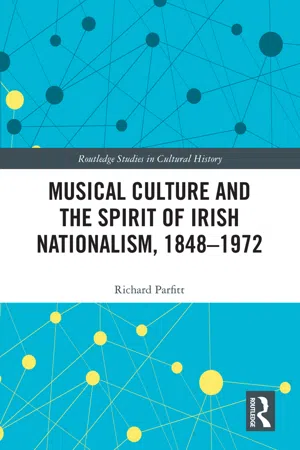
Musical Culture and the Spirit of Irish Nationalism is the first comprehensive history of music's relationship with Irish nationalist politics. Addressing rebel songs, traditional music and dance, national anthems and protest song, the book draws upon an unprecedented volume of material to explore music's role in cultural and political nationalism in modern Ireland. From the nineteenth-century Young Irelanders, the Fenians, the Home Rule movement, Sinn Féin and the Anglo-Irish War to establishment politics in independent Ireland and civil rights protests in Northern Ireland, this wide-ranging survey considers music's importance and its limitations across a variety of political movements.
- 286 pages
- English
- ePUB (mobile friendly)
- Available on iOS & Android
eBook - ePub
Musical Culture and the Spirit of Irish Nationalism, 1848–1972
Part 1
Nationalism, 1848–1913
1
“Oh, What Matter, When for Erin Dear We Fall?”
Fenianism, Radical Nationalism and the Irish Soundscape1
After 1848, the remnants of Young Ireland and the Irish Confederacy were scattered, either through deportation or self-imposed exile, but a number of the 1848 rebels went on to establish the ‘Fenian’ movement. Fenians supported the achievement of an Irish Republic by force, a goal they pursued through two organisations founded in 1858: The Irish Republican Brotherhood (IRB) in Ireland, and Clan na Gael in America. The IRB was a secret, oathbound society, organised into ‘circles’, whereby the leading (‘centre’) figure was only known to a small number of immediate deputies. It had over 50,000 members by 1864. Clan na Gael, meanwhile, sought financial support and military expertise from Irish-Americans. Despite this, the planned rebellion was repeatedly delayed.2 By the time the Fenians eventually instigated their rising in 1867, 1,100 IRB members had been arrested.3 Unsurprisingly, the rebellion was short-lived and did not inspire a general uprising. In the same year, a group of Fenians who were attempting to rescue their imprisoned compatriots killed a police officer. Three of the would-be rescue party were executed and consequently entered nationalist folklore as the ‘Manchester Martyrs’. In subsequent years, radical Republicans (seeking an immediate, fully independent Republic) and constitutional nationalists (content with devolution or a gradual route to independence) cooperated, agitating for land reform and devolved government by combining parliamentary campaigns with agrarian violence. In their music, Fenians used a combination of older songs and their own compositions. This chapter analyses the context and content of nationalist music, and asks how songs were received, employed and performed by political actors.
Nationalist song was the product of a varied soundscape. Nineteenth-century Irish audiences experienced music as a community event, heard or performed in large congregations with shared interests. Dublin theatres provided audiences for art music, particularly ballad operas (combining traditional and operatic songs, also popular in Britain), reflected in the establishment of a conservatoire in the city in 1848. However, largely speaking, art music infrastructure was lacking.4 Cork hosted Ireland’s only university post for music. Consequently, the port city became a fledgling cultural centre, encouraged by the presence of numerous European migrants with more substantial musical training.5 Catholic Church music had a larger audience. Mass predominantly consisted of hymns sung by small choirs or solo singers, accompanied by an organist. Ideally, these singers performed plainchant (characterised by monophonic, unaccompanied melodic lines), although a campaign to improve its quality had limited impact.6 These performances, often in Latin without congregational participation, were not especially rousing.7 However, they did encourage the perception that musical performances defined the cultural allegiance of communal gatherings. They also ensured that Catholic and Protestant cultural experiences differed, albeit marginally; the latter’s church music was more militant.8 Choirs at independent, Catholic-run Christian Brothers Schools had a more varied repertoire, including hymns and popular songs.9 In government-funded national schools, music education was limited, and largely focused on European music (and ‘God Save the Queen’) rather than ‘Irish’ forms (although they did teach Moore’s Melodies).10 For concerts, schools employed pianos.11 By the mid-nineteenth century, the piano was still a luxury item, but it was common in communal musical performance, even if older, cheaper and narrower iterations were often preferred.12 On the one hand, the upper classes habitually kept pianos in their drawing rooms to entertain guests.13 On the other, pianos were common in pubs frequented by the less wealthy, evidenced in piano adverts targeting pub landlords and in their inclusion in the inventories of pubs listed for auction.14 Parades provided perhaps the most striking public performances. In Ulster, the Protestant Orange Order were notorious for their sectarian marches and boisterous musical accompaniment. Army bands also paraded publicly, especially in cities such as Belfast where they were garrisoned, playing patriotic marching songs.15 Their fife and drum bands were particularly suited to marching; the ‘shrill timbre’ of the fifes carried effectively and created an imposing presence, leading the army to make special provision for the bands in its regulations.16 Bands also played at military and State funerals, such as that for the Duke of Wellington in 1852. On these occasions, bands performed funeral marches alongside two military trumpet calls, the ‘Last Post’ and ‘Reveille’.17
The most popular musical cultures encouraged audiences to spend money. From the mid-nineteenth century, even workers had increasing time and money for recreation.18 Temperance societies, founded in Cork in 1838, campaigned for teetotalism, but also produced songs, held concerts, and formed bands, often at great expense to members. Music promoted the organisation, established its territory, and provided social activities (common in societies across Britain, notably insurance-providing friendly societies).19 They also played at meetings supporting O’Connell and Repeal, contributing to the spectacle of his ‘monster meetings’, an important theme in future movements.20 As noted, ballads also had commercial appeal. Performers, male and female, sang in towns and markets, selling printed copies of their songs.21 Recognising their appeal, businesses used ballads in advertisements.22 As this suggests, print culture was important in disseminating music (the success of the Nation provides an obvious example). Several national newspapers operated by 1848, and many carried political songs.23 Music halls were undoubtedly the most popular feature of British urban soundscapes in the second half of the nineteenth century. Beginning in the 1840s, targeting urban workers, the halls dominated pre-war popular musical culture; in Ireland they were most common in Belfast and Dublin.24 Even the limited number of art music venues that operated in Ireland subsidised their income with music hall performances.25 McGlennon’s Star Song Book, the popular British periodical publishing music hall songs, was also printed and sold in Belfast.26 Music hall artistes gained widespread fame, including Ireland’s Percy French, who wrote and performed songs, usually comical, including ‘Mountains of Mourne’ and ‘Phil the Fluter’s Ball’.27 Music hall performances absorbed commercially viable aspects of existing cultures, including ballads, and predominantly consisted of comic and sentimental songs emphasising satire, audience participation (usually communal singing of the chorus), and elaborately costumed comical characters (top hats, dress suits and monocles were common).28 British music hall performers also played patriotic songs, praising British soldiers and denigrating foreign rivals. The term ‘jingoism’ referred to this populist patriotism, specifically ‘MacDermott’s War Song’ in which the singer expressed a willingness to go to war with Russia (‘We don’t want to fight, but by jingo if we do,/We’ve got the ships, we’ve got the men, and got the money too’).29 The piano was a staple of such performances, providing memorable tunes, and identifying heroes and villains through uplifting or discordant accompaniment respectively.30 Nationalist songwriters appropriated and harnessed these soundscapes with considerable success.
Writing nationalist songs was an expression of ideology, but not necessarily a commitment to rebellion. Fenian songwriters all supported nationalist ideals, and while some also engaged in violence, others expressed their ideals in song as a substitute for fighting. Cha...
Table of contents
- Cover
- Half Title
- Series Page
- Title
- Copyright
- Dedication
- Contents
- List of Figures
- Acknowledgements
- List of Abbreviations
- Introduction: “Ballads Have Long Lost Their Revolutionary Powers”
- PART 1 Nationalism, 1848–1913
- PART 2 Revolution, 1913–1923
- PART 3 Independence, 1923–1972
- PART 4 Partition, 1923–1972
- PART 5 Dance
- Conclusion: Nationalist Communities, Revolution and Musical Mischief
- Bibliography
- Discography
- Filmography
- Index
Trusted by 375,005 students
Access to over 1.5 million titles for a fair monthly price.
Study more efficiently using our study tools.
Frequently asked questions
Yes, you can cancel anytime from the Subscription tab in your account settings on the Perlego website. Your subscription will stay active until the end of your current billing period. Learn how to cancel your subscription
No, books cannot be downloaded as external files, such as PDFs, for use outside of Perlego. However, you can download books within the Perlego app for offline reading on mobile or tablet. Learn how to download books offline
Perlego offers two plans: Essential and Complete
- Essential is ideal for learners and professionals who enjoy exploring a wide range of subjects. Access the Essential Library with 800,000+ trusted titles and best-sellers across business, personal growth, and the humanities. Includes unlimited reading time and Standard Read Aloud voice.
- Complete: Perfect for advanced learners and researchers needing full, unrestricted access. Unlock 1.5M+ books across hundreds of subjects, including academic and specialized titles. The Complete Plan also includes advanced features like Premium Read Aloud and Research Assistant.
We are an online textbook subscription service, where you can get access to an entire online library for less than the price of a single book per month. With over 1.5 million books across 990+ topics, we’ve got you covered! Learn about our mission
Look out for the read-aloud symbol on your next book to see if you can listen to it. The read-aloud tool reads text aloud for you, highlighting the text as it is being read. You can pause it, speed it up and slow it down. Learn more about Read Aloud
Yes! You can use the Perlego app on both iOS and Android devices to read anytime, anywhere — even offline. Perfect for commutes or when you’re on the go.
Please note we cannot support devices running on iOS 13 and Android 7 or earlier. Learn more about using the app
Please note we cannot support devices running on iOS 13 and Android 7 or earlier. Learn more about using the app
Yes, you can access Musical Culture and the Spirit of Irish Nationalism, 1848–1972 by Richard Parfitt in PDF and/or ePUB format, as well as other popular books in History & Irish History. We have over 1.5 million books available in our catalogue for you to explore.